Ukraine’s campaign to target Russia’s e-commerce giant Wildberries has had impacts far beyond the Russian federation. For Russia, Wildberries is comparable to Amazon, accounting for about 50% of the country’s online retail market. But its market place is used by manufacturers as far afield as Central Asia.
Founded in 2004 as an online clothing retailer, it has 98,000 pick-up points and supplies a vast network connecting more than a million sellers with consumers across Russia, Belarus, Kazakhstan, Kyrgyzstan, Armenia, Georgia, Uzbekistan and Tajikistan.
In 2025, the Wildberries-Russ group recorded 6.1 trillion roubles (about £55 billion) in sales – up 49% on the previous year. Reuters estimates that Russian online marketplaces now handle goods and services worth the equivalent of 8.5% of the country’s GDP.
What makes Wildberries more than a retailer is its reach. Since 2009, it has offered equal prices for deliveries, no matter whether they are in the Russian heartland or as far as the Kamchatkan peninsula in the Russian far east, or Barentsburg in the high Arctic.
Ukraine justifies targeting Wildberries by pointing to the fact that since Russia’s full-scale invasion, the retailer has also become a military-adjacent commerce platform. It carries tactical clothing, body armour, medical kits and communications equipment. Recent investigations have also found first-person-view drones and drone components listed on the platform.
Until the company reportedly removed the relevant tags in July, searches for “everything for the SVO” (the Russian acronym for spetsialnaya voyennaya operatsiya, special military operation) produced military-related goods. This does not establish Wildberries as a military logistics provider. But it shows how wartime demand can respond through infrastructure originally built for civilian commerce.
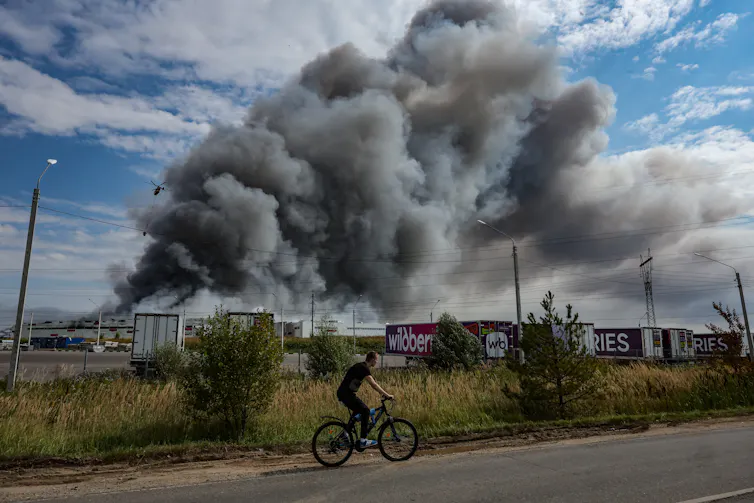
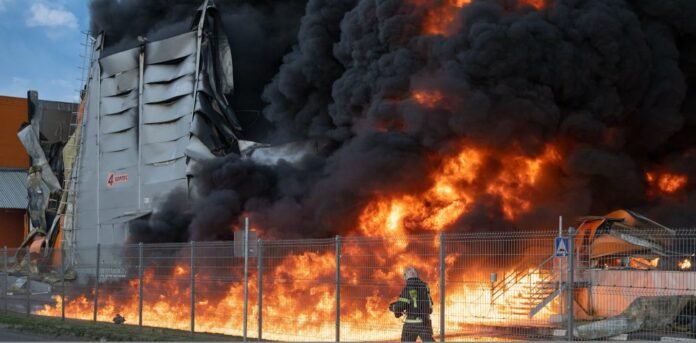
Since July 18, Ukrainian drone strikes have hit at least 20 Wildberries facilities, including three in the past week, damaging or destroying more than 1.18 million square metres of warehouse capacity as of August 7.
Read more: Ukraine assault on Russian retail giant Wildberries brings war home to consumers and retailers
Wildberries is especially vulnerable as it concentrates goods in large warehouses. This makes distribution effective but also creates targets that are directly felt by thousands of businesses and millions of consumers. A successful strike travels through the retailer’s commercial network long after the strike hits.
Cross-border trade
That network also crosses Russia’s borders. In Kyrgyzstan, Wildberries has become an important export channel for small and medium-sized businesses, particularly the country’s burgeoning clothing sector. In March 2026, Wildberries and Kyrgyz Export agreed to create a “Made in Kyrgyzstan” section on the platform across all eight of its markets.
A July survey cited by Kyrgyz business media found that 55% of Kyrgyz Wildberries entrepreneurs said the platform had enabled them to enter foreign markets.
The model has changed the geography of Kyrgyz trade. For decades, the massive Dordoi Bazaar in Kyrgyzstan’s capital, Bishkek, connected sewing workshops with wholesalers, traders and transport companies serving Russia and Kazakhstan.
But digital commerce has added another route: producers can sell directly to Russian consumers while using Wildberries’ warehouses for storage and fulfilment.
That arrangement also creates a new vulnerability. Once Kyrgyz sellers transfer their inventory to a Russian Wildberries warehouse, the goods are physically outside their control. A destroyed warehouse can therefore turn a Russian military strike into a loss for a Kyrgyz business.
Kyrgyz media have already documented such cases. After the first strikes, Kyrgyz sellers reported destroyed inventories and the risk of bankruptcy. One entrepreneur that I interviewed for this article estimated that the volume of goods in his business had fallen by half. A family acquaintance, he said, had lost inventory worth about US$42,000 (£32,200). Another seller went from offering roughly 100 product types to just four.
Around 800 Kyrgyz e-commerce retailers issued an appeal to the government to support them in their compensation claims. While these accounts cannot establish the overall scale of the Kyrgyz losses, they illustrate how quickly a disruption at a distant logistics node can reach businesses in Bishkek.

Tightening supply chain regulations with Russia have already created significant distress for Kyrgyz garment producers for whom Russia is the main market. The Wildberries attacks have exacerbated this stress, which the Wildberries attacks have exacerbated. In response, Kyrgyz authorities have announced financial support in terms of preferential loan agreements and a “tax holiday” for small and medium-scale garment producers from August 1 until the end of the year. Compensation, however, remains largely a promise.
Wildberries’ seller agreement treats damage caused by drones and other military activity as force majeure (an uncontrollable and unforeseeable event) which limits the company’s liability. As one seller told me, Wildberries may be more likely to compensate Russian sellers with direct ties to the company’s financial infrastructure. For Kyrgyz entrepreneurs, even those holding substantial inventories in Russian warehouses, the risk and loss are more likely to remain their own.
War comes to Kyrgyzstan
So, given the ongoing attacks on Wildberries warehouses across Russia, the question for Kyrgyz entrepreneurs is bigger than whether Wildberries can restore its Russian warehouses. It is whether concentrating inventory inside a foreign logistics network remains a viable business strategy during wartime. The people I interviewed for this article argue that alternative storage and shipment opportunities will eventually emerge, but given the sheer scale of the current cash flow gap and the lack of trust in the business, things are unlikely to return to how they were before the attacks.
One possible answer would be to keep more inventory in Kyrgyzstan, diversify fulfilment providers and expand domestic warehousing. Wildberries itself has announced testing alternative “partner hubs”, by relocating them in countries that are outside of Ukraine’s drone range. For Kyrgyzstan, this could reinforce its position as a logistics hub.
But decentralisation has limits. Cross-border friction between Kyrgyzstan and Kazakhstan tends to disrupt flows and lengthen delivery times, despite both countries being part of the same customs union. Building new warehouses also requires substantial time and investment – while a Russian company expanding its logistics infrastructure brings with it concerns about sanctions evasion.
This is not only an economic, but a wider geopolitical issue. While the e-commerce sector appeared to reduce the role of physical distance, in practice, it reorganises dependence around physical warehouses, roads, borders and political alliances. For Kyrgyzstan, the Wildberries strikes demonstrate that the logistics of war can reach Central Asia without a single missile or drone crossing the Kyrgyz border.