On Charlie Hamilton’s regular Amtrak rides from Seattle to Portland, Oregon, and Vancouver, British Columbia, he passes some of the country’s most spectacular vistas: the Puget Sound coast and the Skagit Valley. On clear days, he can even see Mount Rainier. But perhaps the most beautiful sight is not the natural wonders of the Pacific Northwest. It’s the cars and trucks inching along the highway.
“It’s nice to be able to be going along there and going faster than what people on Interstate 5 are doing. We kind of like that bit,” said Hamilton, who leads the train advocacy organization All Aboard Washington.
Indeed, riding the train in the Pacific Northwest can take about as long as driving. The trip between Seattle and Portland takes about 3 hours and 30 minutes by either mode, even though the train makes six stops along the way.
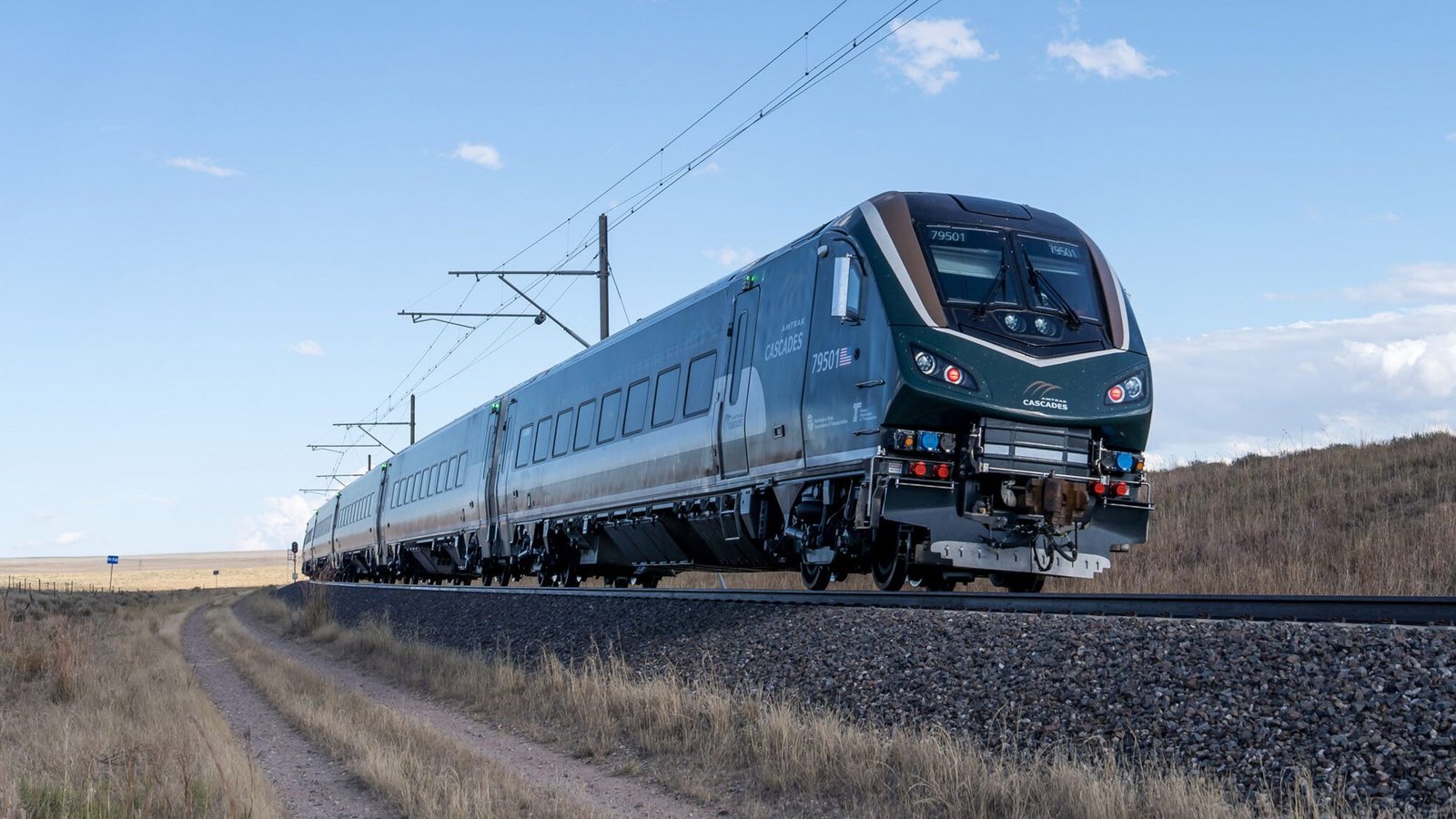
Amtrak plans to begin rolling out 83 new trainsets, dubbed Airo, this fall, starting with eight on the Pacific Northwest’s Cascades route. The trains will eventually serve more than a dozen routes in places like New England, Pennsylvania, and much of the mid-Atlantic region. The $8-billion investment is expected to reduce trip times on multiple routes, though Amtrak did not say by how much, and the trains can reach speeds of up to 125 mph. The Cascades trains will also carry 317 passengers — significantly more than the current Cascades rolling stock — and will boost reliability and comfort, according to an Amtrak spokesperson.
Improved hardware could also help advance All Aboard Washington’s vision of more frequent rail service in the region. “Having trains once an hour would be very helpful, and the Airo trainsets would make it possible to do that,” Hamilton said.
The Airo trains also represent a significant and long overdue refresh for Amtrak, which still has trains that date to the 1970s. The carrier has said the new hardware will provide “significant environmental benefits” while making the rider experience more pleasant. The rollout follows the introduction of new NextGen Acela trains on the Northeast Corridor last summer.
Amtrak’s refresh comes after the Biden administration made a historic $66 billion investment in passenger and freight rail through the Infrastructure Investment and Jobs Act. But it arrives at a tumultuous moment. Despite Amtrak setting ridership records for two consecutive years, the Trump administration has proposed severe cuts to passenger rail funding. Still, the federal government did announce $3 billion in funding, including $2 billion to purchase trains, for Amtrak in August.
Rail carries 8 percent of the world’s passengers, yet accounts for just 2 percent of global transportation energy demand. In that sense, the Airo trains will help make a clean form of transport even cleaner.
Alex Scott, a professor of supply chain management at the University of Tennessee-Knoxville, said rail’s efficiency comes in part from carrying many people at once. “If you can get a fully well-utilized rail car, be it humans or products, those are still more efficient than everybody going in different cars, even if they’re electric cars,” he said.
The trains, built in the U.S. by Siemens, feature electric and diesel propulsion, allowing them to operate on both conventional and electrified routes. While much of the U.S. passenger rail network remains unelectrified, employing new diesel-powered trains can still reduce emissions. “The locomotives they make now, even if they’re not electric, are a heck of a lot cleaner than the old ones, and so upgrading equipment, be it electric or not, is a good answer,” Scott said.
Airo locomotives meet the Environmental Protection Agency’s Tier 4 emissions standards — the agency’s strictest rules for locomotive engines — significantly reducing particulate matter and nitrogen oxide emissions.
Riders on the Northeast Regional route will climb aboard Airo trains in 2027. The new rolling stock will especially benefit riders traveling between Virginia and the Northeast who can wait as long as an hour at Union Station in Washington, D.C. while Amtrak swaps the diesel engine it uses south of the capital to the electric one it uses northbound to Boston. The new trains can quickly transition from diesel to electric power without changing locomotives.
“It’s a win for the environment, it’s a win for the people that are sitting in traffic,” Virginia Passenger Rail Authority spokesperson Karina Romero said. “We definitely want more trains in Virginia.”
Virginia has invested $6 billion in its Transforming Rail in Virginia program. According to Romero, the combination of new trains and improved infrastructure will give riders a more reliable experience.
“You can put down fabulous infrastructure and great tracks,” she said, “but you’ve definitely got to have the equipment to roll on.”