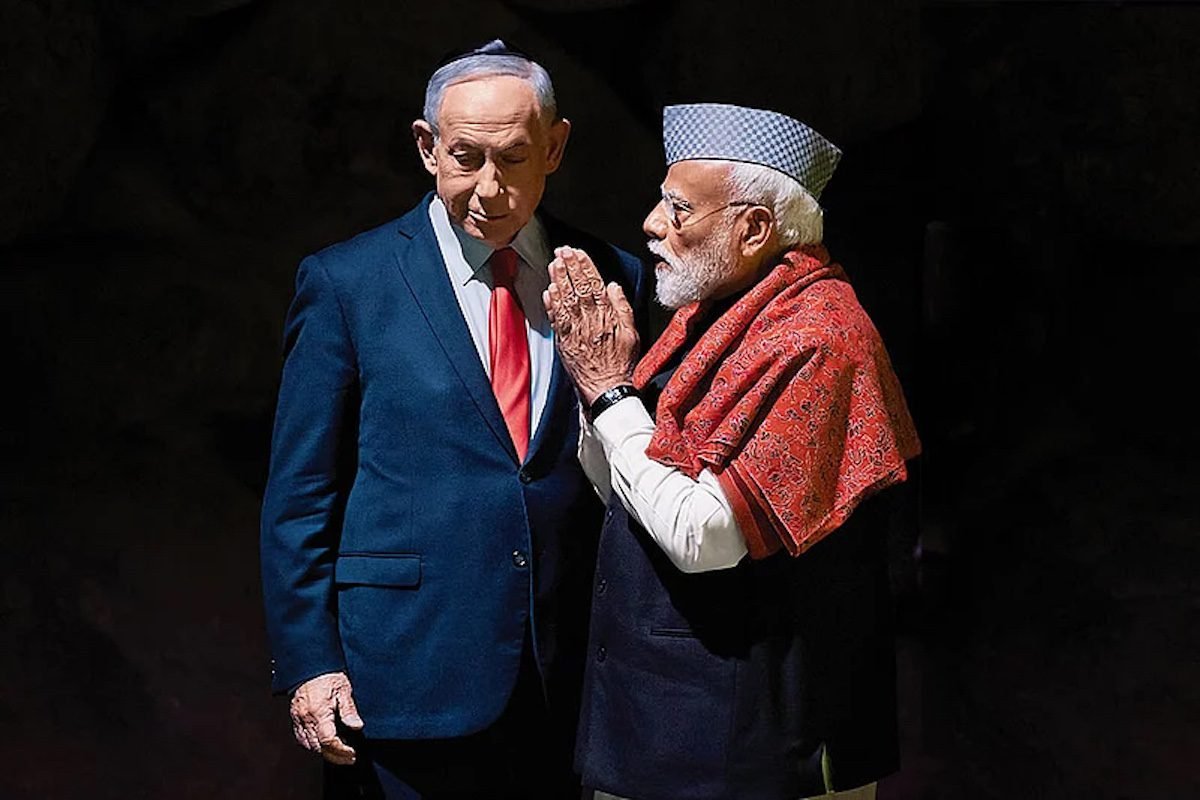
For decades, India-Israel defense relations were straightforward. Israel possessed military technologies, weapons systems and operational expertise that India wanted, while India offered one of the world’s largest defense and weaponry markets. That equation is now changing at warp speed.
India is no longer simply a major customer of Israeli military technology. It is increasingly becoming a manufacturer, joint-venture partner and supplier within Israel’s defense-industrial ecosystem.
This transformation extends beyond bilateral relations, connecting Indian industrial capacity more directly to the security architecture of a Middle East already strained by the Gaza war and wider regional confrontation pitting the US and Gulf states against Iran and its proxies.
A July 2026 Amnesty International investigation offers a detailed picture of this shift. Using shipment-level trade data, Amnesty identified at least 2,596 shipments of weapons, ammunition, parts and components from India to Israel between October 7, 2023 and November 30, 2025.
These included at least 390,516 small-arms parts, 564,970 components of explosive ordnance and 298 military-vehicle components. The significance lies less in the numbers than in what they reveal about the changing structure of the relationship.
From arms buyer to industrial partner
India remains one of the world’s largest importers of major weapons, even as New Delhi pushes aggressively to localize defense production.
India was the world’s second-largest importer of major arms in 2021–25, accounting for 8.2% of global imports, according to the Stockholm International Peace Research Institute (SIPRI). Russia supplied 40% of India’s imports, France 29% and Israel 15%, the same data shows.
The relationship now is increasingly two-way. Amnesty identified Indian private companies, state-owned enterprises and India-Israel joint ventures supplying Israeli defense manufacturers.
Among them are PLR Systems, involving Adani Defence & Aerospace and Israel Weapon Industries; Alpha Elsec Defence & Aerospace Systems, linked to Elbit Systems; and state-owned Munitions India Limited.
Amnesty traced machine-gun parts, components related to 155mm high-explosive artillery ammunition, warheads for Sky Striker loitering munitions and armored-vehicle components, among others. The rights organization says it excluded shipments likely intended for civilian use and components likely associated with anti-missile defense.
In sum, Israel-India defense cooperation is supporting New Delhi’s push for domestic manufacturing, while Indian factories are becoming integrated into Israeli supply chains. The traditional buyer-seller relationship is evolving toward defense-industrial interdependence.
Gaza changes the calculation
Under different circumstances, this transformation might have attracted less international attention. But the Gaza war and the US-Israel conflict with Iran have fundamentally changed the political and legal environment surrounding military transfers to Israel.
Amnesty, for one, argues that continued transfers risk contributing to serious violations of international law and has called for them to stop. The International Court of Justice, meanwhile, is weighing whether Israel is responsible for genocide as defined under international law in Gaza.
But India faces a strategic dilemma regardless of that eventual legal decision and its consequences. New Delhi has traditionally sought to maintain relationships across competing political and strategic camps in the Middle East and elsewhere as part of its non-aligned foreign policy tradition. It has developed close security ties with Israel while preserving key relations with Gulf states, Iran and the Palestinians.
The Middle East is central to India’s energy security and trade, while millions of Indian citizens live and work across the Gulf. India also has major economic relationships with Saudi Arabia and the UAE, retains strategic interests involving Iran and its Chabahar Port, and continues officially to support a negotiated two-state solution to the Israeli-Palestinian conflict.
Deeper involvement in Israel’s wartime defense supply chain makes that balancing act more difficult to maintain. The more India’s industrial base becomes connected to Israel’s war-geared defense economy, the harder it becomes to keep these relationships in separate diplomatic compartments.
Strategic autonomy becomes harder to demonstrate when diplomatic balance coexists with material integration into one side’s wartime defense supply chain.
More than an arms trade relationship
Defense-industrial cooperation binds countries together differently from conventional arms purchases.
Buying a missile, radar or drone is largely transactional. Joint manufacturing, technology transfer and integrated supply chains create deeper relationships involving factories, intellectual property, subcontractors, investment and long-term commercial interests.
For India, the partnership supports its ambition to expand indigenous defense production and reduce dependence on imported finished systems. For Israel, India offers manufacturing capacity, industrial scale and one of the world’s largest defense markets.
These mutual interests make the relationship more resilient, but they also create exposure. Further escalation involving Gaza, Iran or another regional theater could increase scrutiny of Indian companies and policymakers over where Indian-manufactured military products ultimately go.
India should not, however, be mistaken for Israel’s principal external supplier of major weapons. SIPRI estimates that the United States accounted for 68% of Israel’s major-arms imports in 2021–25, Germany for 31% and Italy for 1.3%.
This does not contradict Amnesty’s findings. The two datasets measure different dimensions of the relationship. SIPRI tracks transfers of major conventional weapons, while Amnesty’s shipment-level investigation covers ammunition, parts, components and other military-related goods.
The latter can therefore reveal supply-chain integration that does not appear prominently in major-arms statistics.
A wider Middle East calculation
This all has consequences beyond India and Israel. Regional military competition increasingly operates through networks of drones, missiles, electronics, components, technology partnerships and co-production. India’s growing integration with Israel adds another major Asian industrial power to this architecture.
At the same time, New Delhi is seeking greater influence across the Gulf and wider Middle East. It wants closer economic relations with Saudi Arabia and the UAE, connectivity through projects linking India with the Middle East and Europe, access through Iran’s Chabahar port and a stable regional environment for energy and trade.
A prolonged regional confrontation involving Israel makes these interests increasingly difficult to separate from India’s defense relationship with the country.
For New Delhi, the issue therefore extends beyond whether individual export licenses comply with domestic law. The larger strategic question is how deeply India wants its emerging defense-industrial ambitions connected to conflicts in the Middle East.
To be sure, India has clear reasons to maintain defense cooperation with Israel. Israeli technology has contributed to Indian military modernization, while joint production supports New Delhi’s ambition to become a major defense manufacturer.
But deeper industrial integration brings consequences that a conventional buyer-seller relationship did not. India-Israel defense relations have therefore entered a potentially fraught new phase. India is no longer merely buying Israeli military power – it is increasingly participating in the industrial system that produces it.
For a country seeking greater influence across Asia and the Middle East, the challenge is whether India can deepen its integration into Israel’s defense economy without undermining the strategic autonomy that has long defined its independent foreign policy.
Saima Afzal is a researcher specializing in South Asian security, counterterrorism, and broader geopolitical dynamics across the Middle East, Afghanistan, and the Indo-Pacific. She is currently a research scholar at Justus Liebig University, Germany.