27.6 C
London
Thursday, July 9, 2026
Home Blog

Flores Hobbits’ eating habits offer clues about their evolutionary past

0
flores-hobbits’-eating-habits-offer-clues-about-their-evolutionary-past
Flores Hobbits’ eating habits offer clues about their evolutionary past

Until about 60,000 years ago, diminutive hominin cousins, Homo floresiensis (affectionately nicknamed Hobbits for obvious reasons), shared the island of Flores with Komodo dragons, pygmy elephants, and giant rats.

Based on the presence of hominin and pygmy elephant bones in the same layers of cave sediment, it originally looked like the Hobbits had hunted and butchered dwarf elephants—an impressive feat for such a tiny hominin. But according to University of Tübingen anthropologist Elizabeth Veatch and her colleagues, it was the Komodo dragons that were the hunters, while the Hobbits only showed up to scavenge what was left.

If Veatch and her colleagues are right, their findings may challenge some of the assumptions we’ve made about Homo floresiensis—and about which hominin species was the first to venture into the wider world beyond Africa.

These small hominins weren’t big-game hunters

Extinct pygmy elephant bones unearthed at Liang Bua (the cave site that also seems to have sheltered Homo floresiensis) are covered in marks from Komodo dragon teeth, as well as cut marks from stone tools. Based on these bones, we know that Hobbits and the ancient ancestors of today’s Komodo dragons shared a taste for the same type of meat: pygmy relatives of modern elephants, called Stegodon. At least three species of Stegodon lived on Flores, ranging from 1.25 to almost 2 meters tall and weighing anywhere from 500 kilograms to 1.5 tons.

To better understand the Stegodon bones and how they got to Liang Bua, Veatch and her colleagues started by feeding a nearly whole goat carcass to a Komodo dragon (as one does). The Komodo dragon at Zoo Atlanta had its best day ever, and the researchers compared what resulted to the Stegodon bones from Liang Bua.

The Komodo dragon has serrated teeth and a habit of gripping prey and then shaking its head side to side to rip the flesh away from the bone. This left distinctive marks on the bones, marks that were usually shallower, shorter, and wider than cut marks from stone tools. Veatch and her colleagues also noticed that the zoo’s Komodo dragon went straight for the meatiest parts of the body, which happened to be the same areas where archaeologists found tooth marks on the Stegodon bones at Liang Bua: parts like the limbs and the surprisingly fat-rich feet, as well as the ribs.

Stone tool marks, on the other hand, showed up on the less desirable parts. The pattern didn’t match what you would expect if hominins had first dibs on an elephant they’d just killed, but it did match what you’d expect if they were scrounging for leftovers after the Komodo dragons had eaten their fill. Veatch and her colleagues also found no evidence of fire in the Homo floresiensis layers of the site, which means they probably ate their leftover elephant bits raw. (At least one source claims that elephant meat can be tough to chew if it’s cooked over an open fire, so maybe the Hobbits were onto something.)

That challenges the earlier idea that Homo floresiensis organized and equipped themselves well enough to bring down something as large as a Stegodon. And it may add an interesting angle to an ongoing debate about where Homo floresiensis came from and which hominins were the first to migrate out of Africa. That debate has implications not only for understanding the Hobbits, but for how we make sense of 2-million-year-old stone tools at sites in China.
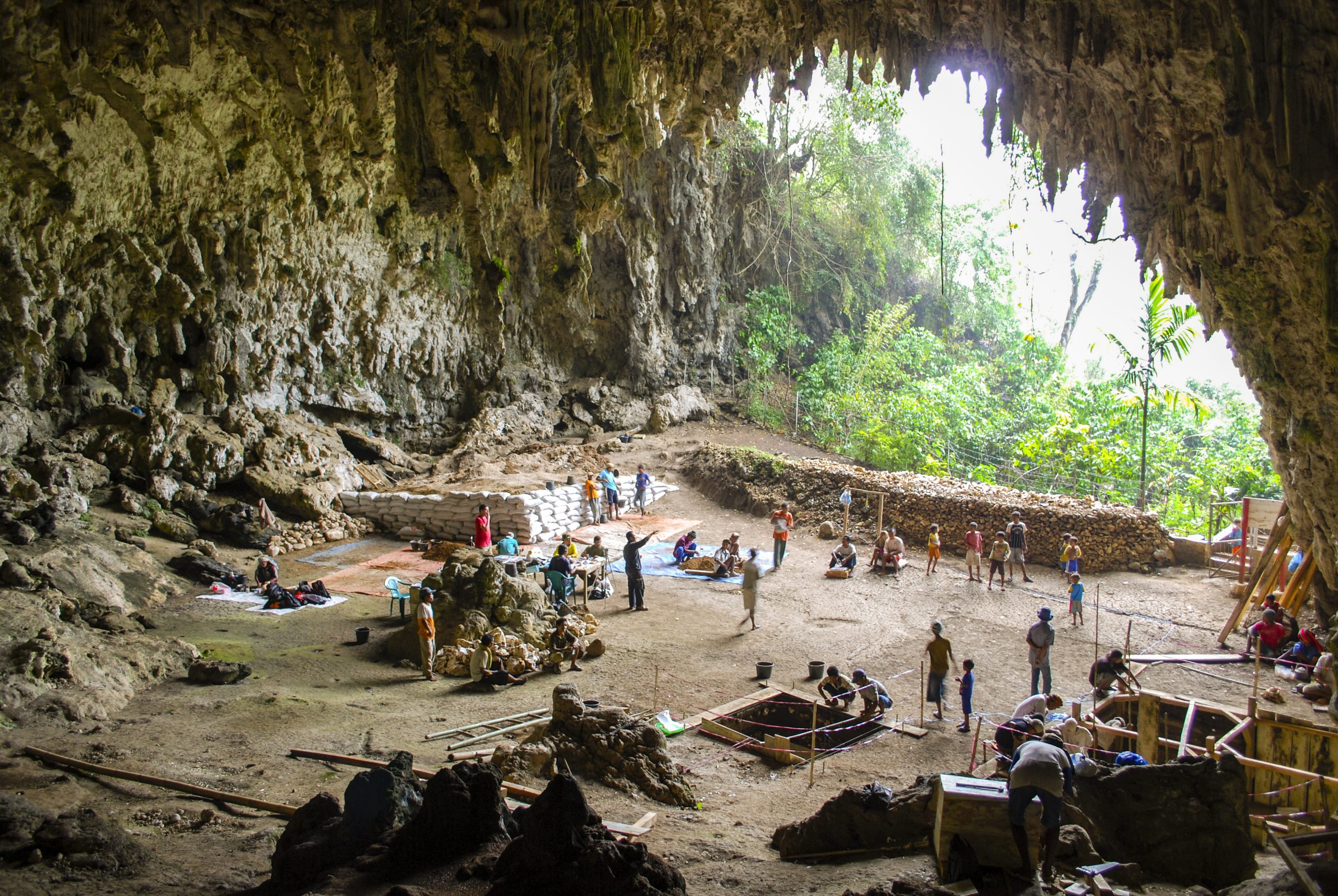
Liang Bua, the limestone cave on the Indonesian island of Flores where the H. floresiensis remains were found.

Liang Bua, the limestone cave on the Indonesian island of Flores where the H. floresiensis remains were found. Credit: Liang Bua Team

The Hobbits and “Out of Africa”

The most widely accepted origin story for the Hobbits (and some similarly short-statured cousins on a relatively nearby island) is that they’re descendants of a species called Homo erectus, which first appears in the fossil record around 1.9 million years ago in Africa. Within a few hundred thousand years, Homo erectus fossils show up everywhere: the Levant, Georgia, China, and Indonesia. In Indonesia, it may have been scattered among the islands in isolated pockets that eventually evolved into separate species, like Homo floresiensis and Homo luzonensis. Or at least that’s one hypothesis.

Homo erectus makes sense as the ancestor of the Hobbits, mostly because we typically think of Homo erectus as the first of our hominin ancestors to expand beyond Africa. The oldest hominin bones found anywhere outside Africa belong to Homo erectus: five skulls and hundreds of other bones, all dating between 1.77 million and 1.85 million years from Dmanisi Cave in Georgia. But stone tools tell a different story.

Stone tools from two sites in China seem to be older than Homo erectus. At Shangchen, a site on the southern edge of China’s Loess Plateau, archaeologists unearthed stone tools from a 2.1-million-year-old layer of sediment. And at the Xihoudu site in northern China, stone tools date to 2.43 million years ago. So either Homo erectus is older than we thought, or some other hominin species got there first. If that’s the case, then an even older member of our genus, like Homo habilis or Homo rudolfensis—species that anthropologists previously surmised weren’t adaptable enough to gain footholds in so many different parts of the world—may be the real ancestor of the Hobbits.

Veatch and her colleagues’ study, along with several previous studies of Homo floresiensis‘ anatomy and behavior, may lend some support to that idea.

chart showing different skull features of four hominin species

This comparison shows Homo floresiensis alongside the skulls of two of its potential ancestors, plus Homo naledi.

This comparison shows Homo floresiensis alongside the skulls of two of its potential ancestors, plus Homo naledi.

“Evidence for behavioral complexity in Homo floresiensis, including complex tool and fire use, have weakened considerably over time,” wrote Veatch and her colleagues. “The evidence to date suggests that Homo floresiensis did not engage in a behavioral repertoire as diverse or as flexible as in modern humans or Neanderthals, possibly due to an ancestry in which large game hunting and controlled use of fire did not evolve.”

In other words, hominins descended from Homo erectus should have at least the same skills and cognitive abilities, which would include things like using fire and, potentially, organized hunting parties. Without those abilities, it’s easier to see Homo floresiensis as potentially descended from some earlier, less brainy species—still tool-users, but not fire-using big-game hunters—like Homo habilis or Homo rudolfensis.

Of course, we still don’t know the answer, and the evidence is complicated.

photo of a partial hominin skeleton in a display case

The skeleton of a female Homo floresiensis in the Natural History Museum in London.

The skeleton of a female Homo floresiensis in the Natural History Museum in London. Credit: Emőke Dénes, CC BY-SA 4.0 , via Wikimedia Commons

Evidence is clear; interpretation is tricky

Veatch and her colleagues’ recent study isn’t the first to challenge the idea that Homo floresiensis hunted big game and used fire, or that they descended from Homo erectus. Some of Homo floresiensis’ features, like the shapes of bones in its feet and the angle of its upper arms, suggest that it may be more closely related to Australopiths like Lucy than to Homo erectus.

On the other hand, despite having a smaller brain than Homo erectus (even relative to its body size), the contours of the inside of Homo floresiensis‘s skull suggest that its prefrontal cortex—an area of the brain associated with cognitive feats like planning and executive function—may have been fairly similar in size and structure to ours.

And it’s hard to say whether hunting Stegodon is a good measure of the Hobbits’ intellectual prowess anyway. Wielding projectile weapons, strategizing group hunts, and bringing down big prey all point to well-developed cognitive abilities (exactly the kind suggested by that hefty prefrontal cortex, in fact), and so does using fire to cook the meat afterward. However, hunting pygmy elephants may simply not have been worth the effort, even for a species that was otherwise capable of doing it.

When you calculate the cost, in time and energy, of killing, butchering, and transporting a carcass (which Veatch and her colleagues did, based on ethnographic data from people who live near modern elephants), elephants just aren’t worth the effort, let alone the risk.

“Although Homo floresiensis could gain a large total calorie return by successfully hunting Stegodon, the costs involved could potentially outweigh any social and/or caloric advantages,” Veatch and her colleagues suggest. Giant rats offered a much better return on investment; they rank ninth on Veatch and her colleagues’ list of Flores most appealing prey species, with Stegodon clocking in at 17th. And that’s probably why giant rat remains are so abundant at Liang Bua, in the layers of the cave associated with Homo floresiensis and the later Homo sapiens layers.

Even though it’s now clear that the Hobbits were not big-game hunters, and it doesn’t look like they used fire at Liang Bua, it’s much less clear what those facts tell us about the Hobbits’ brains or which branch of our family tree they actually belong on. As always, we need more evidence to fill in the details.

photo of a Komodo dragon

10/10, would risk death to boop this snoot.

10/10, would risk death to boop this snoot. Credit: Zoo Atlanta

The questions we can answer

We know you’re wondering: Komodo dragons are venomous, so wouldn’t eating scraps scavenged from their kills have poisoned the Hobbits? The proteins in Komodo dragon venom are too large to pass through modern humans’ stomach linings and would probably have been broken down by the Hobbits’ digestive enzymes, according to Veatch and her colleagues. Please do not test this on yourself (but if you do, email us).

Scavengers would probably have been cautious about approaching kill sites, though. At around 3 meters long and weighing in at 70 kilograms, a Komodo dragon isn’t a beast you would want to encounter in a dark alley or even a reasonably well-lit Indonesian jungle. Now picture yourself as a Homo floresiensis, standing just over a meter tall. The Komodo dragon is three times your size, and has bony-armored skin, serrated teeth (the better to rip your flesh with), and a keen sense of smell (the better to track wounded prey with).

We don’t know whether Komodo dragons snacked on Hobbits back in the day, but there’s no evidence that they did, and Komodo dragons today mostly avoid humans, usually attacking only when they can’t flee.

Of the three species involved here (Homo floresiensis, Stegodon, and Komodo dragons), only the Komodo dragons survive today. Make of that what you will.

Science Advances, 2026 DOI: 10.1126/sciadv.aeb7219 (About DOIs).
NATO summit arms deals show realism trumps values

0
nato-summit-arms-deals-show-realism-trumps-values
NATO summit arms deals show realism trumps values

The liberal internationalist story has always been seductive: Democracies prefer each other, build institutions together and let shared values govern how they distribute power and resources.

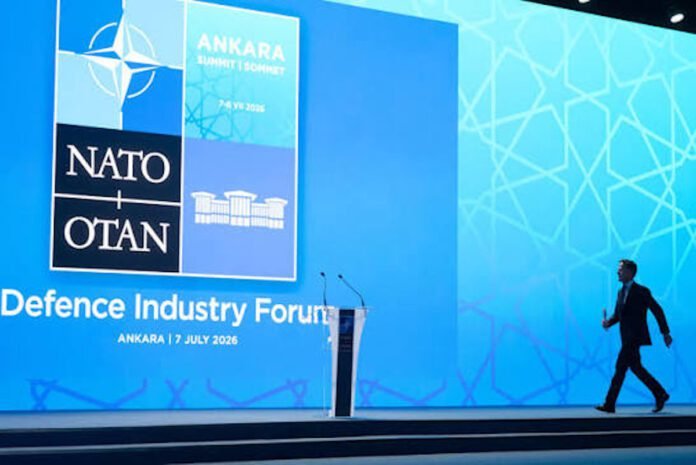
But this week’s NATO summit in Ankara showed that security imperatives trump liberal values in today’s geopolitics.

First, let’s examine the pattern of defense spending. NATO allies gathered in Ankara to announce arms deals worth tens of billions of dollars, structured almost entirely around demonstrating to the Trump administration that Europe was finally paying its share.

This was carefully calibrated to satisfy a transactional US president who has consistently subordinated values-based ideological alignment to security burden-sharing calculations.

Deals announced in Ankara — including Europe’s procurement of American AMRAAM, PAC-3 and GMLRS-variant missiles — involved almost exclusively NATO allies, consolidating a transatlantic defense industrial base that keeps procurement, co-production and R&D tightly guarded within the treaty perimeter.

President Donald Trump has long demanded quantifiable increases in US defense exports, but the overarching need is for tighter interoperability within the NATO alliance, which largely requires common systems.

Fortuitously for Trump, this convergence of industrial and operational logic keeps the benefits structurally reserved for those inside the alliance, with the US remaining indispensable — at least for now.

It is also notable that Canadian Prime Minister Mark Carney chose Germany’s TKMS Type 212CD submarine over South Korea’s Hanwha KSS-III, in a contract worth approximately $70 billion. Both platforms met Canada’s operational requirements, and both came from liberal democracies, leaving no values-based reason to prefer one over the other.

Consistent with alliance logic, Carney emphasized that the deal with Germany would “deepen our partnerships with trusted allies” and “open new opportunities for Canadian businesses in European supply chains,” explicitly tying Canada’s choice to NATO and European integration.

Selecting the German submarine over the Korean one thus integrated Canada deeper into the European defense industrial web.

In Ankara, South Korean President Lee Jae Myung proposed a “Korea-NATO Defense Industry Partnership 2.0” characterized by joint R&D, co-production and the joint operation of weapons systems, and pitched as an upgrade of the conventional buyer-seller model.

If the partnership materializes, still a big if, Korean defense firms could move beyond bilateral cooperation with individual NATO members and gain broader access to alliance-wide procurement and co-production programs.

Hanwha Ocean’s statement after losing the Canadian contract was more circumspect. The Korean company said it had “devoted every effort to winning the contract” — supported by government backing, proven submarine technology and the Korean Navy’s operational track record — but “was unable to overcome the barrier posed by NATO alliances.”

That is effectively an admission that non-NATO member status is still a structural ceiling to deeper integration with the defense alliance.

Second, let’s consider what this portends for Europe. The missile purchases from US firms signed in Ankara may look, on the surface, like transatlantic solidarity. But if the security calculus holds, they should also be regarded as a transitional phase in a longer European strategic project.

In Ankara, NATO Secretary General Mark Rutte described the alliance as entering the “early stages of a defense industrial revolution,” with a focus on three priorities: deep-strike capability, air defense modernization and autonomous systems.

These priorities are now backed by both economic heft and political will. The Netherlands alone announced more than 3 billion euros in deals, including air defense partnerships with Belgium and naval cooperation with Britain.

NATO simultaneously announced it would replace its aging US-built AWACS fleet with a Swedish alternative — Saab’s GlobalEye, in a deal worth up to $4.5 billion — backing the Swedish system over a rival solution from US defense contractor Boeing. That is another signal that European substitution of American systems is firmly underway.

In April 2026, Germany’s Rheinmetall and Dutch firm Destinus announced a joint venture — Rheinmetall Destinus Strike Systems — to produce mass-scalable cruise missiles and rocket artillery from a 100% European value chain, targeting NATO qualification so that the weapons can be procured by all member states.

The EU’s European Defence Industry Programme (EDIP) and its five proposed joint defense projects of common interest — covering drones, maritime and seabed defense, space, air and missile defense, and the Eastern Flank — carry a combined funding ambition of 190 billion euros by 2036.

In the context of future domains like AI, Brussels is already treating autonomous targeting and decision-support systems as strategic infrastructure rather than mere technology, pushing for European-developed models, trusted data pools and secure compute on the continent.

And consistent with the dual-use technology approaches of Washington and Beijing, European defense “primes” and emerging AI firms will be driven to embed AI into sensors, command-and-control and weapons guidance — and to do so on European hardware, cloud and regulatory terms.

The European Commission’s explicit goal is to redirect defense spending inward, reducing the roughly half of European procurement that currently flows outside Europe to the United States, Israel and South Korea.

So while European states currently buy American because of urgent capability gaps and superior US production lines, NATO’s European members should be expected to continue building alternatives on the continent.

That’s because autonomy is the long-term strategic goal, achievable only through the industrial strengthening of states that, per alliance logic, are overlapping members of both NATO and the EU.

Correspondingly, when Europe’s KNDS delivers the next-generation Franco-German main battle tank or when the European missile ecosystem matures, we should expect the leverage Washington currently holds over its European allies through export dependency to progressively diminish.

Finally, let’s consider the effect on the world order. The Ankara summit’s upshot spoke to a longstanding debate in international relations theory. On one hand, liberals often argue that shared values produce durable cooperation — that democracies trust each other because they are transparent, accountable and constrained by domestic politics.

On the other hand, realists argue that security interests and the distribution of power are the primary determinants of international relations.

Ankara demonstrated how NATO premised its industrial agenda on intra-alliance co-production while South Korea, despite its democratic credentials and competitive platforms, was left petitioning at the door.

The same dynamic plays out in the Pacific theater, where, in East Asia Forum’s analysis of the 2026 US National Defense Strategy, Washington plans to integrate South Korean industry into US strategic logistics — shipbuilding, MRO and munitions replenishment — through the bilateral US-Korea treaty channel.

That demonstrates how keenly Seoul’s security flows run through Washington — not Brussels — precisely because the 1953 Mutual Defense Treaty is still its operative architecture.

And so, while Korea’s aspirations to deepen its partnership with NATO are both commercial and strategic, they are also subordinate to the bilateral alliance with America that underwrites Seoul’s security.

In the wider world order, liberal democracies may still be more likely to cooperate with one another than with autocracies. Yet NATO’s Ankara summit shows that when security considerations take precedence in the current geopolitical climate, the primary unit of preference is not shared values but alliance membership.

Or, artfully, shared values are the decor, but when the building is under threat, states reinforce the structure rather than redecorate.

Marcus Loh is the chairman of the Public Affairs Group at PRCA Asia Pacific and a director at Temus, a Singapore AI and digital services firm. He is currently reading War Studies at King’s College London.

Syria says arrested cell behind ‘terrorist bombings’ in Damascus

0
syria-says-arrested-cell-behind-‘terrorist-bombings’-in-damascus
Syria says arrested cell behind ‘terrorist bombings’ in Damascus

Security forces take strict security measures following two consecutive explosions that occurred near the Ministry of Tourism building, injuring 18 people including four security personnel, in Damascus, Syria on July 7, 2026. [Hişam Hac Ömer - Anadolu Agency]

Security forces take strict security measures following two consecutive explosions that occurred near the Ministry of Tourism building, injuring 18 people including four security personnel, in Damascus, Syria on July 7, 2026. [Hişam Hac Ömer – Anadolu Agency]

Syrian Interior Minister Anas Khattab said Thursday that authorities have arrested a cell responsible for “terrorist bombings” that struck Damascus two days ago, Anadolu reports.

“The cell responsible for the terrorist bombings that targeted Damascus two days ago is now in our custody,” Khattab said in a statement carried by the Syrian Arab News Agency (SANA).

He added that authorities will disclose “the identities of the cell members, their roles, and all of their affiliations” once investigations are completed.

Khattab did not provide further details about the suspects or the circumstances of their arrest.

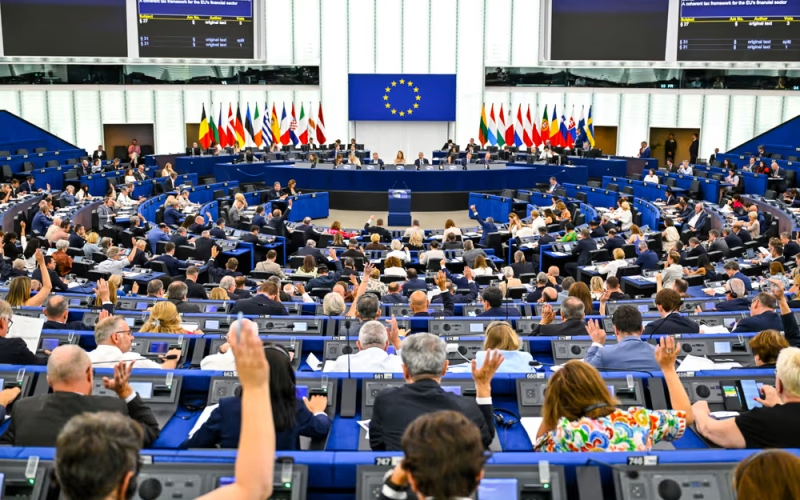
MEPs support Ukraine and Moldova’s EU path while warning Serbia over reform gaps

0
meps-support-ukraine-and-moldova’s-eu-path-while-warning-serbia-over-reform-gaps
MEPs support Ukraine and Moldova’s EU path while warning Serbia over reform gaps


The European Parliament has reaffirmed its support for the European Union accession ambitions of Ukraine and Moldova, while warning that Serbia’s membership process remains hindered by shortcomings in democratic reforms, the rule of law and foreign policy alignment.

In three separate reports adopted on Wednesday, MEPs assessed each country’s progress towards EU membership and outlined the priorities they believe should guide the next stages of the enlargement process.

Ukraine: Continued reforms and long-term support

Parliament welcomed the opening of the first “fundamentals” cluster of Ukraine’s accession negotiations in June 2026 and expressed hope that additional negotiating clusters would be opened in the near future.

The report, adopted by 460 votes in favour, 136 against and 59 abstentions, called for a constructive approach to advancing Ukraine’s European integration while taking into account the EU’s strategic interests and the broader security of Europe.

MEPs commended Ukraine’s efforts to strengthen democratic institutions, uphold the separation of powers during wartime and advance judicial reforms and anti-corruption measures. They also stressed that continued progress in these areas would be essential for reconstruction, transparency and investor confidence.

The Parliament said future elections should only take place once martial law has been lifted and conditions exist to ensure free and fair voting. MEPs also rejected calls for elections while Russia’s war against Ukraine continues.

The report welcomed the first €3.2 billion disbursement under the Ukraine Support Loan and called for predictable multiannual EU financial assistance to help finance Ukraine’s defence and recovery.

MEPs also urged greater pressure on Russia’s wartime economy and supported continued international backing for Ukraine following the G7 leaders’ June 2026 statement.

On relations with Poland, Parliament expressed regret over Ukraine’s decision to rename an elite military unit after figures associated with the Ukrainian Insurgent Army (UPA), saying the move had affected neighbourly relations and calling for renewed reconciliation efforts.

Serbia: Reform implementation remains key obstacle

The Parliament said Serbia continues to describe EU membership as a strategic objective but warned that this commitment is not consistently reflected in government actions.

The report, approved by 468 votes in favour, 116 against and 79 abstentions, said there remains a persistent gap between Serbia’s adoption of EU-related legislation and its implementation, slowing progress towards accession.

MEPs said accession negotiations should only advance when Serbia demonstrates measurable and lasting improvements in areas including the rule of law, judicial independence, democratic institutions, media freedom, electoral standards, and the fight against corruption and organised crime.

They also called on the European Commission to reflect any significant setbacks in reforms when allocating pre-accession financial assistance.

Parliament reiterated that normalising relations with Kosovo remains a condition for support under the EU’s Reform and Growth Plan.

The report also expressed concern over Serbia’s close ties with Russia and its expanding security and defence cooperation with China, stressing that full alignment with the EU’s Common Foreign and Security Policy, including sanctions against Russia, remains a requirement for membership.

MEPs further pointed to low public support for EU membership, which they said has been influenced by longstanding anti-EU narratives in parts of the media and political leadership. Against the backdrop of ongoing protests since late 2024, Parliament said genuinely free and fair elections would provide the best way to address the country’s political crisis.

Moldova: Progress despite external pressure

Parliament also endorsed Moldova’s continued progress towards EU membership, praising the country’s reform efforts despite what it described as persistent Russian interference.

The report, adopted by 505 votes in favour, 115 against and 45 abstentions, welcomed the opening of accession negotiations on the “fundamentals” cluster and urged EU member states to open additional negotiating chapters without unnecessary delay, in line with the merit-based enlargement process.

MEPs noted the European Commission’s assessment that Moldova has made good progress in justice reform and anti-corruption efforts while highlighting the need to continue addressing the influence of oligarchs in politics, business and the media.

The report warned of ongoing Russian attempts to interfere in Moldova’s democratic processes and called on the EU to strengthen support for the country’s institutional resilience, cybersecurity, strategic communications and independent media.

Parliament also welcomed Moldova’s deeper economic integration with the EU single market and its efforts to reduce dependence on Russian energy.

On the Transnistria region, MEPs reiterated their support for Moldova’s territorial integrity and called on Russia to withdraw its military personnel, equipment and ammunition from the territory.

The Strait That Broke the Deal: Gulf Attacks Expose Limits of US-Iran Truce

0
the-strait-that-broke-the-deal:-gulf-attacks-expose-limits-of-us-iran-truce
The Strait That Broke the Deal: Gulf Attacks Expose Limits of US-Iran Truce


Renewed strikes, restored oil sanctions, and Iranian attacks on US partners have turned a temporary diplomatic framework into a fight over who controls the Strait of Hormuz 

Sirens in Jordan, renewed tensions in the Strait of Hormuz, and a blunt declaration from President Donald Trump have turned a temporary US-Iran memorandum of understanding (MOU) into a battlefield dispute over who controls the region’s most sensitive waterway. 

Asked during the NATO summit in Ankara, Turkey, whether the ceasefire was over and whether the MOU was dead, President Trump left little room for diplomatic polish. “It’s a very interesting question. To me, I think it’s over. I don’t want to deal with them anymore,” the US president said, according to a direct transcript of his remarks. He called Iran’s leaders “sick people” and “vicious, violent people,” warned that “if they had a nuclear weapon, they’d use it,” and concluded: “As far as I’m concerned, it’s over.” 

The statement came after Washington moved to reimpose oil sanctions on Iran and launched new strikes on Iranian military targets following attacks on commercial vessels in or near the Strait of Hormuz. The Associated Press reported that the US struck about 90 targets across Iran, including air-defense systems, coastal surveillance assets, missile and drone storage sites, naval capabilities, and military logistics infrastructure. Iran’s Health Ministry said 14 people were killed and 78 wounded in the American strikes. 

Iran responded by claiming attacks on US-linked military targets in Bahrain, Kuwait, Qatar, and Jordan. Petra, Jordan’s state news agency, citing a military source at the General Command of the Jordan Armed Forces-Arab Army, said Jordanian air defenses intercepted eight missiles launched from Iran toward Jordanian territory. The source said missile debris fell in several areas, but no casualties or property damage were reported. Kuwait also reported intercepting missiles and drones. 

For Prof. Eytan Gilboa, an expert on US-Israel relations at Reichman University and Bar-Ilan University, President Trump’s words did not necessarily mean the MOU had formally disappeared. They did, however, expose what he called its basic weakness. 

“Turns out that the two sides are interpreting certain clauses very differently,” Gilboa told The Media Line. The central dispute, he said, is Hormuz. President Trump believed Iran had committed to free passage through the strait, including no tolls or restrictions. Iran, according to Gilboa, reads the same issue in almost opposite terms. 

The whole issue of Hormuz is a matter of control—who controls the straits—and it turns out that the MOU failed to solve that problem

“The whole issue of Hormuz is a matter of control—who controls the straits—and it turns out that the MOU failed to solve that problem,” Gilboa said. In his view, Iran’s interference with passage through the waterway amounted to a violation of the ceasefire framework, forcing the US to respond with strikes on military infrastructure linked to Iran’s control of the strait. 

Washington had already moved economically before the latest exchange of fire. After the attacks on commercial shipping in or near the Strait of Hormuz, the US administration revoked a license allowing Iran to sell oil under the temporary ceasefire framework. A US official told Reuters that Washington would continue negotiating “in good faith” but said Iran’s conduct in Hormuz was “completely unacceptable” and would carry consequences. 

Iran rejected that framing. Its Foreign Ministry said Tehran was carefully observing its commitments under the memorandum regarding Hormuz and called on regional states to avoid steps that contradicted the agreement. Qatar and Saudi Arabia, however, said tankers linked to them had been attacked in or near the strait, and Qatar summoned Iran’s deputy ambassador. 

The dispute became more explicit when Mohammad Bagher Ghalibaf, speaker of Iran’s parliament, said the strait would not be opened on American terms. “The Strait of Hormuz will open only through Iranian arrangements, not American threats,” he said, according to Israeli reports. 

Beni Sabti, an Iran researcher at the Institute for National Security Studies, said the Iranian moves in the Strait of Hormuz were not sudden. Tehran, he said, had been signaling for weeks that it would not accept commercial shipping shifting toward routes near Oman in a way that undermined its claim of control. 

From their perspective, they are now the owners of the Strait of Hormuz

“They said all the time: if there is another route, if the ships pass near Oman or somewhere else, we will not allow it,” Sabti told The Media Line. “From their perspective, they are now the owners of the Strait of Hormuz.” The attacks, he said, followed the warnings Iran had already made in its own media, even if others did not take them seriously enough. 

Sabti argued that President Trump appears frustrated by Iran’s threats and its effort to act as “masters of the region.” But he warned that limited US strikes may not shift the regime’s calculations if they do not hit the center of power or the launch systems used against American partners. 

A limited confrontation, Sabti said, could even serve the regime. “A dictatorial regime always likes a little emergency, a little small war,” he said. At home, he argued, Iran can tell the public that the economy cannot recover because the country remains under attack. Inside the security establishment, it strengthens the generals. Externally, he said, Iran can continue playing the unpredictable actor without necessarily triggering a war aimed at the regime’s demise. 

A dictatorial regime always likes a little emergency, a little small war

That is why Sabti views the sanctions issue as more important than some of the strikes. “The fact that he [President Trump] is restoring the sanctions that stop Iranian oil exports, that really hurts them,” he said. “That is more important than these attacks.” 

Gilboa also sees sanctions and Hormuz as the two practical levers now available to Washington. President Trump, he said, is in “a strategic trap” after a framework that gave Iran economic relief without producing the kind of nuclear or regional concessions Washington wanted. 

Commenting on possible options for President Trump, Gilboa said: “I think his most likely response would be to close the Straits of Hormuz and to reimpose the financial sanctions,” adding that these are the two things that the MOU ostensibly removed. He said the US could combine economic pressure with military activity below the threshold of a full-scale war, though he cautioned that none of the options facing President Trump are particularly good. 

The Israeli angle is more complicated than simply welcoming the MOU’s breakdown. Gilboa said the US and Israel agree on broad goals: Iran should not obtain nuclear weapons, Hezbollah should disarm, and Hamas should disarm before Gaza reconstruction moves forward. The disagreement is over methods. Israel, he said, was skeptical that the MOU could deliver the dismantling or suspension of Iran’s nuclear weapons program. 

Prime Minister Benjamin Netanyahu, according to Gilboa, should now argue in Washington that Israel warned the arrangement would fail. “You negotiated the MOU. You thought this would be a good way to end the war. And we said it would not,” Gilboa said, describing the argument he believes Israel should make. “So maybe we have to achieve a strategic dialogue of the kind that exists in the military area.” Military coordination between the US and Israel remains excellent, he said, but the diplomatic channel has been weaker because of policy disagreements. 

Lebanon is part of that dispute. Israeli operations against Hezbollah have continued outside the US-Iran ceasefire framework, and Gilboa said linking Iran and Lebanon inside the MOU was a mistake because it strengthened Hezbollah’s standing. He argued that Iran must be “dislodged from Lebanon” if the Lebanese government is to regain authority. 

Gilboa said the crisis also exposed competing instincts inside President Trump’s foreign policy team. The MOU, he said, was handled by Vice President JD Vance, whom he described as aligned with the more isolationist wing of the Republican Party, while the separate Israel-Lebanon track was being advanced by Secretary of State Marco Rubio. “It’s interesting to see who in the White House is sponsoring what,” Gilboa said. 

That split, he argued, could shape the domestic Republican debate before 2028 if the Iran framework collapses. “I think Vance failed to negotiate a good deal. It was not a good deal,” Gilboa said, adding that it would be “very easy to stick failure with Iran to him” if he becomes the Republican nominee. Israel, he said, is watching that internal debate closely, not only because of Iran, but because Rubio’s Lebanon track is seen in Jerusalem as more aligned with Israeli security priorities. 

I think Vance failed to negotiate a good deal. It was not a good deal.

Israel’s own posture may also explain why Iran has so far avoided direct fire at Israel during the latest exchanges. Gilboa described it as both restraint and strategic discipline. “I think there is some kind of an Israeli deterrence against Iran,” he said. Gulf states are more vulnerable than Israel because they do not have the same anti-ballistic missile systems, he added. If Iran were to attack Israel directly, he said, Israel would likely use the opportunity to strike both Iran and Hezbollah. 

Sabti made a similar point in blunter terms. Iran, he said, knows Israel is looking for an opportunity to hit harder if dragged back into the conflict directly. “They are not firing at Israel because they know Israel wants to use this to finish the regime,” he said. “They know we are crazy, and we are dying for an opportunity.” 

They are not firing at Israel because they know Israel wants to use this to finish the regime

For now, the conflict is being fought through a narrow but dangerous pattern: US strikes inside Iran, Iranian fire toward American positions and partners, restored oil sanctions, and renewed pressure on shipping through Hormuz. Iranian officials later said a US projectile struck the area around the Bushehr nuclear plant; the claim could not immediately be independently verified. 

The MOU still exists as a document, and US officials continue to leave room for negotiations. But the working reality has changed. Its two most tangible benefits for Iran—oil sanctions relief and easier passage through Hormuz—are now either reversed or contested. Its most important promise for Washington, a controlled pause that could lead toward a final deal, is being tested by missiles flying toward US partners and by President Trump’s own public judgment that, for him, the arrangement is over. 


OpenAI wants its new tool to do your work for you and with you

0
openai-wants-its-new-tool-to-do-your-work-for-you-and-with-you
OpenAI wants its new tool to do your work for you and with you

Last year, when we tested out the “Agent Mode” in OpenAI’s Atlas web browser, we complained that any automated tasks tended to stop after a few minutes, limiting its usefulness for ongoing or complex tasks. With today’s release of ChatGPT Work, OpenAI says it has solved that problem with a new tool that can “stay with a project for hours if needed, and turn a goal into finished work.”

The company is challenging users to evaluate ChatGPT Work by “giv[ing] it a task you already know well,” such as analyzing a budget or preparing a sales meeting. The company also promises that ChatGPT Work can automate entire workflows, going from customer research to a campaign brief to locally tailored marketing assets, for instance. At the same time, the company stresses that the tool will wait for you to “approve important actions.”

ChatGPT Work also integrates Scheduled Tasks, a souped-up version of cron jobs that can “take repetitive tasks off your plate” on a schedule or whenever a monitored event occurs. These tasks can keep going when you’re away from your desk and can be monitored from your phone, the company says.

ChatGPT Work can connect to common workplace management tools like Slack, Microsoft Teams, Google Drive, and SharePoint through various custom-built plugins. The desktop version of the new tool can also access and modify your desktop files or use a built-in browser to access online resources. OpenAI says an updated ChatGPT Chrome extension will also let you perform web-native tasks without switching out of the browser (OpenAI says its dedicated Atlas web browser is now being sunset, less than nine months after its launch).

Give ChatGPT access to all your work tools; what could go wrong?

Give ChatGPT access to all your work tools; what could go wrong? Credit: OpenAI

The ChatGPT Work system will access these outside resources automatically when it seems necessary to complete a prompted task, but users can also reference an outside app directly with the “@” symbol to force the use of a specific third-party tool. However, OpenAI also stresses that access to outside apps and files can be limited using its Compliance API or enterprise and admin controls.

Watch your wallet

Somewhat confusingly, OpenAI says its coding-focused Codex app is now merging with ChatGPT Work. But OpenAI also says that Codex technology is “built-in” ChatGPT Work, and Codex is still available as a separate “view” inside the new ChatGPT app (alongside the “Work” view). The existing ChatGPT desktop app is being rebranded as “ChatGPT Classic,” relegating that basic conversational use case to a deprecated version that has to be specifically requested via a “quick chat” button on Desktop (or a dropdown on mobile, where “Codex” is not available).

These distinctions between “chat” and “work” could be important, because OpenAI warns that ChatGPT Work is “designed for longer, more involved work than a typical chat request” and that those complex tasks “may use more of your plan’s included usage.” ChatGPT Work usage will be billed using the same structure as Codex, with subscription plans ranging up to $100 a month that have built-in usage limits through a credit system

OpenAI seems aware of the sticker shock that can accompany an agent’s extended use and expansive token consumption. ChatGPT Enterprise and Edu subscribers can set overall spend limits or set group- or individual-level limits to support “high-impact work” among certain employees.

The ChatGPT Work rollout comes alongside the debut of the new GPT-5.6 model, a new model that OpenAI promises provides “stronger performance per dollar” for “your hardest work.” That model can operate in three tiers, with the most expensive and high-performance costing $5 for a million input tokens and $30 for a million output tokens.

Graham Platner’s Exit From Senate Race Leaves Maine Dems “Hobbled” in Scramble for New Nominee

0
graham-platner’s-exit-from-senate-race-leaves-maine-dems-“hobbled”-in-scramble-for-new-nominee
Graham Platner’s Exit From Senate Race Leaves Maine Dems “Hobbled” in Scramble for New Nominee


In group chats of progressive activists and political operatives concerned with the state of the Senate race in Maine Wednesday morning, a link to an anonymous Google Doc was making the rounds. It disavowed Graham Platner, the disgraced Democratic nominee whose campaign was throttled by a rape accusation on Monday, and called to replace him with Troy Jackson, a recent gubernatorial contender the document deemed “the one candidate who can hold Platner’s coalition together.”

Platner suspended his Senate campaign on Wednesday evening, and there is no clear alternative to his candidacy. His campaign’s swift downfall has presented Democrats and his primary supporters with several bad options: The party establishment could pick a candidate and inflame an already frustrated base that scoffed at its efforts to anoint Gov. Janet Mills as the nominee, or it could bend to Platner’s past demands and let him influence the selection of his successor.

In either case, a base already exhausted by months of Platner scandals is at risk of fracturing and failing to consolidate behind a potential replacement — and Democrats are at risk of once again losing a key seat they need to pick up for control of the Senate to Republican Sen. Susan Collins.

With so much blame and anger to go around, the fear of poisoning the selection process was on display in the anonymity of the Google Doc pushing Jackson, the Bernie Sanders-endorsed third-place candidate in Maine’s Democratic gubernatorial primary. Jackson, who has already been discussed in national progressive circles as a possible ideological successor to Platner, was first to file paperwork on Tuesday to take the candidate’s place. But the anonymous document, shared with The Intercept by a source who said its origin was unclear, was quick to distance him from Platner.

“In a state where Democrats have hemorrhaged rural support and where Collins has consistently overperformed, Platner has attempted to sell himself as the populist solution. Jackson doesn’t need to sell; his career tells the story,” it says, citing a claim from centrist writer Matthew Yglesias that Jackson is more genuine than Platner.

There are still Platner supporters — and one progressive political operative close to the Platner campaign, who spoke on condition of anonymity because he was not authorized by his employer to discuss the race publicly, said they were divided in their reactions to the rape allegation against their once-powerful candidate.

“There are some people who just immediately decided that they believed his accuser and who feel very betrayed and are just like, ‘Fuck this guy, now we’re screwed,’” the operative said. “And then there are some people who don’t believe her, and there are some people who think that he can continue to run, and some people who think he should run as an independent.” 

Platner announced he was dropping out of the race in an 11-minute video posted on X Wednesday evening. In it, he claimed the rape and sexual assault accusations against him were false and drummed up by an establishment leading a plot against his rise as an outsider in politics.

“I think it’s really important to understand why this is happening in the timeline,” Platner said, asserting that past scandals that dogged his campaign had broken at key political junctures. “There is a reason that this is happening now. I only have until July 13th until I am officially the nominee. This was the last week to try to get me off of the ballot. And that’s why this is occurring.”

The Maine Democratic Party announced that it would hold a nominating convention to pick Platner’s replacement, though its exact shape and timeline remain unclear.

The party has publicly feuded with Platner’s campaign, releasing a statement and an unusual video post on Tuesday saying that the campaign had tried “to put their thumb on the scale of what this process looks like,” after people close to Platner’s campaign told reporters that he would only drop out if he could ensure that the new candidate shared his ideological and policy stances.

In a mass text sent out before Platner dropped out on Wednesday, his campaign manager Ben Chin claimed that the campaign had been told it would have no role in helping to select a new candidate and that the Democratic Senatorial Campaign Committee had sent staffers “to plan a potential nominating process behind closed doors.”

A DSCC spokesperson called the assertion “false” in a statement to The Intercept. “The Maine Democratic Party has made it clear that they are working to put forth an open process to select a nominee. Graham Platner — who was credibly accused of rape — needs to drop out immediately so that Maine Democrats can begin the process of fielding a new candidate and focus on defeating Susan Collins,” the spokesperson wrote.

Platner’s campaign did not immediately respond to The Intercept’s request for comment.

Other potential picks being floated to replace Platner include Jackson’s Democratic gubernatorial opponents Dr. Nirav Shah, the former director of the Maine Centers for Disease Control and Prevention who came in second in the final round of ranked-choice voting in the June primary, and Maine Secretary of State Shenna Bellows, who ranked fourth. 

A source familiar with the matter told The Intercept that outgoing Rep. Jared Golden, a Blue Dog Democrat who represents Maine’s Second Congressional District is not seeking reelection, had been getting calls about running, but on Tuesday night a spokesperson said he had removed his name from consideration.

The progressive political operative warned against the idea that a middle-of-the-road candidate like Golden would be the safest bet to replace Platner against Collins. A “generic Democrat,” the operative said, would find themselves up against a deceptively formidable incumbent, with little chance of mustering the energy that made Platner, for a time, such a threat to Collins.

“People always underestimate Susan Collins, and that’s why I think a lot of us in the progressive movement are saying that you have to give a reason for people to turn out, because turnout in the midterms is everything,” the operative said. “I think a lot of that’s coming from the national Democrats and national pundits who have no friggin’ clue about — I don’t know if I’d say popular — but about how entrenched she is in Maine politics.”

“People always underestimate Susan Collins. … You have to give a reason for people to turn out, because turnout in the midterms is everything.”

Shah said Tuesday that he had few details about what the state Democratic party plans to do. 

“This should be a process that is open, robust, and transparent, not something where the torch is handed from one person to another, because that will undermine faith in that nominee,” Shah told The Intercept. He said his campaign has not yet decided if he’ll file paperwork to enter the race, and that while he had received calls from hundreds of supporters urging him to jump in, he had not heard from any national Democrats.

Jackson, for his part, now has to toe the line between seizing the progressive mantle and being publicly tied to a candidate who lost massive public trust. In a statement Tuesday, he called the allegations against Platner “serious, credible, and deserving of full accountability,” and called on Platner to step down for the sake of the movement that supported him. Jackson did not address his own intention to run, but his spokesperson told The Intercept that he was the person to beat Collins.

“Working Mainers need someone who will take on the wealthy and powerful and give them a voice in D.C. It is clear that Troy Jackson is that person,” said Christine Kirby, the spokesperson. “Since the recent news broke, Troy has been flooded with calls to run for U.S. Senate. He is clearly the strongest option to take on Susan Collins and has consistently won in deep-red Northern Maine.”

The document making the case in Jackson’s favor emphasized his appeal among working-class voters, whom Platner had tried to cultivate but lagged with compared to Collins in recent polling.

Platner reiterated his commitment to working-class politics and repeated his assertion that his campaign represented people who’d been locked out of the halls of power in his departure announcement on Wednesday.

“We live in a political system that is not built for normal people. It is a system that is built structurally to make sure that movements like ours cannot flourish,” Platner said. “That if they begin to succeed, they can be crushed.”

In a statement released before Platner suspended his campaign on Wednesday, the Maine Democratic Party’s executive director Devon Murphy-Anderson sought to thread the needle between castigating Platner and courting his voters.

“While we may be frustrated with Graham Platner’s continued efforts to manipulate this process, we are so thankful for his supporters and all of their efforts to defeat Susan Collins,” Murphy-Anderson wrote. “They are a vital part of our Party and deserve to participate in an open process to select Platner’s replacement.”

A new candidate has to be submitted to the Maine secretary of state by July 27 to qualify for the ballot.

In Shah’s view, anyone picked by Platner would be dragged down by his baggage, while anyone picked by the state party might not have buy-in from the base that Platner helped activate.

“If there is a torch-passing or anointments,” Shah said, “whoever that nominee is will be hobbled out of the gate.” 

Update: July 8, 2026, 8:55 p.m. ET
This story has been updated with news that Graham Platner has suspended his Senate campaign.

Navalization of economic warfare makes trade routes into military targets

0
navalization-of-economic-warfare-makes-trade-routes-into-military-targets
Navalization of economic warfare makes trade routes into military targets

With more than 80% of global trade by volume being transported by sea, maritime shipping lanes are indispensable to the world economy. That fact was starkly illustrated by the war in Iran, which saw Tehran effectively close the Strait of Hormuz to commercial traffic and Washington respond with a blockade of Iranian ports.

Yet such recent events are an aberration from much of the post-Cold War period, during which economic sanctions were enforced far from the sea. Governments relied on financial infrastructure – bank messaging systems, insurance markets, shipping registries and port access rules – to restrict trade without physically stopping ships.

But that system is now under strain. As the United States and its partners have relied more heavily on sanctions as a tool of geopolitical conflict, targeted countries have developed effective evasion networks. In response, the US and its partners are increasingly returning to a more direct form of economic pressure: boarding ships at sea.

Since late 2024, naval forces in Europe and among NATO partners have detained or inspected numerous vessels suspected of carrying sanctioned cargo. These operations have focused on so-called shadow fleet tankers transporting Russian oil.

Since the US blockade of Venezuelan oil began in late 2025, interdiction has spread beyond Russian-linked tankers to Iranian and Venezuelan vessels, and now European and Indian authorities have joined in that effort.

These ships often operate in legal gray zones, using opaque ownership structures, frequent flag changes and alternative insurance arrangements to avoid sanctions enforcement.

As a longtime observer of international security and geopolitical risk, I believe this trend suggests not a coordinated global policy but a broader shift in practice: Sanctions enforcement is moving from financial systems back into physical space.

Why financial sanctions are losing leverage

Modern sanctions have long relied on control over key nodes in global commerce. US and European sanctions on Iran and Russia show how restrictions on dollar clearing, the SWIFT banking network and maritime insurance can severely disrupt trade without physically intercepting cargo.

If banks cannot process payments, ships cannot be insured and ports cannot legally receive cargo, then trade can be effectively halted without direct enforcement. But that leverage depends on visibility and compliance. Over time, sanctioned states have become more effective at bypassing these channels.

A large tanker sails in the ocean.
The tanker Boracay that allegedly belongs to Russia’s so-called shadow fleet. AP Photo/Mathieu Pattier

Russia’s shadow fleet is the clearest example. Hundreds of tankers now operate outside Western insurance and registry systems, moving oil through complex ownership chains that obscure responsibility and destination.

Iran provides a parallel case. Under sustained US and European sanctions – targeting dollar clearing, SWIFT and maritime services – Tehran has developed evasive shipping networks using ship-to-ship transfers, flag-hopping and opaque intermediaries to sustain oil exports, largely to Asia and especially China.

At nearly 1,000 tankers, the global shadow fleet amounts to roughly between 17% and 18.5% of global tanker capacity, according to a 2025 S&P Global estimate. As financial enforcement becomes less reliable, states face a familiar problem: how to enforce sanctions when financial systems no longer provide full visibility or control.

The return of maritime interdiction

Increasingly, many countries feel the answer to declining sanctions leverage is physical interdiction at sea.

While boarding ships is not new, how often it is now used as a tool of sanctions enforcement is. A number of cases since late 2024 have illustrated this broader pattern of European and US interdictions targeting shadow fleet vessels across the Baltic and Mediterranean. They include Finland’s boarding of the Eagle S, Germany’s seizure of the Eventin, and Estonia’s detention of the stateless Kiwala.

Most recently, the EU expanded a naval operation launched in 2020 meant to enforce a United Nations embargo against Libya. By June 2026, the so-named Operation IRINI was conducting shadow fleet inspections and had boarded the Oneiroi, the Nelsa and the Sandhya – all EU-sanctioned tankers operating in international waters.

Other countries are using similar methods for different political purposes. In June 2025, Iran’s Islamic Revolutionary Guard Corps captured the Talara in the Gulf of Oman, citing national security concerns.

The legal language differs, but the operational logic is similar in that it involves using naval power to interrupt commercial shipping for strategic effect.

A legal system built for another era

This global expansion of maritime interdiction is colliding with an international legal framework that was not designed for it.

Under the UN Convention on the Law of the Sea, ships on the high seas fall under the jurisdiction of their flag state. This principle was intended to ensure predictability and limit interference with global shipping.

There are narrow exceptions. Warships may board vessels suspected of piracy, slave trading, statelessness or false flagging. Outside these cases, boarding is generally prohibited.

Modern sanctions enforcement is increasingly being fitted into these exceptions. Shadow fleet vessels often exploit legal ambiguity through frequent flag changes or unclear ownership structures. This allows nations to argue that a ship is effectively stateless or fraudulently flagged.

But sanctions evasion itself is not a legal basis for boarding. As a result, enforcement depends heavily on interpretation, especially around what counts as a valid flag or legitimate registration. The result is a growing gap between a legal system built on clear categories and a maritime economy built to blur them.

Fragmented enforcement environment

A striking feature of the current system is its lack of consistency.

Some vessels are detained and released. Others are fined, seized or redirected. Outcomes vary depending on domestic law, political context and enforcement priorities. Even among countries aligned on sanctions, there is no shared answer to what “successful enforcement” looks like.

Two ships are seen on the ocean.
A Chinese navy ship, right, and a Chinese vessel draw the attention of a Philippine maritime patrol in the disputed South China Sea on June 6, 2025. AP Photo via The Conversation /Joeal Calupitan

This is very different from earlier periods of coordinated maritime enforcement. During UN sanctions on Iraq in the 1990s and early 2000s, naval operations were carried out under a single Security Council mandate, with standardized procedures and shared rules.

No equivalent framework exists today for shadow fleet enforcement. Nations are acting in parallel rather than through a unified system, producing uneven and sometimes contradictory outcomes.

Although current activity is concentrated in Europe and surrounding the Strait of Hormuz, the implications extend further. Once maritime interdiction becomes a normal tool of economic statecraft, it is unlikely to remain confined to one region or one political context.

In the South China Sea, China has expanded maritime law enforcement under broad domestic categories, such as fisheries protection and anti-smuggling operations. These rely on a similar logic as other interdictions: using legal classification to justify coercive presence at sea.

In the Gulf, Iran has already shown how tanker seizures can be framed as responses to sanctions or national security threats.

Amid the rise in interdictions, there is no universally accepted system for sanctions enforcement at sea. There is no shared tribunal, no inspection authority and no agreed mechanism for resolving disputes over vessel status or cargo legitimacy.

This matters because enforcement is expanding faster than governance. Naval forces are operating in a legal environment that is increasingly unclear, without the institutional structures that once constrained or standardized action.

The lack of institutional clarity

Maritime interdiction does not replace financial sanctions. Banks and insurers remain central to economic pressure, but they are no longer sufficient on their own.

As a result, countries are increasingly layering physical enforcement onto financial restrictions, boarding ships not because financial tools have disappeared but because they no longer fully close enforcement gaps.

The risk is that this hybrid system develops without clear rules or consistent standards, increasing the potential for miscalculation and conflict at sea. If boarding practices become routine under broad legal interpretations, other countries are likely to adopt similar methods in different contexts.

The key risk lies not in policy convergence but in setting precedents that blur the boundaries between law enforcement, coercion and commerce.

John Calabrese is assistant professor, School of Public Affairs and non-resident senior fellow, Middle East Institute, American University

This article is republished from The Conversation under a Creative Commons license. Read the original article.

Hunter Biden’s Comeback Takes a Wild Turn

0
hunter-biden’s-comeback-takes-a-wild-turn
Hunter Biden’s Comeback Takes a Wild Turn


Hunter Biden is making a surprising new move as he tries to clean up his battered public image.

The scandal-plagued son of former President Joe Biden has landed a new role as executive director of Peak Path Health, an upscale drug and alcohol rehabilitation center tucked into Los Angeles’ Hollywood Hills.

The appointment comes after years of legal trouble, addiction battles and relentless public scrutiny. Hunter pleaded guilty to federal tax charges and was convicted in an illegal gun-possession case before receiving a pardon from his father in 2024.

Now, the 56-year-old is attempting to turn his troubled past into a professional comeback.

Peak Path Health announced Biden’s new position in a press release, pointing to his personal recovery journey and seven years of sobriety as part of what he brings to the role.

According to the center, Biden’s “recovery experience,” along with his work in community service and nonprofit leadership, gives him a “unique perspective” as the facility helps people and families dealing with substance use, mental health struggles and long-term wellness.

But the new job is not the only reason Hunter is back in the headlines.

Despite reportedly facing roughly $17 million in legal bills, Biden has also raised eyebrows by hinting at a possible political future.

During a podcast appearance with California Gov. Gavin Newsom, Hunter joked — or perhaps did not joke — that he would consider joining Newsom on a 2028 presidential ticket.

“Here’s the deal. I’ll run, but only as your VP, because the truth of the matter is that the vice president’s residence is a lot cooler. It’s a lot easier job, too,” Hunter told the governor.

Presidential historian Leon Wagener told RadarOnline.com he did not believe Hunter was simply playing around.

“I don’t think he was joking, and neither did Newsom,” Wagener said. “I think Hunter thinks it’s a good idea.”

Hunter also appears eager to throw himself back into the political spotlight in a far more combative way.

He recently blasted plans to hold a UFC-style fight event on the White House South Lawn as part of America’s 250th birthday celebration, saying he was “offended” by the idea.

In a lengthy post on X addressed to UFC commentator Joe Rogan, Hunter even challenged Donald Trump Jr. to a one-on-one fight.

“Cage match between me and Don Jr.?” Hunter wrote. “Your call on the venue. Anywhere but the South Lawn.”

The challenge instantly added another wild chapter to Hunter’s public comeback attempt.

Between the Hollywood Hills rehab job, talk of a possible 2028 political role and a proposed cage match with the Trump family, Hunter Biden is clearly not disappearing quietly.

Instead, he appears to be trying to rewrite his story in the most Hunter Biden way possible: loudly, dramatically and right in the middle of America’s political circus.

New York Hasn’t Raised Housing Allowances for Needy Residents in Decades. That’s Unconstitutional, a Lawsuit Says.

0
new-york-hasn’t-raised-housing-allowances-for-needy-residents-in-decades-that’s-unconstitutional,-a-lawsuit-says.
New York Hasn’t Raised Housing Allowances for Needy Residents in Decades. That’s Unconstitutional, a Lawsuit Says.

New York makes an unusual promise to its residents: Its constitution says the state must provide “aid, care and support for the needy.”

But for at least the fourth time in almost 40 years, the state is being sued for failing to live up to this commitment by putting impoverished families at risk of homelessness.

A new lawsuit filed last month argues New York is failing for the same reason it has in the past: The welfare allowance it provides for housing, known as a shelter allowance, doesn’t come close to the cost of the state’s rents, which are among the highest in the country. The Legal Aid Society and Empire Justice Center, both nonprofits, are demanding that the state increase the allowance and provide enough financial assistance to keep families and individuals housed.

“I don’t want to sleep in the street. I don’t want to go to the shelter,” said 54-year-old Minerva Pacumio, a plaintiff in the lawsuit who is facing eviction. “I don’t want to lose everything.”

New York’s shelter allowance doesn’t cover rent for modest private housing anywhere in the state, according to the lawsuit and an independent analysis performed by New York Focus and ProPublica. The state hasn’t raised the monthly allowance for families with children since 2003 — when it was set at $450 for a family of four in New York City. And the amount has barely budged for adult-only households since 1988.

Pacumio receives a $250 monthly allowance to cover the one-bedroom apartment she rents in Queens for $1,900. She lives with her two adult daughters, one of whom is disabled; Pacumio handles her care herself five days out of the week. The other, Pacumio said, has mental health issues and has been unable to find work.

Pacumio said she owes thousands in back rent.

“When you don’t change your shelter allowance amounts for 40 years for single people and 20 years for families, I think there’s a reasonable argument that could be made that you’re not even really trying to meet your constitutional obligations to provide aid and care to the needy in New York State,” said Pavita Krishnaswamy, a supervising attorney for the Legal Aid Society’s Civil Practice Law Reform Unit.

The lack of aid pushes people toward an emergency shelter system that cannot meet the demand of rising homelessness: New York Focus and ProPublica last year found that nearly half of the state’s unhoused families and individuals outside of New York City are placed in hotels with minimal support to help them return to permanent housing. The state regularly pays more to put someone up in a hotel than it would have cost to cover rent for modest housing, the news organizations found.

Read More

The Office of Temporary and Disability Assistance, the agency responsible for setting shelter allowances, has responded to past calls for an allowance increase by saying the Legislature would have to allocate more funding in the state budget. The budget is already projected to run multibillion-dollar deficits in coming years.

Over the past several legislative sessions, state lawmakers sponsored bills that would have pinned the allowance to fair market rent, the federal government’s estimate of how much it costs to rent modest private housing. Those bills have repeatedly failed, and their sponsors say little will change without the governor’s backing.

“The governor controls — any governor of New York state controls — the budget process. We can’t just fund things that the governor would not agree to,” said Assemblymember Linda Rosenthal, a Democrat who chairs the housing committee and repeatedly sponsored the failed legislation in the state Assembly.

The office of Gov. Kathy Hochul, also a Democrat, did not respond to multiple requests for comment or to written questions. An Office of Temporary and Disability Assistance spokesperson did not respond to questions from New York Focus and ProPublica about whether the agency had ever requested additional funding for shelter allowances. He declined to comment for this story, citing the pending litigation.

In past litigation, the state has argued that the constitution doesn’t command the state to meet all of poor families’ needs.

A “Kafka-esque Situation”

For Legal Aid, this is familiar ground. This is at least the fourth lawsuit it has filed against the state accusing New York of failing to provide enough welfare assistance for rent. In the late ’80s, the nonprofit filed a landmark case on behalf of Barbara Jiggetts, a single mother of three who was renting an apartment in Queens. Jiggetts was receiving $270 a month to help cover $381 in rent — about 70% of what she owed each month. Legal Aid argued that the state was shirking its obligation to keep her and her children safely housed.

In the Jiggetts case, the court ordered the state to temporarily cover rent for New York City families with children facing eviction until the establishment of “a lawful” shelter allowance that would keep them housed together.

But the state waited until 2003 to raise the shelter allowance, blowing past the court’s original deadline by five years.

The state has also created a permanent supplement to fill the gap between the allowance and rent. But the supplement offered in the city is only available to families with children. So, when Pacumio’s youngest turned 18, she lost the supplement, which constituted the majority of her housing assistance. Outside New York City, that supplement is optional, and just 15 of 57 counties choose to offer it to families with children, according to the Empire Justice Center.

The new lawsuit seeks either an increase in the shelter allowance or a mandatory expansion of the supplement statewide, regardless of household composition — or both.

Since 2003, the Office of Temporary and Disability Assistance has reviewed the allowance four times — every five years, as required. During its last review in 2023, more than 100 comments poured in, many imploring the agency to increase the benefit. Some shared personal stories from unhoused New Yorkers who said the shelter allowances weren’t enough to prevent homelessness, according to the state register.

Pleas also came from the counties themselves. Michael Iapoce, the social services commissioner for Ulster County, wrote at the time that there wasn’t a single habitable apartment available for rent that would be covered by the shelter allowance.

“The shelter allowance is totally irrational and arbitrary,” he said. “There is no reasoned justification to keep the shelter allowance and supplements so low.” His comments on the regulations were attached as an exhibit to the lawsuit.

As it stands, people poor enough to qualify for public assistance and looking for a place to rent find themselves in a “cruel Dickensian or Kafka-esque situation,” said Susan Antos, the managing attorney for public benefits at Empire Justice Center. The shelter allowance is too low to allow them to afford even a modest place, but under the rules, recipients may have their benefits cut if they stop looking.

State Sen. Brian Kavanagh, the Democratic chair of the Senate’s housing committee, said it’s hard to tease out how much it would cost to increase the shelter allowance because of how public assistance caseloads may change over time. As of June 2025, the most recent month for which figures are available, nearly three-quarters of a million people were receiving public assistance.

Kimberly Maldonado is one of the recipients. She has lived in the same rent-stabilized apartment in Brooklyn since she was 22. Now 55 and living alone, she said that she was forced to stop working in June of last year because of ongoing health issues and relies on her daughter to cover her rent. Maldonado receives $215 a month to help cover $1,114 in rent, doesn’t qualify for a state supplement because she doesn’t have minor children, and receives no other financial assistance for housing from the state.

Maldonado, a plaintiff in the new lawsuit, told New York Focus and ProPublica she was afraid that the state would never provide the help financially desperate New Yorkers need.

“As long as people are quiet and we don’t try to speak up and get help and get them to change the laws, the rules, or whatever it may be, we’re never going to get help, we’re never going to get nothing changed.”

0FansLike
0FollowersFollow
0FollowersFollow
0SubscribersSubscribe
- Advertisement -
Google search engine

Recent Posts