The liberal internationalist story has always been seductive: Democracies prefer each other, build institutions together and let shared values govern how they distribute power and resources.
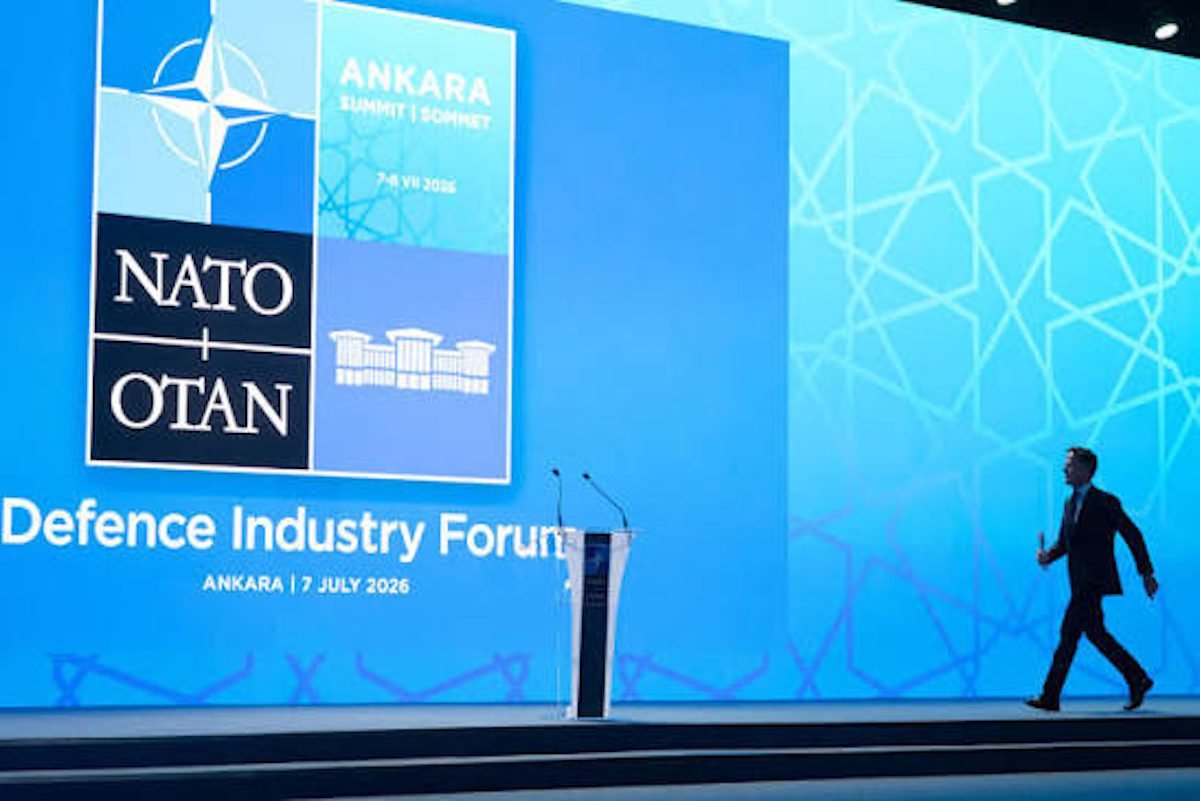
But this week’s NATO summit in Ankara showed that security imperatives trump liberal values in today’s geopolitics.
First, let’s examine the pattern of defense spending. NATO allies gathered in Ankara to announce arms deals worth tens of billions of dollars, structured almost entirely around demonstrating to the Trump administration that Europe was finally paying its share.
This was carefully calibrated to satisfy a transactional US president who has consistently subordinated values-based ideological alignment to security burden-sharing calculations.
Deals announced in Ankara — including Europe’s procurement of American AMRAAM, PAC-3 and GMLRS-variant missiles — involved almost exclusively NATO allies, consolidating a transatlantic defense industrial base that keeps procurement, co-production and R&D tightly guarded within the treaty perimeter.
President Donald Trump has long demanded quantifiable increases in US defense exports, but the overarching need is for tighter interoperability within the NATO alliance, which largely requires common systems.
Fortuitously for Trump, this convergence of industrial and operational logic keeps the benefits structurally reserved for those inside the alliance, with the US remaining indispensable — at least for now.
It is also notable that Canadian Prime Minister Mark Carney chose Germany’s TKMS Type 212CD submarine over South Korea’s Hanwha KSS-III, in a contract worth approximately $70 billion. Both platforms met Canada’s operational requirements, and both came from liberal democracies, leaving no values-based reason to prefer one over the other.
Consistent with alliance logic, Carney emphasized that the deal with Germany would “deepen our partnerships with trusted allies” and “open new opportunities for Canadian businesses in European supply chains,” explicitly tying Canada’s choice to NATO and European integration.
Selecting the German submarine over the Korean one thus integrated Canada deeper into the European defense industrial web.
In Ankara, South Korean President Lee Jae Myung proposed a “Korea-NATO Defense Industry Partnership 2.0” characterized by joint R&D, co-production and the joint operation of weapons systems, and pitched as an upgrade of the conventional buyer-seller model.
If the partnership materializes, still a big if, Korean defense firms could move beyond bilateral cooperation with individual NATO members and gain broader access to alliance-wide procurement and co-production programs.
Hanwha Ocean’s statement after losing the Canadian contract was more circumspect. The Korean company said it had “devoted every effort to winning the contract” — supported by government backing, proven submarine technology and the Korean Navy’s operational track record — but “was unable to overcome the barrier posed by NATO alliances.”
That is effectively an admission that non-NATO member status is still a structural ceiling to deeper integration with the defense alliance.
Second, let’s consider what this portends for Europe. The missile purchases from US firms signed in Ankara may look, on the surface, like transatlantic solidarity. But if the security calculus holds, they should also be regarded as a transitional phase in a longer European strategic project.
In Ankara, NATO Secretary General Mark Rutte described the alliance as entering the “early stages of a defense industrial revolution,” with a focus on three priorities: deep-strike capability, air defense modernization and autonomous systems.
These priorities are now backed by both economic heft and political will. The Netherlands alone announced more than 3 billion euros in deals, including air defense partnerships with Belgium and naval cooperation with Britain.
NATO simultaneously announced it would replace its aging US-built AWACS fleet with a Swedish alternative — Saab’s GlobalEye, in a deal worth up to $4.5 billion — backing the Swedish system over a rival solution from US defense contractor Boeing. That is another signal that European substitution of American systems is firmly underway.
In April 2026, Germany’s Rheinmetall and Dutch firm Destinus announced a joint venture — Rheinmetall Destinus Strike Systems — to produce mass-scalable cruise missiles and rocket artillery from a 100% European value chain, targeting NATO qualification so that the weapons can be procured by all member states.
The EU’s European Defence Industry Programme (EDIP) and its five proposed joint defense projects of common interest — covering drones, maritime and seabed defense, space, air and missile defense, and the Eastern Flank — carry a combined funding ambition of 190 billion euros by 2036.
In the context of future domains like AI, Brussels is already treating autonomous targeting and decision-support systems as strategic infrastructure rather than mere technology, pushing for European-developed models, trusted data pools and secure compute on the continent.
And consistent with the dual-use technology approaches of Washington and Beijing, European defense “primes” and emerging AI firms will be driven to embed AI into sensors, command-and-control and weapons guidance — and to do so on European hardware, cloud and regulatory terms.
The European Commission’s explicit goal is to redirect defense spending inward, reducing the roughly half of European procurement that currently flows outside Europe to the United States, Israel and South Korea.
So while European states currently buy American because of urgent capability gaps and superior US production lines, NATO’s European members should be expected to continue building alternatives on the continent.
That’s because autonomy is the long-term strategic goal, achievable only through the industrial strengthening of states that, per alliance logic, are overlapping members of both NATO and the EU.
Correspondingly, when Europe’s KNDS delivers the next-generation Franco-German main battle tank or when the European missile ecosystem matures, we should expect the leverage Washington currently holds over its European allies through export dependency to progressively diminish.
Finally, let’s consider the effect on the world order. The Ankara summit’s upshot spoke to a longstanding debate in international relations theory. On one hand, liberals often argue that shared values produce durable cooperation — that democracies trust each other because they are transparent, accountable and constrained by domestic politics.
On the other hand, realists argue that security interests and the distribution of power are the primary determinants of international relations.
Ankara demonstrated how NATO premised its industrial agenda on intra-alliance co-production while South Korea, despite its democratic credentials and competitive platforms, was left petitioning at the door.
The same dynamic plays out in the Pacific theater, where, in East Asia Forum’s analysis of the 2026 US National Defense Strategy, Washington plans to integrate South Korean industry into US strategic logistics — shipbuilding, MRO and munitions replenishment — through the bilateral US-Korea treaty channel.
That demonstrates how keenly Seoul’s security flows run through Washington — not Brussels — precisely because the 1953 Mutual Defense Treaty is still its operative architecture.
And so, while Korea’s aspirations to deepen its partnership with NATO are both commercial and strategic, they are also subordinate to the bilateral alliance with America that underwrites Seoul’s security.
In the wider world order, liberal democracies may still be more likely to cooperate with one another than with autocracies. Yet NATO’s Ankara summit shows that when security considerations take precedence in the current geopolitical climate, the primary unit of preference is not shared values but alliance membership.
Or, artfully, shared values are the decor, but when the building is under threat, states reinforce the structure rather than redecorate.
Marcus Loh is the chairman of the Public Affairs Group at PRCA Asia Pacific and a director at Temus, a Singapore AI and digital services firm. He is currently reading War Studies at King’s College London.