18.9 C
London
Monday, April 27, 2026
Home Blog

Meet the Mayor of a Tiny Texas Town Who Wants to Limit How Cities Can Govern

0
meet-the-mayor-of-a-tiny-texas-town-who-wants-to-limit-how-cities-can-govern
Meet the Mayor of a Tiny Texas Town Who Wants to Limit How Cities Can Govern

Reporting Highlights

  • Small-Government Advocate: Art Martinez de Vara is a South Texas lawyer and historian who has helped push a theory of limited government across the state.
  • Curtailing a Big City’s Power: He was the lawyer for a successful campaign to force Dallas to hire more police officers while also stripping the city of its immunity from lawsuits.
  • Hometown Troubles: He’s mayor of a town that embraced his small-government ideals but struggles to provide basic services and has no sewer system.

These highlights were written by the reporters and editors who worked on this story.

In February, Texas Attorney General Ken Paxton filed a lawsuit accusing Dallas officials of failing to adequately fund the city’s police department and violating a voter-approved measure requiring it to hire up to 900 new officers.

“I filed this lawsuit to ensure that the City of Dallas fully funds law enforcement, upholds public safety, and is accountable to its constituents,” Paxton said in a news release demanding that the city adhere to a 2024 change in its charter. “When voters demand more funding for law enforcement, local officials must immediately comply.”

The reason Paxton could pursue such action, the reason the Dallas city charter even requires hiring more officers, was due in large part to a man named Art Martinez de Vara. A private attorney with a law practice based in Houston and a tiny South Texas town called Von Ormy, Martinez de Vara was one of the driving forces behind the changes in the charter that opened Dallas up to such a lawsuit in the first place.

Martinez de Vara’s personal website lists him as a state historian, an anthropologist and an attorney, in that order. He’s also the mayor of Von Ormy, a community of 1,100 people. But over the past two decades, Martinez de Vara has been much more than that. He has made a name for himself in Texas conservative circles as the architect behind the formation of a handful of small towns with austere — nearly nonexistent — local governments.

His push for limited-government concepts is not out of the norm in Texas, a state that has long worn that badge with pride. But the so-called “liberty city” experiment, in which communities agree to lean governments, little to no taxation and scant regulation, never grew into a large-scale movement. So in recent years, Martinez de Vara and other limited-government advocates have taken a different tack: They’ve ramped up efforts to restrict local governments’ ability to decide how they spend their money and which policies they can adopt.

That’s what happened in Dallas.

Two years ago, Martinez de Vara joined a coalition of power players associated with a nonprofit called Dallas HERO, a group funded in part by Republican megadonor and Dallas-area hotelier Monty Bennett.

As HERO’s attorney, Martinez de Vara helped draft and lobby for ballot measures that required the city to dedicate a large share of its budget to hiring more police officers and significantly increase starting pay, even if it meant cutting other public services. Last year, the city agreed to fund hiring 350 more officers to begin meeting the new requirement, which has no timeline for compliance.

Another measure Martinez de Vara helped draft made the city more vulnerable to lawsuits from opponents of its actions, by stripping the city of its immunity from litigation.

The measures, the group argued, would make Dallas safer and ensure local officials were more accountable to their constituents. But Dallas’s elected officials, nearly all of whom were opposed to the measures, say the reality has been detrimental. They are cutting city services and staff to ensure they have the money for the new recruits, even as crime continues to drop. And they’ve already had to spend additional money to defend themselves against a lawsuit brought by a couple who argued that the city violated its own noise regulations by allowing the construction of a church basketball court near their home. (A judge dismissed the couple’s claims tied to the city charter amendment, but that ruling is now on appeal.) Paxton’s lawsuit — which Dallas maintains it still has immunity from — now puts a new microscope on the city more than a year after the propositions passed.

“The Republican officials running Texas have long sought to gain leverage over the Democrat officials running the state’s largest cities, so I am not surprised that Attorney General Paxton joined with HERO lawyers to sue Dallas,” said Cal Jillson, a political science professor at Southern Methodist University.

Dallas is not the only city dealing with the fallout from efforts pushed by Martinez de Vara.

Earlier in his career, he persuaded five small towns to incorporate. At least two of them still struggle to provide basic services.

In Von Ormy, just outside of San Antonio, the town still doesn’t have a sewer system 18 years after it was created, relying entirely on septic tanks. And about 60 miles away in the town of Kingsbury, Mayor Shirley Nolen, a supporter of Martinez de Vara, acknowledged that the low-tax, small-government model has been hard to maintain. “That’s kind of a double-edged sword,” she said. “There’s no regulation.”

During the past year, Martinez de Vara also served as the attorney for the nonprofit Texas Government Accountability Association. According to Republican former Texas Rep. Matt Krause, previously a member of the association board, the organization is funded in part by Bennett, who has used his fortune to advocate for the passage of school vouchers, end transgender care for youth and upend homeless services in big cities.

Bennett and Martinez de Vara declined to talk to WFAA for this story. When WFAA traveled to Von Ormy to ask Martinez de Vara about HERO, he declined to talk, citing pending litigation. When asked about his work in Von Ormy, he said, “I can’t because it’s all tied in.”

The accountability association’s leaders spent most of 2025 trying to entice, and sometimes force with petition drives, various cities and other government entities across Texas to enter into contracts that required them to pay membership fees to the organization and adhere to a set of prescribed accountability and transparency requirements. If they failed to do so, they risked being sued.

Odessa, a Republican stronghold in West Texas, became one of the first cities to sign on. But the city quickly sued TGAA to get out of the deal, arguing in court documents that the group sought to “illegally transfer” local rulemaking power to itself and wanted the right to veto decisions made by city leaders.

Elected officials should not give up government immunity or their ability to make their own decisions, said Bill Helfand, a municipal law expert and Houston attorney.

“I cannot imagine how any responsible government official or body would agree that they are not capable of self-governance, literally,” Helfand said. “I would vote against any person running for any elective office who agreed they need outside oversight to ensure they are doing their elected duties.”

A gravel road runs between over a dozen cars parked alongside multiple single-wide housing units, with electricity wires running from a row of telephone poles.
Art Martinez de Vara is mayor of Von Ormy, outside of San Antonio. It’s one of the small Texas towns he helped turn into so-called liberty cities. Christopher Lee for ProPublica and The Texas Tribune

The Rise of the “Liberty City”

Over the course of a career that began nearly two decades ago, Martinez de Vara has worked for two state lawmakers and served as assistant general counsel for the Republican Party of Texas. He also has at least 15 years of experience in local government, including terms as either mayor or city attorney in several small towns near San Antonio.

That journey started in 2006, when Martinez de Vara was still a law school student at St. Mary’s University and he began a campaign to incorporate Von Ormy, a 2-square-mile community just southwest of San Antonio on Interstate Highway 35. By forming their own local government, Von Ormy citizens would have the legal authority to make their own laws.

Martinez de Vara worked with residents who feared annexation from sprawling San Antonio, framing the effort as an example of how Texans could resist what he saw as creeping municipal overreach. Von Ormy, he said, would form a government that would work toward eliminating property taxes while still providing basic services to its residents, and would offer free business permitting and few regulations.

“We were fighting not only for sewer, potholes and police protection but for self-determination and empowerment of our community,” Martinez de Vara wrote in a firsthand account of the incorporation campaign. In May 2008, Von Ormy residents said yes to becoming their own city in a vote of 117 to 16.

Martinez de Vara, who did not grow up in Von Ormy but whose family has lived there for generations, became its first mayor. The town’s incorporation and his election garnered statewide attention for the model of government he proposed, one he said made Von Ormy the “freest little city in Texas,” according to a 2017 story in the Texas Observer. He later called the community “a unique opportunity to experiment with democracy,” describing it as the kind of place where people can freely set off fireworks and smoke cigars wherever they want.

But cracks quickly began to form. Martinez de Vara had pushed incorporation partly to help fund construction of a sewer system for the community, whose residents relied on septic tanks. But the sewer service was going to cost millions of dollars and would require the city to borrow money. Martinez de Vara opposed taking on any extra debt.

Tensions escalated over Martinez de Vara’s plan to eliminate property taxes, according to interviews, City Council minutes and previous news accounts. Some City Council members began to question whether the zero property tax approach was sustainable, possibly creating an overreliance on sales taxes.

Martinez de Vara eventually succeeded in eliminating the city’s property taxes. But the move threw the City Council into disarray and eventually led to misdemeanor charges against council members who were charged with violating the Texas Open Meetings Act in an attempt to override his action. Those charges were later dropped, and Martinez de Vara eventually decided not to seek a subsequent term as mayor amid the turmoil. Council members reinstated the property tax in his absence.

The challenges, however, were not a deterrent for his vision of expanding the liberty cities model. Over the years, he helped various communities in some capacity to incorporate and eventually started working to enshrine the liberty cities model into law.

Doing so, Martinez de Vara told attendees at a January 2015 forum sponsored by the influential conservative Texas Public Policy Foundation, would prevent future elected leaders from abandoning the model by, for instance, raising taxes. The group supported such legislation in a policy brief calling the liberty city model a “new concept for self-governance.”

Martinez de Vara by then had become chief of staff for state Sen. Konni Burton, a Republican who represented portions of North Texas west of Dallas and was a leader in one of the founding tea party chapters. In February 2015, Burton filed a bill that would bar leaders of liberty cities from adopting a property tax without approval from at least 60% of voters, mandate voter approval before taking on public debt and allow a citizen’s bill of rights “expressly limiting” city authority. The bill did not pass. Burton, who left office in 2019, declined to speak to WFAA for this story.

The idea behind the liberty city movement in Texas, especially for small rural cities, was to promote incorporation for basic public services at low cost. But in practice, the model has not proven successful, said Jillson, the SMU political science professor.

“A few towns, like Von Ormy, tried it, but the results were disappointing,” Jillson said. “Turns out meaningful public services do cost money, so mayors and city councils were left fighting over tax cuts and poor services until everyone simply threw up their hands.”

More than a decade after its formation in 2015, the town of Kingsbury, which Martinez de Vara helped to incorporate, has only one paid employee. Everything else is handled by volunteers. “We don’t have water or sewer. We don’t have trash pickup,” said Nolen, the town’s longtime mayor. “It’s all very self-reliant farmers and ranchers out here. We don’t want any property tax.”

The liberty cities model of fewer regulations, however, has also brought with it the challenge of dealing with a landfill that moved in just outside the tiny city’s boundaries. Some balked when Nolen began talking about passing zoning rules, she said.

“People are like, ‘Well, I don’t want anybody telling me what to do on my own property,’ and I’m like, ‘I don’t either.’ However, I don’t want Joe Bob’s unlined-hole-in-the-ground battery disposal coming in next to my house,” she said.

Sixty miles away in Von Ormy, two truck stops make up a significant part of the city’s revenue. Residents and businesses still rely on septic tanks, and locals say larger businesses have been hesitant to relocate there because of the lack of sewer service.

“I’m sure you’ve driven around,” said Alex Quintanilla, a former city commissioner. “There’s nothing around here. What is there?”

A small green sign on a post stating, “Von Ormy city limit” and “ pop 1,300,” alongside the silver backs of two other signs, on an empty country road lined with low trees and shrubs.
The small town of Von Ormy lacks basic public services like sewer systems, which makes recruiting new investment for the community difficult. Christopher Lee for ProPublica and The Texas Tribune

A New Tactic, an Uncertain Future

Martinez de Vara’s vision for a liberty city, and whether he can carry it out, will be tested once again. Von Ormy reelected him as mayor last year, a few months after the passage of the Dallas HERO initiatives.

Even as he returned to the leadership role of the town, Martinez de Vara and his allies, through the Texas Government Accountability Association, continued efforts to dictate how other cities make budget and policy decisions.

The TGAA branded itself as an initiative focused on helping local governments embrace stronger ethics and transparency. But officials in cities that encountered the new organization questioned that goal. Some argued the organization’s real aim was to find a way to control cities, similar to what happened with Dallas HERO in 2024.

The connections between Dallas HERO and TGAA go beyond kindred philosophies and the legal services of Martinez, who also served as TGAA’s lawyer. The man who handles finances for TGAA is the chief accounting officer for a hotel company founded by Bennett, the business owner who provided financial support for the Dallas HERO propositions. Dallas HERO and TGAA share a mailing address, according to the organizations’ 990 tax forms from 2024. The same mailing address is also listed on the 2024 IRS filing for Dallas Express Media, the parent company for the conservative online site Dallas Express, of which Bennett is publisher. The website posted several pieces championing Dallas HERO and lambasting city leaders who opposed it. Similarly, the site criticized city council members of one community for declining to join TGAA.

Krause, the former state representative and former TGAA board member, said he has known Bennett and Martinez de Vara for years through his work in conservative politics. As with HERO, he said, Bennett financially supports the accountability association.

“When I knew I was going to be working with Art again on TGAA, I was really excited,” Krause said. “He’s just a brilliant guy. It doesn’t surprise me that that’s somebody that Monty would have trusted and respected to be kind of the final voice on these kinds of things.”

TGAA’s model has been to hold cities to frequent audits and, in general, bind future councils to an externally written rulebook that limits local officials’ discretion, critics say. If a member entity is accused of violating the agreement, the TGAA agreement requires it to waive governmental immunity from citizen lawsuits.

TGAA tapped at least two of the cities Martinez de Vara had helped incorporate to sign on, including Kingsbury, where he is still city attorney. The town was the first to join.

The group also approached Providence Village, a planned community in North Texas that Martinez de Vara had helped to incorporate more than a decade earlier. Leaders of the town declined. Representatives from TGAA started a door-to-door campaign in the small city. They sought to gather signatures to “force the town to hold and pay for, at taxpayers’ expense, an election to add a provision to our town charter requiring TGAA membership,” Mayor Linda Inman posted on Facebook last June.

Inman, who did not respond to repeated requests for comment, wrote on Facebook that TGAA was using a recruitment strategy “that relies on buzzwords and scare tactics to mislead voters into signing their tax dollars away to a nonpublic, third-party entity with no interest in the towns and cities they’re targeting.”

In the end, only Kingsbury and Odessa, a city of 124,000 people, joined the organization. Von Ormy officials considered joining but took no action.

Odessa signed on at the behest of its conservative city manager, John Beckmeyer, former head of the state GOP. Beckmeyer did not return messages seeking comment for this story.

After new City Council members were elected in Odessa in November 2024, the city sued to get out of the deal. The terms of the contract were steep: After a grace period, Odessa would have to pay roughly $24,000 annually to maintain its membership, an amount that could increase and had no cap. The contract had no end date. And the only way the city could get out of the agreement was to hold a citywide election.

Layne Rouse, an attorney representing Odessa in the case, said the TGAA is an example of “dark money controlling politics through a backdoor contract” because its donors aren’t public.

In December, a judge declared Odessa’s TGAA contract “void and unenforceable.” The association appealed the ruling but, on Feb. 12, withdrew the appeal without explanation.

TGAA officials did not respond to questions about the lawsuit or its efforts to recruit cities.

Now TGAA’s future, and Martinez de Vara’s role with the group, appear up in the air. Besides withdrawing its appeal of the Odessa lawsuit, the group hasn’t had any meetings since December. Recent efforts to contact TGAA employees and board members have resulted in emails bouncing back.

But Martinez de Vara remains busy. When Paxton, the state attorney general, filed the lawsuit in February suing Dallas, a P.O. Box associated with Martinez de Vara’s law office in Von Ormy was listed on the petition. He represents two Dallas residents in the lawsuit who say they’ve been harmed by the city’s failure to grow its police force.

He told The Dallas Morning News that Dallas HERO had “no formal role in the litigation” but confirmed that he remains its attorney.

“I coordinated with the attorney general’s office. They were in need of someone to represent the private plaintiffs and I agreed to do so,” Martinez de Vara said. “I was a logical person to reach out to.”

Trump’s ‘madness’ masks calculated quest for a bipolar world

0
trump’s-‘madness’-masks-calculated-quest-for-a-bipolar-world
Trump’s ‘madness’ masks calculated quest for a bipolar world

Since Donald Trump returned to the White House on January 20, 2025, his foreign policy has often appeared chaotic and mercurial.

He has repeatedly insulted longstanding US allies, threatened them with tariffs and pursued aggressive military actions abroad. He has left the European Union, the United Kingdom, Japan, South Korea, India and traditional partners and allies reeling.

Actions such as the US intervention in Venezuela in January 2026 that resulted in the capture of Nicolas Maduro, and the February 2026 US-Israeli strikes on Iran that killed Supreme Leader Ayatollah Ali Khamenei, have fueled accusations of presidential recklessness. Many analysts have dismissed these moves as signs of “Trump’s madness.”

Yet beneath the surface bluster lies a more deliberate, if high-risk, strategy: Trump aimed to shape a bipolar world order with the US and China as the main poles. His erratic style —insults, tariff threats and sudden displays of military force — reshapes alliances, contains China and affects global stability.

At the heart of Trump’s vision is a hardheaded recognition of today’s geopolitical reality. The US can no longer easily confront China through outright military conflict or total economic decoupling.

China’s economic might, technological advancements in areas like artificial intelligence, quantum computing, the green energy transition and its growing military capabilities in space, air, naval and land make direct containment extraordinarily difficult — far harder than isolating the Soviet Union during the Cold War, because China combines the USSR’s military might with the Japanese manufacturing of the 1980s.

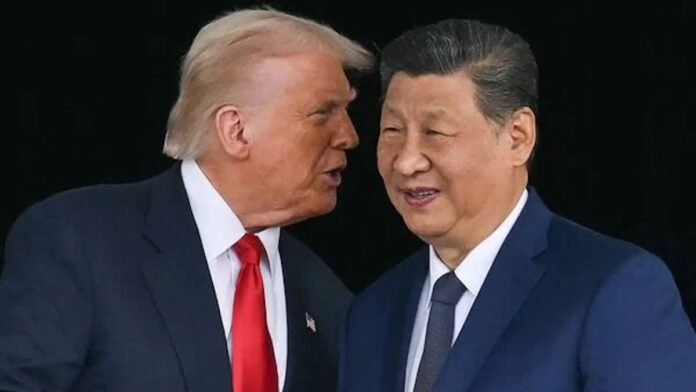
This underscores the complexity and resilience of China’s global strategy. Trump’s meeting with Chinese President Xi Jinping on the sidelines of the Asia-Pacific Economic Cooperation summit in Busan, South Korea, in October 2025 illustrated this calculus.

Trump described the encounter as an “amazing” G2 moment, signaling a willingness to acknowledge a duopoly of superpowers for the time being. Yet this co-leadership for the US is tactical and temporary.

The deeper aim is to revive a bipolar structure in which the US and China set the global agenda. At the same time, other nations align behind one or the other — ultimately positioning America to undermine China when the moment is ripe, much as the West helped to accelerate the Soviet Union’s collapse in the 1980s.

The strategy stems from a profound American anxiety: the fear of losing unipolar dominance in a rapidly shifting multipolar world. Trump understands that a direct showdown with Beijing risks mutual ruin: if the US even scratches China, the US will feel economic pain.

Instead, he seeks to provoke China just enough to deter challenges to the US dollar’s hegemony while pressuring allies to limit their economic engagement with Beijing. The message to partners is clear: reduce reliance on China and prioritize ties with the US, or face economic consequences. This plays out in two interconnected fronts.

First, Trump has wielded tariffs as a blunt instrument of coercion against allies. The EU, UK, Japan, South Korea and India have all faced threats or impositions of higher duties on key exports such as automobiles, steel, and technology goods.

These are not mere trade spats; they are diplomatic levers designed to force caution in dealings with China. By squeezing allies economically, Trump hopes to redirect trade and investment flows toward the US and secure their support for maintaining dollar supremacy—a system he and many American strategists view as existential. Once lost, dollar dominance would be nearly impossible to reclaim.

Second, these pressures aim to encircle and isolate China over time. Trump’s public humiliations — such as the tense White House meeting with Ukrainian President Volodymyr Zelensky or the August 2025 summit with Russian President Vladimir Putin in Alaska that appeared to sideline European concerns — send a broader signal.

In Trump’s framing, the world revolves around two superpowers. Smaller powers should choose sides or accept a subordinate role rather than pursue an independent multipolar world order.

Actions in Venezuela and Iran fit into this timeline as demonstrations of resolve and attempts to gain leverage. The January 2026 operation in Venezuela that captured Maduro showcased the US’s willingness to act decisively in its backyard, removing an oil-rich regime long aligned with China and Russia.

The February 2026 strikes on Iran, which escalated into a broader conflict involving regime-change elements, were reportedly intended to be quick and to strengthen Trump’s hand ahead of a planned March 31-April 2 visit to China. Iran’s resilient response delayed that trip until May 14-15, leaving Trump to negotiate from a weaker “position of strength.”

Still, these moves reinforce the image of unpredictability that Trump cultivates as a strategic asset. Internally, the plan involves bolstering American economic and military strength while granting China limited co-leadership in multilateral forums — only to chip away at Beijing’s influence through backchannel diplomacy, alliance realignment and selective decoupling.

The ultimate objective is to sideline China as a true peer competitor, preserving US primacy within a bipolar framework that has historically favored America. Yet this gambit is fraught with challenges and contradictions. China has repeatedly rejected a strict G2 condominium, instead championing multilateralism and an “equal and orderly multipolar world.”

Beijing is actively cultivating ties across the Global South and beyond through the Belt and Road Initiative, the Asian Infrastructure Investment Bank, BRICS expansion and the Shanghai Cooperation Organization. Exploring how China’s counter-strategies could undermine or adapt to Trump’s bipolar vision can deepen understanding of the strategic contest.

Allies, meanwhile, are not passive pawns. India, though, maintains Quad cooperation to balance China while expanding bilateral trade with Beijing. The EU is deepening strategic autonomy and exploring independent policies. Japan and South Korea prioritize economic pragmatism alongside security alliances.

Public humiliation and tariff threats risk alienating partners rather than consolidating them, potentially accelerating the very multipolarity Trump fears. Exploring these dynamics can help the audience see how US alliances might evolve and influence the strategic landscape.

Moreover, Trump’s approach buys time against China’s rapid technological ascent, but time is a double-edged sword. If China successfully builds resilient supply chains, alternative financial mechanisms and a network of partners resistant to US pressure, the bipolar vision collapses.

In a true multipolar order, the US would face simultaneous competition on multiple fronts, straining its military resources and diminishing the dollar’s gravitational pull. Rising defense budgets could yield diminishing returns in terms of geopolitical gains.

Trump’s behavior may look unhinged to critics — insulting allies one day, striking adversaries the next — but it reflects a calculated, if improvisational, effort to freeze the global order in a favorable configuration.

History, however, cautions against overconfidence in such double games. Alliances are shifting as nations pursue their own interests. The public in many countries increasingly favors inclusive multilateralism, sovereign equality and rules-based cooperation over raw power politics.

Whether Trump’s strategy ultimately succeeds remains uncertain. A restored Cold War-style bipolarity could entrench confrontation and instability for decades. Conversely, if China and other rising powers consolidate a more distributed global order, American dominance will erode further — not through dramatic collapse, but through gradual diffusion of influence.

This contest transcends a simple US-China rivalry. It is a struggle over the architecture of the international system itself. World opinion largely favors fairness, cooperation and shared prosperity over perpetual dominance by any single power or duo.

Trump’s tariffs and provocations may weaken alliances and undermine his own leverage in the long run. The coming months and years — marked by the rescheduled May 14-15 Trump-Xi summit and ongoing global realignments — will reveal whether this high-stakes gamble can reshape the world, or whether the forces of multipolarity prove too strong to contain.

Follow Bhim Bhurtel on X at @BhimBhurtel and subscribe to his Substack here.

Hormuz Is the War’s Invoice—and Washington Can’t Pay It

0
hormuz-is-the-war’s-invoice—and-washington-can’t-pay-it
Hormuz Is the War’s Invoice—and Washington Can’t Pay It

 What Washington Missed?

Closing the Strait of Hormuz is not a side detail. It is the main pressure point. Every day the strait stays shut adds a new layer of cost to the global economy; and the shock travels back to the United States fast. This is not only about the price of oil. It is about a supply-chain squeeze: shipping insurance, freight costs, industrial inputs, petrochemicals, raw materials. Then inflation that lands on American consumers like a delayed war tax.

Washington’s mistake was deeper than one bad assumption. It believed military force alone can break political will, that markets will “adjust” on their own, and that a crisis can be managed through statements and threats the way you manage an election campaign.

But the economy does not negotiate with speeches. It reads facts: the passage is closed, risks are up, and costs are piling up.

Hormuz as a Weapon: “Economic Nuclear” without the fallout

The clearest lesson from this round is that Hormuz has become a new kind of deterrent: an economic weapon that can rival traditional military tools without radioactive fallout and without clear global red lines. Closing it does not kill directly, but it can choke slowly: energy prices, shipping, factories, then public anger and electoral punishment.

Iran’s advantage is structural. It does not need a classic battlefield victory to force a political outcome. It only needs to keep economic pressure alive until Washington goes looking for a deal. That is exactly what we are seeing.

Why Trump now looks like he is begging for a deal?

When the effects start reaching the U.S. economy (i.e. imported inflation from Asia, stress on supply chains, fear of shortages or price spikes in key industrial materials) the White House shifts from the language of “deterrence” to the language of “exit”. That is why channels suddenly reopen, mediators multiply, and Trump pushes for a fast deal.

The problem is that Trump wants a deal as a “moment”: a quick announcement, a press conference, a victory headline. Then details can be postponed. Iran, especially now, is not playing the headline game. It is playing the time game: each day raises the price of American retreat and strengthens Tehran’s leverage.

William Burns offers a rescue map—will Trump listen?

Inside the U.S. establishment, there is a realistic argument for how to get out. William Burns—former CIA director and a veteran of the Iran file—signals one basic rule: stop digging the hole deeper.

His core point is simple: serious negotiations require professionals, patience, and a return to the logic of the Obama-era nuclear framework, not fantasies of Iranian “capitulation”.

Diplomacy with Iran is not diktat. It is trade-offs: limits or a freeze on enrichment under strict verification, in exchange for meaningful sanctions relief. This is not generosity toward Tehran. It is the only formula that can produce a durable agreement.

On Hormuz, Burns’ implied approach is also clear: treat it as more than a bilateral US–Iran issue. Bring in the Gulf states that share the waterway. The goal is not to hand Iran a “toll booth” on world trade. The goal is a regional arrangement that reduces the chance of a repeat closure: maritime security, transit understandings, and potentially an internationally supervised mechanism—framed as a public good (clearing mines, stabilizing shipping) rather than as a reward.

Why is Iran hardening its position?

Because Tehran sees the full picture: a struggling US administration, nervous markets, and uneasy allies. And inside Iran, the hardline logic gains ground: this is not a moment for a cheap compromise. It is a moment to raise demands. Their argument is blunt: if the strait reopens without a serious political and economic price, Washington will try the same approach again later. So, they want a lesson that makes the next adventure too costly.

But hardening has limits.

Real negotiations do not give any side “everything”. Every player has ceilings and vulnerabilities. Iran has a powerful card; but turning pressure into lasting gains requires discipline, not triumphalism.

Washington’s Real Danger is Domestic

If the closure drags on, the crisis will not stay “over there”. It will become a US domestic issue: inflation, pressure on industry, supply disruptions, and political rivals weaponizing the failure. That is why Trump demands an immediate deal and why he is searching for any channel that can deliver an off-ramp before the bill grows larger.

Worse, time reduces American freedom of action. Any later agreement will look like a concession made under pressure. Delay does not strengthen Washington. It weakens its credibility, emboldens rivals, and alarms allies.

What does this mean for the region?

It means the rules are changing. Deterrence is no longer only about missiles and aircraft. It is also about chokepoints and supply chains. A region once managed through American military presence is being reshaped by the ability to disrupt global trade. That will alter Gulf calculations, Europe’s energy debate, and Asia’s view of reliance on a single vulnerable corridor.

Therefore, Trump wants a quick exit because time is working against him. Iran is tightening because time is working for it. But strategy is not a nerve game alone. It is the management of costs, gains, and limits.

Hormuz today is not just a passage. It is an economic leverage point that can decide political outcomes. Those in Washington who still treat it as a footnote will pay the price—first in markets, then at the ballot box.

The views expressed in this article belong to the author and do not necessarily reflect the editorial policy of Middle East Monitor.

Meet the players who lost big money on Peter Molyneux’s failed Legacy

0
meet-the-players-who-lost-big-money-on-peter-molyneux’s-failed-legacy
Meet the players who lost big money on Peter Molyneux’s failed Legacy

This week, players are being asked to pay $25 for early access to Masters of Albion, a god game throwback that legendary designer Peter Molyneux (Populous, Dungeon Keeper, Black and White) says will be the last game he ever works on. But the players who poured roughly $54 million in cryptocurrency into Molyneux’s previous game, Legacy, say they’re still bitter about getting swept up in Molyneux’s broken promises of a best-in-class economic simulation and the opportunity for “play to earn” riches.

Legacy players who spoke to Ars Technica described pre-purchasing thousands of dollars’ worth of NFTs, in some cases, to buy into the crypto-fueled vision offered by Molyneux, his development studio 22cans, and publisher Gala Games. Those players said the Legacy they got was a pale shadow of what was promised, with a broken-by-design economic system that caused players to abandon the game en masse within a couple of weeks of its 2023 launch.

Despite the game’s almost total failure as a going concern, though, Legacy rode the crest of the crypto hype wave to pre-sold economic success that Molyneux said “[gave] us the money to fund Masters of Albion,” in a 2024 interview. “That’s what we used the majority of the money for…”

Legacy was paid for upfront, man,” former Gala Games Chief Marketing Officer and President of Blockchain Jason “Bitbender” Brink told Ars. “Gala paid a minimum guarantee to… [Molyneux] and his team. The NFT sales for Legacy go toward that minimum guarantee.”

Legacy, like other Gala Games products, ended up being “a lot of hype, promises, and implied functionality that never occurs,” said Old Man Smithers, a Gala Games researcher who has documented the company’s early history for their YouTube channel. “Instead, you get a minimum viable product, and then it’s forgotten about while the next project is hyped.”

In exchange for their crypto millions, players who bought into Legacy got “a proto-idle-tapper… with a bigger screen,” Brink added. “People are angry, pissed, and disillusioned, and I don’t blame them.”

Town Stars in their eyes

To understand why players put millions of crypto dollars into Legacy long before it was released, you need to understand a bit about Gala Games, the crypto-focused gaming company and Legacy publisher that was founded in 2019. From the start, the new outfit attracted some strong initial interest in the then-trendy blockchain gaming space (aka “web3 gaming”) thanks to the involvement of Zynga veteran Eric Schiermeyer and crypto evangelist Wright Thurston.

Town Star? More like Farm Star, am I right?

Town Star? More like Farm Star, am I right? Credit: Gala Games

In September 2020, Gala Games debuted its own crypto token, GALA. Instead of selling GALA directly through a relatively standard Initial Coin Offering, Gala Games sold 50,000 “founder nodes” to early adopters who would share in a collective daily distribution of 8.5 million GALA to start. Another 8.5 million in daily GALA went to a “Gala Games Conservatorship,” a relatively opaque group that served as the company treasury to fund future development projects.

Those daily GALA drops were practically worthless until August 2021, when GALA’s listing on the Binance Smart Chain simplified trading and added important liquidity to the market for the cryptocoin. But the real market frenzy around GALA started that October, when Gala Games finally turned on play-to-earn features in its simple farming resource simulation Town Star.

Town Star players could purchase from a limited supply of NFT farming units to help supercharge the lucrative in-game production of the game’s bespoke TOWN crypto token, with rarer, pricier NFT units being more productive. The game also provided players with a “Gala Power” bonus based on how much GALA they had in their wallet, helping drive interest in a token that had been nearly worthless up to that point.

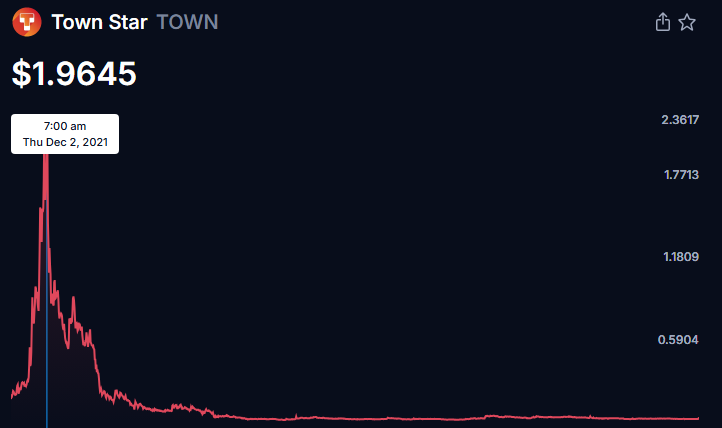
Quickly, crypto “degens” and curious, FOMO-driven, pandemic-trapped lookie-loos started flooding into Town Star on the promise of play-to-earn riches. As they did, the price of the TOWN token shot up from about 21 cents at the end of October to a peak of nearly $2 at the beginning of December. The GALA token price also shot up from about 2 cents in September to around 9 or 10 cents in October, then to a brief record of 65 cents on December 1. The price of Gala Games’ founder’s nodes saw similar price increases from a few thousand dollars to nearly $100,000, both on secondary markets and for the dwindling supply sold directly by Gala Games itself.

The peak of speculative Town Star earnings came just before the announcement and initial NFT land sale for Legacy.

The peak of speculative Town Star earnings came just before the announcement and initial NFT land sale for Legacy. Credit: Crypto.com

For those who got in early, the brief Town Star frenzy was a massive and somewhat shocking windfall. One early GALA user who asked to remain anonymous (and who we’ll refer to as Phil) said his purchase of six founder’s nodes for an average of $1,400 each was “not that big of a deal” when GALA was at a sub-penny price. But “when the bull run happened, all of a sudden those nodes are printing some serious money.”

Phil said he reinvested some of those sudden GALA earnings back into Town Star NFTs and was able to make $100,000 worth of crypto in December 2021 on about “ten minutes of play a day… I’m not even any good at Town Star, I just had a couple dozen Cranebots and other assorted high-value NFTs.”

“I knew in my heart that it couldn’t logically continue this way,” Phil continued. “I didn’t quit my job—but while it was happening, it was a very powerful drug.”

If you’re winning, someone is losing

The reason Town Star’s amazing bull run couldn’t ”logically continue”—and the reason most play-to-earn games quickly fail—is a simple matter of monetary inflows and outflows. In the early days, as new speculative players flood into a hot game, their fresh, incoming initial investments drive up the price of the associated crypto tokens, helping to fuel the profits of the speculative players that came in before them.

When the wave of new speculative players slows or stops, though, keeping those crypto prices high requires a core group of non-speculative players willing to buy the token just to play the game, without any expectations of cashing out. These kinds of “pay to play” players are how a game like EVE Online has maintained a robust, long-lasting in-game economy, even without using cryptocurrency.

Town Star’s extremely basic farming simulation didn’t keep non-speculative players playing or paying for long, though, and the flood of new money coming into the system quickly slowed to a trickle. When that happened, Gala started rebalancing the in-game economy and shrinking TOWN distributions, reducing profits for existing players and hastening an economic death spiral. By May 2022, both TOWN and the GALA token were down 90-plus percent from their late 2021 peaks.

“The reality is… what you really need in order for this really to work is a great game that people want to play and get nothing out,” Brink said. “And that’s the problem… By and large, web3 games are predicated on getting something out.”

Former Gala Games executive Jason “Bitbender” Brink says the economic systems for games like Legacy were destined to fail.

Former Gala Games executive Jason “Bitbender” Brink says the economic systems for games like Legacy were destined to fail. Credit: TED x St George

While Town Star’s pay-to-earn model couldn’t work in the long term, the late 2021 moment when early players were making serious crypto profits helped burnish Gala Games’ image among web3 gaming advocates. “The way that Gala hooked everyone was that incredible period of time where everyone was earning a ridiculous amount of money for simply playing Town Star,” Phil said. “Seeing what could happen with play-to-earn brought a lot of FOMO and greed into the system.”

One Gala player going by the handle Titan told Ars that the significant earnings players briefly saw in Town Star “baited the hook for all future NFT sales” in other Gala Games, like Legacy. “People had that expectation stuck in their head.”

Molyneux was one of those people who got high play-to-earn expectations embedded in their heads. “I’ve worked on so many designs and I’ve worked on so many games, but to think that someone could be playing my game and earning money, what an incredible honor that would be to have,” Molyneux said in a late-2021 interview with The Verge. “But we’re going to have to be super careful.”

Trust me, I made Populous

Legacy didn’t start as a blockchain game. Molyneux originally announced the title in 2019 as a “reworking of the very first game I did… a game where you ran a little business.” The concept was sold as a standard single-player narrative simulation, charting the player’s journey from “shed tinkerer to industrial despot” with all the “moral conundrums” that entailed.

Legacy’s shift to Gala Games’ crypto platform came later, after what Molyneux said in a 2021 press release was “an out-of-the-blue call with old friend Mike McCarthy, who was working at Gala.” That phone call led to what Molyneux said was “a lightbulb moment.”

“We came to realize I had developed a game perfect for crypto gaming. Every mechanic in Legacy was tailor-made for the blockchain environment,” he said.

Molyneux laid out his grand vision for the new crypto-fueled version of Legacy in an on-stage presentation in front of hundreds at the first Galaverse conference, held in Las Vegas in December 2021 amid the brief peak of the Town Star-driven GALA bubble. The core idea of building a small town into an industrial metropolis was still there in Moylneux’s new vision, but it was now infused with frequent multiplayer contests where players would compete to earn valuable “LegacyCoin” crypto token by designing and producing the most appealing items from raw in-game resources.

Molyneux (left) waxes philosophical about “play to earn” games alongside Gala Games’ Michael McCarthy at 2021’s Galaverse expo.

Molyneux (left) waxes philosophical about “play to earn” games alongside Gala Games’ Michael McCarthy at 2021’s Galaverse expo. Credit: Gala Games / Youtube

Molyneux made a lot of his now-famous grandiose promises about the design of Legacy, of course, calling it “a vast and epic game” where you could design “any conceivable product… anything you can think of” to build your business around. In a contemporary interview with The Verge, he promised “the most advanced simulation that I have ever been involved with,” complete with “moral choices and [a] narrative storyline [that] really picks at those moral choices.” At Galaverse, he added, “I’ve been involved in simulations for decades now, and this is everything we know about those simulations.”

In addition to Molyneux’s usual game design bluster, though, was a newfound enthusiasm for the idea of making money from simply playing a game. “And because it’s a blockchain game, you earn,” Molyneux said at Galaverse, leaning on the last word for emphasis. “For a game designer, imagine how exciting it is to know that a game design that you’ve been working on, people will be earning money with it!”

“I want to focus and make Legacy the defining game of blockchain gaming—because that’s the sort of ridiculously optimistic person that I am—and a defining game of any of the games that I’ve created before,” he said in a separate livestreamed Galaverse interview. “It feels like the start of something interesting… I just get super excited in places like this, and I think what Gala is doing is incredible.”

A financial success before it’s even done

Molyneux’s enthusiasm around the Legacy announcement in December 2021 was well-timed with the height of the speculative crypto bubble surrounding Town Star. Amid that frenzy, Gala Games sold the initial allotment of 4,661 NFT plots of Legacy land within days of first putting them up for public sale. Players who bought those NFTs were promised the opportunity to earn crypto in the eventual release, either by using those leases to play directly or by loaning out their land to “free” players in exchange for a share of their in-game earnings.

The list price of the crypto used to purchase those plots was roughly $54 million at the time, but that figure includes some cheaper plots that were given to Galaverse attendees to help prime the market. Not all of the Legacy NFT money was new to the GALA ecosystem, either; many purchasers were just using crypto profits they had already made from founder’s nodes, Town Star play, or the recent sudden appreciation of GALA itself.

The store page for the unique “Heart of London” Legacy NFT, which sold for about $900,000 in cryptocurrency in 2021.

The store page for the unique “Heart of London” Legacy NFT, which sold for about $900,000 in cryptocurrency in 2021. Credit: 22 Cans / Gala Games

“It was a peak bull market, people were buying all sorts of crazy things,” Brink said. People with Gala founder’s nodes found themselves with “a significant stream of income that you would then turn around, and it’s almost like it’s free money, go buy game stuff with it,” he added.

“What got me interested in Legacy was the fact I made a lot of GALA in the early days and I was simply buying NFTs in anything Gala was going to launch… but not so many as to bankrupt myself,” a player going by the handle Mouldy told Ars.

Regardless of the source, all that crypto spending represented real value flowing back into the coffers of Gala Games, justifying the minimum guarantee that Brink says Gala paid to Legacy developer 22cans. That made Legacy a business success well before its actual launch and ensured that any subsequent long-term player interest would be at least somewhat financially irrelevant to the companies involved. Players sunk significant crypto money into a just-announced title based on their faith in Molyneux’s game design prowess and, crucially, the expectation that they’d eventually be able to earn that money back—and more—when the game launched.

“They are trying to raise money to fund the project and then build it after,” one anonymous Legacy player (we’ll call him Victor), told Ars. “Basically, we are seed investors.”

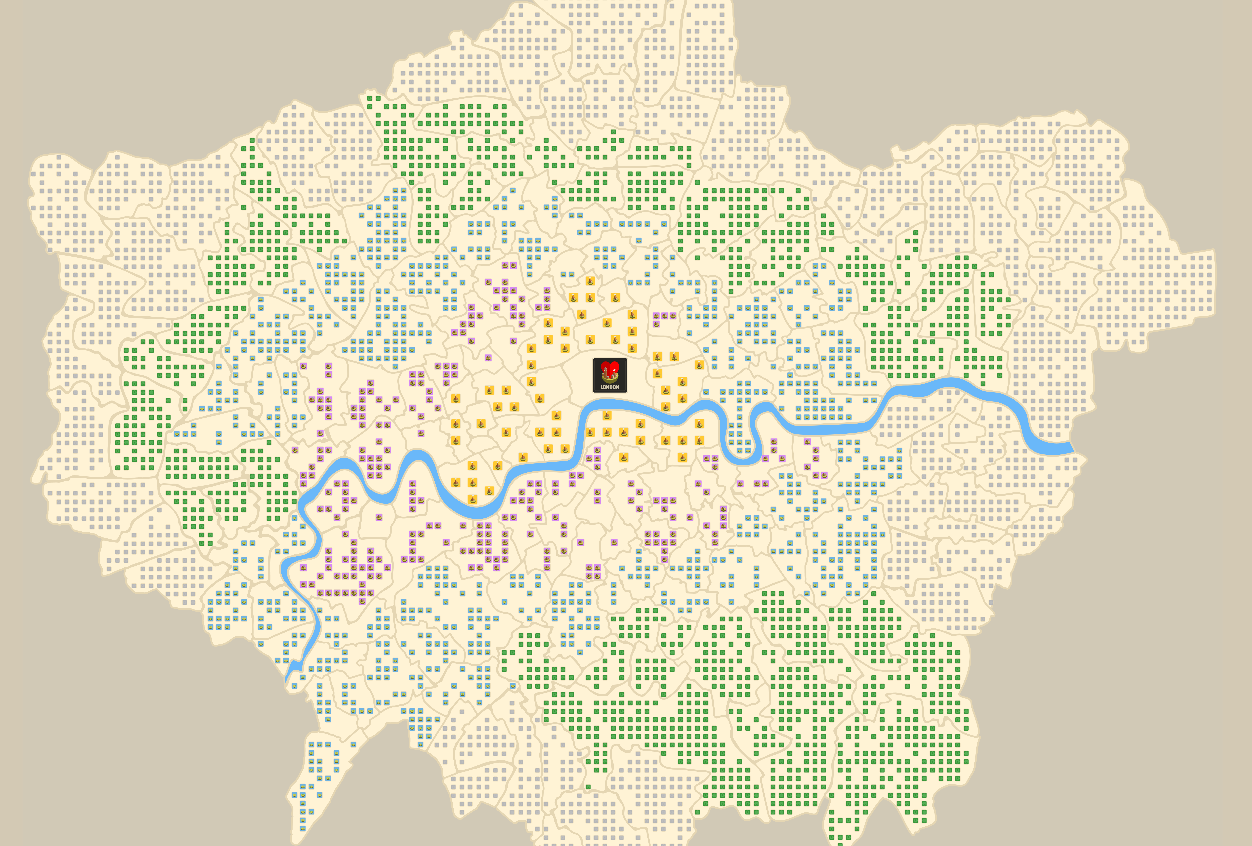
A map of the more than 4,000 Legacy land plot NFTs sold. Rarer lots closer to the “Heart of London” offered certain gameplay benefits and commanded higher prices.

A map of the more than 4,000 Legacy land plot NFTs sold. Rarer lots closer to the “Heart of London” offered certain gameplay benefits and commanded higher prices. Credit: 22 Cans / Gala Games

It’s a system that seems well-designed for Molyneux’s style of enthusiastic early hype. “[Molyneux] is a remarkably charming person,” Brink said. “He’s very easy to talk to, he has interesting ideas, he’s very affable… He didn’t come across as some scheming shyster or anything like that. He just was a guy who was very passionate about his games and was super fun to talk to.”

But pre-selling a game so heavily based on these kinds of promises can also lead to a sense of inflated expectations that are impossible to meet. “The game developers would be like, ‘Oh yeah, this is a great idea, I’d love to do this,’” Brink said of Gala Games marketing in general. “And the problem is that, when you say ‘I’d love to do this,’ the community takes that as ‘I’m 100% going to do this for sure, on my mother’s grave,’ which is not necessarily the case.”

Dead in weeks

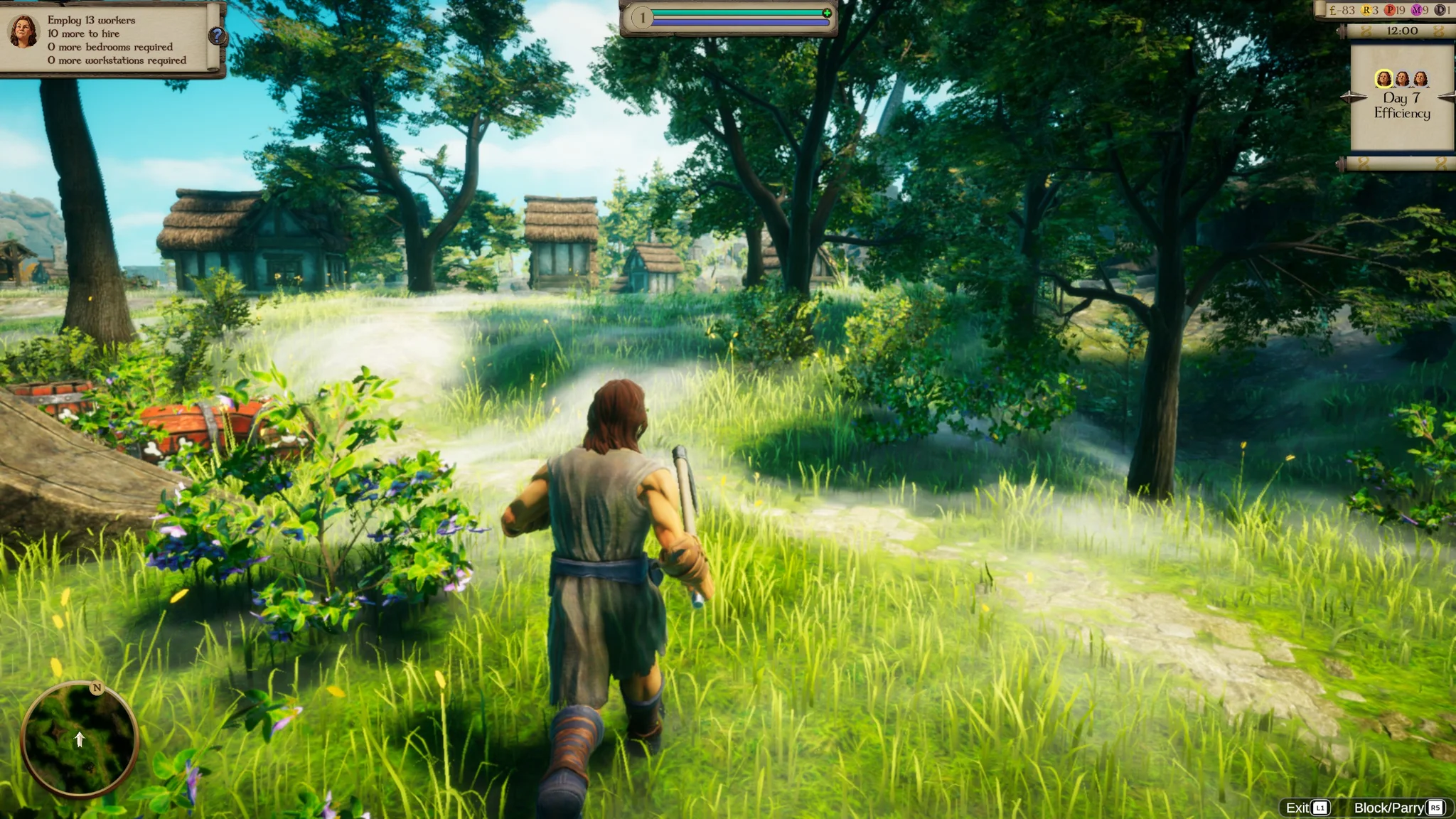
By the time Legacy finally launched in October 2023, it was a far cry from the ambitious game Molyneux had talked up nearly two years before. The core gameplay loop involved a lot of artificial timers and seemingly endless, repetitive clicking to convert crops into ingredients and then move those ingredients into factories. Players could then unlock the opportunity to use those factories to produce and trade bespoke burgers or bicycles, for instance, but the limited design options available left a lot to be desired, especially at the start.

While there was a basic “town satisfaction” rating that affected how efficiently players’ automated workers could operate, there was little to be seen of what Molyneux had once promised would be “the most advanced simulation that I have ever been involved with.”

A launch-day video from Gala Games gives an overview of how Legacy worked.

The play-to-earn economics were even worse. Plans to build that economy around a unique LegacyCoin had been scrapped in favor of a complex system where players used Gems (earned in-game or purchased directly from Gala with crypto or dollars) to purchase entries in design popularity contests that ran almost continuously. Winning those contests would grant players Legacy Tickets that would then be automatically converted to GALA using an arcane formula at the end of every day.

Players quickly found that actually earning money from these competitive events was nearly impossible, though. Those who took the time to read the Legacy litepaper discovered that the total prize pool for daily in-game events was a paltry “15 percent of the GALA spent on in-game Gems.” That means a full 85 percent of the new money players were spending to enter those contests post-launch was simply retained by Gala Games (The millions of dollars in crypto players spent on land plots to access the game in the first place was a separate sunk cost, at this point).

“The problem with that [15 percent payout] is it literally makes it completely impossible, due to very well understood thermodynamic principles, for anyone to get more out than what they’ve put into it,” Brink said bluntly. “Which means that [the game] sucks and is not fun, right?”

“Imagine if a casino would take an 85 percent rake on a poker game,” Victor added. “That’s exactly what they’re doing… Basically if you didn’t win the contests in Legacy, you were losing money. And then it got to [the point that] if you won, you would break even.”

While Legacy added new in-game product categories like Ice Cream well into 2024, the player base had already moved on from the game’s broken economic model.

While Legacy added new in-game product categories like Ice Cream well into 2024, the player base had already moved on from the game’s broken economic model. Credit: Legacy / X

Once players began to understand those economic realities, the vast majority didn’t see much point in sticking around. A player with the handle Ed777 told Ars that Legacy’s core gameplay was “fun for the first few days” but turned quickly when “the huge bugs started to crop up and it became apparent that the game economy was a joke. Between these two things, most players simply abandoned the game. Some of the bugs were fixed. But the economy never was.”

The losses pile up

Victor told Ars that “there were a few players for a few days” but that “the economy was dead in about two weeks.” That was particularly disappointing, he said, because he had spent $10,000 on a high-end Legacy Conglomerate plot after playing an early demo of the game at 2023’s Galaverse 2 show in Malta. In the end, Victor said he earned “less than $100” from that plot, mostly by loaning his deed to other players. Including his spending on Gala’s other games, Victor said he is “down seven figures total… Fortunately, I’m not destitute, but it’s absolutely brutal.”

After spending “thousands” on Legacy after hearing it hyped at the first Galaverse, Ed777 said his total in-game earnings amounted to $9.84. Another player going by the handle tsappydays said they paid $100 for the cheapest plot of Legacy land only to abandon the game after a few days when “it was clear daily users wasn’t enough” to support any earnings from competitions.

While other Legacy players Ars spoke with were hesitant to discuss precisely how much they had spent, everyone said they regretted buying into the game. Many early Gala Games faithful told Ars that they avoided Legacy entirely after getting burned by the collapsing economics of earlier Gala titles.

A player going by Tim T told Ars he got into Legacy “in December 2021, during the heady days of Gala,” when rising crypto values made it seem like a sure thing. By the time the game came out months later, though, “I and all the other OGs knew that neither Gala, nor 22cans, really cared about the game and wouldn’t put much into maintaining or improving it.”

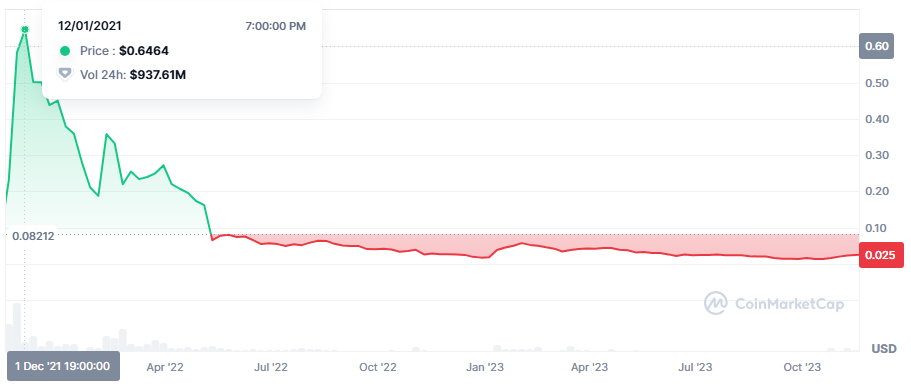
Legacy started selling NFT land plots when GALA was priced on the left side of this graph. The game actually launched when GALA was priced on the right side of this graph.

Legacy started selling NFT land plots when GALA was priced on the left side of this graph. The game actually launched when GALA was priced on the right side of this graph. Credit: CoinMarketCap

The only users I found who actually made money from Legacy (outside of Gala Games or 22cans) were the ones who focused on flipping virtual real estate rather than playing the game itself. “When Legacy started out, the degens, IMO, were the ones buying,” said Faz, who runs a longstanding Discord full of disgruntled Gala Games players. “When a sale would start, they would buy a bunch of land then resell at a profit anything that was sold out in the store… People spent thousands, and tens of thousands [of dollars].”

Phil, the early Gala founder’s node purchaser, said he bought one of the game’s high-end Conglomerate deeds for 100,000 GALA (about $60,000 at the time) during the presale. After the purchase, though, he said he “felt a little ill immediately because it was by far the largest purchase outside of a house that I have ever done and I did it so easily with the push of a mouse button.”

Within 36 hours, he had resold that Conglomerate deed to someone else on OpenSea for 27 ETH, worth about $100,000 at the time. “I was over the moon and relieved to have such a great flip, and the panic of having such an expensive purchase in my account was gone,” he said. “I can’t express to you how much I was relieved to not have any NFTs tied to the launch.”

An expensive lesson, for some

Today, Legacy is functionally unplayable; it doesn’t even appear on the list of games on Gala Games’ website. While the players who spent thousands of dollars on Legacy land plots still technically control the associated NFTs, those crypto tokens are practically worthless without an active game to monetize them.

(Gala Games COO Mark Skaggs said in an email that the company would not be able to offer comment on specific questions sent regarding this story. A 22Cans representative told Ars that “as we work on the coming updates to our current title… the studio would rather use that time to promote Masters of Albion rather than enter into any postmortem on previous titles.”)

From the start, Gala Games has been careful not to describe purchases of its tokens and NFTs as an investment. “The only reason to get a node is to help support the growth of a decentralized ecosystem based around the ethos of giving gamers freedom and ownership of their own assets,” the company wrote in early 2021. “As node owners support the network, they receive GALA and NFTs as rewards for their support.”

At the same time, the company’s marketing efforts focused heavily on the potential to earn money by buying into its games and the risk of waiting too long to get in. “The people who were first to play it are going to get more than people who are last to play it,” Gala Games CEO Eric Schiermeyer said in a March 2020 interview. “So, I mean, there’s definitely a reason to come in.”

Molyneux said the proceeds from the failed Legacy helped 22cans fund development of the new Masters of Albion.

Molyneux said the proceeds from the failed Legacy helped 22cans fund development of the new Masters of Albion. Credit: 22cans

While some Gala Games players I talked to said they spent money at least in part to support web3 gaming philosophically, most said they were primarily putting money in to get more money out. A player with the handle Higher Primate told Ars they regret the $86,000 they paid for a founder’s node at the peak of the GALA bull market. “At that time, I also thought their game library was impressive for web3. [Now] all of those games I was sold have now all been abandoned,” he said. “I purely FOMO’d in, thinking they had the secret sauce for web3 gaming.”

“Let’s put it this way, If you spent tens of thousands or more on a ‘game piece’ for a game, and you were told that the game piece would allow you to earn in-game… then of course you would expect to earn your initial investment back,” Ed777 said.

“If you are spending the amount of money some people were spending on some of their NFT’s… it 100 percent is an investment,” Higher Primate added. “Gala isn’t a charity. You aren’t just giving hundreds of thousands of dollars away because you like games.”

The investment those players thought they were making in Legacy ended up serving as a de facto investment in the new Masters of Albion. Molyneux said in a 2024 Eurogamer interview that the pre-sold NFT earnings 22cans made from Legacy weren’t “quite as much as people speculated.” Still, he said the profits from that failed crypto project were enough to “bring back [former colleagues] Russell [Shaw] and Mark [Healey] and Ian [Wright]” to work on Masters of Albion. “It’s not cheap to do that. You’ve got to bring them away from their jobs.”

Looking back at Legacy in that interview, Molyneux seemed at least a little chagrined to have been taken in by the web3 gaming hype of just a few years ago. “We were sold by a company called Gala Games on this—and I’m very susceptible to these ideas—that play-to-earn gaming could be a big thing,” he said. While Molyneux was able to admit that he’s “not a person that deeply understands” the play-to-earn economic model, he told Eurogamer that, despite the play-to-earn hype he expressed at Galaverse, he now felt that “in my opinion … [it] doesn’t really work financially, or in gameplay terms.”

For the players who lost significant money backing Molyneux’s vision for Legacy, that lesson was an expensive one. For Molyneux’s company, the process of learning that lesson apparently proved quite lucrative.

European anti-fraud office opens investigation into Peter Mandelson

0
european-anti-fraud-office-opens-investigation-into-peter-mandelson
European anti-fraud office opens investigation into Peter Mandelson


The European Anti-Fraud Office (OLAF) said it ​had opened an investigation into Peter Mandelson, ‌Britain’s former ambassador to the U.S. and an ex-EU politician under scrutiny over his ties to deceased sex offender Jeffrey ​Epstein.

“OLAF can confirm the opening of an ​investigation on the case that you refer to. ⁠However, as the investigation is ongoing, OLAF ​cannot issue any further comment,” it said via email .

“This is in order to protect the confidentiality of ongoing and possible ensuing investigations, possible subsequent judicial proceedings, personal ​data and procedural rights,” it added.

The formal ​opening of a probe into 72-year-old Mandelson, who served as EU ‌trade ⁠commissioner between 2004 and 2008, comes after OLAF had initially said in February that it was looking into the situation.

Mandelson’s legal representatives did not immediately respond ​to a request ​for comment.

Prime ⁠Minister Keir Starmer appointed Mandelson, who served as a minister when Labour was ​last in power more than 15 years ​ago, ⁠as Britain’s Ambassador to the US in late 2024, only to then sack him last September after a ⁠trove ​of emails revealed the depth ​of Mandelson’s ties with Epstein.

Katie Couric Breaks Silence on Matt Lauer Bombshell

0
katie-couric-breaks-silence-on-matt-lauer-bombshell
Katie Couric Breaks Silence on Matt Lauer Bombshell


Katie Couric is finally weighing in on one of the most explosive scandals to ever rock morning television — and she’s making it crystal clear where she stands.

The former “Today” show queen didn’t hold back while speaking about disgraced ex-co-anchor Matt Lauer and the woman who brought him down, Brooke Nevils — and her comments are turning heads.

“I feel terrible for her,” Couric admitted during a high-profile appearance at the City Harvest Presents The 2026 Gala: Shaken, Not Stirred in New York City.

The veteran journalist, now 69, praised Nevils for going public with her story, calling her “very brave” for detailing the shocking allegations in her 2020 memoir, Unspeakable Things: Silence, Shame and the Stories We Choose to Believe.

Even though Couric revealed she hasn’t read the entire book, she said what she did see was enough to leave a lasting impact.

“I think she’s very brave to write the book,” she added.

The accusations at the center of the scandal are nothing short of jaw-dropping.

Nevils, a former NBC News employee, alleged that Lauer sexually assaulted her during the 2014 Sochi Olympics while they were on assignment. In her memoir, she further claimed the abuse didn’t stop there — accusing him of another assault inside his office at NBC’s “Today” show headquarters.

The allegations detonated inside NBC in 2017, when Nevils filed a formal complaint that triggered an internal investigation. Within 24 hours of the claims becoming public, Lauer was fired in a stunning fall from grace after decades as one of America’s most recognizable TV faces.

He has denied the allegations, maintaining that their relationship was consensual.

Couric, who co-hosted “Today” alongside Lauer from 1997 to 2006, appeared to separate her personal memories from the scandal that later engulfed the show.

“I will always have the happiest memories of my 15 years on the ‘Today’ show,” she said, describing it as one of the most exciting and fast-paced jobs in television.

She acknowledged the grueling early mornings — often waking up at 3 a.m. — but said the intense schedule created a tight-knit, almost family-like bond among staff.

Still, the shadow of the scandal looms large over the legacy of the iconic morning program.

And Couric didn’t stop there.

In a separate conversation ahead of the White House Correspondents’ Dinner, she also took aim at Donald Trump, accusing the current president of repeatedly attacking journalists while simultaneously seeking their attention.

“We’ve got this president who trashes the press, who insults reporters on a daily basis — especially female reporters, but really all reporters — who has no respect for the First Amendment,” she said.

Couric pointed to what she called a glaring contradiction in Trump’s behavior, saying it’s “weird” to see a room full of journalists covering someone who, in her view, openly disdains them while still craving their approval.

The timing of her remarks — and her willingness to revisit the Lauer scandal — is once again putting one of television’s darkest chapters back in the spotlight.

Indonesia-US overflight debate misses the strategic point

0
indonesia-us-overflight-debate-misses-the-strategic-point
Indonesia-US overflight debate misses the strategic point

When Indonesians hear the phrase military overflight, the image that often comes to mind is simple: foreign military aircraft freely crossing the skies without permission. It is a powerful image because it directly touches on sovereignty, one of the most sensitive elements of foreign and defense policy.

But in the 21st century, military overflight no longer works that way. The real story unfolding across the Indo-Pacific is not about whether countries grant “blanket overflight access” in a formal, legal sense.

It is about how military access is increasingly constructed through a web of logistics arrangements, training agreements, interoperability clauses, and expedited clearance procedures that make overflight possible without ever being described as such.

This is the new architecture of access. And Indonesia is now geographically, strategically and diplomatically positioned at the center of it.

Previous reports suggested that Washington was seeking access to Indonesian airspace for US military aircraft. The proposal leaked just before Indonesian Defense Minister Sjafrie Sjamsoeddin was scheduled to visit the Pentagon on April 13 to sign the Indonesia-US Major Defense Cooperation Partnership (MDCP) agreement.

Regarding this, the Indonesian Ministry of Foreign Affairs has urged caution in discussing the proposal. Recent reports indicate that the Defense Minister and retired Indonesian National Armed Forces (TNI) personnel have been involved in further discussions.

Official statements emphasize that no agreement has been reached, that discussions remain at an early stage, and that Indonesia continues to uphold its long-standing bebas aktif foreign policy.

All of this can be entirely true — and still miss the deeper strategic dynamic at play. To understand why, we must look beyond Indonesia and examine what has happened elsewhere in the region.

In the Philippines, the Enhanced Defense Cooperation Agreement (EDCA) never explicitly granted the US “overflight rights.” There is no clause that says American aircraft may fly freely across Philippine airspace.

Yet today, through access to multiple facilities, pre-positioned logistics, rotational presence, and routine exercises, US military aircraft can move through the archipelago with an ease that is administrative rather than political.

In Papua New Guinea, a 2023 defense cooperation agreement similarly avoided language about bases or blanket access. Instead, it provided for the use of certain ports and airfields, logistics cooperation, and contingency access. Strategically, this transformation made Papua New Guinea a critical transit node between Guam and Australia.

Vietnam, a country deeply cautious about sovereignty and allergic to formal alliances, has allowed aircraft carrier visits, defense exchanges, and increasingly regular military interactions with the United States — all while firmly insisting that it has granted no base and joined no alliance.

Even among NATO allies in peacetime, military overflight is rarely “free.” Permissions still exist on paper. But through standing agreements, those permissions have been pre-authorized to the point where they function as routine administrative clearances.

In each of these cases, the host country can honestly say: “We did not grant overflight rights.” And yet, operationally, access has expanded dramatically. This is what defense analysts sometimes describe as “access without bases, presence without permanence.”

And it is here that Indonesia’s role becomes especially significant. Geographically, Indonesia sits astride the most efficient air corridors linking the Western Pacific, the South China Sea, the Indian Ocean and northern Australia.

Without Indonesia, any rapid air movement across this theater requires longer routing, more refueling, and greater operational complexity. With Indonesia, the Indo-Pacific air map becomes far more seamless. This is not speculation; it is a simple fact of geography.

From the perspective of US military planners concerned with contingencies in Taiwan, the South China Sea or broader Indo-Pacific mobility, Indonesia is the missing piece that completes the regional air corridor.

But this does not mean Washington needs — or will even ask for — “blanket overflight” as the public might imagine.

What matters far more are the smaller, less dramatic provisions that rarely attract headlines, namely logistics support arrangements, humanitarian assistance and disaster relief cooperation, joint training frequency, interoperability mechanisms, and faster diplomatic clearance procedures for military aircraft.

Individually, each of these looks harmless. Technically, none violates Indonesia’s sovereignty. Politically, none resembles granting a foreign military special rights in the airspace.

Collectively, however, they can produce the operational effect of very broad access. This is why the careful language used by Indonesian officials in response to recent reporting is so interesting.

Phrases such as “urging caution,” “still under review,” and “no binding agreement” are not denials. They are classic diplomatic signals used when an issue is real, sensitive, and still being navigated internally.

We have seen this pattern before in other countries before major defense cooperation frameworks took shape. The key point for Indonesia, therefore, is not whether it will ever sign a document titled “overflight agreement.” That is highly unlikely and unnecessary.

The more important question is whether the public is aware that modern military access was built without ever being labeled as such. Indonesia’s doctrine of “bebas aktif” has always rested on careful management of sovereignty, strategic autonomy and balanced relations among major powers.

That doctrine is not automatically threatened by defense cooperation. But it can be quietly tested by cumulative arrangements that, over time, change the practical reality of how the airspace is used in times of crisis.

This is not an argument against cooperation with the US. Nor is it an accusation that Indonesia is about to abandon its principles.

It is an argument for strategic awareness. Because in today’s Indo-Pacific, overflight is no longer negotiated in the sky. It is negotiated in logistics clauses, training agreements and clearance procedures on the ground.

And for a country as central as Indonesia, understanding that distinction may be more important than the debate over any single term in any single defense cooperation document.

AD Agung Sulistyo is a Jakarta-based researcher specializing in Southeast Asian diplomacy and transnational law.

Assad Brothers Summoned in Absentia as Syria Opens Landmark Trial of Former Security Chief

0
assad-brothers-summoned-in-absentia-as-syria-opens-landmark-trial-of-former-security-chief
Assad Brothers Summoned in Absentia as Syria Opens Landmark Trial of Former Security Chief


The court’s summonses for Bashar and Maher Assad added symbolic weight to a proceeding targeting figures once considered untouchable

[Damascus] Damascus on Sunday opened the public trial of a senior security official from Syria’s former regime, in what is widely seen as the beginning of a transitional justice process after years of conflict.

The scene reflected profound shifts in Syria’s landscape: Syrians gathered inside the courtroom, including some who had been wanted by security forces under Bashar Assad only a few years ago, now finding themselves witnesses to a long-awaited moment of accountability.

As the judge called the name of the defendant, Atef Najib, the court also issued in absentia summonses for Bashar Assad and his brother Maher Assad, in a moment laden with symbolic and political significance. Many in attendance, who had experienced years of persecution or repression, appeared to be reclaiming a new narrative within the courtroom, shifting from the accused or the hunted to observers of legal proceedings targeting figures once seen as untouchable. This transformation shows the scale of change in Syria’s power dynamics and gives the trial a dimension that extends beyond the judiciary, redefining the relationship between state and society in the pursuit of justice and accountability.

Najib, a former brigadier general and head of the Political Security Branch in Daraa, topped the list of defendants appearing before the court, with a notable official and media presence, as well as participation from diplomats and international observers. The trial comes as part of efforts by the new authorities to hold accountable individuals accused of committing serious violations against civilians during the Syrian uprising.

He was among the first Syrian officials targeted by Western sanctions after the outbreak of protests in 2011. The US Treasury Department designated him on April 29, 2011, accusing him of involvement in serious human rights abuses during his tenure in Daraa. The sanctions included freezing any assets under US jurisdiction and banning dealings with American individuals and entities.

The European Union imposed sanctions on him on May 9, 2011, including asset freezes and a travel ban across member states, as part of broader measures targeting senior Syrian military and security officials. These sanctions were based on repeated allegations by international human rights organizations linking him to repression, arbitrary detention, and torture, particularly in the early stages of the protests that began in Daraa, placing him among figures subjected to sustained international isolation.

The first session was held at the Palace of Justice in Damascus, where a courtroom had been prepared for the Criminal Court. The Ministry of Justice confirmed that the proceedings would be public, marking an unprecedented step for trials involving senior figures of the former regime.

Eceptional and historic

Speaking to The Media Line, Damascus Attorney General Hossam Khattab described the day as “exceptional and historic” in Syria’s transitional justice trajectory, calling the trial a pivotal moment for the judiciary within what he termed the “new Syrian state.”

He said judicial institutions now stand with the victims, “championing their pain and suffering,” signaling a shift toward redressing past abuses and reinforcing the principle of accountability after years of conflict. He added that this trial and others expected to follow reflect the state’s determination to deliver justice and restore both material and moral rights to Syrians, particularly victims, including formal recognition of their suffering and efforts toward reparations.

Khattab noted that Najib is being tried in person, while Bashar Assad, Maher Assad, and others are being prosecuted in absentia. He said this is the first session in what is expected to be a broader process and includes the presence of private plaintiffs, reflecting the direct involvement of victims in the legal proceedings. Observers say the trial represents a real test of the Syrian judiciary’s ability to handle complex cases involving widespread violations, amid both domestic and international scrutiny.

The move is widely viewed as a major shift in addressing past abuses, as such cases had long remained beyond accountability inside Syria until recent political changes opened the door to prosecutions.

Crowds of Syrians attend Atef Najib’s trial, at the 4th Criminal Court in Damascus, Syria, April 2026. (The Media Line)

Justice is possible, even if delayed

One victim’s relative, the father of a young man detained in the early days of the protests, told The Media Line that attending the session “represents a moment we have waited for many years.” He added that seeing Najib in court “restores some sense that justice is possible, even if delayed.” The family still does not know their son’s fate, but he expressed hope that the trials will uncover the truth and establish accountability.

In another testimony, a woman who lost her brother during the Daraa events said her participation as a civil claimant “is not only to demand justice, but to give a voice to those who could not attend.” She added that hearing the case inside a courtroom, in the presence of judges and lawyers, “gives victims a sense that their suffering has not been forgotten,” expressing hope that accountability will extend to “everyone involved, regardless of their position or influence.”

Najib is closely associated with the early days of Syria’s 2011 uprising, when he headed Political Security in Daraa, the city where protests first erupted. Rights groups have accused him of overseeing abuses, including the detention and torture of children, which contributed to escalating unrest.

Reports also indicate that Najib, a cousin of Bashar Assad, held several sensitive security positions, making him a key figure in the regime’s security apparatus at the time.

For victims’ families, the trial represents a long-awaited opportunity to hold perpetrators accountable. Many hope it will mark the beginning of a broader series of prosecutions targeting other figures as part of a comprehensive transitional justice process.

According to informed sources, future phases are expected to include trials of additional former regime figures after the conclusion of Najib’s case.

These developments come within a broader effort by Syrian authorities to establish transitional justice mechanisms, including accountability, truth-seeking, and reparations, in a bid to turn the page on the past and build a new phase.

Observers note that the success of these trials will depend on judicial independence, transparency, and their ability to meet the expectations of victims and the international community, which has repeatedly called for accountability.

Najib’s trial marks a pivotal moment in modern Syrian history, signaling a shift from impunity toward legal accountability. While the road to comprehensive justice remains long, this step may lay the foundation for a new era defined by accountability and the rule of law.

As proceedings continue, attention will remain fixed on courtrooms in Damascus, where the judiciary is being tested for the first time in confronting a heavy legacy of abuses in a country striving to rebuild after years of conflict.

China’s sovereign debt to debut in SE Asia’s largest economy

0
china’s-sovereign-debt-to-debut-in-se-asia’s-largest-economy
China’s sovereign debt to debut in SE Asia’s largest economy

A landmark agreement allowing China to issue sovereign bonds in Indonesia’s domestic market on a reciprocal basis signals a deliberate push for regional financial integration.

The reciprocal sovereign bond issuance agreement between China and Indonesia marks a strategic breakthrough. For the first time, China will be allowed to issue yuan-denominated sovereign bonds directly in Indonesia’s domestic capital market, with Indonesia receiving similar rights in China’s market.

This goes beyond typical swap lines or cross-listings; it represents an institutionalized opening between two of Asia’s largest debt markets.

Historically, investors fleeing geopolitical turmoil have gravitated toward the deep liquidity and perceived stability of US debt. However, the prolonged Middle East conflict has introduced a dual shock: energy price spikes that rekindle inflation in Western economies, and a growing realization that US fiscal trajectories are themselves under strain.

In this context, Chinese government bonds offer a compelling alternative. China’s relatively contained inflation, a current account surplus and a managed exchange rate provide stability that contrasts with the volatility seen in commodity-driven emerging markets.

Moreover, the People’s Bank of China has maintained a more predictable monetary policy than the Federal Reserve, which is caught between rate-cut expectations and sticky inflation.

As global funds — sovereign wealth funds, central banks and institutional investors — reallocate portions of their portfolios into CGBs, Beijing can finance its domestic restructuring, including deleveraging local government debt and supporting strategic sectors, at lower yields.

This influx of safe-haven demand effectively subsidizes China’s transition toward a consumption- and technology-driven economy, reducing its reliance on volatile foreign direct investment.

Energy market volatility has also accelerated interest from Gulf oil exporters who, seeking to diversify their dollar-denominated assets, view CGBs as a hedge against both Middle East instability and potential US sanctions. This creates a positive feedback loop: China gains stable financing while energy-supplying nations gain a geopolitical hedge.

The geoeconomic consequences for China are immediate and multi-layered. First, the agreement creates a direct channel for absorbing Indonesian rupiah liquidity into yuan-denominated assets, deepening offshore yuan markets without requiring full capital account convertibility.

Second, it reduces transaction costs for bilateral trade and investment, as Indonesian institutions can hold Chinese government paper as collateral for rupiah-yuan settlement.

Third, it sets a precedent for other ASEAN nations. If Indonesia — a notably protectionist economy with a history of resource nationalism — accepts Chinese sovereign issuance, it signals to Malaysia, Thailand and Vietnam that financial integration with China is compatible with national economic sovereignty.

For China, the agreement advances the long-term goal of internationalizing the renminbi. Unlike swap lines that merely provide emergency liquidity, a reciprocal bond market creates a durable, two-way asset relationship.

Indonesian pension funds, insurers and banks that buy CGBs become structural holders of yuan assets, creating natural demand for hedging instruments, custody services and eventually a deeper renminbi bond ecosystem across Southeast Asia.

This moves China closer to its ambition of building an alternative Asian financial architecture that operates parallel to — and potentially independent of — the dollar-based system.

The combination of CGBs as a safe haven and the Indonesia agreement carries significant geopolitical weight. At the strategic level, China is steadily eroding the dollar’s “exorbitant privilege.”

When Middle Eastern oil exporters and Southeast Asian central banks shift reserves into CGBs, they reduce their need to hold US Treasuries for liquidity purposes. While the shift is incremental, the trajectory is clear: China is offering a politically risk-diversified asset to a world weary of weaponized finance — following the freezing of Russian assets — and US fiscal brinkmanship.

In the Asia-Pacific, China gains enhanced leverage over regional financial governance. Indonesia’s agreement is not merely technical; it reflects Jakarta’s strategic calculation that deeper integration with China’s financial system offers stability and growth.

For China, this translates into soft power: being able to issue debt on another nation’s home turf signals trust and institutional equivalence. It also complicates any potential US-led financial decoupling.

If ASEAN central banks already hold CGBs as reserves, they face prohibitive costs in joining coalition-style sanctions against China. Reciprocal bond issuance thus acts as a financial insurance policy against geopolitical coercion.

However, the consequences are not uniformly positive for China. Greater safe-haven status invites scrutiny. Global investors will demand transparency about China’s local government debt, shadow banking risks and property sector troubles.

Any default or forced restructuring in the provincial bond market could rapidly reverse CGBs’ safe-haven status, triggering capital flight. Additionally, the Indonesia agreement exposes China to competition: Indonesian sovereign bonds issued in China’s market might offer higher yields, potentially diverting domestic Chinese savings away from local government projects.

For the broader international system, China’s rise as a debt safe haven and its deepening Asian financial integration signal the emergence of a multipolar reserve-asset landscape. Global safety will no longer be synonymous with US Treasuries alone.

The geoeconomic consequence is potentially more resilient global liquidity — investors have alternatives — but also greater fragmentation. Two distinct spheres of safe assets could emerge: a dollar bloc anchored in New York and London, and a renminbi bloc anchored in Shanghai and Hong Kong, with Indonesia acting as a bridge.

China’s global interest lies in managing this transition without provoking a dollar crash or a destabilizing reversal in capital flows. The prudent path involves continued reciprocity: as Indonesia opens its market to Chinese bonds, China must further open its capital account, allowing foreign investors to hedge and exit without friction.

If Beijing succeeds, it will have transformed its debt from a source of domestic concern into a tool of geoeconomic statecraft — one that offers stability to a volatile world while quietly reshaping the financial order in its favor.

The Middle East crisis and the Indonesia agreement are not isolated events; they are accelerants of a long-term shift whose consequences will define the next decade of global finance.

Bob Savic advises on sanctions, supply chains and geopolitical risk and is co-author of the new book “Multipolarity and the Changing Global Order” published by Springer.

Sheikh Jarrah: How ceasefires enable Israel’s quiet annexation

0
sheikh-jarrah:-how-ceasefires-enable-israel’s-quiet-annexation
Sheikh Jarrah: How ceasefires enable Israel’s quiet annexation

On 20 April 2026 the Jerusalem District Planning Committee approved an 11-storey ultra-Orthodox Jewish religious school known as Or Somayach, or the Glassman Yeshiva, in the heart of Sheikh Jarrah. The project will rise on five dunams of land at the southern entrance to the neighbourhood, directly opposite Sheikh Jarrah Mosque. It includes dormitories for hundreds of students and residential units for teaching staff. Palestinian officials immediately condemned the move, saying it deliberately exploits the current regional distractions.

While fragile ceasefires hold in Gaza and Lebanon and attention shifts to Iran, Israel is pressing ahead with its settler-colonial project in occupied East Jerusalem and the West Bank. This latest step in Sheikh Jarrah is no isolated event. It is part of a systematic drive to displace Palestinians and implant settlers, killing off any realistic two-state solution and breaking international law. Palestinian families are bearing the brunt.

The decision is the latest chapter in a decades-long campaign. Occupation authorities seized the land years ago under the pretext of “public needs” and handed it in 2007 to the US-linked Or Somayach Institutions.

If the complex is built, it will sharply increase the settler population, tighten security controls and change the character of the neighbourhood beyond recognition. Residents already endure daily harassment, restricted movement and the constant threat of eviction.

Rawhi Fattouh, head of the Palestinian National Council, called the approval part of a calculated colonial strategy. “The approval of the Or Somayach project is part of a systematic colonial project that uses regional turmoil to impose unlawful changes in occupied Jerusalem,” he said. In his view, the timing is no accident. The move takes advantage of the focus on ceasefires elsewhere to push through facts on the ground that would otherwise face stronger resistance.

This single project is only one piece of a much wider land grab. Last August Israeli authorities finalised the controversial E1 plan, which clears the way for thousands of new housing units linking East Jerusalem to the Ma’ale Adumim settlement bloc. When completed, it will cut East Jerusalem off from the rest of the West Bank and create an unbroken Israeli corridor. In February this year the government restarted formal land registration across large parts of Area C, the first time since 1967. Critics rightly label it de facto annexation, a process that could transfer vast tracts of Palestinian land to the Israeli state.

Buffer zones around settlements keep expanding, new outposts keep appearing and bypass roads keep multiplying. All these measures restrict Palestinian access to their own farmland and homes. Taken together, they make a contiguous Palestinian state geographically impossible and lock in permanent occupation.

The regional ceasefires have handed Israel the political cover it needed. Six months after the Gaza ceasefire began in October 2025, the humanitarian crisis continues, restrictions, disease outbreaks and reconstruction remain stalled.

Yet attention has moved on. The Lebanon ceasefire that started in mid-April and the uneasy pauses around Iran have pulled diplomatic and media focus away. Palestinian officials have directly linked the Sheikh Jarrah decision to this distraction.

The Israeli rights group Ir Amim warned that the yeshiva plan will sharply increase pressure on Palestinian residents. If it goes ahead, daily insecurity will rise for families who have lived in Sheikh Jarrah for generations. Children will grow up in neighbourhoods deliberately redesigned to exclude them. Parents will watch their heritage and future prospects disappear under concrete and ideology.

Every one of these steps violates international law. Settlement activity in occupied territory breaks the Fourth Geneva Convention. The E1 plan and the land registration process amount to annexation and forcible transfer, both banned under the convention and repeated UN resolutions. The International Court of Justice has repeatedly declared such actions illegal.

By moving forward Israel undermines the legal protections that should safeguard Palestinian rights in East Jerusalem. It also destroys any realistic chance of the city serving as the capital of a future Palestinian state, a demand rooted in international consensus and Palestinian national aspirations.

The human cost falls on ordinary Palestinian families. Many already carry the scars of repeated eviction threats and home demolitions.

The new yeshiva will bring hundreds more settlers into their midst and make daily life even harder. These families are not abstract statistics. They are the living proof of the dispossession that international law was meant to prevent.

The message from Sheikh Jarrah and the parallel moves in the West Bank is unmistakable. Ceasefires that leave the occupation untouched do not bring peace. They simply open the door to the next phase of dispossession. While the world watches fragile truces elsewhere, Israel continues to bury the two-state solution and impose a one-state reality of apartheid and inequality.

Real security and stability in the region demand more than temporary pauses in violence. They require genuine accountability, an immediate end to settlement expansion and the full restoration of Palestinian rights, including the right of return and Jerusalem as the capital of Palestine. Only by confronting the occupation’s relentless continuity can the international community uphold international law and advance the equality and justice the Middle East so urgently needs.

The views expressed in this article belong to the author and do not necessarily reflect the editorial policy of Middle East Monitor.

0FansLike
0FollowersFollow
0FollowersFollow
0SubscribersSubscribe
- Advertisement -
Google search engine

Recent Posts