Since Donald Trump returned to the White House on January 20, 2025, his foreign policy has often appeared chaotic and mercurial.
He has repeatedly insulted longstanding US allies, threatened them with tariffs and pursued aggressive military actions abroad. He has left the European Union, the United Kingdom, Japan, South Korea, India and traditional partners and allies reeling.
Actions such as the US intervention in Venezuela in January 2026 that resulted in the capture of Nicolas Maduro, and the February 2026 US-Israeli strikes on Iran that killed Supreme Leader Ayatollah Ali Khamenei, have fueled accusations of presidential recklessness. Many analysts have dismissed these moves as signs of “Trump’s madness.”
Yet beneath the surface bluster lies a more deliberate, if high-risk, strategy: Trump aimed to shape a bipolar world order with the US and China as the main poles. His erratic style —insults, tariff threats and sudden displays of military force — reshapes alliances, contains China and affects global stability.
At the heart of Trump’s vision is a hardheaded recognition of today’s geopolitical reality. The US can no longer easily confront China through outright military conflict or total economic decoupling.
China’s economic might, technological advancements in areas like artificial intelligence, quantum computing, the green energy transition and its growing military capabilities in space, air, naval and land make direct containment extraordinarily difficult — far harder than isolating the Soviet Union during the Cold War, because China combines the USSR’s military might with the Japanese manufacturing of the 1980s.
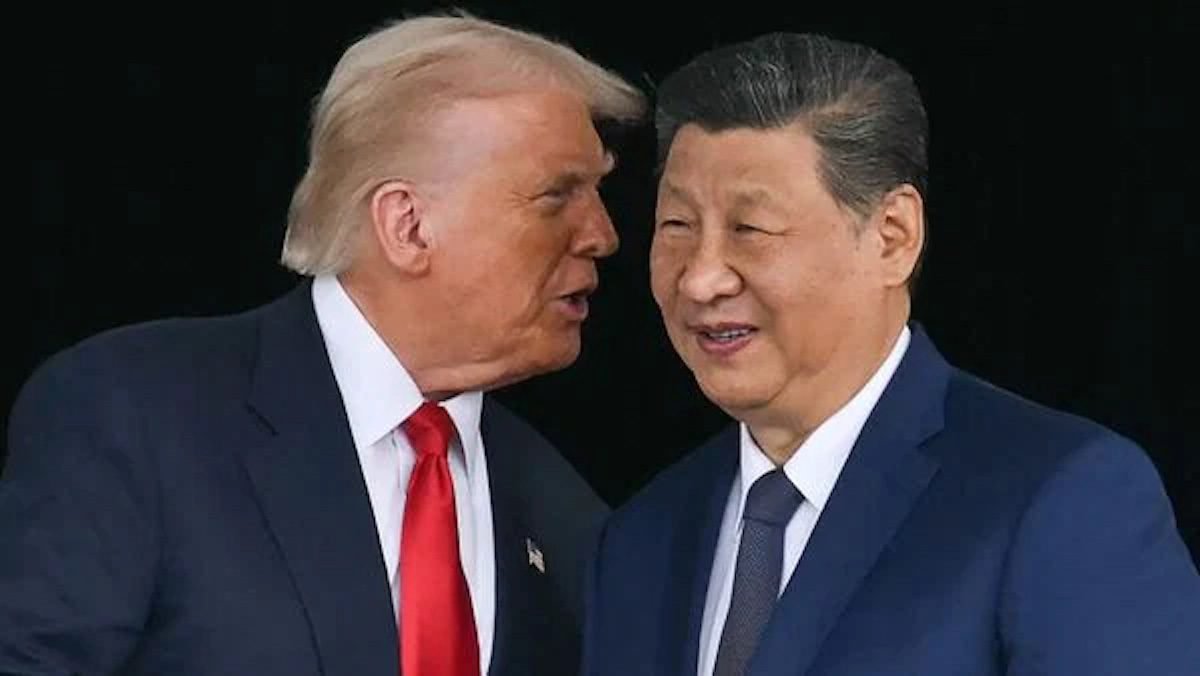
This underscores the complexity and resilience of China’s global strategy. Trump’s meeting with Chinese President Xi Jinping on the sidelines of the Asia-Pacific Economic Cooperation summit in Busan, South Korea, in October 2025 illustrated this calculus.
Trump described the encounter as an “amazing” G2 moment, signaling a willingness to acknowledge a duopoly of superpowers for the time being. Yet this co-leadership for the US is tactical and temporary.
The deeper aim is to revive a bipolar structure in which the US and China set the global agenda. At the same time, other nations align behind one or the other — ultimately positioning America to undermine China when the moment is ripe, much as the West helped to accelerate the Soviet Union’s collapse in the 1980s.
The strategy stems from a profound American anxiety: the fear of losing unipolar dominance in a rapidly shifting multipolar world. Trump understands that a direct showdown with Beijing risks mutual ruin: if the US even scratches China, the US will feel economic pain.
Instead, he seeks to provoke China just enough to deter challenges to the US dollar’s hegemony while pressuring allies to limit their economic engagement with Beijing. The message to partners is clear: reduce reliance on China and prioritize ties with the US, or face economic consequences. This plays out in two interconnected fronts.
First, Trump has wielded tariffs as a blunt instrument of coercion against allies. The EU, UK, Japan, South Korea and India have all faced threats or impositions of higher duties on key exports such as automobiles, steel, and technology goods.
These are not mere trade spats; they are diplomatic levers designed to force caution in dealings with China. By squeezing allies economically, Trump hopes to redirect trade and investment flows toward the US and secure their support for maintaining dollar supremacy—a system he and many American strategists view as existential. Once lost, dollar dominance would be nearly impossible to reclaim.
Second, these pressures aim to encircle and isolate China over time. Trump’s public humiliations — such as the tense White House meeting with Ukrainian President Volodymyr Zelensky or the August 2025 summit with Russian President Vladimir Putin in Alaska that appeared to sideline European concerns — send a broader signal.
In Trump’s framing, the world revolves around two superpowers. Smaller powers should choose sides or accept a subordinate role rather than pursue an independent multipolar world order.
Actions in Venezuela and Iran fit into this timeline as demonstrations of resolve and attempts to gain leverage. The January 2026 operation in Venezuela that captured Maduro showcased the US’s willingness to act decisively in its backyard, removing an oil-rich regime long aligned with China and Russia.
The February 2026 strikes on Iran, which escalated into a broader conflict involving regime-change elements, were reportedly intended to be quick and to strengthen Trump’s hand ahead of a planned March 31-April 2 visit to China. Iran’s resilient response delayed that trip until May 14-15, leaving Trump to negotiate from a weaker “position of strength.”
Still, these moves reinforce the image of unpredictability that Trump cultivates as a strategic asset. Internally, the plan involves bolstering American economic and military strength while granting China limited co-leadership in multilateral forums — only to chip away at Beijing’s influence through backchannel diplomacy, alliance realignment and selective decoupling.
The ultimate objective is to sideline China as a true peer competitor, preserving US primacy within a bipolar framework that has historically favored America. Yet this gambit is fraught with challenges and contradictions. China has repeatedly rejected a strict G2 condominium, instead championing multilateralism and an “equal and orderly multipolar world.”
Beijing is actively cultivating ties across the Global South and beyond through the Belt and Road Initiative, the Asian Infrastructure Investment Bank, BRICS expansion and the Shanghai Cooperation Organization. Exploring how China’s counter-strategies could undermine or adapt to Trump’s bipolar vision can deepen understanding of the strategic contest.
Allies, meanwhile, are not passive pawns. India, though, maintains Quad cooperation to balance China while expanding bilateral trade with Beijing. The EU is deepening strategic autonomy and exploring independent policies. Japan and South Korea prioritize economic pragmatism alongside security alliances.
Public humiliation and tariff threats risk alienating partners rather than consolidating them, potentially accelerating the very multipolarity Trump fears. Exploring these dynamics can help the audience see how US alliances might evolve and influence the strategic landscape.
Moreover, Trump’s approach buys time against China’s rapid technological ascent, but time is a double-edged sword. If China successfully builds resilient supply chains, alternative financial mechanisms and a network of partners resistant to US pressure, the bipolar vision collapses.
In a true multipolar order, the US would face simultaneous competition on multiple fronts, straining its military resources and diminishing the dollar’s gravitational pull. Rising defense budgets could yield diminishing returns in terms of geopolitical gains.
Trump’s behavior may look unhinged to critics — insulting allies one day, striking adversaries the next — but it reflects a calculated, if improvisational, effort to freeze the global order in a favorable configuration.
History, however, cautions against overconfidence in such double games. Alliances are shifting as nations pursue their own interests. The public in many countries increasingly favors inclusive multilateralism, sovereign equality and rules-based cooperation over raw power politics.
Whether Trump’s strategy ultimately succeeds remains uncertain. A restored Cold War-style bipolarity could entrench confrontation and instability for decades. Conversely, if China and other rising powers consolidate a more distributed global order, American dominance will erode further — not through dramatic collapse, but through gradual diffusion of influence.
This contest transcends a simple US-China rivalry. It is a struggle over the architecture of the international system itself. World opinion largely favors fairness, cooperation and shared prosperity over perpetual dominance by any single power or duo.
Trump’s tariffs and provocations may weaken alliances and undermine his own leverage in the long run. The coming months and years — marked by the rescheduled May 14-15 Trump-Xi summit and ongoing global realignments — will reveal whether this high-stakes gamble can reshape the world, or whether the forces of multipolarity prove too strong to contain.
Follow Bhim Bhurtel on X at @BhimBhurtel and subscribe to his Substack here.