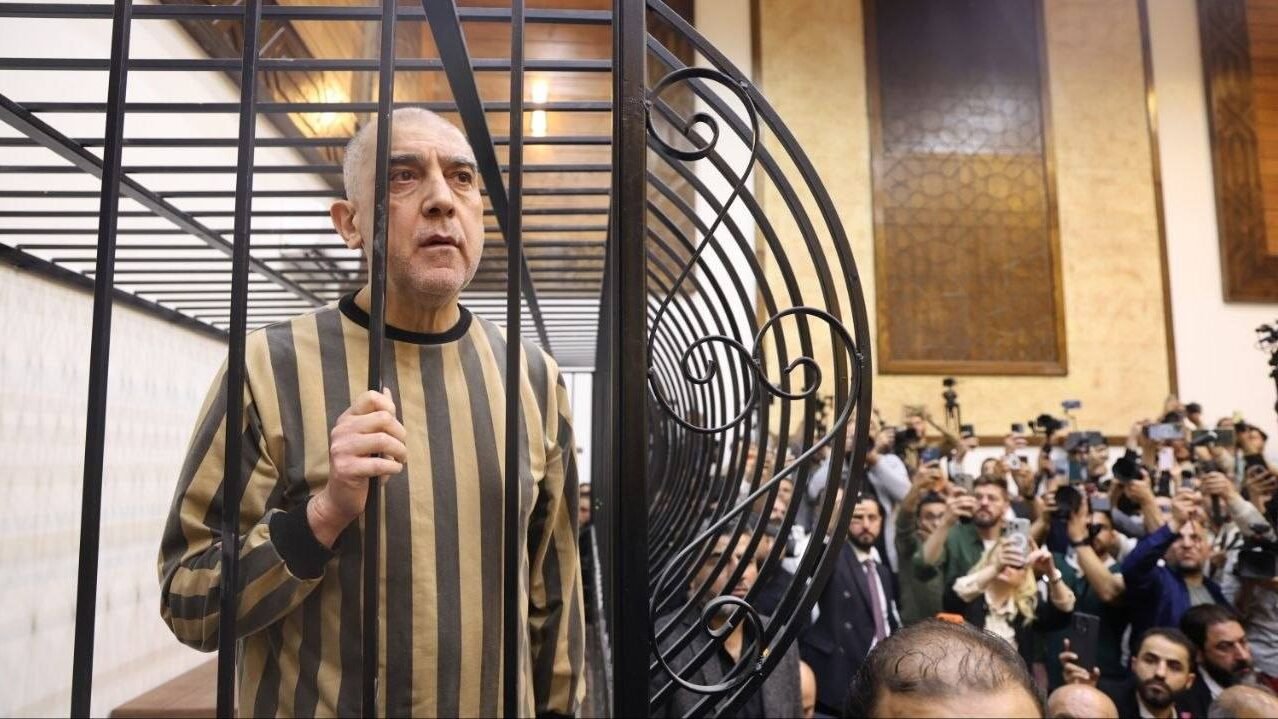
The court’s summonses for Bashar and Maher Assad added symbolic weight to a proceeding targeting figures once considered untouchable
[Damascus] Damascus on Sunday opened the public trial of a senior security official from Syria’s former regime, in what is widely seen as the beginning of a transitional justice process after years of conflict.
The scene reflected profound shifts in Syria’s landscape: Syrians gathered inside the courtroom, including some who had been wanted by security forces under Bashar Assad only a few years ago, now finding themselves witnesses to a long-awaited moment of accountability.
As the judge called the name of the defendant, Atef Najib, the court also issued in absentia summonses for Bashar Assad and his brother Maher Assad, in a moment laden with symbolic and political significance. Many in attendance, who had experienced years of persecution or repression, appeared to be reclaiming a new narrative within the courtroom, shifting from the accused or the hunted to observers of legal proceedings targeting figures once seen as untouchable. This transformation shows the scale of change in Syria’s power dynamics and gives the trial a dimension that extends beyond the judiciary, redefining the relationship between state and society in the pursuit of justice and accountability.
Najib, a former brigadier general and head of the Political Security Branch in Daraa, topped the list of defendants appearing before the court, with a notable official and media presence, as well as participation from diplomats and international observers. The trial comes as part of efforts by the new authorities to hold accountable individuals accused of committing serious violations against civilians during the Syrian uprising.
He was among the first Syrian officials targeted by Western sanctions after the outbreak of protests in 2011. The US Treasury Department designated him on April 29, 2011, accusing him of involvement in serious human rights abuses during his tenure in Daraa. The sanctions included freezing any assets under US jurisdiction and banning dealings with American individuals and entities.
The European Union imposed sanctions on him on May 9, 2011, including asset freezes and a travel ban across member states, as part of broader measures targeting senior Syrian military and security officials. These sanctions were based on repeated allegations by international human rights organizations linking him to repression, arbitrary detention, and torture, particularly in the early stages of the protests that began in Daraa, placing him among figures subjected to sustained international isolation.
The first session was held at the Palace of Justice in Damascus, where a courtroom had been prepared for the Criminal Court. The Ministry of Justice confirmed that the proceedings would be public, marking an unprecedented step for trials involving senior figures of the former regime.
Eceptional and historic
Speaking to The Media Line, Damascus Attorney General Hossam Khattab described the day as “exceptional and historic” in Syria’s transitional justice trajectory, calling the trial a pivotal moment for the judiciary within what he termed the “new Syrian state.”
He said judicial institutions now stand with the victims, “championing their pain and suffering,” signaling a shift toward redressing past abuses and reinforcing the principle of accountability after years of conflict. He added that this trial and others expected to follow reflect the state’s determination to deliver justice and restore both material and moral rights to Syrians, particularly victims, including formal recognition of their suffering and efforts toward reparations.
Khattab noted that Najib is being tried in person, while Bashar Assad, Maher Assad, and others are being prosecuted in absentia. He said this is the first session in what is expected to be a broader process and includes the presence of private plaintiffs, reflecting the direct involvement of victims in the legal proceedings. Observers say the trial represents a real test of the Syrian judiciary’s ability to handle complex cases involving widespread violations, amid both domestic and international scrutiny.
The move is widely viewed as a major shift in addressing past abuses, as such cases had long remained beyond accountability inside Syria until recent political changes opened the door to prosecutions.

Crowds of Syrians attend Atef Najib’s trial, at the 4th Criminal Court in Damascus, Syria, April 2026. (The Media Line)
Justice is possible, even if delayed
One victim’s relative, the father of a young man detained in the early days of the protests, told The Media Line that attending the session “represents a moment we have waited for many years.” He added that seeing Najib in court “restores some sense that justice is possible, even if delayed.” The family still does not know their son’s fate, but he expressed hope that the trials will uncover the truth and establish accountability.
In another testimony, a woman who lost her brother during the Daraa events said her participation as a civil claimant “is not only to demand justice, but to give a voice to those who could not attend.” She added that hearing the case inside a courtroom, in the presence of judges and lawyers, “gives victims a sense that their suffering has not been forgotten,” expressing hope that accountability will extend to “everyone involved, regardless of their position or influence.”
Najib is closely associated with the early days of Syria’s 2011 uprising, when he headed Political Security in Daraa, the city where protests first erupted. Rights groups have accused him of overseeing abuses, including the detention and torture of children, which contributed to escalating unrest.
Reports also indicate that Najib, a cousin of Bashar Assad, held several sensitive security positions, making him a key figure in the regime’s security apparatus at the time.
For victims’ families, the trial represents a long-awaited opportunity to hold perpetrators accountable. Many hope it will mark the beginning of a broader series of prosecutions targeting other figures as part of a comprehensive transitional justice process.
According to informed sources, future phases are expected to include trials of additional former regime figures after the conclusion of Najib’s case.
These developments come within a broader effort by Syrian authorities to establish transitional justice mechanisms, including accountability, truth-seeking, and reparations, in a bid to turn the page on the past and build a new phase.
Observers note that the success of these trials will depend on judicial independence, transparency, and their ability to meet the expectations of victims and the international community, which has repeatedly called for accountability.
Najib’s trial marks a pivotal moment in modern Syrian history, signaling a shift from impunity toward legal accountability. While the road to comprehensive justice remains long, this step may lay the foundation for a new era defined by accountability and the rule of law.
As proceedings continue, attention will remain fixed on courtrooms in Damascus, where the judiciary is being tested for the first time in confronting a heavy legacy of abuses in a country striving to rebuild after years of conflict.