25.4 C
London
Wednesday, July 1, 2026
Home Blog

ICE Flouting Federal Judge’s Order to Stop Arresting Immigrants at New York Courts

0
ice-flouting-federal-judge’s-order-to-stop-arresting-immigrants-at-new-york-courts
ICE Flouting Federal Judge’s Order to Stop Arresting Immigrants at New York Courts


Federal agents took three people into custody at immigration courts in New York City over the last week in what lawyers said appears to be the first grave violations of two orders by federal judges barring such arrests.

On Thursday, U.S. Immigration and Customs Enforcement agents arrested an Ecuadorian man at a court at 26 Federal Plaza and a man from the Dominican Republic at another court at 290 Broadway, both in Lower Manhattan. The arrests continued on Monday, when ICE agents detained a third man, originally from Guatemala, at 290 Broadway.

In legal filings challenging the detentions of the men taken Thursday, advocates with the nonprofit Make the Road New York accused ICE of not only violating their clients’ right to due process, but also of brazenly flouting a federal court order.

The judge’s order barred ICE from making arrests at Manhattan immigration courts in all but a narrow handful of exceptions, while a similar ruling issued on June 23 from a federal court in California applies nationwide.

By detaining the men at court on Thursday, ICE appears to be directly contravening the New York order without yet providing a justification, according to Rep. Dan Goldman, D-N.Y.

“ICE continues to flagrantly violate the law by arresting immigrants who are attending their mandatory court hearings, despite a court order mandating an end to courthouse arrests,” Goldman said in a statement to The Intercept, adding that his office was working to get the men released.

ICE appears to be acting outside the law, according to Murad Awawdeh, the head of the advocacy group New York Immigration Coalition.

“We’re witnessing ICE, yet again, operate in a lawless and rogue fashion and not following court orders.”

“We’re witnessing ICE, yet again, operate in a lawless and rogue fashion and not following court orders,” Awawdeh said. “We’re supposedly a nation under the rule of law, and our judicial branch has said that this agency must stop engaging in this lawless behavior, and they continue to do so.”

In its habeas corpus filings, lawyers from Make the Road demanded that the two men arrested Thursday be released and allowed to continue navigating the immigration process.

In a statement to The Intercept, a spokesperson for ICE denied that the agency had violated any court order. The spokesperson did not explain how the arrests fit into the exceptions to the ban on courthouse arrests put in place by the federal judge.

No Exceptions

From May 18 until last week, just two arrests had taken place at Manhattan immigration courts; in both cases, the detainees were swiftly released after lawyers and immigrant rights groups mobilized to invoke the federal judge’s order.

That has not been the case for the men arrested on Thursday and Monday. All three men have since been transferred to detention centers, according to ICE records.

The Dominican man arrested Thursday is currently being held at ICE’s Delaney Hall detention facility in Newark, New Jersey, while the Ecuadorian man arrested the same day is being held at the D. Ray James ICE Processing Center in Folkston, Georgia. The Guatemalan man arrested on Monday is being held at the Orange County Detention Facility in upstate New York. (The Intercept is withholding the detained men’s names because of the sensitive nature of their cases.)

The arrests appeared to end a brief period of calm at Manhattan immigration courts in the wake of the May 18 ruling by Judge Kevin Castel requiring ICE to revert to a policy put in place in 2021. The Biden-era policy allowed for courthouse arrests with prior authorization in only a handful of instances, including when a person might pose a threat to national security or to public safety — narrowly defined as cases in which agents are in direct pursuit of a subject or if it would not be possible to make the arrest in another location.

In their statement, the ICE spokesperson pointed to a conviction for trespassing on the part of the Dominican man and a 2025 conviction for disorderly conduct on the part of the Ecuadorian man.

One immigration lawyer said the courthouse arrests were part of a growing pattern of increased ICE detentions.

“For whatever reason, that order is essentially being disregarded, and we’ve seen a pretty significant uptick in detentions,” said Benjamin Remy, senior coordinating attorney at the immigration protection unit of the New York Legal Assistance Group.

In the year and a half since President Trump returned to office and unleashed the agency as part of his mass deportation agenda, ICE has repeatedly been found in violation of orders around the detention of immigrants. The alleged violations have been ramping up in recent months, according to advocates and court records.

“We’ve seen ICE have a fairly flexible and adaptive relationship when it comes to the truth and the facts,” Remy said, “and to complying with court orders and frankly to rule of law as a fundamental concept.”

An Impossible Bind

Beginning in May 2025 and continuing for almost exactly a year, ICE arrests at 26 Federal Plaza, 290 Broadway, and another immigration court at 201 Varick Street were commonplace, with hundreds of people swept up by masked ICE agents when they showed up for scheduled hearings. According to an analysis published last August by The City Reporter, a local news site, more than half of courthouse arrests nationwide were taking place in New York.

Like the overwhelming majority of people arrested in immigration courts over the past year, the men arrested over the past week were following demands made of them by the immigration system.

Both men arrested last week had fled home due to persecution, entered the U.S., and been detained before obtaining release as their cases proceeded, according to petitions filed on their behalf by Make the Road New York. When summoned to court, both showed up as instructed.

ICE has repeatedly defended the arrests as legitimate. Immigration advocates, however, have warned that it puts immigrants in an impossible bind, forcing them to decide between risking arrest by following the law and showing up to court, or losing any chance of lawfully remaining in the country by skipping a hearing.

“It is not uncommon for me to encounter folks walking into court in the morning already just sobbing,” Remy told The Intercept. “These arrests are discouraging the legal process. It’s discouraging people’s fundamental constitutional right to due process and to be able to have their day in court.”

You’ve never heard of these glaciers, but they’re becoming critical climate havens as America’s iconic mountain glaciers and their water fade

0
you’ve-never-heard-of-these-glaciers,-but-they’re-becoming-critical-climate-havens-as-america’s-iconic-mountain-glaciers-and-their-water-fade
You’ve never heard of these glaciers, but they’re becoming critical climate havens as America’s iconic mountain glaciers and their water fade

If you have ever hiked in the high peaks of Colorado, the Wasatch Range in Utah or the Tetons in Wyoming, you’ve almost certainly seen a rock glacier, perhaps without even knowing it.

Rock glaciers are slow-moving masses of rock debris and ice that flow downhill the same way that glaciers do, but they are covered by a thick layer of rock and boulders that can easily be mistaken for stable ground.

There are at least 1,500 active rock glaciers across the western U.S., and they’re important. That’s because while the icy white glaciers people typically picture have been shrinking and even disappearing, our new study shows that rock glaciers and their frozen water are remaining mostly stable despite rising temperatures.

The thick debris mantle shades the ice, keeping it colder, similar to how ski areas have started covering their slopes with reflective blankets in summer to stave off melting. The result is that rock glaciers continue to provide meltwater for streams in summer as they always have, but they aren’t disappearing.

A cross section of a rock glacier shows the thick permafrost layer that stores frozen water. Utah Geological Survey

Climate refuge among Tetons’ shrinking glaciers

We study glaciers around the world. In the new paper, we examine how different types of glaciers are changing beneath the soaring peaks of the Teton Range of Wyoming.

We found that the Tetons’ white, icy glaciers thinned by 2.75 feet per year (0.84 meters per year) between 2014 and 2022, about seven times faster than in the previous half-century. Rock glaciers, on the other hand, were close to stable, losing only about 0.16 feet (0.05 meters) per year in 2014-2022, with no change relative to the 1967-2014 period.

Every year, mountain glaciers partially melt and then rebuild again as snow falls in winter. But as temperature rise, glaciers are losing more ice than they gain. The vast majority of glaciers in temperate mountain ranges like the Tetons are projected to melt away completely by the end of the century, meaning a critical source of water for mountain streams and lakes will disappear. However, where rock glaciers are present, their protected ice will continue to release meltwater into the streams below, buffering the streams against warming temperatures and drying.

Because of this, streams fed by rock glaciers have emerged as potentially critical climate refugia – places likely to stay cooler while everything around them warms – for cold-water wildlife in high-mountain ecosystems.

Four people look tiny from a distance as they walk across a vast glacier

Researchers move across the ice of Teton Glacier, the largest alpine glacier in Grand Teton National Park. D. McGrath

A wide array of species already live in the cold meltwater that emerges from rock glaciers, from stoneflies to the bull trout that eat them. As glaciers fade, the ties between cold-water animals and rock glaciers will likely only become tighter.

For instance, the meltwater stonefly (Lednia tumana), an aquatic insect listed under the U.S. Endangered Species Act in 2019 due to climate-related habitat loss, relies on the fading glaciers of Glacier National Park. But it can also be found downstream of rock glaciers, which are likely to give the stonefly a chance of survival as other glaciers disappear.

Our study showed that having a major ice source feeding a stream has limited the warming of that stream over the past decade.

Scott Hotaling and colleagues hike up to a large rock glacier in the Tetons.

We found that streams fed by rock glaciers warmed slowly, by about 1.1 degrees Fahrenheit (0.6 degrees Celsius) over the decade, while icy glaciers warmed by about 1 F (0.9 C). Streams that were fed by seasonal snowpack, small patches of ice and groundwater warmed more rapidly, by 6.1 F (3.4 C) over the same period. In one instance, the small snowfields feeding one of our long-term study sites largely disappeared, causing the stream below it to stop flowing by late summer.

How much water is in rock glaciers?

Rock glaciers will not replace the glaciers and snowfields that are disappearing. A recent study estimates that rock glaciers in the region hold the equivalent of 0.6 cubic miles (2.5 cubic kilometers) of water, about one-fifth the amount in mountain glaciers.

And climate projections show that even rock glaciers are not immune to a warming climate. Many could become ice-free by the end of the century under current warming projections.

Researchers use radar technology to measure ice thickness on a rock glacier in Colorado. D. McGrath photo.

Understanding how much ice is contained in rock glaciers and how fast they are likely to melt is vital to help natural resource and land managers plan for the landscapes they will be managing later this century.

Rock glaciers also offer unique analogs for studying what appear to be debris-covered glaciers on Mars. Research has sought to better understand these rock glacierlike features on Mars, as well as test technology, such as the use of drone-based radar systems to measure ice and debris thicknesses, here on Earth.

So, the next time you’re out in the mountains, staring off into the distance, look carefully for these large fields of rock that appear to be flowing down the mountainside. And pay attention to that small trickle of meltwater emerging from the toe of the rock glacier.

While meltwater from rock glaciers alone certainly won’t make up for the glaciers lost, it could help mitigate the most severe impacts where rock glaciers persist.

US home battery installations hit record high on rising electricity costs

0
us-home-battery-installations-hit-record-high-on-rising-electricity-costs
US home battery installations hit record high on rising electricity costs

US homeowners have embraced home batteries in record-breaking numbers in early 2026, spurred on by state incentives while seeking to offset rising residential electricity costs. The trend could even unlock a more flexible energy supply for power grid operators and even AI data centers.

New home battery installations reached a record 673 megawatts of energy storage in the first quarter of 2026, according to the US Energy Information Administration. That trend was driven by states with high electricity prices that have implemented policies to incentivize home battery installation, Bloomberg News reported.

This residential battery trend stands out as a natural next step for states that have already successfully boosted rooftop solar adoption among homeowners, given how batteries enable homeowners to use stored solar energy at night. California and Hawaii accounted for the majority of new residential battery storage, while Texas and Arizona also saw significantly higher numbers of installations.

California incentivizes homeowners with solar panels to also install batteries by offering better pricing for residential electricity exported to the grid after sunset, Bloomberg reported. Hawaii offers a one-time payment of $400 for every kilowatt of battery storage that homeowners install.

However, the record-breaking home battery installations coincided with a slowdown in residential installations of solar panels—the result of the Trump administration and Republican-driven One Big Beautiful Bill having eliminated a 30 percent federal solar tax credit for homeowners. Nonetheless, US electricity generation from solar power continues to rise and even surpassed coal-fired generation back in April.

The battery installation spree also coincides with rising electricity costs for US residential customers. The Energy Information Administration’s latest data shows that the nationwide average for residential electricity costs increased by more than 7 percent in April 2026 when compared to electricity costs in April 2025. So homeowners with smart home battery-management systems could benefit from storing energy when electricity prices are lowest and draining them during peak demand periods.

Such increases in home battery capacity also provide more options for power grid operators in managing rising electricity demand—especially through virtual power plant schemes that network together and coordinate the energy storage and discharge of thousands of home batteries while compensating homeowners.

Some home battery providers have built this into their business models. For example, the Austin-based startup Base Power offers heavily discounted home batteries and discounted electricity rates in exchange for managing the overall battery fleet as a virtual power plant.

The amount of US home battery capacity incorporated by virtual power plants soared by 153 percent in 2025, according to Yale E360. It also highlighted a demonstration in July 2025 that showed how 100,000 home batteries could provide more power than a large gas peaker plant.

Some companies even see opportunities to tap home battery capacity for energy-hungry AI data centers, which are also contributing significantly to fast-rising electricity demand across the United States. On June 24, the companies Sunrun, Renew Home and Tesla announced an agreement to combine “hundreds of thousands of home battery systems operated by Sunrun and Tesla” into “the largest distributed power plant in the country.” The companies claimed they could deliver more than 16 gW of power to both hyperscaler data centers and utility companies.

The San Francisco startup SPAN is taking an even more unorthodox approach by installing data center servers at suburban homes—a proposal that incorporates residential batteries and possibly solar panels for backup power.

Urban trees aren’t just nice, scientists say — they’re mandatory

0
urban-trees-aren’t-just-nice,-scientists-say-—-they’re-mandatory
Urban trees aren’t just nice, scientists say — they’re mandatory

They tower overhead and sway in the wind and often teem with squawking birds, yet trees are easy to ignore. Urbanites rush by them without noticing, and without appreciating all the work they do: Trees reduce temperatures, mitigate flooding, and provide habitat for animals. 

City leaders are no exception to this oversight. As mayors around the world pledge to reduce municipal greenhouse gas emissions, they’re missing the literal low-hanging fruit of bolstering urban forests, dozens of scientists argue in a new essay. “We have to elevate it from something that is nice to have to something that we require — like, mandatory,” said Manuel Esperon-Rodriguez, an ecologist at Bangor University in the United Kingdom and lead author of the piece, which published today in the journal PLOS Climate. “In the same way that we treat education, security, transportation, it has to be elevated to that level.”

What makes urban forestry so important? For one, trees significantly cool the concrete jungle by providing shade and releasing water vapor to “sweat.” Patches of greenery also allow stormwater to soak into the ground instead of pooling and flooding — that investment alone will spare cities from economic damages as a warming atmosphere makes rain fall harder. Spending time in parks also boosts mental health, while urban farms produce nutritious food and create jobs. Planting trees, especially native species, also provides shelter and food for fauna. At the same time, vegetation absorbs pollutants, improving air quality for everyone.

These scientists have laid out a four-point approach to funding, raising, and maintaining urban forests. This, by the way, includes individual trees on sidewalks, parks, and woodlands in cities. But it’s really about all the vegetation — not just trees but shrubs as well — within the city limits, whether that’s in someone’s backyard or growing in a street median.

The first hurdle is investing in this stuff. Urban forestry isn’t just about buying a bunch of trees and hiring people to put them in the ground. It takes resources to maintain them, especially when they’re newly planted and not yet established, and therefore more vulnerable to stresses like pests. Money can (and does) come from private funders, but that cash isn’t always a guarantee. So city governments should be setting aside money for these green spaces, the researchers argue. “We say that it has to be critical infrastructure, because then we need a special budget dedicated just to them,” Esperon-Rodriguez said. 

Read Next

Even for cash-strapped governments, this is an investment proven to bring dividends: A recent report found that for every dollar put into parks and recreation, cities reap $3 in local economic benefits every year. That’s because green spaces encourage people to exercise, supporting public health and reducing the costs associated with sedentary lifestyles. By attracting locals and tourists, parks also spur economic activity as folks filter into surrounding neighborhoods to shop or have lunch. So while yes, it does take money to plant and maintain this greenery, it’s in a city’s best interests to do so.

Mayors must ensure that these domains blossom in an equitable way, the scientists add. Richer areas tend to be much greener, and therefore cooler, than underserved neighborhoods. People who can’t afford air conditioning are at higher risk of the urban heat island effect, or the tendency for the built environment to absorb the sun’s energy all day and release it throughout the night. “Then what’s the cost?” Esperon-Rodriguez asked. “They are missing opportunities, they are missing recreational activities. And if they don’t have air conditioning, then on top of that there is the issue of health.”

Officials can’t just roll into a neighborhood and plant trees, though — the essay argues that cities have to collaborate with their communities on strategies for doing so. Some folks might want more fruit trees, for instance, while others might object to cherries splatting on the sidewalk. Some might worry about their allergies, and request trees that don’t spew so much pollen. 

Esperon-Rodriguez adds that expanding the canopy across a metropolis, and doing so equitably, needs to be enshrined in some way. That is, it can’t just be a mayoral candidate’s promise to increase tree cover by 30 percent, but something that’s legislated. This is not only more durable over the years, and hopefully decades, but helps citizens hold elected officials accountable if they’re not meeting targets, Esperon-Rodriguez said.

Overall, these campaigns need to be evidence-based, the essay argues. Cities, for example, have to identify not just the tree species that communities prefer, but ones that will actually survive ever-climbing temperatures. It’s not just thinking about increasing the canopy in the near term to meet some goal, but making sure cities are more verdant and safer in the long run. “It’s a way to secure,” Esperon-Rodriguez said, “that whatever we’re planting today is going to survive the next 10, 20, or 50 years.”


Cape Verde’s World Cup success reflects a nation that has repeatedly defied the odds

0
cape-verde’s-world-cup-success-reflects-a-nation-that-has-repeatedly-defied-the-odds
Cape Verde’s World Cup success reflects a nation that has repeatedly defied the odds

For decades, the west African island nation of Cape Verde was perhaps best known for the music of late singer Cesária Évora. This summer, however, the Atlantic archipelago has gained fame for a different reason: football. As one of the surprise stories of the 2026 Fifa World Cup, Cape Verde has captured the imagination of fans worldwide.

The team has qualified for the knockout stages after a run that included a 0-0 draw with the reigning European champions, Spain. The Cape Verde goalkeeper, Vozinha, has also become one of the most recognisable faces of the tournament. His follower count on Instagram increased from around 50,000 before the Spain match to over 17.4 million by the end of June.

With a population of just over 500,000 people spread across ten islands (nine inhabited), Cape Verde is used to defying the odds. The arrival of the Portuguese in the 1460s made the archipelago a strategic hub in the making of the Atlantic world. On Santiago Island, they founded the oldest European settlement south of the Sahara Desert, Ribeira Grande.

This city, which is now called Cidade Velha, became a hub linking continents through maritime trade, migration and, tragically, the transatlantic slave trade.

A map showing the location of Cabo Verde off the west coast of Africa.

Cape Verde is made up of ten islands off the west coast of Africa, and has a population of around 500,000 people. PorcupenWorks / Shutterstock

Resource deprived and plagued by frequent droughts, the end of the slave trade in the mid-19th century marked a period of decline. This period continued until the archipelago gained independence in 1975 through a joint liberation struggle with Guinea-Bissau.

A key figure in this movement was Amilcar Cabral, who was born in Guinea-Bissau to Cape Verdean parents and was educated in Cape Verde. He emerged as one of Africa’s most influential leaders in the anti-colonial struggle and gained widespread support across European countries thanks to his diplomatic skills.

After attaining independence, Cape Verde was declared an “unviable” state by the then US secretary of state, Henry Kissinger, and thereafter by some international financial institutions. They saw it as too small and resource-poor to survive on its own.

Yet 50 years later, the nation has transformed itself from one of the poorest countries in the world to an upper-middle-income state.

Transition to democracy

Political stability enabled Cape Verde to introduce pioneering democratic reforms in the 1990s. After 15 years of single-party rule, the country’s first election in 1991 saw the incumbent African Party for the Independence of Guinea and Cape Verde peacefully transfer power to the newly founded opposition Movement for Democracy.

This formed the foundation for what has become one of Africa’s strongest democracies. Cape Verde is routinely praised for its pragmatic politics and overall good governance, ranking third out of 54 countries on the Ibrahim Index of African Governance behind the Seychelles and Mauritius. It has the second-highest life expectancy in Africa, at between 75 and 77 years, as well as high rates of literacy and human development. Its child mortality rates are also among the lowest in Africa.

In a country where football is deeply woven into everyday life, a broad commitment to human development has been complemented by sustained investment in youth football and talent development by Fifa that has boosted sporting infrastructure.

With one of the highest migration rates in the world, the Cape Verdean diaspora is another key aspect of the archipelago’s success story. Often called Cape Verde’s “11th island”, the emigrant population is estimated to be larger than the resident population.

Migrant remittances constitute much bigger financial flows to the country than foreign aid or foreign direct investment. This was particularly relevant during the COVID pandemic. The World Bank and Cape Verde’s central bank reported a record increase in remittances of over 30% for 2021 as emigrants responded to the socioeconomic shocks caused by pandemic restrictions.

The Cape Verdean football federation has tapped into this diaspora for the national team. From 2002, players developed abroad have been recruited to represent the archipelago. These include players based in Portugal, France, the Netherlands and even Ireland.

In 2019, Ireland-born defender Roberto Lopes (known as Pico) recalled being contacted by the then-coach of Cape Verde, Rui Águas, on LinkedIn and first ignoring the message because it was in Portuguese and he thought it could be spam.

Cabo Verde's goalkeeper, Vozinha, waves to fans.

Cape Verde’s goalkeeper, Vozinha, has become one of the most recognisable faces of the 2026 Fifa World Cup. Sam Wasson / EPA

Cape Verde’s story is not one of perfection. The vast majority of the population is aged under 35 and many young people there face unemployment, precarious work and limited opportunities. This is prompting many to seek better futures abroad.

Despite the progress achieved through the passing of the Parity Law in 2019, which requires that neither women or men hold less than 40% or more than 60% of positions in electoral lists, women’s political representation and gender equality also remain a significant challenge for the nation.

As the archipelago’s independence day approaches on July 5, Cape Verdeans all over the world have every reason to celebrate. And if Cape Verde pulls off another upset in their match against Argentina on July 3, it would be a fitting tribute to a nation that has spent the last 50 years proving that size need never define ambition.

Ithaca’s king defies the gods in final The Odyssey trailer

0
ithaca’s-king-defies-the-gods-in-final-the-odyssey-trailer
Ithaca’s king defies the gods in final The Odyssey trailer

We’re counting down the days until the release of Christopher Nolan’s The Odyssey, and Universal Pictures has released one last trailer to keep anticipation high.

Most of us read some version of The Odyssey in high school, so we’re familiar with the story: Odysseus, legendary Greek king of Ithaca, begins the long journey home after 10 years of fighting in the Trojan War. But the journey doesn’t go smoothly, as Odysseus and his men encounter the cyclops Polyphemus, the Sirens, and an enchantress named Circe, among other obstacles. Meanwhile, Penelope, his long-suffering wife, wards off hundreds of suitors eager to usurp Odysseus’ position.

Matt Damon stars as the wandering Ithacan king. The cast also includes Anne Hathaway as Penelope; Tom Holland as Odysseus’ son, Telemachus; Robert Pattinson as Antinous, one of Penelope’s many suitors; Jon Bernthal as the Spartan king, Menelaus; Benny Safdie as the Achaean commander during the Trojan War, Agamemnon; John Leguizamo as Odysseus’ faithful servant, Eumaeus; Himesh Patel as his second-in-command, Eurylochus; Will Yun Lee and Jimmy Gonzales as crew members; and Mia Goth as Penelope’s maid Melantho. We also have Zendaya as Athena, Charlize Theron as Circe, and Lupita Nyong’o in a dual role: both Helen of Troy and Helen’s sister, Clytemnestra.

We got our first look at stills of Damon’s Odysseus in February 2025, an extended teaser last July, and a full-length trailer in December. A second trailer in May gave us our first glimpse of Theron’s Circe and Pattinson’s conniving Antinous, the latter intent on wooing Penelope and ruling over Ithaca in Odysseus’ stead (as well as snidely taunting Telemachus for his daddy issues). The infamous cyclops briefly appeared, as well as footage of Odysseus and his men battling the cannibalistic race of giants known as Laestrygonians and navigating around the treacherous whirlpool Charybdis.

This final trailer incorporates much of the same footage. What’s new: Telemachus expressing his desire to rule in his father’s absence and Penelope quickly quashing such ambitions. “They’re not giving up power to you or Odysseus,” she says. “Do you think life goes back to the way it was? That world is gone. If he returned, he’d have to kill them. Like you will.”

Odysseus makes it clear he’s prepared to bring all the vengeance that’s required to reclaim his throne. Zendaya’s Athena also makes an appearance, telling Odysseus the gods told him what would come with the fall of Troy.

“Then I defy the gods,” Odysseus declares.

The Odyssey hits theaters on July 17, 2026. The film was shot entirely in IMAX; it will release in IMAX and on 75 and 35 mm.

Ireland faces packed agenda as it takes over rotating EU Council presidency

0
ireland-faces-packed-agenda-as-it-takes-over-rotating-eu-council-presidency
Ireland faces packed agenda as it takes over rotating EU Council presidency


Ireland has assumed the rotating six-month presidency of the Council of the European Union, succeeding Cyprus, with a packed agenda that includes new sanctions on Russia, EU enlargement, negotiations on the bloc’s next long-term budget and mounting global trade tensions.

The presidency marks the eighth time Ireland has held the role since joining the European Economic Community in 1973. Under the Gaelic slogan “Ní neart go cur le chéile” (“Strength with unity”), Dublin will chair negotiations among member states and seek compromises on major legislative and political files.

Taoiseach Micheál Martin said Ireland was taking over “at a critical time for the EU, with greater uncertainty and unpredictability in the world.”

Russia sanctions and enlargement among immediate priorities

One of Ireland’s first challenges will be securing agreement on a new package of sanctions against Russia before a 15 July deadline. Without a deal, the EU’s price cap on Russian oil would automatically be revised under an existing formula, potentially increasing the cap above its current level.

Diplomats expect an agreement to be reached, although Bulgaria has threatened to veto the package if sanctions are imposed on Patriarch Kirill, head of the Russian Orthodox Church, and Lukoil founder Vagit Alekperov. Sofia has also expressed concerns over the impact of the proposed measures on fertilisers and spare parts for its metro system.

Ireland has also made EU enlargement a key priority. Following the opening of the first accession negotiation cluster with Ukraine and Moldova under the Cypriot presidency, Dublin hopes to advance talks further despite Hungary’s cautious stance on the process.

The presidency will also oversee work on Montenegro’s accession negotiations, with Brussels aiming to make the country’s accession treaty a model for future enlargements.

Budget negotiations and trade disputes

Ireland will play a central role in negotiations on the EU’s next seven-year budget, including revised spending proposals and discussions on new EU-wide revenue sources.

The Irish presidency is expected to present a revised negotiating framework in October, as member states seek agreement between maintaining traditional spending on agriculture and cohesion while increasing investment in climate action, innovation, technology and defence.

Trade issues are also expected to dominate the six-month term.

The presidency begins amid renewed tariff threats from US President Donald Trump, who has warned of 100% tariffs on European countries that impose digital services taxes. While trade policy is managed by the European Commission, Ireland will be responsible for maintaining unity among member states should tensions escalate.

At the same time, the EU is preparing possible trade measures against China after recording a €360 billion trade deficit in 2025. Brussels has given Beijing until October to present what it describes as tangible measures to rebalance trade relations.

Ireland will also oversee work on the EU’s “One Europe, One Market Roadmap”, which aims to complete several key economic initiatives before the end of 2026, including legislation on the Savings and Investments Union, the Cybersecurity Act, the digital euro and the proposed Industrial Accelerator Act.

Separately, Ireland begins its presidency while facing scrutiny over allegations involving Aughinish Alumina, Europe’s largest alumina refinery. Following reports linking the company’s business activities to the Russian economy, the Irish government has launched an investigation and said it will share its findings with the European Commission. The outcome could eventually influence future discussions on whether alumina should be included in EU sanctions against Russia.

Nigeria Discovers World-Class Critical Minerals Deposit in Kaduna State 

0


Nigeria has announced the discovery of a polymetallic mineral deposit in Kaduna State containing nickel, copper, gold, platinum group metals and rare earth elements, as the government steps up efforts to expand mining into a major source of economic growth alongside the country’s oil industry. 

The deposit is located in the pegmatite region of Gidan Waya in Jema’a Local Government Area and was discovered by Steron Mining. The Nigerian Geological Survey Agency confirmed the find, which government experts described as one of Nigeria’s most significant critical minerals discoveries in recent years. 

Kaduna State is known for high-grade platinum, lithium and other associated rare earth elements. Steron Mining also recently announced the discovery of 3.3 million metric tons of lithium reserves at a project near Abuja, with total mineral resources estimated at 94.8 million tons. 

The discovery comes as Abuja pursues reforms intended to expand the solid minerals sector and increase domestic processing of raw materials. The government now requires mining license applicants to submit plans for processing and refining minerals within Nigeria rather than exporting raw ore. 

Authorities have also revoked more than 1,600 inactive or illegally held mineral titles, while the Mining Cadastre Office canceled more than 4,700 dormant, expired and illegally acquired titles as part of efforts to combat illegal mining and speculative land banking. 

China has emerged as a major investor in Nigeria’s mining industry, particularly in mineral processing. Jiuling Lithium Mining Company is investing $600 million in a processing facility on the Kaduna-Niger state border, while Canmax Technologies is developing a $200 million lithium processing plant in Nasarawa State. The projects support Nigeria’s policy of increasing domestic value-added processing before export. 

Despite the government’s focus on mining, crude oil remains Nigeria’s largest source of foreign exchange, generating ₦20.22 trillion ($14.66 billion) in export revenue during the first five months of the current year. 

The Nigerian National Petroleum Company Limited has set a target of increasing crude oil production by about 100,000 barrels per day to 1.8 million bpd, while the 650,000-barrel-per-day Dangote Refinery continues supplying Nigeria’s domestic fuel market and exporting refined petroleum products. 

Inside the Collapse of Global Accountability for Israel | Palestine This Week

0
inside-the-collapse-of-global-accountability-for-israel-|-palestine-this-week
Inside the Collapse of Global Accountability for Israel | Palestine This Week

This episode of Palestine This Week opens with Israel’s renewed push to promote the so-called “voluntary migration” of Palestinians from Gaza, asking whether ethnic cleansing is now being pursued without even the pretence of concealment.

This episode of Palestine This Week opens with Israel’s renewed push to promote the so-called “voluntary migration” of Palestinians from Gaza, asking whether ethnic cleansing is now being pursued without even the pretence of concealment. We also look at Trump’s proposed Gaza board and warnings that it could create a legal black hole for officials and contractors, before turning to the unprecedented lawsuit filed by ICC judges against US sanctions they describe as an attempt to punish and coerce the court.

The episode also explores growing threats to journalism, from the UK’s State Threats Bill to double standards in how the media defines press freedom, alongside new revelations about the Hannibal Directive during the events of 7 October. We then assess whether Israel’s confrontation with Iran has punctured the myth of Israeli military invincibility, and close with Lebanon, where Israeli media figures speak openly about pushing the country towards civil war as part of a wider regional strategy.

WATCH: Is Israel Losing Its American Shield? | Palestine This Week with Mouin Rabbani

A space history mystery: What happened to the Viking arm used 50 years ago?

0
a-space-history-mystery:-what-happened-to-the-viking-arm-used-50-years-ago?
A space history mystery: What happened to the Viking arm used 50 years ago?

Michael Collins looked down at his watch.

The Apollo 11 astronaut had already beaten the original schedule for the opening of the National Air and Space Museum by three days, but no one would remember that if these final 36 minutes didn’t go perfectly.

President Gerald Ford and Vice President Nelson Rockefeller took 35 seconds to find their seats on the red, white, and blue bunting-lined outdoor stage. The flyover by the Thunderbirds was quick enough. At any other event, it would have been the only time-dependent concern of the day.

Collins kept glancing at the time. The Presentation of Colors took 20 seconds.

The national anthem, performed by the Air Force Band, took about 85 seconds. Then came the invocation delivered by the Bishop of Washington, and then the Secretary of the Smithsonian, Dillion Ripley, welcomed everyone who had come out for the ceremony.

Warren Burger, Chief Justice of the United States and the chancellor of the Smithsonian, made short work of introducing the president. Ford then took to the podium at 11:13 am.

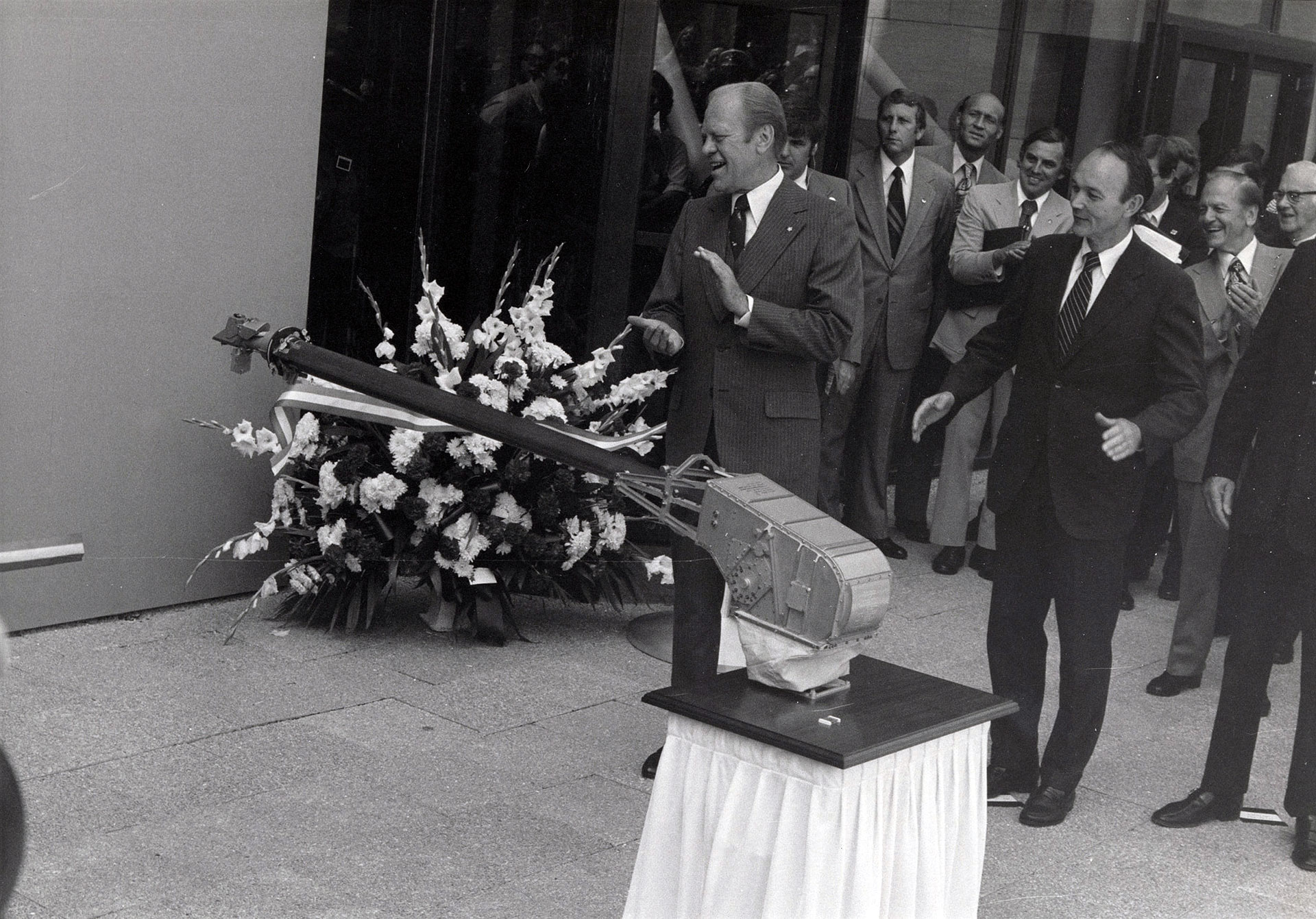
President Gerald Ford and Michael Collins, National Air and Space Museum director, react to the Viking arm cutting the ribbon, opening the building to the public on July 1, 1976.

President Gerald Ford and Michael Collins, National Air and Space Museum director, react to the Viking arm cutting the ribbon, opening the building to the public on July 1, 1976. Credit: Smithsonian

“This beautiful new museum and its exciting exhibits of the mastery of air and space is a perfect birthday present from the American people to themselves,” he said. “Although it is almost impolite to boast, perhaps we can say with patriotic pride that the flying machines we see here, from the Wright brothers’ 12-horsepower biplane to the latest space vehicle, were mostly ‘Made in USA’.”

Nine and a half minutes later, Ford concluded. “Thomas Jefferson said, ‘I like to dream of the future better than the history of the past.’ So did his friendly rival, John Adams, who wrote of his dream ‘…to see rising in America an empire of liberty, and a prospect of two or three hundred millions of freemen, without one noble or one king among them. You say it is impossible. If I should agree with you in this, I would still say, let us try the experiment.’”

“I can only add, let the experiment continue,” said Ford.

Red lights, green lights, snip!

Everyone on the stage then moved over to the entranceway of the new building, the “Smithsonian Institution National Air and Space Museum,” as inscribed on a 12-foot-tall (4-meter) teal backdrop. Mounted atop the temporary wall were two sets of traffic lights, a pair of side-by-side green lights (currently off) and a set of red lights, now blinking.

Centered in front of the wall, about 11 feet (3.45 meters) away, was a small table draped in white cloth supporting a piece of NASA hardware. It may not have been clear to all of the ceremony’s guests and spectators, but mounted to a wood base sitting atop the table was the surface sampler arm from an engineering model of a Viking Mars lander.

A red, white, and blue ribbon was strung between the arm and the wall, passing through the center of the arm’s sampler end.

After the National Air and Space Museum’s opening-day (July 1, 1976) ribbon-cutting concluded, NASA reportedly packed up and took back the Viking engineering arm assembly.

After the National Air and Space Museum’s opening-day (July 1, 1976) ribbon-cutting concluded, NASA reportedly packed up and took back the Viking engineering arm assembly. Credit: Smithsonian

About 36 minutes earlier, NASA initiated a signal to the real Viking 1 probe—then 20 days from landing on Mars—which it then relayed back to Earth. At the distance separating the two planets that day, communications took about 18 minutes one way. The well-traveled command was then received by a tracking station and sent to the engineering arm sitting in front of the museum.

As Ford, Collins and Ripley looked up, the green lights blinked on, confirming the signal had been received.

“I was holding my breath,” said Collins in an interview decades later recalling his role as the first director of the National Air and Space Museum. “I was thinking about all those electrons going lost up there in space and all these VIPs standing around looking at this ribbon and this mechanical shearing device and nothing would happen.”

Part of the challenge was that the time of the opening kept changing. Originally, the museum was scheduled to open on July 4 as a birthday gift to the nation, but it was felt that it would compete with other bicentennial celebrations, and besides, the museum was ready to open.

Then there was the lander at Mars.

Viking 1 was supposed to land on July 4, but when it arrived in its certification orbit two weeks earlier, imagery of the primary landing site showed its terrain was too rough to guarantee a safe landing. NASA delayed the landing to July 20 as a more suitable landing site was sought.

So Collins was already dealing with date and time changes beyond his control.

“But believe it or not, all of the electrons did their cute little things and the ribbon got snipped and the building got opened. It was good,” he said.

An engineering model of a Mars lander on display in a museum.

The Viking proof test article, seen here in the Boeing Milestones of Flight Hall, was donated to the National Air and Space Museum in 1979 by NASA.

The Viking proof test article, seen here in the Boeing Milestones of Flight Hall, was donated to the National Air and Space Museum in 1979 by NASA. Credit: Smithsonian National Air and Space Museum

The doors then opened, and the public got their first look at the Wright brothers’ 1903 Flyer, Charles Lindbergh’s “Spirit of St. Louis” and NASA space capsules, including the command module Columbia that Collins flew to the moon in 1969.

Of course, NASA and the Smithsonian were not going to allow a wayward signal to ruin the day. There was always a backup plan.

“We were prepared to cheat,” said Don Lopez, who was a member of the museum’s original staff and later its deputy director before his death in 2008. “We had a guy in the back with a button to push if it didn’t happen.”

A mystery 50 years in the making

With the ribbon cutting a success, contemporary reports suggest NASA packed up the sampler and took it back with them.

So what became of that arm?

Inside the museum on July 1, 1976, Viking was represented by a static model that had previously been in the US pavilion at the 1975 Paris Air Show and then was on display in the “Life in the Universe?” gallery.

It was not until a few years later (1979) that NASA donated the Viking that millions have since seen in the Boeing Milestones of Flight Gallery—the proof test article that was used on Earth during the Viking 1 and Viking 2 missions to gauge the probes’ behavior and to test their responses to radio commands.

The same model had earlier been used to verify that the landers could survive the stresses they would encounter during launch and landing. It is therefore unlikely, though not impossible, that NASA removed the arm from the test article in 1976 to be used in a ceremony.

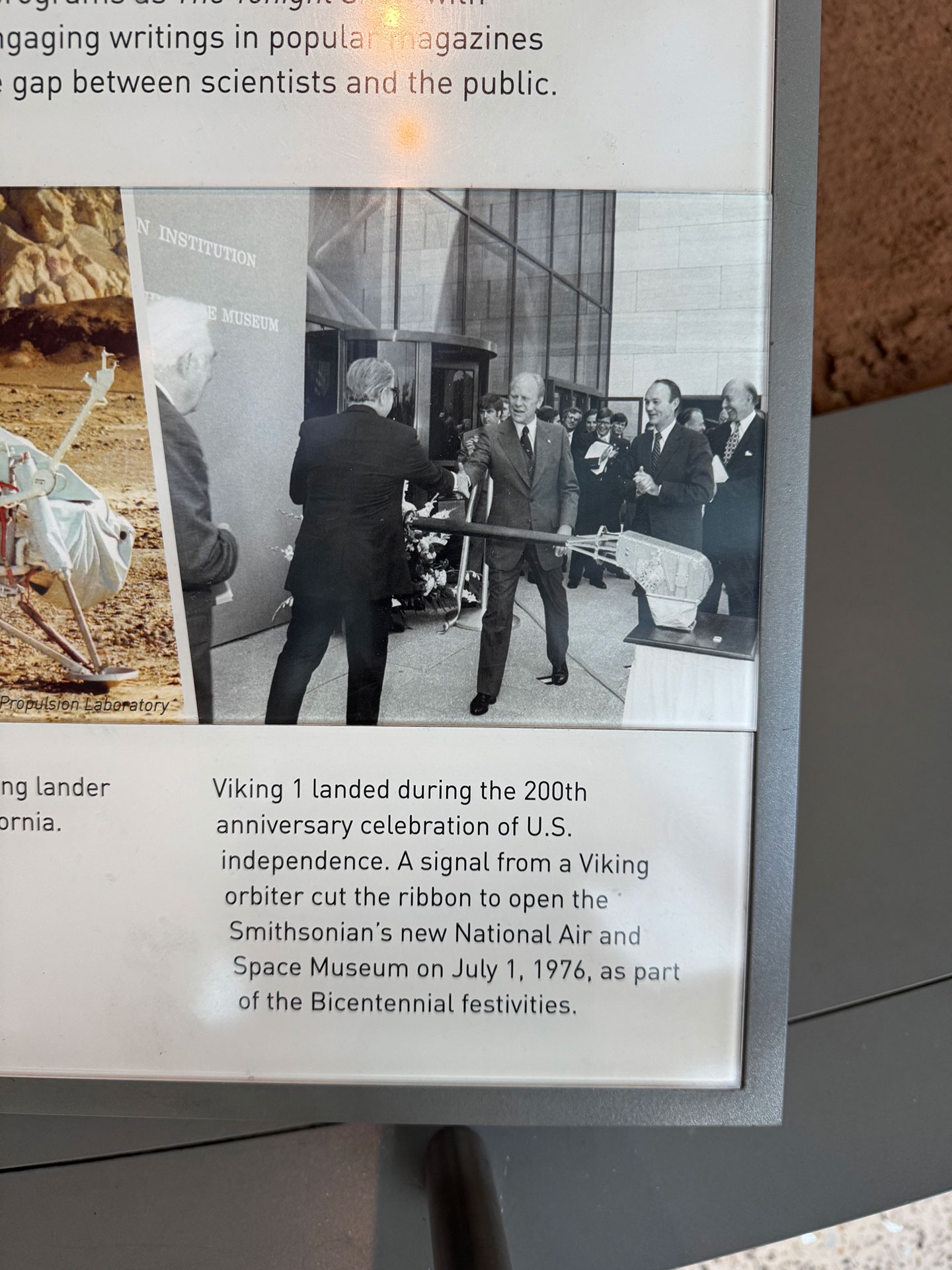
The current signage in the National Air and Space Museum mentions and pictures the ribbon cutting but does not identify the Viking surface sampler arm.

The current signage in the National Air and Space Museum mentions and pictures the ribbon cutting but does not identify the Viking surface sampler arm. Credit: Smithsonian National Air and Space Museum

At least three other active arms were made. In addition to the two on Mars and one at the National Air and Space Museum, engineering models of the sampler are on display today at the Virginia Air and Space Science Center in Hampton (referred to as the science test/thermal effects article) and the California Science Center in Los Angeles (which is either the landers’ static or dynamic test model).

The last one was on exhibit at the Kennedy Space Center Visitor Complex in Florida until 2019, when it was returned to NASA. Today, it’s believed to be at a planetarium in New Jersey.

Unfortunately, photographs and footage from the 1976 ceremony are not clear enough to read the serial or part numbers off the arm assembly, and no one at the museum seems to remember or know which model the arm came from (if any).

On Wednesday morning (July 1), before opening five newly renovated galleries to the public, the National Air and Space Museum will host a private ceremony to mark its 50th anniversary. The event will feature remarks by NASA Administrator Jared Isaacman and Amanda Wright Lane, the great-grandniece of Orville and Wilbur Wright.

The half-century celebration will not hinge on a signal from space. But perhaps on some future commemoration, the arm that opened it all can be identified and given its long-awaited due.

0FansLike
0FollowersFollow
0FollowersFollow
0SubscribersSubscribe
- Advertisement -
Google search engine

Recent Posts