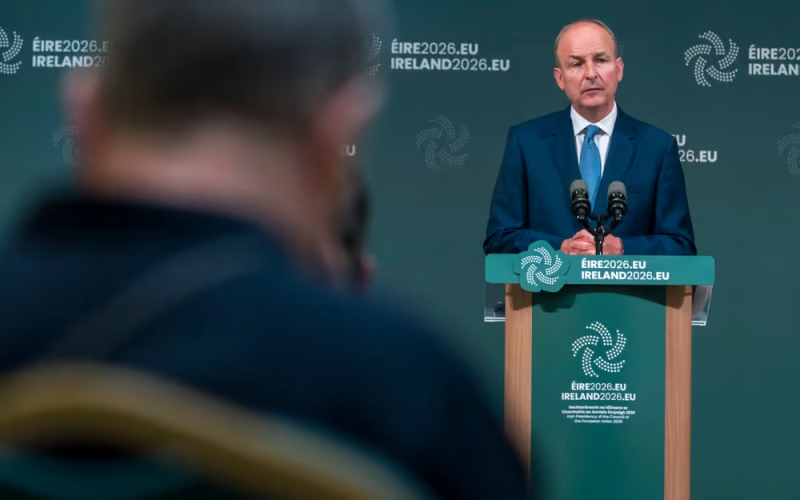
Ireland has assumed the rotating six-month presidency of the Council of the European Union, succeeding Cyprus, with a packed agenda that includes new sanctions on Russia, EU enlargement, negotiations on the bloc’s next long-term budget and mounting global trade tensions.
The presidency marks the eighth time Ireland has held the role since joining the European Economic Community in 1973. Under the Gaelic slogan “Ní neart go cur le chéile” (“Strength with unity”), Dublin will chair negotiations among member states and seek compromises on major legislative and political files.
Taoiseach Micheál Martin said Ireland was taking over “at a critical time for the EU, with greater uncertainty and unpredictability in the world.”
Russia sanctions and enlargement among immediate priorities
One of Ireland’s first challenges will be securing agreement on a new package of sanctions against Russia before a 15 July deadline. Without a deal, the EU’s price cap on Russian oil would automatically be revised under an existing formula, potentially increasing the cap above its current level.
Diplomats expect an agreement to be reached, although Bulgaria has threatened to veto the package if sanctions are imposed on Patriarch Kirill, head of the Russian Orthodox Church, and Lukoil founder Vagit Alekperov. Sofia has also expressed concerns over the impact of the proposed measures on fertilisers and spare parts for its metro system.
Ireland has also made EU enlargement a key priority. Following the opening of the first accession negotiation cluster with Ukraine and Moldova under the Cypriot presidency, Dublin hopes to advance talks further despite Hungary’s cautious stance on the process.
The presidency will also oversee work on Montenegro’s accession negotiations, with Brussels aiming to make the country’s accession treaty a model for future enlargements.
Budget negotiations and trade disputes
Ireland will play a central role in negotiations on the EU’s next seven-year budget, including revised spending proposals and discussions on new EU-wide revenue sources.
The Irish presidency is expected to present a revised negotiating framework in October, as member states seek agreement between maintaining traditional spending on agriculture and cohesion while increasing investment in climate action, innovation, technology and defence.
Trade issues are also expected to dominate the six-month term.
The presidency begins amid renewed tariff threats from US President Donald Trump, who has warned of 100% tariffs on European countries that impose digital services taxes. While trade policy is managed by the European Commission, Ireland will be responsible for maintaining unity among member states should tensions escalate.
At the same time, the EU is preparing possible trade measures against China after recording a €360 billion trade deficit in 2025. Brussels has given Beijing until October to present what it describes as tangible measures to rebalance trade relations.
Ireland will also oversee work on the EU’s “One Europe, One Market Roadmap”, which aims to complete several key economic initiatives before the end of 2026, including legislation on the Savings and Investments Union, the Cybersecurity Act, the digital euro and the proposed Industrial Accelerator Act.
Separately, Ireland begins its presidency while facing scrutiny over allegations involving Aughinish Alumina, Europe’s largest alumina refinery. Following reports linking the company’s business activities to the Russian economy, the Irish government has launched an investigation and said it will share its findings with the European Commission. The outcome could eventually influence future discussions on whether alumina should be included in EU sanctions against Russia.