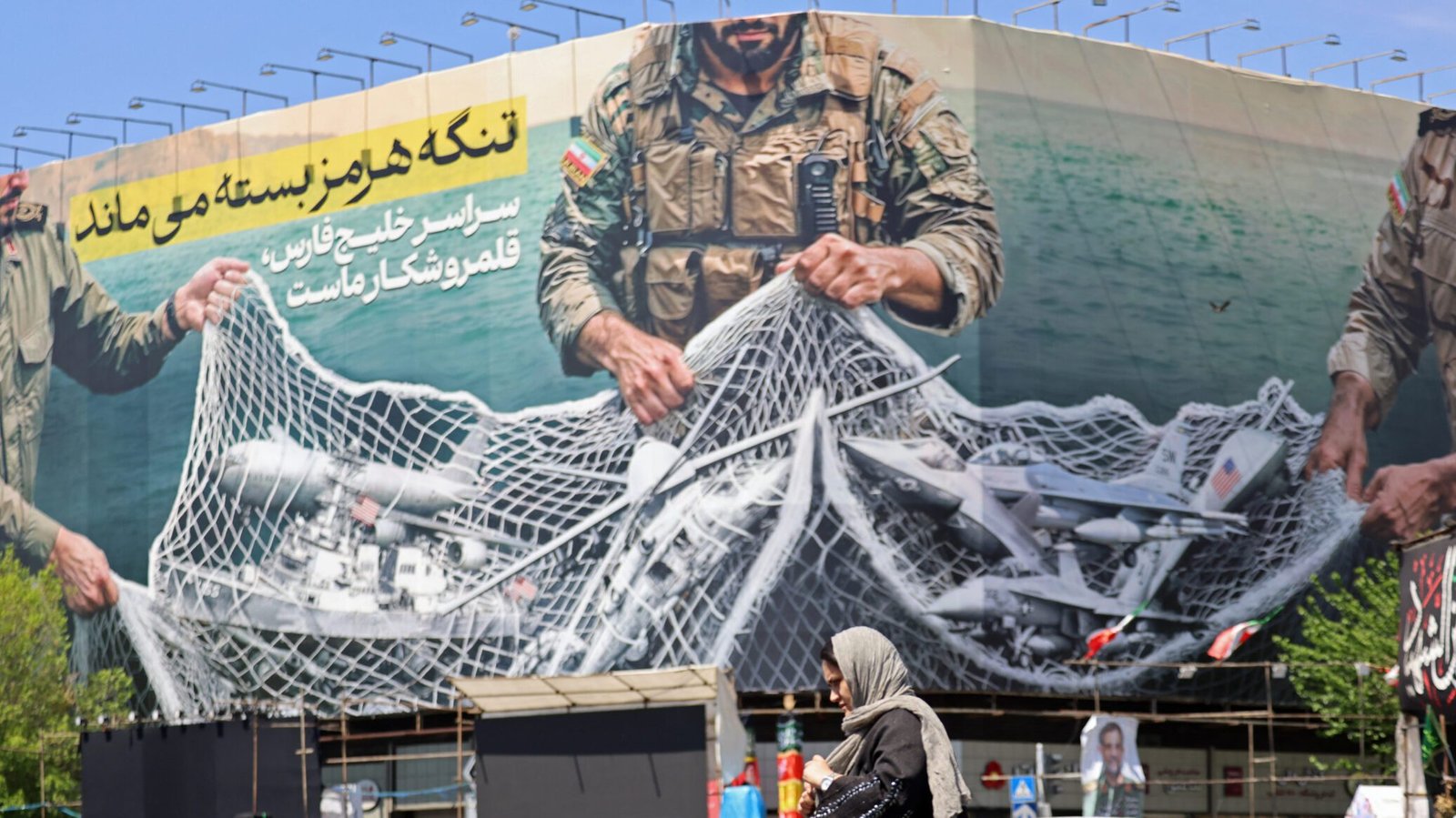
As a ceasefire lowers the risk of direct escalation, movement through Hormuz remains weak, with experts warning that the immediate problem is maritime security, not the lack of pipeline plans
Traffic through the Strait of Hormuz has fallen sharply, and even after the ceasefire announced by President Donald Trump and accepted by Israel, the route is still moving at a fraction of its normal level.
Noam Raydan, a senior fellow at the Washington Institute for Near East Policy, told The Media Line that the latest available data showed activity through the strait, inbound and outbound, was “still very weak” and that “we’re talking about at least five to six vessels.” Earlier in April, before the blockade took hold, the number had risen into double digits. “We were still seeing around between like 10 and 15 vessels,” she said. “But now it’s back down to single digit.”
This is not normal flow. We’re not seeing a kind of healthy movement of ships, non-Iranian vessels.
Her point was not only that traffic has dropped, but that what remains is not the kind of movement usually associated with a functioning waterway. “This is not normal flow,” she said. “We’re not seeing a kind of healthy movement of ships, non-Iranian vessels.” That matters because much of the public discussion in recent days has moved in another direction.
Only days before the ceasefire announcement, Prime Minister Benjamin Netanyahu had again raised the idea of rerouting Gulf exports to the Mediterranean, reviving proposals that have circulated for years without advancing. President Donald Trump, who later announced the ceasefire, had focused on reopening the strait and setting a deadline for further action. On paper, those are two different conversations, one about immediate pressure and the other about longer-term alternatives.
At sea, however, the present crisis continues to define the story. Raydan said, “I’m very careful with how I describe the situation right now,” pointing out the behavior of ships rather than official declarations. “At least one ship we saw making a U-turn in the Gulf of Oman and returning back to the Strait of Hormuz,” she said, adding that this showed “some effectiveness to the blockade.” At the same time, she warned that it was too early to claim a full picture. “As long as we are dealing with these dark activities, it is really difficult to give a full assessment,” she said.
That uncertainty runs through nearly every aspect of the maritime picture. Raydan said some ships linked to Iran are still entering the Persian Gulf, particularly from areas near the United Arab Emirates and Oman, and noted that “some ships are turning off their AIS” (Automatic Identification System).
You need to look at case by case. You cannot just say, ‘Yes, it’s working.’ ‘No, it’s not working.’ It doesn’t work like that.
She also described at least one vessel that went dark in the Gulf of Oman and had not resumed transmitting its signal. The point, as she framed it, was not that nothing is moving, but that what is moving cannot be read in a simple way. “You need to look at case by case,” she said. “You cannot just say, yes, it’s working. No, it’s not working. It doesn’t work like that.” That is a much more complicated picture than the language of full closure or full reopening. Iran, for its part, is not presenting the situation as temporary.
The Islamic Revolutionary Guard Corps has referred to what it calls a “new Persian Gulf order” and said the strait will not return to its previous state. That language matters because it aligns with what is visible in the traffic data: some movement has resumed, but not under the conditions that existed before.
For the shipping industry, the problem is not theoretical, but operational. Raydan said she had seen comments from a Western European shipping company whose vessels were still unable to move because the risk environment remained too uncertain.
It’s very unclear to them what the security situation is, what the security guarantees are. Will Iran attack? What about the mines?
“It’s very unclear to them what the security situation is, what the security guarantees are,” she said. “Will Iran attack? What about the mines?” She was careful there too, saying she did not have concrete data on the mines and stressing that the reports were not a confirmed operational map. But that is precisely the issue from the point of view of shipowners and crews: uncertainty itself is enough to stop movement. “The operational environment for the shipping industry” remains “very volatile,” she said. “There are risks. They need to take them into consideration.”
In practical terms, that means immobility. “We’re talking about hundreds of ships, thousands of seafarers,” she said. “They’re just stuck in the Persian Gulf.” She then described the choice facing vessels in unusually blunt terms. “You wouldn’t expect ships to just decide to sail without coordinating with Iran,” she said. “Either they coordinate, they work with Iran, meaning reach out to Iran, or probably they might be forced to pay, or they just don’t leave.”
That is where the second question begins: if Hormuz is under this kind of pressure, what can replace it?
Prof. Eyal Zisser, vice rector of Tel Aviv University and a scholar of Syrian, Lebanese, and broader Arab politics, told The Media Line that the renewed focus on alternatives reflects a real change in Gulf perceptions, but not a change in the limits those states face. “First of all, we need to wait and see what will be the end, the point where the war will be ended,” he said. “But clearly, Iran became a source of threat. I mean, it was well known, but this time it was materialized.” That is the part he sees as new.
The threat is no longer a background scenario but a present fact. From there, interest in alternatives is unavoidable. “I think they will have to find alternatives,” he said. “And there are alternatives, and they will start, but it takes time.”
I think they will have to find alternatives. And there are alternatives, and they will start, but it takes time.
Asked how realistic current proposals are, he was more direct. “It will take years,” he said. He then added the point that runs through his entire interview and serves as a check on much of the public rhetoric: “And still the Iranians can hit those installations. So, it’s not very easy.”
Vita Avrahamov, a researcher at the Jerusalem Institute for Strategy and Security specializing in geopolitics, economics, and energy issues, gave the quantitative side of that same argument. “There is no immediate solution that can fully replace the energy exports through the Strait of Hormuz,” she told The Media Line.
There is no immediate solution that can fully replace the energy exports through the Strait of Hormuz
In her estimate, the strait normally carries about 20 million barrels of oil per day, while existing alternatives amount to around 3.5 to 5.5 million barrels per day, or roughly 17 to 27 percent of that volume.
“These options are viable as strategic diversification, but not as a full bypass solution,” she said. She broke those alternatives down into three broad directions. The first is the Red Sea route through Saudi infrastructure, which she called “the most immediately viable,” but still limited. “Saudi Arabia’s exports through the Red Sea … is only a partial solution and cannot fully replace exports through the Strait of Hormuz,” she said, adding that the bottleneck is not only the line itself but “limited loading capacity available at the Yanbu export terminal.”
The second direction points toward the Mediterranean, including potential links through Israel or revived Iraq-Turkey routes toward Ceyhan or Haifa. Those, she said, “offer shorter access to European markets but face substantial geopolitical barriers.” The third direction points toward Oman and the Arabian Sea, which she said are “politically more neutral and strategically attractive” but would require major new investment in pipelines, ports, logistics networks, and secure transit arrangements. Her bottom line was that “none currently offers a comprehensive or politically frictionless alternative to Hormuz.”
Raydan was more direct on that point. “Nothing can substitute the Strait of Hormuz,” she said. She did not deny that contingency plans exist. “You can have contingency plans. You can have pipelines like the one in Saudi Arabia, the east-west pipeline to the Red Sea, which has definitely been leveraged in order to push volumes and bypass the Strait of Hormuz. UAE also has a pipeline.” But she immediately pushed back against the way those options are being used in some public commentary. “Let’s be honest,” she said. “We cannot replace, these pipelines cannot replace the flows out of the Strait of Hormuz.”
She then put a number on what is at stake: “We’re talking about an average loading of some 20 million barrels per day,” referring to the period from early January to early March before the war. “We need to be realistic here,” she said. “You can have contingency plans like pipelines, but let’s not pretend.” Her frustration with some of the reporting around the issue came through clearly. “I’ve been seeing a lot of reports about it, that Strait of Hormuz can be substituted and that land routes can substitute sea lanes. It doesn’t work like that.”
That may be the most important corrective to the political conversation now taking shape around the Strait of Hormuz. The problem, as Raydan sees it, is being misdescribed when it is turned into an infrastructure debate too quickly. “It’s more an issue of maritime security,” she said. She returned there at the end of the interview too, saying that “this is a key topic that requires the full focus right now, maritime security, the principle of freedom of navigation,” and that both would remain “a key subject in the region for years to come.”
Zisser, from a different angle, made a similar point when he pushed back on recent political messaging. “Sometimes these statements do not have anything to do with reality,” he said. Later in the interview, when asked what the public might be missing, he was even blunter: “Sometimes … statements by politicians are more wishful thinking than has to do with reality.”
Sometimes … statements by politicians are more wishful thinking than has to do with reality
Avrahamov put it in more technical terms, but the direction was comparable. Large-scale alternatives, she said, require “substantial capital investment, long development timelines, and credible security guarantees,” and their feasibility remains constrained by “enduring geopolitical fragmentation.”
The immediate story is not that a new network is ready to take over from Hormuz. It is that the route still carrying the region’s oil is functioning in a degraded, highly uncertain way, while the options most often cited in public are either partial, politically difficult, or years away.
The ceasefire has lowered the temperature, but not resolved the operating conditions in the strait. Raydan’s description remains the clearest one: traffic is “still very weak,” non-Iranian movement is not healthy, ships are stuck, and the whole question cannot be settled with slogans about pipelines. For now, Hormuz is still the system in use. It is just a system under stress. And as Raydan put it, “Nothing can substitute the Strait of Hormuz.”