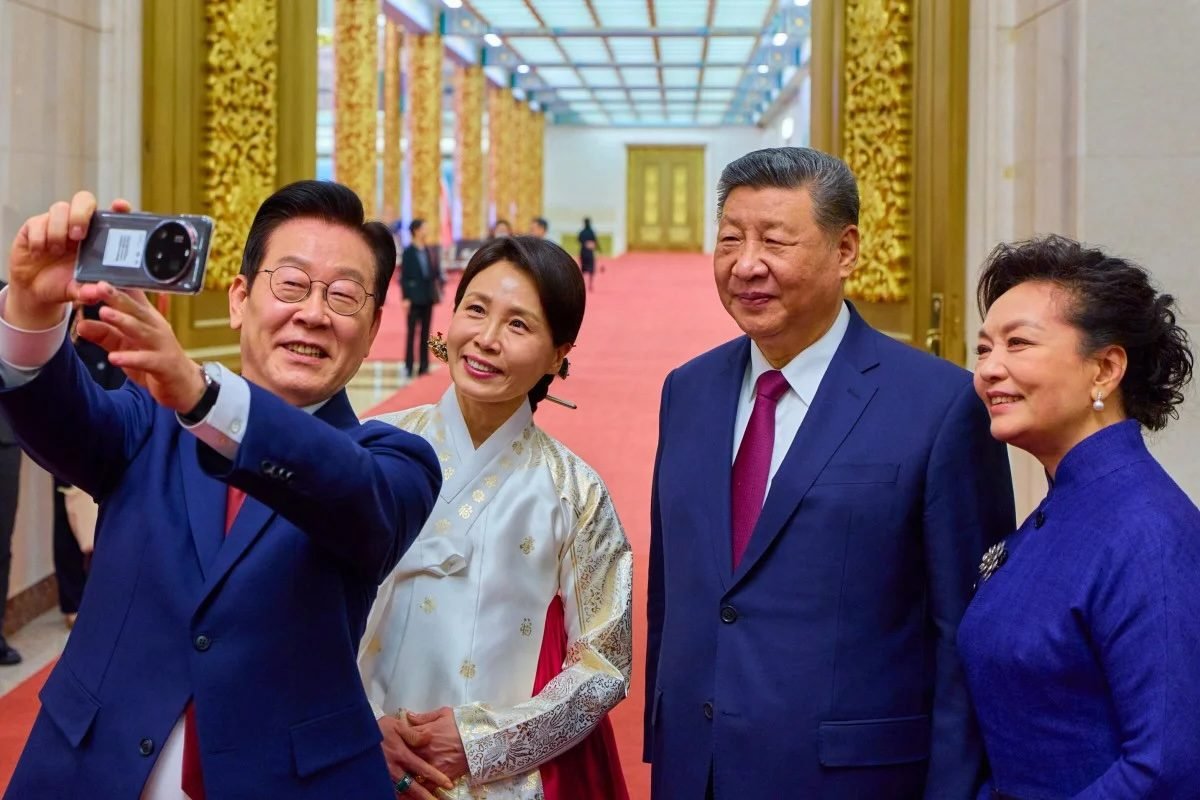
The impending three-day visit of President Lee Jae-myung to India is not routine diplomacy – it is a strategic inflection point for both countries and the wider Indo-Pacific. The regional order that once underpinned stability is fragmenting. Economic interdependence is increasingly a liability, and long-standing security guarantees are under strain.
In this shifting landscape, India and the Republic of Korea face a common reality: the frameworks that supported their growth and security are eroding. This visit must therefore be treated as a strategic intervention, not another exercise in signing memoranda of understanding. Incremental, transactional engagement is no longer sufficient. What is at stake is not just economic cooperation, but long-term strategic autonomy and resilience in an increasingly contested region.
A strategic landscape in flux in Korea
The Republic of Korea currently stands at a decisive strategic crossroads. Internal divisions concerning foreign policy orientation – particularly between constituencies advocating deeper alignment with the United States and Japan, and those favoring expanded engagement with China and Russia – have moved beyond abstract debate and are now shaping tangible policy outcomes. These divergences carry significant implications for the evolving balance of power in the Indo-Pacific.
South Korea’s economic and security posture has long been defined by a structurally embedded balancing strategy. On one hand, its security architecture remains closely tied to the United States, with approximately 28,500 US troops stationed on the peninsula and a bilateral alliance that has persisted for over seven decades. On the other hand, China accounts for approximately 20–25 percent of South Korea’s total trade, rendering it Seoul’s largest trading partner by a substantial margin.
South Korea’s internal policy divide is now more pronounced than at any point in the past decade. The US alliance-oriented camp continues to emphasize shared democratic values, credible deterrence against North Korea, and the maintenance of a rules-based international order underpinned by close coordination with the United States. In contrast, the China-oriented camp prioritizes economic pragmatism, deeper supply chain integration with China, and a calibrated hedging strategy designed to preserve flexibility.
Recent geopolitical developments have further accentuated this divide. Perceptions of a less-than-decisive performance by US military power in crises linked to Iran are strengthening the position of those in Seoul who advocate a more autonomous foreign, security, and defense posture. This perception – irrespective of its empirical accuracy – is politically consequential. It is accelerating calls for enhanced strategic self-reliance and diversification of partnerships, thereby complicating the long-standing logic of exclusive dependence on US-led security frameworks. This evolving dynamic has produced a structural paradox: a posture of heightened caution in security affairs coexisting with deep and persistent economic interdependence.
Why this matters for India
For India, the implications are substantial. South Korea is not merely a bilateral partner; it constitutes an important node within the broader Indo-Pacific strategic architecture. Bilateral trade has surpassed $27 billion in recent years, with stated ambitions for it to reach $50 billion. South Korean firms such as Samsung, Hyundai, and LG have collectively invested more than $10 billion in India, contributing to manufacturing capacity, employment generation, and technological diffusion.
More fundamentally, the partnership aligns with India’s strategic vision of a free, open and inclusive Indo-Pacific. Both countries share convergent concerns regarding supply-chain vulnerabilities, maritime security and technological resilience. Should the Republic of Korea prove unable to effectively manage the expanding influence of China across both its economic structures and security policy, the consequences would extend well beyond the Korean peninsula and manifest across multiple strategic domains.
The immediate impact would likely involve a weakening of efforts to diversify global supply chains, as deeper economic entanglement with China would constrain Seoul’s participation in alternative production and technology networks.
This would, in turn, reduce the effectiveness of emerging minilateral frameworks designed to enhance resilience and coordination among like-minded states. At a systemic level, such a trajectory could contribute to the gradual erosion of democratic alignment in the Indo-Pacific, as normative cohesion yields to economic compulsion.
For India, the consequences would be particularly acute – including increased strategic pressure along its eastern periphery and a more constrained regional operating environment. This is not a speculative scenario but an observable and accelerating trend.
The failure of transactional engagement
India’s approach to South Korea has been broadly competent but insufficiently ambitious, notwithstanding official narratives of a rapidly expanding strategic partnership. Engagement has too often been framed in transactional terms – encompassing trade agreements, investment facilitation and incremental cooperation – rather than being situated within a comprehensive strategic vision.
This orientation has produced three principal shortcomings.
First, there has been an underutilization of strategic convergence across key sectors such as defense, technology and maritime security.
Second, India’s influence within South Korean strategic discourse remains limited, as it is not yet perceived as a central actor when compared with the United States or China.
Third, India has not consistently addressed South Korea’s core concerns – including supply-chain security, export controls, North Korean threats and regional instability – with sufficient clarity or urgency. In a rapidly evolving geopolitical context, such incrementalism constitutes a structural limitation.
The New Delhi visit – a strategic opportunity
The forthcoming presidential visit should be reframed as a strategic reset rather than a ceremonial engagement. It offers a valuable opportunity to signal long-term commitment, align strategic priorities and reshape perceptions within both countries’ policy communities. The prevailing pattern of concluding numerous memoranda of understanding without substantive follow-through must be reconsidered.
India and South Korea exhibit strong complementarities in technology and supply chain resilience. South Korea’s advanced capabilities in semiconductors and its dominance in the global DRAM market, when combined with India’s expanding investments in electronics manufacturing, provide a foundation for a structured and mutually beneficial partnership. Such collaboration can reduce dependence on China while generating sustained economic gains.
Defense cooperation remains comparatively underdeveloped relative to its potential. South Korea’s position as a major defense manufacturer and India’s expanding requirements and emphasis on domestic production creates significant scope for joint development, co-production and technology transfer. These initiatives would strengthen defense industrial capacities while advancing shared strategic objectives.
Maritime cooperation should also be elevated, particularly within the Indian Ocean region, given its centrality to global energy trade and regional stability. Simultaneously, greater emphasis must be placed on sustained institutional engagement. India must deepen its interactions with South Korean think tanks, universities, and policy institutions in order to build long-term influence. Strategic alignment is not instantaneous; it emerges through sustained intellectual exchange and consistent diplomatic investment.
Countering strategic drift
A central challenge in the bilateral relationship is the growing perception within segments of South Korean discourse that alignment with China is both economically inevitable and strategically rational. This narrative necessitates deliberate and sustained engagement at multiple policy levels by India.
India is well positioned to offer an alternative framework for cooperation – one that integrates strategic autonomy with diversified partnerships. Unlike rigid alliance systems, India’s approach emphasizes flexibility, resilience and mutual respect. This aligns closely with South Korea’s own imperative to avoid excessive dependence on any single power while preserving policy autonomy.
A strengthened India-South Korea partnership enhances strategic autonomy for both countries. For South Korea, it reduces overreliance on China and expands its strategic options. For India, it reinforces its presence in East Asia and contributes to a more balanced Indo-Pacific order. This engagement is not about alignment in binary terms but about constructing equilibrium within the regional system.
The costs of inaction are considerable. A failure to act decisively could result in a gradual realignment of South Korea toward China’s economic and strategic orbit, while India risks marginalization in a region central to its long-term interests. More broadly, such inertia could weaken the Indo-Pacific architecture, as strategic vacuums are inevitably filled by actors willing to act with greater urgency.
A moment that demands clarity
The Republic of Korea is not yet lost to India’s strategic competitors, but the window for shaping its trajectory is narrowing. Within its policy establishment, there remains a core constituency committed to democratic alignment and diversified partnerships. This segment must be actively engaged, reinforced, and systematically cultivated.
India cannot afford hesitation; timing is now a decisive factor. The upcoming visit to New Delhi must deliver more than symbolic outcomes – it must generate tangible, forward-looking results and commitments that meaningfully redefine the partnership. This is a moment that demands clarity of purpose, ambition, and strategic resolve.
The Indo-Pacific order will not be shaped by passive actors. It will be defined by those who recognize inflection points and act with determination. India must be among them. The time to lead from the front has arrived.