Axios, citing classified US intelligence, said Cuba had over 300 military drones from Russia and Iran and discussed possible attacks on the US naval base at Guantánamo Bay, US military vessels, and Key West
Tensions between Washington and Havana appear to be rising as several pressures converge: President Donald Trump’s escalating rhetoric, Cuba’s worsening economic crisis, US pressure on Havana’s foreign ties, and new allegations—reported by Axios and not independently verified by Reuters—that Cuba acquired military drones from Russia and Iran.
The central issue is not whether Cuba could defeat, or even seriously threaten, the United States militarily. The question is whether alleged defensive preparations, US domestic politics, regional escalation, and Trump’s broader use of coercive pressure could create a pretext for a dangerous confrontation less than 100 miles from Florida.
Axios, citing classified US intelligence, said Cuba had acquired more than 300 military drones from Russia and Iran and had discussed possible attacks on the US naval base at Guantánamo Bay, US military vessels, and Key West, Florida.
Reuters said it could not independently verify the Axios report. Cuban Foreign Minister Bruno Rodríguez Parilla accused Washington of fabricating a “fraudulent case” to justify sanctions and potential military intervention, while Havana has framed any military preparation as part of its right to self-defense under international law.
Cuban President Miguel Díaz-Canel also warned that any US military action would lead to a “bloodbath” and “incalculable consequences” for regional peace and stability. At the same time, he insisted that Cuba “does not represent a threat,” directly rejecting the US narrative that Havana could pose an offensive danger to American territory.
The allegations emerged as the Trump administration intensified sanctions on Cuba, targeting 11 officials, several military figures, and the island’s main intelligence agency. Reuters reported that the designations are part of a wider campaign that includes efforts to block most Venezuelan oil shipments to Cuba, a measure that has worsened the island’s fuel shortages, power outages, and economic crisis.
President Trump has also repeatedly framed Cuba as a potential target after Iran and Venezuela. In March, he said Washington could soon reach a deal with Cuba or take other action after Iran, signaling that developments in the long-strained relationship could move quickly. Reuters also reported earlier statements in which President Trump raised the possibility of a “friendly takeover” of Cuba, while the Cuban government denied that high-level talks were taking place.
This is the context in which the drone allegations are being interpreted: not only as an intelligence question, but as part of a wider pattern of coercive pressure by Washington against adversaries in different regions. The comparison to the Middle East is less about a formal Cuba-Iran axis than about a recurring method—sanctions, threats, regime-change language, and negotiations conducted under pressure.
Still, a reported drone capability is not the same as evidence of an imminent Cuban attack. Jorge I. Domínguez, a Cuba specialist and retired Harvard government professor, cautioned against treating the allegations as established fact.
He told The Media Line that the drone allegation had not been established and noted that most of Cuba’s conventional military equipment still dates to the Soviet era, with only limited Russian updates.
He laid out three possible interpretations of the drone report: fabrication, deterrence, or a trigger for broader US military action.
Domínguez said the report could reflect three possibilities: that Cuba has no drones and the claim is being used to justify escalation akin to the “weapons of mass destruction” claim made against Iraq in 2003 which was later debunked; that Cuba has drones for deterrence; or that Washington could use such a capability as grounds for military action, which he said would be difficult to confine to a narrow ‘surgical’ strike.
His assessment points to the core danger: even if the drone allegation is true, the military implications are not straightforward. A limited drone stockpile would not necessarily give Havana the capacity to sustain a war with the United States. It could, however, reshape Washington’s risk calculus, especially if US officials argue that drones near American territory or Guantánamo Bay constitute an unacceptable threat.
Domínguez also rejected the idea that Cuba would rationally choose to attack US territory. He argued that Cuba had never attacked Guantánamo Bay or US soil and had no rational incentive to do so. “It would be madness to do so, and the Cuban leaders may be many things, but stupid is not one of them,” he said.
That distinction is important. Cuba may seek defensive deterrence, especially if it believes US intervention is possible. But a deliberate Cuban attack on American soil would invite an overwhelming US response and would likely be politically suicidal for Havana.
For this reason, the more immediate risk may not be a Cuban offensive move, but a US decision to interpret Cuban military preparations as justification for action.
Reuters also reported that the Trump administration accused Cuba of allowing the island to be used for foreign intelligence, military, and terrorism-related activities. Havana rejected that accusation and said Washington was manufacturing a case for intervention.
President Trump’s language has blurred the line between coercive diplomacy and regime-change signaling. For Domínguez, Trump’s “friendly takeover” formulation should be understood as political rhetoric but not dismissed as harmless.
No takeover of Cuba would be friendly
Domínguez said the phrase functioned as threatening political messaging, especially toward Cuban-American audiences in South Florida, while requiring no immediate action from the president. Practically, he added, “No takeover of Cuba would be friendly.”
The phrase may have been aimed at several audiences at once: Cuban-American voters in Florida, Cuban officials, regional partners, and other US adversaries. But that ambiguity can itself increase risk by preserving pressure without clearly defining the policy end state, leaving Havana to guess whether the threat is symbolic, electoral, diplomatic, or operational.
Whether this amounts to a coherent Trump doctrine is less clear. Domínguez argued that the president’s approach to Iran, Cuba, and other crises looks less like a structured strategy than a series of improvised pressure moves.
Whether there is an overall ‘Trump strategy’ is very unclear. The president’s approach to the war in Iran has changed, sometimes within a 24-hour cycle
“Whether there is an overall ‘Trump strategy’ is very unclear. The president’s approach to the war in Iran has changed, sometimes within a 24-hour cycle,” he said.
The connection between Cuba and the Middle East is therefore not necessarily ideological. Cuba and Iran do not share a deep strategic project comparable to Cold War alliances. But both are adversaries of Washington, both are under US pressure, and both may look for ways to complicate American planning. Russia adds another layer, given its long-standing relationship with Havana and its current strategic dependence on asymmetric tools, including drones, after years of war in Ukraine.
Domínguez described this as an old geopolitical pattern rather than a new anti-American bloc.
“One old pattern of behavior is that the enemy of my enemy might be my partner. The Cuban and Iranian leaderships have little in common other than their common US adversary. Collaboration between the two governments in the past has been slight, but there has been some,” he said.
He added that Russia has long been a Cuban partner, but that the relationship today is far weaker than it was in the Cold War.
This matters because overstating Cuba’s role as a Russian or Iranian platform risks misunderstanding the balance of power. Cuba is not a second front comparable to Iran. It is a fragile state under severe economic pressure, geographically close to the United States, but militarily weak.
“The Cuban government is so weak relative to the US that it would be laughable to worry about its being a platform to pressure Washington
“The Cuban government is so weak relative to the US that it would be laughable to worry about its being a platform to pressure Washington,” Domínguez said.
He added that the more plausible threat to the United States would be a Cuban state collapse, with humanitarian fallout and mass migration rather than a direct military challenge.
This is where the most serious scenario may emerge. A US pressure campaign could further weaken Havana, but the collapse of the Cuban state would not automatically produce a stable, pro-American transition. It could instead produce social disorder, mass migration, and a humanitarian emergency.
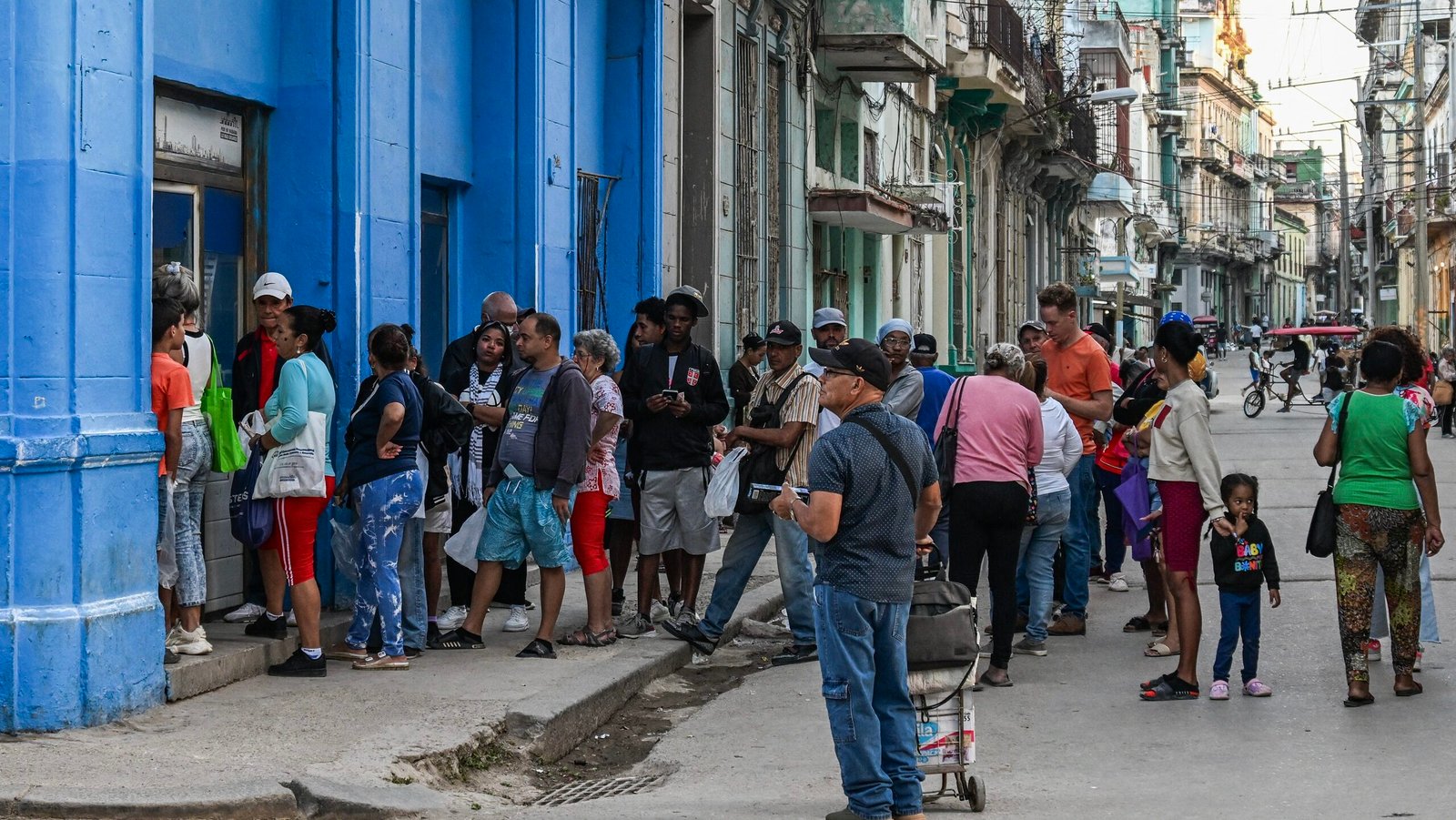
Cuba’s internal crisis is already severe. Reuters has reported that sanctions and efforts to block Venezuelan oil shipments have worsened fuel shortages and prolonged electricity outages on the island.
These shortages are not simply economic indicators; they affect food distribution, medicine, transport, public services, and the Cuban state’s capacity to preserve order.
Dr. Jorge Duany, former director of the Cuban Research Institute at Florida International University, told The Media Line that possible futures for US-Cuba relations range from a negotiated transition to collapse and even military intervention.
“Under the first scenario, the Trump administration could offer substantial economic relief in exchange for significant political and economic concessions, such as the release of political prisoners and the expansion of private enterprise on the island,” Duany said.
“This scenario would follow the playbook of the Trump administration in Venezuela, although it remains unclear who could act as an intermediary between Cuba and the United States, akin to Delcy Rodríguez’s role in Venezuela,” he added.
But Cuba is not Venezuela. Domínguez warned against assuming that a Venezuela-style political transition can simply be transferred to Havana.
“If the Cuban government were toppled, one difference with Venezuela is that there is no equivalent to Maria Corina Machado, the superbly effective opposition organizer. Is there a Cuban Maduro? No. The leadership has become collective since Raúl Castro stepped down and aged even more. Kidnapping Raúl would not topple the regime,” he said.
He also said it was unclear whether Cuba had any insider figure capable of brokering or facilitating a transition.
That lack of a clear alternative structure is one of the central uncertainties. A negotiated transition would require credible interlocutors, guarantees, and a domestic Cuban actor capable of managing change. A forced collapse would provide none of those conditions.
Duany’s second scenario is more destabilizing: the internal disintegration of the Cuban state under economic pressure.
He said a second scenario would involve the regime’s inability to provide basic subsistence needs such as food, medicine, and fuel, leading to instability, protests, and broader social disorder.
“Such circumstances could create the conditions for a new, massive wave of refugees to the United States. Several observers have recently noted that large-scale uncontrolled outmigration would likely represent the most serious security threat to the United States,” he noted.
That analysis aligns with the current humanitarian picture. If Cuba’s economy deteriorates further, the most direct consequence for Washington may not be a drone strike or military confrontation, but a disorderly migration crisis. In that sense, Cuba’s weakness could become more destabilizing than its military capacity.
The third scenario is military, though not necessarily a full-scale invasion. Duany argued that a more limited operation could become conceivable if Washington links Cuba to a legal case against Raúl Castro. Reuters reported that, according to a US Justice Department official, the Trump administration was planning to indict Castro over the 1996 shootdown of two planes operated by Brothers to the Rescue, while other reporting has described such charges as under consideration.
“The final scenario, which could coincide with the second, would involve a limited military operation following the Venezuelan experience, where former President Nicolás Maduro was extradited on drug trafficking charges,” Duany said.
“If the United States indicts former Cuban President Raúl Castro for the 1996 shootdown of four pilots of an anti-Castro exile organization, he could also be exposed to a targeted commando raid,” he added.
At the same time, Duany stressed that a full invasion remains unlikely.
“The human, economic, and political costs make a full-fledged US invasion of Cuba highly unlikely at this moment,” he noted.
This distinction is important. The most plausible escalation may not be a conventional invasion of Cuba, but a sequence of coercive steps: sanctions, indictments, intelligence warnings, interdictions, limited operations, and diplomatic pressure framed as a path toward transition. The danger is that each step could narrow the space for negotiation while increasing Havana’s incentive to demonstrate deterrence.
If verified, the drone allegations would fit that logic without making Cuba anything like a peer military threat. They could still provide Washington with a security rationale for escalation. If they remain unverified, they may still shape public perception and strengthen the political case for further pressure.
The Cuba crisis is therefore connected to the Middle East, not because Havana is another Iran, but because the same strategic language is being applied across theaters: adversaries are told to make a deal, accept pressure, or face consequences. Iran, Venezuela, and Cuba are different cases, with different military capacities and internal dynamics. Yet, in Trump’s rhetoric, they appear as linked tests of American coercive power.
For now, the most dangerous element may be uncertainty itself. Cuba is weak, but not passive. Washington is powerful, but not always predictable. Russia and Iran may offer Havana symbolic or limited military support, but neither can realistically protect Cuba from the United States. The result is a crisis in which miscalculation may matter more than planning.
As Domínguez put it, “random chance” may play as large a role as any formal scenario.