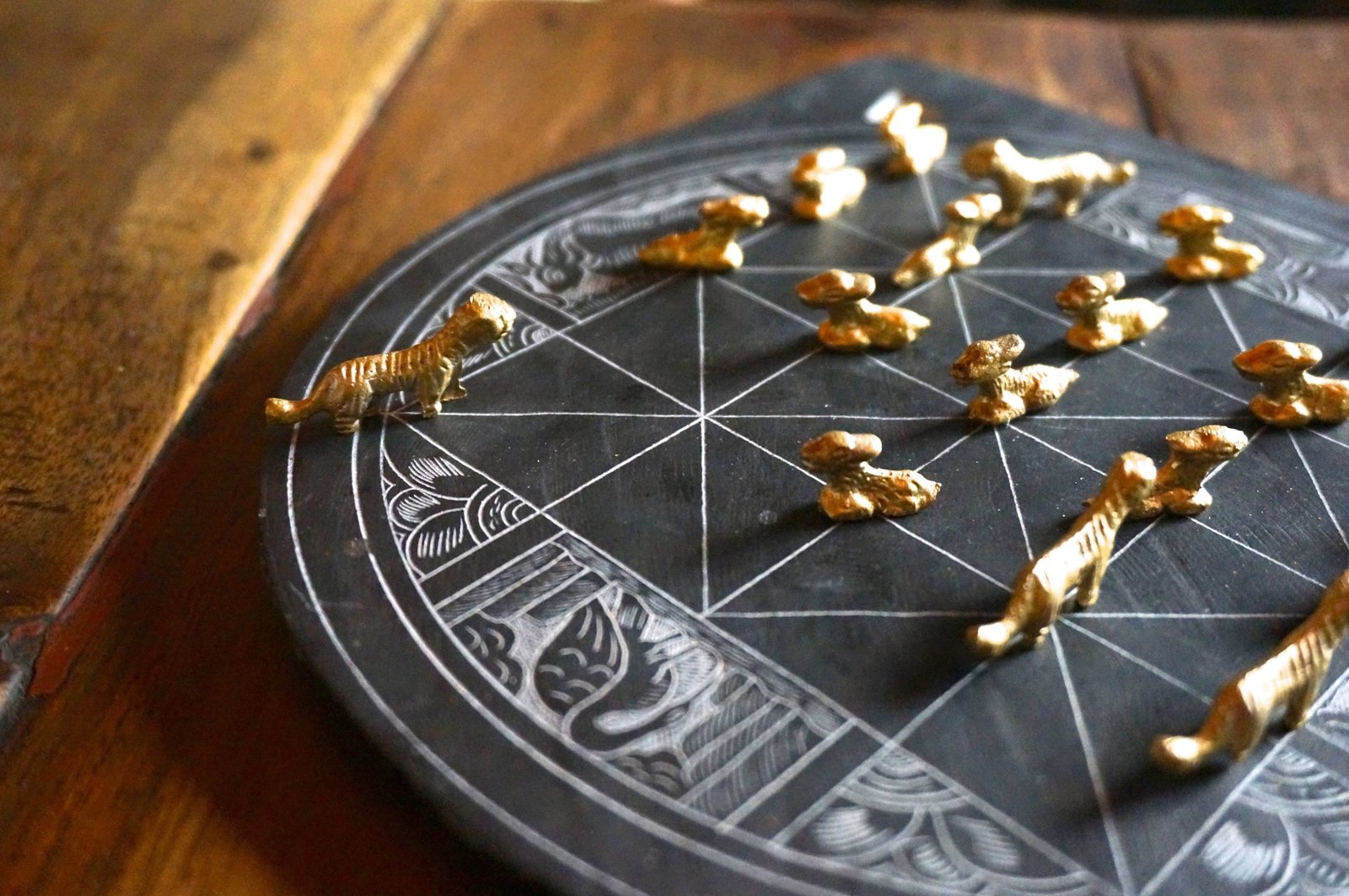
Somewhere in the foothills of Nepal, old men still gather around a wooden board carved into a five-by-five grid, moving carved tigers and goats across its intersections with quiet concentration. The game is called Bagh-chal — literally, ‘Tiger Move’ — and it has been played here for a thousand years. Most young Nepalis have never heard of it and that is a shame. Right now, in the deserts and mountain ranges of West Asia, Bagh-chal is being played on a very large scale.
The US-Israeli-Iran war is, for the moment, frozen. Washington rejected Tehran’s proposal. Tehran rejected Washington’s. After months of air strikes, proxy battles, and nervous watching of oil prices, the conflict has settled into something neither side wanted — a stalemate. To understand how that happened, forget the think-tank reports for a moment. Pull out a Bagh-chal board instead.
A game of asymmetric opponents
Bagh-chal is not a fair game, and that is precisely the point. This game is between two opponents, whom we call “Tiger” and “Goat.” Four tigers face twenty goats across a grid of twenty-five intersections.
The tigers are fast, aggressive, and dangerous — they can jump over goats and remove them from the board. Win the game by capturing five goats, and the tigers have done their job. The goats, slow and individually weak, have a different task entirely: surround the tigers, block every possible move and grind the game to a halt.
This is not a trivial math problem but a strategic equilibrium. As noted by researchers Lim Yew Jin and Jurg Nievergelt, Bagh-chal always ends in a draw when both players play optimally. Defeat for either side is typically associated with sub-optimal performance. The size of the game tree for Bagh-chal can reach 10⁴¹, similar to that for chess; however, the result will generally be a win, a loss or a draw. The tigers are simply too powerful to beat but they may face a defeat or a draw.
What the game knows but the modern military strategist forgets all too easily is that might does not equal victory. The tiger may eat four goats and yet not win the game. Might without position is mere bluster.
The tigers’ strike
Operation Epic Fury was initiated by the US and Israel on February 28, 2026. It was a huge undertaking that involved attacks on Iranian nuclear infrastructure, the manufacture of its missiles, its military generals, and even the residence of the supreme leader. Bases and support from the Gulf Cooperation Council nations were made available. For a few weeks, it seemed that the tigers were really enjoying their game.
Iran’s conventional navy was degraded. Its air defenses were repeatedly punched through. Senior commanders were killed. The kind of damage that would have crippled a lesser state was inflicted, and the world watched. American and Israeli planners had done their homework on hard targets. Their intelligence was good, their munitions precise, their execution disciplined.
However, there comes the point where Bagh-chal’s analogy works best: A tiger that runs ahead in the game and takes one goat at a time eventually ends up running away from its own strength; the tiger wins battles but loses the war. This was precisely how the situation played out: The US-Israeli axis continued winning battle after battle, while strategically losing ground.
Iran’s geography — the Zagros Mountains, dispersed underground facilities, a network of proxy forces stretched across four countries — made it nearly impossible to deliver a knockout blow. Every strike that degraded one node activated three others. The Strait of Hormuz was disrupted. GCC infrastructure took retaliatory hits. Global energy markets went haywire. What was intended as a swift campaign of coercion became, incrementally and then all at once, a prolonged war of attrition.
The goats hold the board
Iran’s strategy for the past two decades has been to build exactly the kind of resilience that makes conventional superiority less useful. Hezbollah in Lebanon, the Houthis in Yemen, various militia networks in Iraq and Syria — these are not simply “terrorist” proxies as American and Isarelis termed them. They are, in Bagh-chal terms, goats placed carefully across the regional board. They do not need to beat the tiger. They need to make the board ungovernable.
And that is what they did. While Iran absorbed punishing strikes — thousands of civilian casualties, millions displaced, significant damage to its conventional military — the “mosaic” of its national security architecture held together. Leadership decapitation did not produce collapse. Institutions adapted. Proxies filled gaps. The supreme irony of modern asymmetric conflict is that the side absorbing the most punishment is not necessarily the side that is losing.
The “goat” strategy is brought to life here. Suffer losses, stick together, sacrifice when required, and always block the tigers from obtaining any clear road to victory. It is far from glorious. It is certainly uncomfortable. But it gets the job done. By April 2026, when the ceasefire came, it reflected precisely this reality. Iran had not won. America had not won. Israel had not won. The board had been played to a draw — not because anyone chose it, but because optimal play on both sides, across months of brutal conflict, produced the outcome that Bagh-chal’s mathematics predicted it would.
GCC states are victims of multipolarity
Gulf Cooperation Council states merit a specific mention as well because their position within the current situation was very awkward for them. They were nominally part of the American-Israeli offensive operation but became subjects of Iranian reprisal operations that they did not want to be a part of.
As seen through the eyes of Bagh-chal, it was a herd unable to keep together. Not out of fear, but because it only takes common sense to realize it’s not safe to be sandwiched between tigers and goats fighting for the board.
Meanwhile, China and Russia offered Iran the kind of indirect support — economic lifelines, diplomatic cover, weapons components — that sustained the goat formation when it might otherwise have faltered. The multipolar world that both Moscow and Beijing have been advocating for years found a concrete expression in this conflict: The tigers’ dominance was contested not by a single rival but by a structural shift in how the board is organized.
What the game tells us
Bagh-chal was not designed as a political theory. It was designed as entertainment, as a test of wit between neighbors on a winter evening. But games that survive a thousand years tend to have encoded in them some truth about the world.
This is not going to be the first instance where the mighty state learns this lesson the hard way. West Asia, similar to Bagh-chal, requires patience and formation rather than haste and violence. The goats need not roar. It’s simply required that they stay in place.
The 2026 Iran conflict has several lessons worth sitting with:
1) Material superiority does not translate automatically into strategic victory. The US and Israel had overwhelming conventional advantages. They achieved everything their targeting lists called for. And they still could not force Iran into the outcome they wanted.
2) Endurance is a form of power. Iran’s ability to absorb punishment and keep functioning — economically, militarily, institutionally — was itself a strategic weapon. Resilience is not passive. It is the deliberate construction of a system designed to absorb shocks.
3) What constitutes a victory is an evolving concept. Ten years ago, to win the Iran problem involved regime change or total denuclearization. Now, following Epic Fury, there is a silent conversation about whether the status quo of nuclear deterrence is all that can be realistically achieved.
4) Board control matters more than body count. Iran never matched US firepower. It did not need to. It needed to control enough of the regional space — through proxies, geography, economic leverage — that no clean solution was available to its opponents.
A thousand-year-old warning
There is something quietly humbling about watching the world’s most sophisticated military apparatus arrive at the same conclusion that Nepali villagers built into a wooden board game a millennium ago.
You can be the tiger. You can be faster, stronger, and better armed. You can capture goat after goat and feel the momentum of the game in your favor. And then you look up, and the board is surrounded. Every path forward is blocked. You have not been beaten — you have been immobilized. And in this game, immobilization is tiger’s defeat.
Bagh-chal is disappearing from Nepal. The young people do not play it anymore; screens are more entertaining than carved wooden boards. That is unfortunate, because the game carries a warning that the screen is not delivering clearly enough: in geopolitics as in Bagh-chal, the side that seems to be winning early is not always the side that wins in the end.
The tigers roared. The goats held their formation. The board, for now, is contested — which is exactly how the game was always supposed to go.
Follow Bhim Bhurtel on X at @BhimBhurtel and subscribe to his Substack here.