The Georgia-Israel model has proven that through economic ties, tourism, and people-to-people initiatives, diplomacy is possible
“I want to tell them that it is possible to establish 100 public diplomacy offices around the world at no cost to the State of Israel.”
It is the kind of promise that can sound implausibly large: a global network built without a state budget, formal diplomatic postings or a conventional government campaign. But for Itsik Moshe, the proposal is not a theory. It is an attempt to take a model forged over decades between Israel and Georgia—through business, tourism, culture and personal relationships—and reproduce it far beyond the Caucasus.
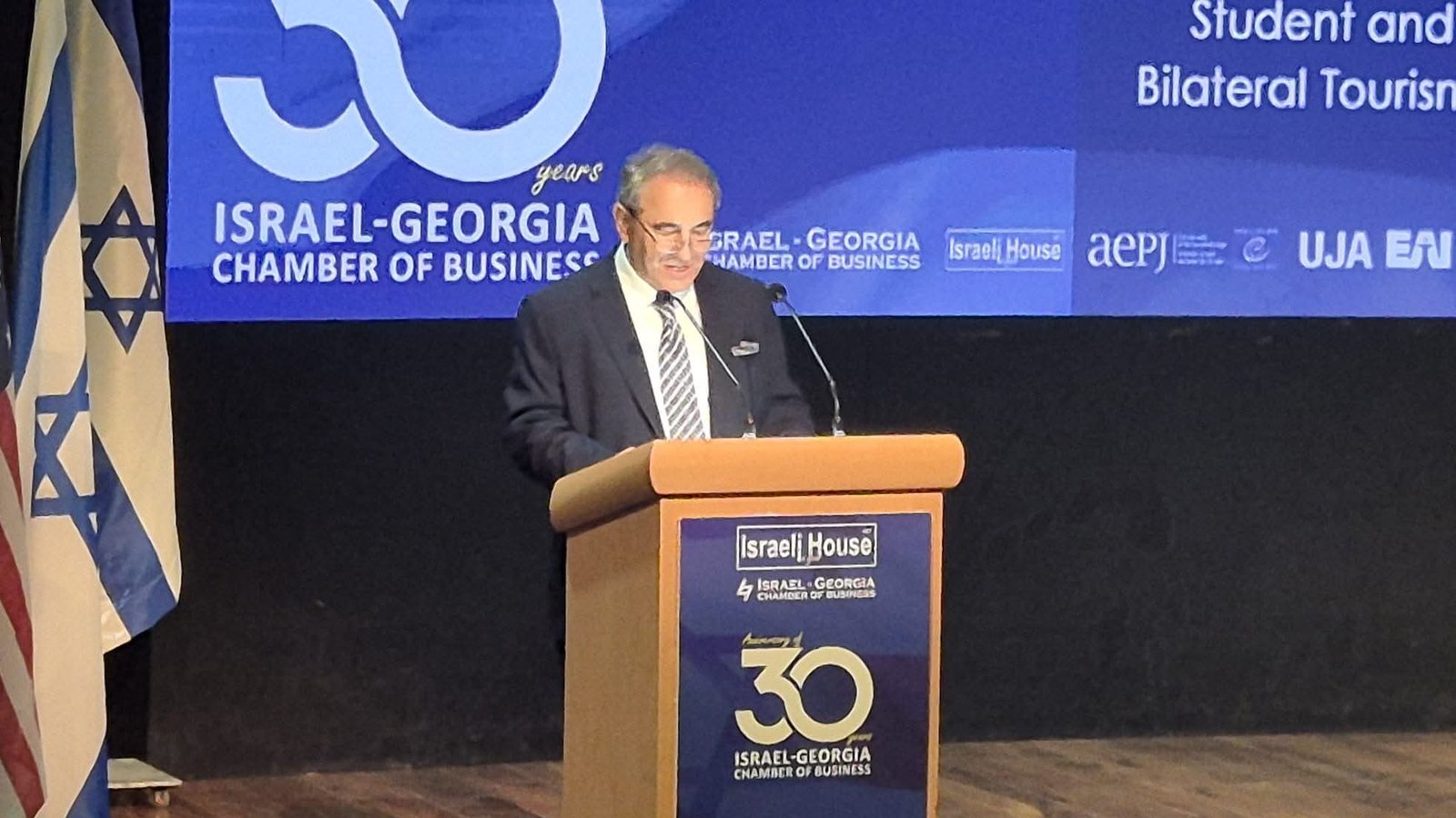
Israeli and Georgian officials, civic leaders, and business figures gathered at Jerusalem’s Begin Center in July to mark 30 years of the Israel-Georgia Business Chamber. The event also recognized 35 years of Moshe’s activity connecting the two countries and 15 years of Israel House, the public-diplomacy initiative he founded.
Moshe, head of the Israel-Georgia Business Chamber, described a strategy grounded in relationships built locally, country by country. “All our success comes from the fact that we work bilaterally, in both directions,” he told The Media Line. “In every country, they want us to operate there, and that is essentially what is new about this approach.”
In every country, they want us to operate there, and that is essentially what is new about this approach
When asked what the conference was intended to launch, Moshe said it was aimed at “the Israeli government, the Knesset, the national institutions and the Israeli public.” Its centerpiece is a proposed network of 100 public-diplomacy offices, alongside “a practical program to combat antisemitism.”

Itsik Moshe. (Gabriel Colodro / The Media Line)
The Georgian relationship, he argued, offers the proof of concept. “That is also why the Georgian model is so important,” Moshe said. “Cooperation between countries in tourism, culture and the economy is extremely important for building relations. Once those relationships exist, it becomes much easier to conduct public diplomacy on behalf of the State of Israel.”
For nearly a decade, Moshe said, his work was concentrated in Georgia. “But after the incident that you know about, when the Revolutionary Guards tried twice to assassinate me because of my Zionist activity, my public diplomacy work and the relationships we had built, we expanded our activity.”
“Today, we operate in 30 countries,” he said, while emphasizing that the proposed 100-office network remains an ambition rather than a completed project. “In my opinion, this is work that government officials cannot do, and it is also work that local Jews cannot do.”
Instead, he said, they work “with local people or with Israelis who are active on the ground.” The model, in his words, is “a very effective method because we can bring something of our own while also building that connection.”
In response to a question about the initiative’s central priorities, Moshe emphasized the message itself. “In my opinion, the message is the most important thing,” he said. “It is not only about talking about yourself.”
His argument is that antisemitism and racism should be framed as a problem for the societies in which they flourish—not simply as an injustice directed at Israel or Jews. “My message is clear and unequivocal: a country in which there is racism and antisemitism cannot be a successful or advanced country,” Moshe said. “Therefore, they should not do Israel a favor; they should do themselves a favor.”
A country in which there is racism and antisemitism cannot be a successful or advanced country. Therefore, they should not do Israel a favor; they should do themselves a favor.
“For the health of their own societies, they need to be normal countries,” he added, “and it is much easier to work with a normal country.”
Moshe also argued that combating antisemitism requires more than advocacy. “It is impossible to fight antisemitism without decisions being enshrined in law,” he said, calling for coordinated work with the Israeli government, Knesset, public organizations, national institutions, the Jewish Agency and Israeli embassies.
Moshe outlined five pillars of activity, beginning with the 100 proposed representative offices, and a program to combat antisemitism through parliamentary resolutions and educational material. “This involves passing resolutions against antisemitism in national parliaments and incorporating relevant material into education systems,” he said.
In his address, Moshe framed the evening around five connected priorities: 100 public-diplomacy offices, legally grounded anti-antisemitism programs, stronger Israeli business ties abroad, partnerships with students and young leaders, and interfaith and general tourism. “The good news for all of us is that this is possible,” he said. “With a small amount of support—not money and not official positions, but public backing—we can establish 100 public diplomacy offices worldwide.”
Another central priority is cultivating non-Jewish student leaders worldwide. “We cannot work only with Jewish communities,” Moshe said. “In my opinion, Jews should eventually immigrate to Israel, but working with non-Jews is extremely important.”
He described the access challenge on campuses as acute but also saw a path through it. “By working with student leaders—and we have student leaders here with us this evening—we can show them that Israel is a normal country. Once they see that, it becomes much easier to work and take action.”
A recent meeting in Ashdod at Kivunim, he said, brought together young Israelis and Georgians. “Young Israelis and young Georgians are beginning to work together. In my opinion, that is the most genuine bridge.”
Moshe’s emphasis on student leaders was also practical: he said non-Jewish students from Georgia had arrived in Israel and begun developing joint projects. “This is the only way we will be able to enter universities around the world,” he said. “Connections with the next generation of students are therefore extremely important, and we must build upon them.”
He said the hardest part is not necessarily reaching audiences abroad, but persuading Israel itself to adopt a different approach. “The most difficult thing is convincing ourselves and our own country that this is the most effective approach,” he said. “I want to tell you that the world has changed. This is the age of the internet; everything is different. Therefore, we also need to work outside the box and approach things differently.”
For Akram Hasson, a Druze Knesset member representing New Hope, the anniversary was a reminder that the chamber has functioned as far more than a business forum.
“The Business Chamber has promoted business and cultural relations with the State of Georgia, a country that we respect and appreciate,” Hasson said, invoking Georgia’s role in helping Jews from across the former Soviet Union reach Israel in 1990. “Therefore, we are indebted to them, and we love them.”
The relationship has produced both investment and cultural exchange. “Among the things taking place are investments by Israelis who travel to the capital, Tbilisi, and to Batumi,” Hasson said. “They invest there and establish many projects.”
He pointed to educational initiatives, performances at Georgia’s national theater, events at its national museum and visiting delegations and also urged both countries’ leaders to deepen their engagement in areas such as “advanced technology, high-tech, cybersecurity and several other fields in which we have expertise.”

Akram Hasson. (Gabriel Colodro / The Media Line)
“Israel is an advanced and constantly developing country that can provide support and assistance,” Hasson said. “We have a large Georgian community here in Israel, so the relationship is very strong and very special.”
Moshe used the conference to highlight new commercial activity as well: a reported NIS 1 billion hotel investment agreement in Jerusalem; plans to replicate an Airport City model in Georgia; emerging agricultural import agreements; a planned NIS 30 million hotel investment in Rustavi; and prospective Israeli high-tech operations in Georgia.
For Moshe, such activity is integral to diplomacy: “In my view, the businesspeople who enter countries even before diplomatic relations are established are the real ambassadors.”
Tourism, Moshe argued, should also be treated as public diplomacy. He said 500,000 potential visitors from Eastern Europe were not coming to Israel because of the lack of direct connections, and maintained that attracting them would improve Israel’s image and generate economic activity.
Hasson linked the chamber’s milestone to the 15-year record of Israel House’s public-diplomacy initiative. “They began teaching about Judaism and antisemitism at universities,” he said. “This is a major achievement because antisemitism is raising its head almost everywhere in the world.”
When asked about Israel’s challenge in explaining its story abroad, Hasson said his background enables him to reach audiences in a distinctive way. “I am not Jewish, and I also speak Arabic,” he said. “I speak to the entire Arab world and to all the Arab media networks, which have brainwashed people around the world.”
Speaking to The Media Line, he said, “It is therefore important for them to hear from someone who belongs to a minority, lives in the State of Israel, serves in the army, is a politician and represents the country. That is more powerful than having a Jewish person come and speak, because people might say that he is saying those things simply because he is Jewish.”
His proposed response combines direct engagement with broad civic participation. “We tell the truth, we show them the facts, and we debate with them,” Hasson said. “That is why we must reach every possible place.”
As chairman of the Higher Education Committee, he said he proposed mobilizing Israel’s approximately 350,000 students to publish four posts each month. “That would amount to more than 1.5 million posts every month about what is happening in the State of Israel.”
For Hasson, education must begin early. “We tell them that we need to start in kindergarten and raise a new generation—a generation built on values and respect, one that considers human life the highest value, believes in tolerance, learns about others and respects their religions and traditions.”
We tell them that we need to start in kindergarten and raise a new generation
He called students “the best ambassadors we could possibly have” and described Moshe’s initiative as an “Israel House in every country.” “There are also many volunteers,” he said. “There are many good people and citizens who are capable of helping, but we need to recruit them, bring them in and give them the necessary tools.”
The conversation at the Begin Center moved beyond the Israel-Georgia relationship to the contest over global perceptions of Israel—sometimes referred to as the 8th front. Former Mossad agent Sagiv Asulin called it a front that Israel has failed to treat with sufficient seriousness.
“This is the only front basically that we are losing terribly to be honest,” he argued.

Sagiv Asulin. (Gabriel Colodro / The Media Line)
Asked why, Asulin said the central failure was institutional: “Basically it was not declared as a threat.” In his view, an undeclared threat cannot be systematically confronted. “If it’s not a threat, how will you fight that? How will you even confront something like that?”
He contrasted this with threats Israel has formally identified, such as Iran and Hezbollah, where “eventually we see the results,” he said. “But with that, Israel officially didn’t declare this threat as a threat, so we are not there.”
“Our enemies are doing that for years already,” he said, referring to investments by countries like Qatar, Turkey, and Iran in education, sport, culture, social media and research centers. “And the outcome of that is what we see in Europe, what we see in London, in Brussels, in Madrid, in New York.”
Asulin said Israel should first formally recognize the battle over public perception as a national threat. He maintained that while Israel’s security institutions have proven effective against conventional military adversaries, a different, dedicated framework is needed to address this non-kinetic challenge.
“But to confront this kind of threat, Israel needs to have another organization,” he said. “If you want, we can call it the 8th Front Organization or Mossad for Public Perception or something like that.”
The envisioned institution would coordinate strategy across public, media, and social media arenas. “It will be semi-security because it deals also with the public, with media, with the social media, but needs to be an official organization that will centralize and will lead all the agenda and all the strategy to deal with this threat,” he explained.
But Asulin cautioned against making the campaign only about defending Israel and fighting antisemitism. “The way to do that, I think, is exactly the opposite.”
“Israel needs to recruit Western civilization to fight together for the values and the future of Western civilization, not antisemitism and not Judaism, not Zionism and not Israel as a state,” he said. “This is a concept that is wider than just Israel.”
Israel needs to recruit Western civilization to fight together for the values and the future of Western civilization, not antisemitism and not Judaism
That wider story was embodied by Lourd Atia, an 18-year-old Israeli Arab Muslim activist who grew up in Jewish religious communities in Jerusalem and now advocates for Israel. “I’m an Israeli Arab Muslim girl, and I grew up in a Jewish religious society most of my life in Jerusalem as the only Arab girl in each community that I came into,” she said.
Her advocacy, she said, has brought hostility from multiple directions. “I get a lot of hate from both sides,” Atia said. “Most people don’t believe me that I’m an Israeli and that I’m an Arab girl.”
More deeply, she described the emotional cost of living between communities. “I never felt [I] belong anywhere,” Atia told The Media Line. “Like I wasn’t Jewish enough for the Jewish community and I wasn’t Arab enough for the Arab community.”
Her parents, she said, raised their children with a simple identity: “They were always teaching us because they were living like this that we are first of all Israelis and that’s our country, and that’s the country that we are going to stand with.”

Lourd Atia. (Gabriel Colodro / The Media Line)
Atia said she once hoped to join the Israeli army but found the process difficult as a Muslim Arab citizen. She instead chose Magen David Adom, where she has volunteered for four years, including during the war, and where she is now a paramedic.
“My thing to the country will never stop,” she said. “I will always give to my country during my life with the advocacy, with the Magen David Adom.”
She also wants to encourage wider service. “I will also be wanting to promote to put all Arabs in the army and all Israeli civilians no matter what their … background is, just to go serve.”
When asked about misinformation among young people, Atia drew on a recent trip to Germany, where she spoke alone to several schools. “I was standing in front of 500 people. The only Israeli. No one was with me. No Israeli ambassador … I was by myself there,” she said.
Her message was that Israel cannot be understood through social-media fragments. “The young generation is really, really feeding from the news from the social media. I’m sorry. They don’t really get the whole picture,” Atia said.
“The big picture is so much more complicated than it seems,” she said. “It’s not like a black and white kind of picture.”
“And I think you just need to come to Israel to see for yourself what is actually happening here,” she added. “The whole big picture is not perfect, that’s for sure. It’s really, really complicated, but just understand the big thing and then decide whatever you want to decide.”
Atia plans to move to London for four years to continue her advocacy, develop a startup she began at 15 and begin her studies, while remaining engaged in Israeli public life.
The Begin Center gathering celebrated a relationship already built through commerce, culture, education, tourism and people-to-people contact. It also made a larger claim: that public diplomacy gains force when it is rooted in durable local partnerships rather than delivered as a one-way message.
Moshe’s speech signals that his efforts are becoming more firmly rooted in Jerusalem. By year’s end, he said, Israel House plans to move into the National Institutions Building, working alongside other bodies on public diplomacy and the fight against antisemitism. “Moving to Jerusalem, just like holding this conference in Jerusalem, is entirely natural,” he said.
For Moshe, the next chapter is not an abstract policy aspiration. It is an effort to replicate the relationship he has spent three and a half decades building between Israel and Georgia.
“The next year I want to make copy-paste for this relation for this success to the other 100 countries in the world.”