From Jaffa to Bnei Brak, voters reveal hopes for political change, concerns over security and equality, and deep divisions over Israel’s future as election turnout reaches its highest level in decades
In Jaffa, Tom and Shani spent Israel’s election day getting married. Tom called it “the perfect day.” With guests enjoying a day off work, he said, no one had to rush between jobs, preschool pickups, and bedtime routines. Shani said their guests arrived relaxed and “with good energy,” bringing a festive atmosphere to a day when millions of Israelis were making decisions about their country’s future.
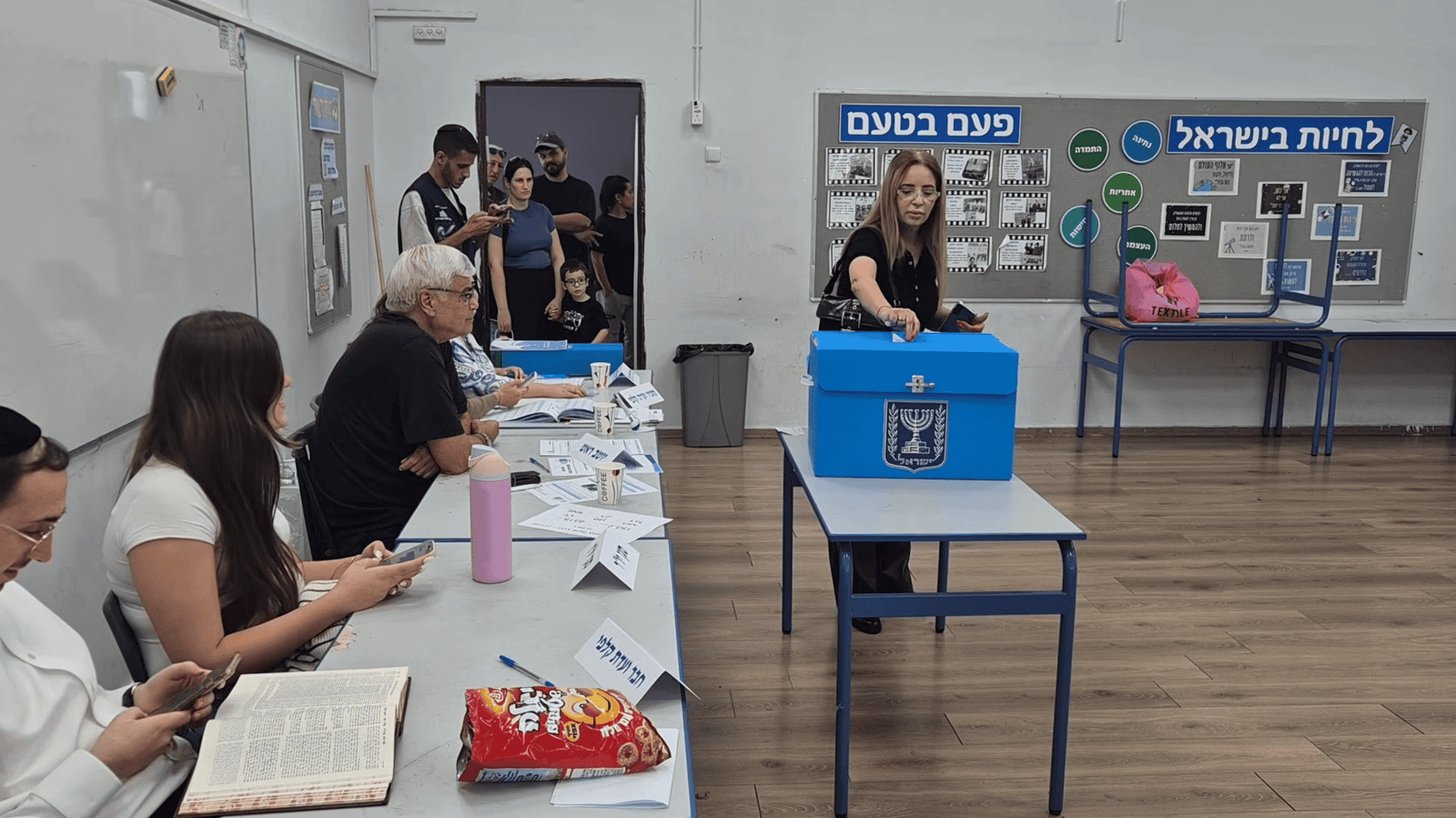
By the time polls closed at 10 p.m. Tuesday, October 27, voter turnout had reached 77.7%, with nearly 5.7 million ballots cast, according to the Central Elections Committee. The figure, which was not yet final, represented the highest participation in a Knesset election since 1999, comfortably exceeding the 70.6% recorded in 2022.
The unusually high turnout reflected the intensity of Israel’s first election since the Hamas-led attack of October 7, 2023, and the wars that followed. Updated exit polls from Israel’s three main television networks projected 52 seats for the opposition’s change bloc, 50 for Prime Minister Benjamin Netanyahu’s bloc, and 18 for the Arab parties. Neither of the two main blocs appeared able to form a government without additional parliamentary support.
Throughout election day, The Media Line spoke with voters in cities across Israel about their choices, their expectations, and the issues they believed would shape the country’s future.
For Amos, a young resident of Kfar Saba, the heavy turnout was a reason for optimism.
I want to see a change from the current government, and I see that people also want change
“I feel hopeful,” he told The Media Line. “I want to see a change from the current government, and I see that people also want change.”
Yet his optimism was accompanied by concern that a change in government might provoke resistance or violence. His greatest fear was that Israelis would grow more extreme and continue “splitting apart.”
In Jaffa, Muslim voter Jamil Beker described a society in which relations between Jewish and Arab citizens had deteriorated as the political climate shifted further to the right.
“Racism became more than ever,” he told The Media Line.
Beker recalled a period when relations between the two communities were better and expressed concern about the deepening divisions in Israeli society. For him, the election was about more than which political bloc would govern.
“The most important thing is to take care of human rights and the law,” he said.
Other voters expressed more explicit political preferences.
In Tel Aviv, Ricky Liberman stood holding a flag of the Democrats party. She told The Media Line she wanted the election to deliver “regime change.”
Samuel Misrahi, interviewed in Ramat Gan, said he had once supported Likud but no longer believed the party represented his political views.
“The Likud lost the way,” he told The Media Line.
Misrahi said he was supporting Gadi Eisenkot, leader of the Yashar party and a former Israel Defense Forces chief of staff, whom he regarded as a stronger choice to lead the country’s next generation.
But David, another voter in Ramat Gan, saw Netanyahu as essential to Israel’s security.
We have to vote for Bibi Netanyahu to protect our country
“We have to vote for Bibi Netanyahu to protect our country,” he told The Media Line.
David also pointed to Netanyahu’s relationship with President Donald Trump, saying it “could help our people.”
Henry Reich, interviewed nearby, placed a different issue at the center of his decision: the longstanding controversy over military service by Haredi men.
Calling enlistment “the main issue in these elections,” Reich said he hoped Israelis would vote for greater equality in sharing the responsibilities of national service.
For Yossi Maman, a Yashar supporter in Jaffa, the election was inseparable from the events of October 7.
Maman, who said he had served as an Israeli military officer and lived in Denmark for 40 years, described the Hamas-led attack as the decisive reason for his support for replacing the government.
“October 7 changed everything,” he told The Media Line. “We don’t want anyone who was in office on October 7 to be in office again.”
Maman argued that issues such as military service, education, and the cost of living could provide common ground for Israelis if the country’s political leadership changed.
The electoral considerations were different in Bnei Brak, a predominantly Haredi city where religious authority plays an important role in political life.
Shlomo Cohen described how instructions from rabbis influenced the decisions of some voters. While certain religious leaders urged their followers to vote, he said, others instructed them to stay home.
Even if he tells you right is left and left is right, you do what he says
“Everyone does what his own rabbi tells him,” Cohen told The Media Line. “Even if he tells you right is left and left is right, you do what he says.”
For some Haredi voters, Cohen added, election day also involved additional religious observances. Some recited extra psalms during their prayers, while others visited the graves of revered rabbis before heading to the polls.
Cohen returned to the principle he said guided his community’s political behavior.
“If your rabbi tells you to vote, you vote. If he tells you not to vote, you don’t vote.”