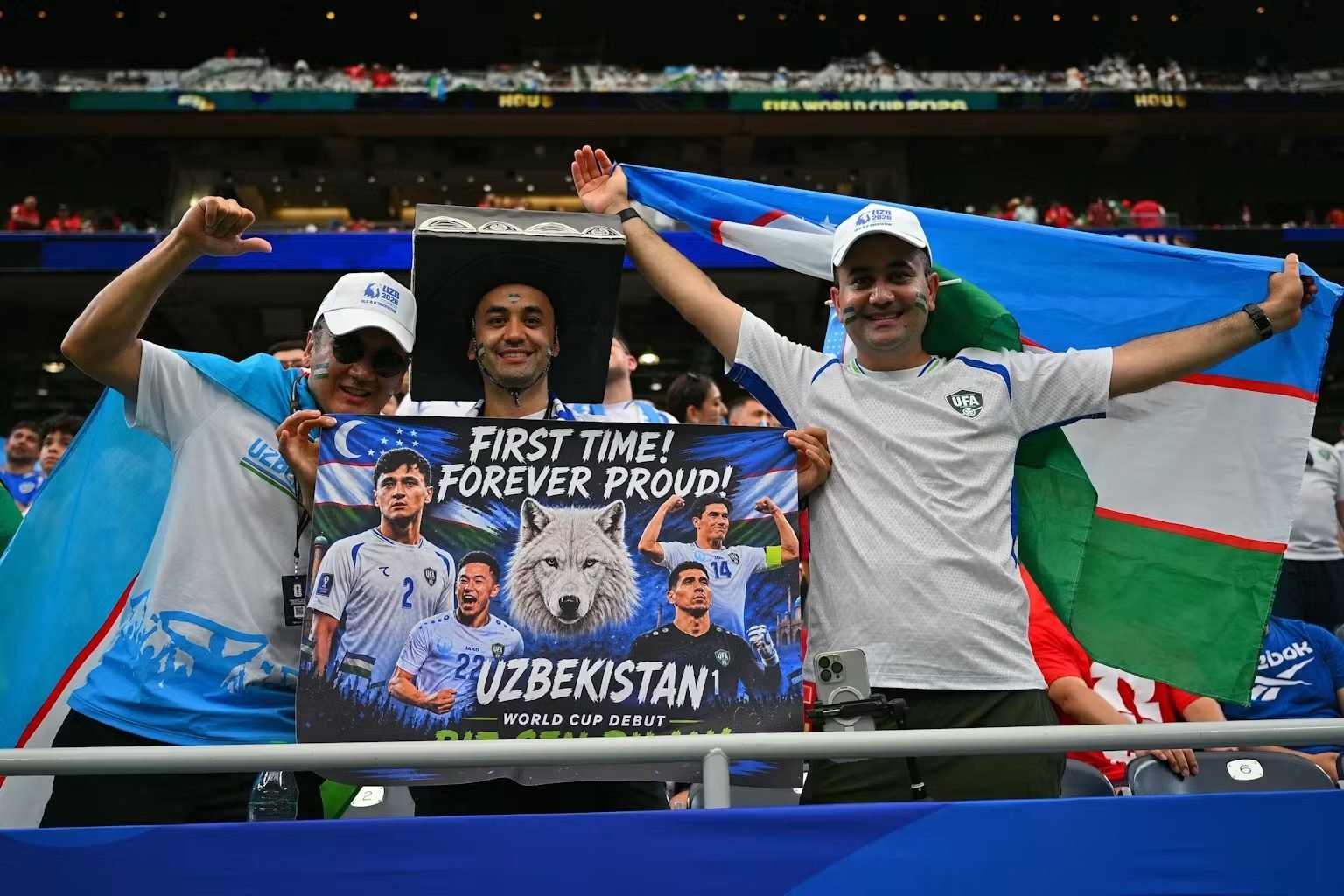
The expanded men’s World Cup in 2026 has given fans the chance to cheer on the exploits of first-time qualifiers, some of which many people might previously have struggled to locate on the map. Standout moments have already included Curaçao’s goal-keeping heroics in earning a draw against Ecuador and Cabo Verde’s upset by pegging back reigning European champion Spain.
But one story has largely gone under the radar: the participation of Uzbekistan. According to some pundits, Uzbekistan should have collapsed into violent chaos years ago. Instead, it has become the first Central Asian state to play on soccer’s grandest stage. Behind this lies a fascinating tale of geopolitics and peace.
In the 1990s, overwrought geopolitical analysis portrayed the region as dangerous and in desperate need of western salvation. This was particularly true of the US. In 1997, Zbigniew Brzezinski, national security advisor to Jimmy Carter and an éminence grise of the US foreign policy establishment, dubbed Central Asia “the Eurasian Balkans” on what he called the “grand chessboard” of great-power competition.
At the intersection of Uzbekistan, Kyrgyzstan and Tajikistan sits the Ferghana Valley. With its complex patchwork of borders, enclaves and ethnic minorities, it became the focal point of this discourse of danger. A 1999 policy report written by American academics warned that, without US help, the valley could become “a breeding ground of terrorism” and “a hotbed of religious and political extremism”.

Like most parts of the world, Uzbekistan has had its problems. Rapid economic growth has led to serious urban pollution, and youth unemployment is high, thanks to the growing population. As is the case with other countries in the region, a lack of political pluralism limits its ability to effectively grapple with these problems.
But the dire scenarios predicted by western analysts have not come to pass. For my research on borders, nation-building and geopolitics in the Ferghana Valley, I interviewed policymakers across the region. They all stressed the region’s ability to draw on historic cultural ties and practices of statecraft to manage the difficult transition from Soviet republics to independent nations.
After Uzbekistan, Kyrgyzstan and Tajikistan gained their independence from the Soviet Union in 1991, the Ferghana Valley states inherited a set of complicated and disputed borders originally drawn as internal Soviet boundaries in the 1920s. These have proved contentious – yet in recent years the three countries have made a series of deals to transfer territory and fully delimit their boundaries.
The Khujand Declaration of March 2025 defined the boundary between the three valley states and put an end to decades of tension. In terms of international experience, this counts as remarkably quick progress.
Resolving border tensions
It is in the Ferghana Valley itself where progress is most visible. I saw border tensions ratchet up in the late 1990s and early 2000s. But in the past decade, a new generation of leaders has not only resolved territorial disputes but pushed a significant growth in cross-border economic, social and cultural connections. They have reopened dozens of previously closed border crossings, relaxed red tape and incentivised cross-border trade. This has led to significant increases in regional trade and has eased ethnic tensions.
In October 2025, the first Ferghana Valley Peace Forum brought governments and civil society together under a new platform for dialogue. A key organizer of the event, Akramjon Ne’matov, the first deputy director of the Institute for Strategic and Regional Studies, an influential state-affiliated thinktank in Tashkent, emphasised that “the forum’s goal is to strengthen trust and good-neighborly relations, promoting a shared vision of the region as a space of cooperation and mutual benefit”.
According to Ne’matov, it serves as a robust response to the vision presented in Brzezinski’s “grand chessboard.” That outdated narrative not only was flawed but risked becoming a self-fulfilling prophecy. It sowed mistrust rather than fostering development.
Despite initiatives like the ill-fated Central Asian Union, Central Asia has not succeeded in creating formal EU-style regional institutions. Western academics have routinely dismissed such attempts as mere “virtual regionalism.” But research from St Andrews University shows that informal arrangements between authoritarian governments to respect each other’s sovereignty and not allow single external powers to dominate have led to the emergence of an effective, informal regional order premised on personal diplomacy, stability and coexistence.
Shared destiny
This digs deep into historical notions of shared destiny. As a politician in Tashkent put it to me: “The important thing to keep in mind is that we are one home in Central Asia, one culture.” As the dissolution of Yugoslavia in the 1990s, and the wars in Armenia and Azerbaijan and Russia and Ukraine wars suggest, Central Asia has arguably been more successful at resolving post-cold war ethnic and border disputes than Europe.
In March this year, I joined a sell-out crowd at an Uzbek Super League match, cheering on Ferghana Neftchi as it beat Tashkent Lokomotiv 3-1. The game took place in an impressive modern stadium in Ferghana. This confounded the predictions of 1990s analysts who saw the Ferghana Valley as the supposed locus of all the region’s ills.
Fellow fans were already looking forwards to the World Cup – although one wryly repeated to me a quip by comedian Hojiboy Tojiboev that the Uzbek team would “go there, eat ice-cream and then come back.”
On the pitch, this first foray onto football’s biggest stage has been challenging for the “White Wolves”, as the Uzbek team is known. But away from football, in our age of border closures and ratcheting geopolitical tensions, the West can learn a lot from Uzbekistan about how to manage regional tensions and plan shared futures.
Nick Megoran is a professor of political geography, Newcastle University; Independent Social Research Foundation.
This article is republished from The Conversation under a Creative Commons license. Read the original article.