2 killed, 2 injured after Saudi air defenses intercept drone targeting Aramco oil field
This picture shows Aramco tower at the King Abdullah Financial District (KAFD) in Riyadh on April 16, 2023 [FAYEZ NURELDINE/AFP via Getty Images]
Two foreign nationals were killed and two others injured Wednesday after Saudi air defenses intercepted a drone attempting to target a facility at Saudi Aramco’s Shaybah oil field in the country’s Eastern Province, the Energy Ministry said, Anadolu reports.
A ministry official said Saudi air defenses intercepted the drone as it attempted to strike one of the facilities at the oil field, according to the Saudi Press Agency (SPA).
Debris from the interception sparked a fire in a vehicle belonging to a contractor working at the field, outside the facility’s perimeter, the official said.
The incident did not affect operations at the oil field, the ministry added.
The official identified the two fatalities as Philippine and Nepalese nationals, while the injured were Pakistani and Indian nationals.
Relevant authorities responded to the incident and took the necessary measures, according to the statement.
The incident comes amid escalating hostilities between Yemen’s Houthi group and the Saudi-led coalition supporting Yemen’s internationally recognized government.
The Houthis have recently threatened to target Saudi energy infrastructure, including facilities operated by Saudi Aramco, as fighting intensifies in Yemen.
FCC chair warns media not to run the “fake polls” Trump keeps complaining about
Federal Communications Commission Chairman Brendan Carr today warned broadcasters about airing “fake polls,” amplifying one of the many complaints that President Trump has regularly made about the news media.
Carr’s post on X said, “Many journalists and broadcasters have been amplifying or airing these Polls without regard to basic journalistic ethics and without informing the public that those Polls lack a scientific, accurate, or even real basis… Broadcasters are advised to avoid engaging in News Distortions or running Broadcast Hoaxes by airing Polls that would violate their regulatory obligations.”
Carr urged broadcasters to “provide their viewers with additional context and information about Polls they have covered.” In fact, one small polling outfit was exposed as a hoax this week, and a similar incident occurred in August. News outlets have reported on these hoaxes, providing the very “context” that Carr said is needed.
Carr’s post did not mention any specific fake polls or any specific broadcasters that aired them. The vagueness of Carr’s post may be useful for his and Trump’s ongoing battle against the news media. In August, Trump demanded that the FCC punish or rebuke an NBC journalist for saying he has “mixed results” in election endorsements, and wrote that the FCC must do something about “THE FAKE POLLS USED BY OUR CROOKED MEDIA.”
Ex-FCC chairs: Carr wants “self-censorship”
Carr’s latest warning to broadcasters came as no surprise, given that he has spent much of the past two years threatening broadcast licenses and opening investigations into Trump’s least favorite news companies. Former Republican and Democratic FCC chairs and commissioners recently said Carr is seeking to censor and chill the speech of broadcasters through a proceeding that threatens the licenses of ABC-owned stations.
“FCC Chair Brendan Carr’s threat against broadcasters over their reporting on political polls is yet another truly outrageous attempt to censor and control the information available to Americans as they prepare to vote… Carr is now seizing on reports about fabricated political polling as an excuse to once again try to scare broadcasters into self-censorship,” said a statement today from a group of former FCC chairs and officials.
Today’s statement was attributed to former Chairman Tom Wheeler, a Democrat; former Chairman Mark Fowler, a Republican; and seven former high-ranking FCC officials. “Good-faith reporting on public polls—even ones that turn out to be made up—is not a violation of the FCC’s news distortion or hoax rules. And the FCC has zero authority to dictate editorial decisions,” they said.
Wheeler, Fowler, and others previously signed a letter objecting to the ABC investigation. The letter called it “the latest attack in a sustained campaign by Chairman Carr and the Trump administration of threatening legal sanctions against licensees whose speech President Trump dislikes.”
Anna Gomez, the only Democratic commissioner on the current FCC, wrote today that “Pollsters who intentionally mislead the public should answer for it, but broadcasters who report publicly available polling data should never be punished when a poll is wrong. FCC rules on news distortion or hoaxes do not apply to a station that reports this data in good faith.”
Pollster admits hoax
An entity called Wedgewood Polls said yesterday that it published fabricated polling data “to test whether media outlets, aggregators, and commentators would report on data without verifying the source, methodology, or underlying firm legitimacy.” It claimed to be running an experiment on the modern political polling industry.
“Despite having no history, formal credentials, or real data behind the vast majority of our releases, Wedgewood Polling was added to major polling aggregators, including The New York Times, FiftyPlusOne, and VoteHub, and repeatedly treated as a legitimate news source,” the statement said.
Notably, the three polling aggregators mentioned in the statement are not broadcast stations or news networks whose programming is carried on local broadcast stations. That’s relevant because Carr has repeatedly said he merely uses the FCC’s regulatory authority over broadcasters with licenses to use public spectrum, and not media outlets that do not have FCC licenses. Carr’s post yesterday warned broadcasters to “comply with their public interest obligations” under “the terms of their federal licenses.”
While Wedgewood Polls claimed that its data faced no scrutiny from news organizations, FiftyPlusOne said it was preparing to publish an article exposing the fraud and had sent a request for comment to Wedgewood. “They did not respond to our request, but instead posted a public statement on social media admitting that they had been fabricating data,” FiftyPlusOne wrote.
FiftyPlusOne, The New York Times, and VoteHub all say they did some vetting of Wedgewood before deciding to use its polls. FiftyPlusOne wrote:
Their statement alleges that FiftyPlusOne, The New York Times, and other poll aggregators did not conduct appropriate vetting of their firm prior to aggregating their polls; this is false. We reached out to them to ask who they were and confirm the methodology statement on their website. We were given two names, Jack Sims and Andrew Prater. We were able to independently confirm that Sims had previous experience in the polling industry and reviewed their methodology statement in detail. It is not atypical for a pollster to leave an existing firm, form their own, and self-fund some surveys to build reputation; we had no reason at the time to believe this case was any different. Wedgewood operated as if it were a legitimate polling firm, including collecting money from donors to conduct crowd-funded polls, and sharing raw survey data (which we now have confirmed was fraudulent) with FiftyPlusOne on Oct. 15, 2026.
NYT and VoteHub explain poll inclusion
VoteHub Head of Data Science Zachary Donnini said that after talking to Wedgewood’s “head pollster,” Votehub “assigned them a D grade and included their polling data on our site.” Meanwhile, the New York Times updated its polling page with a statement about Wedgewood.
The New York Times said it sends all new pollsters “a series of questions regarding the identities of the pollsters; the methods they were using to draw their sample, contact respondents and weight their polls; and the source of their funding.” Wedgewood answered the questions, and the NYT used 15 of its polls for state and congressional-district races.
The Wedgewood “polls were never included in the tracker or average of President Trump’s approval rating or of the national polls tracking overall preference for control of Congress,” the NYT said.
In the previous incident this year, a group called Median Strategies admitted it faked poll results as part of a “social experiment.” The NYT said it never included that group’s results in its trackers “because the group did not respond to our questions about its methodology.”
Nate Silver removed Wedgewood from his polling site today. Wedgewood polls tended to be about 1 percentage point more favorable for Democrats than other polls, according to Silver.
North Korea tells border troops to take ‘resolute action’ if South threatens their safety
North Korea has told its border troops to take “prompt and resolute action” if South Korean forces threaten their safety, state media said on Wednesday, raising the risk of a clash along the heavily armed frontier.
The report came a day after Seoul pledged to punish “resolutely” any further provocation by Pyongyang if North Korea acted on threats to strengthen its military posture along the border.
North Korean Army Marshal Pak Jong Chon inspected fortifications on the border with South Korea on Tuesday, accompanied by Kim Yo Jong, the powerful sister of leader Kim Jong Un, KCNA reported.
Kim Yo Jong said new firepower units had “taken their firing positions” at the border, KCNA reported.
Tensions between North and South Korea have risen since Pyongyang began fortifying its border in April 2024. The two countries are separated by the Demilitarized Zone that was established when the Korean War ended in an armistice in 1953.
Seoul says Pyongyang has sent up to 7,000 workers to the border this year, with about 50 crossings of the Military Demarcation Line, which bisects the DMZ, to South Korea’s side of the border.
On Wednesday, North Korea rejected Seoul’s allegations, with Pak dismissing the claim as an “absurd assertion” designed to shift blame, KCNA reported.
The North Korean army knew where the border lay “better than any others” and was only doing what it should within its own territory, Pak said, urging soldiers to turn the border into an “impregnable fortress”.
South Korea said North Korean mines caused a border blast last month that seriously wounded two of its soldiers, and called on Pyongyang to suspend the fortification work.
Rubio’s Central Asia pitch is about more than minerals
<
article id=”post-951552″>
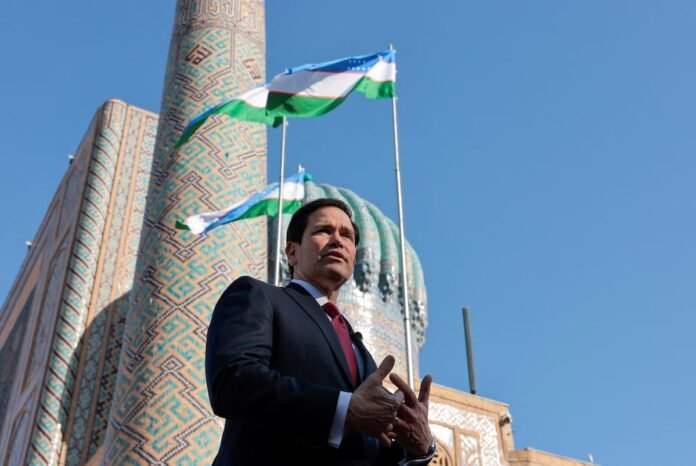
US Secretary of State Marco Rubio arrived in Samarkand on October 19 with nearly 300 American business leaders, seeking to deepen US commercial ties with Central Asia.
Washington’s renewed interest will matter less for how many agreements it produces than for whether American investment helps the region move beyond being merely a supplier of raw materials.
At the C5+1 meeting, Rubio promoted critical minerals, trade links and technological cooperation. Reuters reported that the visit produced few immediate public results, though US officials described it as a chance to build long-term relationships.
Washington is increasingly driven to diversify supply chains away from China, especially for industries that depend on strategic minerals.
For Kazakhstan, Kyrgyzstan, Tajikistan, Turkmenistan and Uzbekistan, the prize is potentially bigger than supplying American manufacturers. Investment could build domestic processing, create skilled jobs and strengthen their negotiating positions.
Russia remains tied to Central Asian economies through trade, labor migration, energy infrastructure and security arrangements. China has financed transport networks and built substantial commercial partnerships. The arrival of American companies will end neither.
And Rubio wisely acknowledged as much. Speaking in Samarkand, America’s top diplomat rejected the idea that Uzbekistan should stop working with Moscow or Beijing. Washington, he said, wanted American companies to compete, not to dictate whom its partners do business with.
Still, more trading partners do not automatically bring more economic independence. A country can sell minerals to several buyers and still remain dependent on foreign companies for processing, technology and market access.
Uzbekistan, for one, has recognized the challenge. At the Samarkand meeting, Foreign Minister Bakhtiyor Saidov called for cooperation spanning geological exploration, mineral processing and local industrial clusters. Tellingly, it is a proposal to build industries, not merely to secure supplies.
For American firms, the challenge is to make local processing commercially viable while securing reliable supplies. For Central Asian governments, it is to ensure that investment builds domestic capabilities and not just boosts exports.
To be sure, not every mineral can be processed economically near its source. Electricity prices, technology, infrastructure and scale determine where processing makes most commercial sense.
Washington should prioritize projects in which commercial incentives and regional development goals align. Joint processing ventures, workforce training and technology partnerships could serve both interests.
Central Asia’s five main economies also differ in the opportunities they offer. Kazakhstan and Uzbekistan have larger markets and more established industrial bases, while Tajikistan and Kyrgyzstan face greater infrastructure and financing constraints. American investment strategies should reflect those differences.
The Trans-Caspian corridor could offer another route between Central Asia and Europe, but its competitiveness depends on infrastructure investment and more efficient cross-border transport.
A September 2026 World Bank assessment projected that strategic infrastructure investment could more than triple trade volumes along the corridor and halve travel times by 2040, with larger potential gains if paired with relevant reforms.
The World Bank estimated that the corridor would need more than US$25 billion in physical infrastructure and another $30 billion in supporting investment through 2040.
These projections reflect the scale of the region’s challenge. Alternative trade routes require sustained financing, regulatory cooperation and reliable transport services, not simply diplomatic announcements.
Environmental pressures complicate the investment agenda. Water and electricity are scarce in the region, and mineral processing consumes both at scale. That means projects must weigh energy availability, water efficiency and environmental safeguards carefully alongside commercial returns.
Washington should judge success by productive capacity rather than by the number or value of mineral agreements. The relevant indicators will be whether projects secure financing, build commercially sustainable processing plants, train local workers and improve access to international markets.
Central Asian governments, meanwhile, should negotiate transparent invesstment terms and realistic commitments to local industrial development without creating projects that depend on permanent subsidies.
Rubio’s visit aimed to build on the C5+1 framework established in 2015. But what sets the latest US effort apart is its commercial emphasis and Washington’s growing concern about strategic supply chains.
Central Asian governments do not seek to swap dependence on Russia or China for dependence on the United States. Rather, they want stronger domestic industries and more leverage in dealing with all outside partners and customers.
The real test of Rubio’s initiative is not where Central Asia sells its minerals, but rather how much of their value Central Asians can keep.
Saima Afzalis a researcher specializing in South Asian security, counterterrorism, and broader geopolitical dynamics across the Middle East, Afghanistan, and the Indo-Pacific. She is currently a research scholar at Justus Liebig University, Germany.
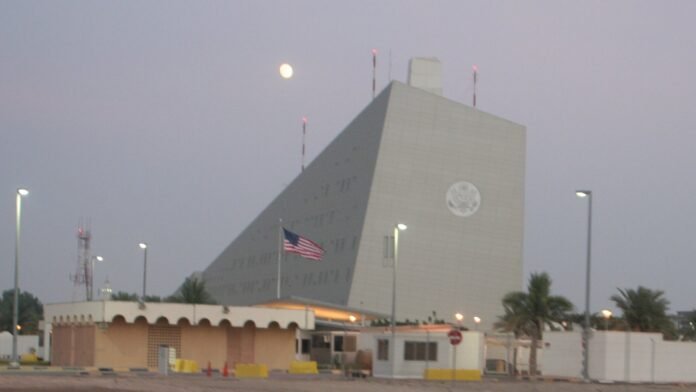
US Prepares Gulf Embassy Evacuations as Houthi Attacks Intensify
The United States is preparing to evacuate some diplomatic personnel and their family members from embassies in the Gulf as Houthi attacks escalate, official sources told Reuters.
Two US officials said the ordered departures could extend to all personnel and their families at the US Mission to Saudi Arabia. The US Embassy in Riyadh issued a security alert Wednesday warning that further Houthi attacks on Saudi Arabia were possible following recent deadly strikes, including an attack on Riyadh’s airport.
Saudi Arabia’s Energy Ministry said two foreign workers were killed Wednesday in a drone attack targeting facilities belonging to oil company Aramco. The victims were from the Philippines and Nepal.
A drone attempting to strike a facility at Aramco’s Shaybah oil field was intercepted, according to the ministry. The interception resulted in a fire in a contractor’s vehicle outside the facility’s boundaries. Operations at the oil field continued as usual.
Separately, the Saudi-led coalition said Wednesday that its forces intercepted five drones launched toward the kingdom over the Medina area and eastern regions.
Coalition spokesman Turki Al-Maliki said Tuesday that forces intercepted another drone over Riyadh. Several hours earlier, the coalition shot down a Houthi ballistic missile headed toward the Saudi capital.
Residents heard two loud explosions Tuesday morning and received warnings through mobile phone applications. No injuries or damage were reported.
Tesla published its third-quarter 2026 financial results this afternoon. Earlier in October, it reported its sales and deliveries for the three-month period, selling fewer cars than in the same quarter in 2025, yet it still beat analyst projections. Now we can see how those sales translate to the bottom line. Tesla brought in $28 billion in revenue in Q3, almost the same as in 2025.
Automotive revenues were $20.6 billion, a 3 percent decrease year over year. Perhaps more troubling is the decline in revenue from solar panels and storage batteries—this line of business had been growing, but for Q3 revenue fell 16 percent year over year to $2.9 billion. Services and other revenues, though, which include parts and Supercharger use, grew by a third to $4.6 billion.
But the company—like the rest of us—has seen its expenses go up. Operating expenses rose by 39 percent to $4.8 billion, dropping the company’s operating margin to just 2.6 percent; in Q3 2025, Tesla’s margin was 5.8 percent. Net profit fell to $787 million, down 43 percent year over year. What’s more, capital expenditures were up by 110 percent to $4.7 billion, and free cash flow was down 62 percent to $1.5 billion.
Tesla can no longer rely on selling regulatory credits to other automakers: these fell to $113 million this quarter, down from $417 million in Q3 2025. Now, virtually every other automaker has a portfolio of electric vehicles and no longer needs to offset its emissions by pooling with Tesla. In the US, Tesla CEO Elon Musk’s support helped elect a president who has abolished such credits entirely, with Musk’s blessing.
Tesla’s letter to investors says its flat revenues were due to lower average selling prices, selling fewer cars, not receiving as much in credits, and also the decline of its energy storage business. Together with the reduced credits and battery and solar sales, a big jump in operating expenses is responsible for the diminishing profitability; some of this is Tesla spending rampantly on AI hardware, but some is also the CEO’s extravagant compensation package.
Town leaders chided residents for warning of flash floods. Then, the river took two children.
This story was co-published with ProPublica, a nonprofit newsroom that investigates abuses of power. Sign up for Dispatches, a newsletter that spotlights wrongdoing around the country, to receive ProPublica stories in your inbox every week.
Peak tourist season had arrived in Ruidoso, New Mexico, and Mayor Lynn Crawford was campaigning to convince the public that the village was safe. A Republican with white hair and a Texas drawl, Crawford said he was frustrated with residents who were sharing warnings of flooding on social media. “They spout stuff off,” he said in a radio address on June 30, 2025. “And I don’t know why they’re so afraid. I do not understand it.”
The community had experienced severe flooding the previous summer, after two wildfires burned 25,000 acres above town, in the Sacramento Mountains. The fires and floods had destroyed about 1,000 homes. Together, the Village of Ruidoso and its smaller neighbor, Ruidoso Downs, are home to some 10,000 residents, but that number more than doubles during the summer.
Since then, residents had been on edge. A new monsoon season had arrived, bringing sporadic flooding that jeopardized the town’s economic engine of horse racing. At stake were big crowds to celebrate the Fourth of July, watch quarter horse racing, and enjoy cool weather that’d lured Texans here for generations.
“We have flooding temporarily,” Crawford had told a Texas news anchor in an interview. “And just almost as fast as it came to town, and went through town, it’s gone.” Crawford, who is 64, managed an exclusive club at the Ruidoso Downs Race Track & Casino and once called that his “real job.” He made less than $26,000 as mayor.
But if the town’s economy was precarious, so was its geography. The South Fork and Salt fires charred the landscape, leaving soils that didn’t easily absorb water. Imagine spilling hot wax on a carpet, letting it cool, and repeatedly pouring water over it. Now place the wax on steep hills above a river lined with log homes, tourist shops selling wooden bears, and an iconic racetrack.
Officials were aware of the threat but clung to Ruidoso’s animating idea: that nature could be subdued for the enjoyment of tourists and profit of the community. Nowhere was this more apparent than at the track, where the Rio Ruidoso, channeled through culverts, crossed the infield. After the 2024 flooding damaged the track, the culverts had been rebuilt with a $16 million public investment authorized by New Mexico’s Democratic governor, Michelle Lujan Grisham.
The track had only recently reopened, and flooding was again threatening to derail the racing season. On June 26, internal records show, Ruidoso’s emergency management department was at a heightened threat awareness level. Flooding had destroyed a bridge upstream of the town, and the forecast called for more rain.
But publicly, the village maintained it was prepared and the community was safe. The next day, the emergency manager reduced the threat level a notch, and the communications department chided residents for sharing warnings of catastrophic flooding on social media, noting that some posts featured old videos. “Protect our community from fear-based falsehoods,” the village implored in a public service announcement.
Village of Ruidoso Mayor Lynn Crawford, shown in his office, was presiding at a council meeting when the flood hit. Cengiz Yar
On July 4, and one state over, violent flooding killed more than 130 people in central Texas. But multiple tourists who were arriving in Ruidoso said they had no idea the town was in danger. At the racetrack, the horses ran, and Crawford hosted members at the Ruidoso Jockey Club, where private tables cost as much as six figures.
That weekend, Sebastian Trotter and his family traveled to Ruidoso from El Paso, Texas. Trotter was an Army helicopter pilot stationed at Fort Bliss; his wife, Stephanie, was a nursing student. They thought the place looked family friendly; they saw no warnings online. They brought their two children and three dogs. On Sunday, July 6, they parked their trailer in a desirable spot on the water’s edge at the Riverview RV Park. In online photos, the river appeared gentle. “You could go put your toes in,” said Sebastian.
That day, the Rio Ruidoso — “noisy river,” in Spanish — briefly flooded and firefighters rescued at least four people. The Trotters saw the water rise, but the campground host said it was a regular occurrence. Then the river receded.
In the park, the Trotters’ children, Sebastian Rowan, 7, and Charlotte, 4, biked under the tall pines. The boy was a soccer player who was enchanted by the idea of camping in the woods; Charlotte was bright and cheery, sometimes applying glitter to her father’s mustache. Later, the family walked through the village, where elk and wild horses occasionally graze near tourists.
On Tuesday, July 8, the Trotters were visiting a lake when they saw clouds form. They decided to head into town, ordering pizza before allowing the children to pick out souvenirs. The younger Sebastian selected a rainbow gemstone, Charlotte a bracelet and a ring. Then they returned to the RV park, where they relaxed by the river.
At 1 p.m., Crawford presided over a council meeting at Village Hall. He began by recognizing the Texas flood victims and nodding to Ruidoso’s relative success. “We want to keep all of central Texas in our thoughts and prayers and see how bad it was and how fortunate we’ve been,” he said. “The goal of the village is to protect the village.” That meant balancing public safety with tourism, he said.
At almost the same moment, storm clouds gathered in the mountains. Even short periods of moderate rain on severe burn scars can unleash post-fire floods. By 1:30 p.m., radar indicated storms might douse both scars simultaneously. A little before 2 p.m., firefighters texted images of the radar to one another. “It could be interesting,” wrote one. Only about a third of the department was on duty at the time and the chief, Cade Hall, had for weeks declined to position additional flood specialists near low-lying areas.
Hall disputed ProPublica’s reporting about the emergency response but declined to comment with specifics.
Less than an hour later, another flood arrived, carrying debris that backed up behind bridges. The water kept coming, fanning onto roads until the normal course of the river disappeared. What the wall of brown water carried told residents it was time to panic.
Jason Fulcher, an owner of the Riverview RV Park, saw a tree-size log in the waterway. Two miles downstream, a maintenance worker at a mobile home park saw a car float past and lodge against a bridge.
Farther downstream, the track’s executives did not need physical signs of danger; they knew what was coming because they’d been alerted.
But the Trotters were caught unprepared. Around 3 p.m., they retreated to their trailer to escape the rain. Then the flood tore through a wall and took their children.
The July 2025 flood left Riverview RV Park, where the Trotter family and others were staying, littered with debris. Cengiz Yar
The wildfire crisis engulfing the West presents a secondary threat that has received less attention: Entire neighborhoods could wash away in debris flows and floods that often follow.
Scientists say there’s a direct correlation between fire intensity and flood risk. Research shows that if more than 20 percent of the ground burns at moderate to high severity, especially on steep slopes, there’s an increased danger of debris flows and post-fire flooding during storms. The fires that burned above the Rio Ruidoso watershed far exceeded that threshold.
Before the 2025 tourist season, local and state officials had an opportunity to safeguard Ruidoso and adapt to the realities of a warming climate that is exacerbating wildfires and flooding. The state and village each commissioned experts to model flooding scenarios. The engineers’ reports predicted serious flooding. “They told us exactly where it was going to come and what it was going to do,” said Hall, the fire chief. Federal emergency officials suggested that significant parts of the town should relocate away from the river.
Instead, leaders from the mayor to the governor recommitted to tourism and the racetrack.
The South Fork and Salt fires burned in 2024. The McBride Fire was in 2022. Lucas Waldron / ProPublica
Since the July 8, 2025, flood, officials have insisted they performed admirably against a historic disaster. Michael Martinez, the village’s former deputy manager, who helped direct the response, said, “We’re lucky we didn’t have a Texas.”
But according to five first responders, the tragedy could have been avoided. All of the first responders spoke on the condition of anonymity for fear of reprisal. Their accounts are supported by public records, including emails, internal reports, and hydrologic assessments. Before July 8, Crawford, Hall, and others made decisions that left residents and tourists vulnerable, even though they knew a damaging flood was likely, first responders and officials say.
Some of those choices, such as the village’s promotion of tourism to visitors largely unaware of the threat, appeared to be financially motivated, according to current and former officials who worked on flood response. “Money was the driver,” said Thora Walsh Padilla, the former president of the Mescalero Apache Tribe, which is based south and west of town. “You’re taking a chance with people who aren’t even from this area and don’t know how to get around enough.” She added, “You’re putting them in jeopardy.”
Other missteps were caused by inaction: the failure to relocate vulnerable residents and to replace infrastructure damaged during previous flooding, even as the governor drove the state’s $16 million investment in the track. And just before the flood arrived, at least one of the RV park’s owners received emergency alerts but did not evacuate campers.
Village officials including Crawford did not respond to more than 70 questions from ProPublica, including about whether they had emphasized tourism at the track over public safety. But in an interview last year, Crawford said, “Who’s to blame? I didn’t start the fire.”
Reached by phone, Kerry Gladden, the village’s public information officer, referred questions to an attorney, who did not answer them. Village officials have said that their emergency department sent text-message warnings before the flood through a system that the public had to sign up for.
A spokesperson for Lujan Grisham said the state’s investments in the track were necessary to protect life and safety. The track’s general manager, Rick Baugh, did not respond to multiple inquiries about ProPublica’s reporting, and one of the racing operation’s owners didn’t answer questions sent by email.
The lapses and missed opportunities in Ruidoso offer challenging lessons about the harsh reality facing communities throughout the American West. This summer, post-fire flooding and debris flows killed one person and prompted more than a dozen rescues in Colorado. In August, flash floods in the Grand Canyon killed three; some of those floodwaters had coursed over burned areas. And in Utah, Governor Spencer Cox declared a state of emergency following post-fire flooding in three counties.
The West is not yet prepared for the spreading threat. While federal scientists have created a national model to assess the likelihood of post-fire debris flows, communities don’t have an easily accessible tool to gauge their risk of post-fire flooding.
Ruidoso still looks like a tourist hub, but it survives on disaster aid from the state and federal governments. Since 2024, the state and federal governments have spent over half a billion dollars on disasters in Ruidoso — nine times the village’s annual budget.
Even as funding pours in, first responders say the village remains inadequately prepared to protect residents and tourists.
Ruidoso’s bustling downtown on a Friday afternoon this past summer. The village and its smaller neighbor, Ruidoso Downs, are home to some 10,000 residents, but that number more than doubles during the summer. Cengiz Yar
Ruidoso is not a glitzy escape of vast alpine vistas. Homes are close together, built into riverbanks, and overhung with trees. Cabins abut RV parks. Located in Lincoln County, it has long been an escape for working families from Texas and soldiers stationed at Fort Bliss, 130 miles to the south. “Our kids deserved this small trip,” Stephanie Trotter wrote on social media after the July 8 flood.
The place they booked sat across from a 19th-century mill that’s recognized as the village’s birthplace. One of the RV park’s owners, Fulcher, said that if you looked hard enough, you might find bullet holes in the trees from old Western battles.
The village’s colonial founders were unwise to set their community on the river. The Mescalero Apache traditionally lived on hills above the creeks and wetlands to avoid rising water and mosquitoes, Walsh Padilla said. Over and over, the river flooded, including in 2008 and 2022. Randall Camp, the former Lincoln County manager and public works director for Ruidoso, said: “The river can’t be trusted.”
Many new residents did not understand the danger. Fulcher and his wife, Lindsey, moved to Ruidoso from the Houston area in 2022, seeking a quiet life near family. Jason was leaving a high-income, high-stress career in gas sales. The 1.5-acre property they purchased sat just below confluences of the Rio Ruidoso and two tributaries. Lindsey’s sister and brother-in-law had their own RV park upriver.
The Fulchers arrived as the threat reached a new extreme. A decade ago, researchers from Northern Arizona University studied tree rings on the Mescalero Apache reservation, finding that fires had occurred regularly — every six to 18 years, in many cases — until the turn of the 20th century. Then they declined in frequency as the government started suppressing fires. With fewer fires, the forests grew thick. The shade drew tourists. But, Walsh Padilla said: “This isn’t natural. It’s not natural anymore.”
The Forest Service’s policy of quickly extinguishing fires was symbolically tied to Lincoln County, where in 1950, firefighters found a singed bear cub in the mountains northeast of Ruidoso. The injured cub was named Smokey and flown to the National Zoo in Washington, D.C., where it became the living icon for the agency’s ongoing messaging campaign.
As the climate warmed, the government’s policy of putting out fires fundamentally altered the landscape. Between 1950 and 2010, wildfires in the Rio Ruidoso watershed burned just under 11,000 acres, according to a ProPublica analysis of data from the National Interagency Fire Center. Since then, nearly 54,000 acres have burned — an area nearly five times larger than in the previous 60 years. And scientists say those fires are hotter than ever, as heavy fuels like Douglas firs and ponderosa pines lose moisture in the warming climate.
In June 2024, two major fires ignited, and monsoon rains soon followed. A 16-foot flood tore through town on July 20, 2024.
Three massive wildfires have charred the mountains above Ruidoso since 2022. Cengiz Yar
The Fulchers’ house, which was located in their park, sustained minor damage, but their relatives’ property, a couple hundred yards upstream, was destroyed. The Federal Emergency Management Agency deemed Chelsey Jarvis and Darrel McKay’s house uninhabitable and prohibited them from building even temporary housing on the land. The couple closed the park for the season. “I wasn’t going to put people in harm’s way because I wanted their money,” Jarvis said during an October 2024 village meeting, as she begged the council to buy their property. “It’s just going to be Groundhog Day. Next year it’s going to wash away.”
Jarvis proposed they turn the park into a retention pond to slow floodwaters and protect downstream businesses. Officials were considering such drastic measures. The Natural Resources Conservation Service, or NRCS, a subagency of the U.S. Department of Agriculture, had raised the idea of a large-scale buyout. It had recently committed $106 million to move more than 600 homes following 2022 flooding in Kentucky.
The project in Ruidoso would be even more costly. Martinez, the village’s former deputy manager, and Camp, who was then the county manager, estimated they needed $650 million to move about 1,000 properties. But the NRCS would only pay if a local partner provided a 25 percent match, meaning the county, village, or state would have to raise vast sums. While Jarvis and McKay immediately said they wanted a buyout, Jason Fulcher was torn. He loved his property. But he and his wife worried that the village’s infrastructure didn’t adequately protect their home. In December 2024, they submitted a form saying they wanted to be relocated.
During New Mexico’s 2025 legislative session, no lawmaker proposed funding a buyout for Ruidoso. By spring, with the opportunity fading for a mass relocation of homes and businesses, optimism crept back into public discourse.
According to Jarvis and McKay, Crawford encouraged them to reopen their park, saying the village needed affordable rentals. (Neither Crawford nor the village answered a question about the interaction.) As tourist season approached, the families adopted different strategies. Jarvis said she was never comfortable with reopening, but McKay felt the family had little choice given how much they’d invested. They resolved to keep their property open but only to book half the camp sites.
Fulcher, on the other hand, wanted a full park from June to September, when the most tourists arrived and so did the monsoons. He said he’d withdrawn all his retirement savings to cover the down payment and improvements on the $645,000 property, and he was so attached to the place that he’d rebuffed multiple potential buyers. The park needed to be fully operational, he said, “because at 50 percent operational, we’re losing money every month.”
On March 31, 2025, the village released a new map of the floodplain online, which allowed viewers to zoom in on their properties. The map was based on flood models created by a company called Cobb, Fendley & Associates, which had months earlier outlined a dire scenario to village officials.
The floodway is the river channel where fast-moving water flows during a flood. A floodplain is the area expected to flood during a 100-year storm. Sources: Satellite image via NAIP. 2025 floodplain and floodway data were obtained from the Village of Ruidoso. Lucas Waldron / ProPublica
The company had been hired to model what might happen in a 100-year storm — a term that reflects the anticipated depth and intensity of rainfall. In January 2025, a Cobb Fendley engineer sent an email to the village saying that the company thought a 100-year storm would bring six times the volume of the July 2024 flood that destroyed Jarvis and McKay’s home. In a separate report, Cobb Fendley identified more than 200 at-risk addresses. The list included their property, as well as the Fulchers’ RV park.
But the village didn’t make clear the threat to existing properties. When officials discussed the map, they often focused on its impact on development and building permits. “There was never a time where we specifically said, ‘Someone can die,’” Martinez, the village’s former deputy manager, said in an interview. “Never have I ever stated those words. Everything I’ve ever shared with somebody has been: ‘This is the floodplain. This is what was adopted. These are the new high-water marks. If we ever get a flood that is a 100-year flood, the waters will get this high.’”
Both RV parks were in the floodplain. But both Fulcher and McKay said they’d internalized the government’s optimism. “The leadership dang sure makes you feel like it’s gonna be OK,” said McKay. “All they kept saying was build back better. We’re stronger.”
Members of the New Mexico National Guard provided sandbags in order to help local residents protect against flooding last summer.Cengiz Yar
The destroyed Ruidoso Downs racetrack on July 31, 2025. Continued flooding left it caked in mud and debris. Cengiz Yar
On May 25, 2025, Lujan Grisham celebrated the reopening of the track, aided by the funds she secured. “Ruidoso Downs has reopened for its first races since those disasters in record time,” read a post on the governor’s official Instagram page. “Ruidoso Strong!”
New Mexico’s constitution prohibits the use of public funds on private businesses in most cases, but there are exceptions for certain public and economic development projects. Records show that starting in September 2024, New Mexico’s then-transportation secretary, Ricky Serna, directed a team of engineers to prioritize work at the track, even as his subordinates raised concerns that FEMA might not reimburse the costs because the project hadn’t yet met the agency’s standards.
Crews excavated an 8-acre basin in the infield to serve as a holding pond, while contractors rebuilt the culverts under the track and reinforced the road leading into it. These efforts were designed to slow floodwater, but the project also allowed the track to reopen.
The track was best known for hosting the world’s richest quarter horse race, the All American Futurity, which awarded $3 million annually, with half going to the contest’s winner.
Horses at the track were cared for by grooms, many of whom were immigrants. The grooms worked for horse trainers rather than the track itself. But the track provided space for them to sleep in barns and storage rooms, in what one executive called industry-standard conditions. Baugh, the general manager, did not answer questions about living conditions at the track. Izzy Trejo, executive director of the New Mexico Racing Commission, said in an email that the commission had no authority over the matter. “The living conditions for the grooms is the responsibility of each individual trainer,” said Trejo.
But there was little scrutiny of such issues at “our beloved racetrack,” as Crawford has called it. In addition to the mayor, the village’s public information officer previously handled publicity for the track and the mayor of Ruidoso Downs previously oversaw its security.
The racetrack’s various businesses and their owners, Jana and Johnny Trotter — they are not related to Sebastian and Stephanie — contributed more than $35,000 to Lujan Grisham’s gubernatorial campaigns. Michael Coleman, a spokesperson for the governor, said in an email, “The infrastructure improvement projects at Ruidoso Downs and the surrounding area were undertaken because of the life-safety risk the site posed to the surrounding community.” Coleman said the project was “not solely for economic development reasons.”
But the track framed the project differently. “The clock’s ticking,” said Tim Keithley, the track’s former marketing director, in a February report by KRQE, a New Mexico outlet. “We need to race so that the community can have tourism and bring those Texans over to spend some money with us.”
As work at the track progressed, one urgent mitigation project upriver lagged. Officials were concerned about old and damaged bridges and culverts on the Rio Ruidoso. During floods they could act like dams, forcing rising water onto roads and increasing the threat downstream. “If you have a bunch of debris that comes in and clogs bridges, at some point that’s going to release,” said Eric Queller, Ruidoso’s emergency manager.
In the year leading up to the 2025 tourist season, bridge repairs and replacements once again fell by the wayside as village and state officials argued over who was responsible for them. The work at the track, meanwhile, was completed by Memorial Day.
On Sunday, July 6, when firefighters made at least four flooding rescues, the Ruidoso News posted a video about the track repair on its Facebook page. In the video, which was produced by the newspaper’s general manager, Eugene Heathman, Crawford said the infrastructure was holding.
The next day, an executive at the paper’s parent company, El Rito Media, told Heathman his journalism, which had included footage of severe flood damage, was bad for business. The executive has since left the company and told ProPublica he was acting on the orders of El Rito’s publisher, Richard Connor. In a statement, Connor denied attempting to influence coverage. “We have dug, investigated, and sought out all angles in our flood and racetrack coverage,” he said.
Heathman soon resigned. The video of Crawford at the track has disappeared from the internet, and Heathman’s footage showing flood damage has been removed from the Ruidoso News’ Facebook account.
The Rio Ruidoso near downtown Ruidoso rose quickly during a flash flood on July 30, 2025, after rain hit burn scar on the surrounding mountains. Cengiz Yar
Just before 2 p.m. on July 8, a fierce rain began to fall near the headwaters of one of the Rio Ruidoso’s upper forks. Within 10 minutes, nearly ¾ of an inch of rain pelted the charred ground. At 2:12 p.m., the National Weather Service sent out a flash flood warning, which it upgraded to an emergency 35 minutes later, after debris slid down steep slopes and into the river.
At Village Hall, Crawford adjourned the council meeting just before 3:10 p.m., saying: “We’ve had a wall of water come over. It’s predicted this is the big one.” Shortly after, he called the track’s general manager, Rick Baugh.
Josh Gibson, a track executive, was with Baugh when the call arrived. He said Crawford “told him he had 45 minutes or so before the water got there.” (Baugh did not respond to repeated inquiries, and Crawford and Gladden, the public information officer, did not answer a question about the call.)
The advance notice allowed Baugh and his colleagues to alert dozens of grooms living in the barns to evacuate before the flood reached them.
Three miles upstream, at the Riverview RV Park, Jason Fulcher, the Trotters, and other campers stood by the river. They talked about the weather. They talked about which trailers they preferred. They talked about whether there were any reports of ghosts in the area. The Trotters’ children played in the shade.
Multiple people who were in the park received text alerts warning of flooding. But all of them, including one of the park’s owners, said the alerts seemed routine. “We received watch and warning alerts daily, sometimes multiple times in the same day,” Fulcher said in an email. He also told ProPublica in an interview that he’d followed the village’s advice: “Just be vigilant. Watch the skies, stay out of low-lying areas, watch the river.” But he didn’t stay out of low-lying areas, because his property sat in one.
The Trotters said that although their phones were on, they didn’t receive any alerts from the National Weather Service. They did not know about the village’s alerts. “There was nothing,” Sebastian said.
Residents had “alert fatigue.” So officials wanted first responders to drive into threatened areas on dangerous flood days to ensure that people evacuated. In parts of the community, including much of Ruidoso Downs, first responders showed up with loudspeakers, telling people to seek high ground just before the flood arrived.
But at the Riverview RV Park, no one came, even though the park sat just about a third of a mile from the fire department’s headquarters.
After receiving the alerts, Fulcher began his monsoon season routine: He went to the riverbank to ask guests to move back. Fulcher said the Trotters were among those he asked to step slightly away from the river; the Trotters dispute this.
When it started to rain, the children retreated to their trailer, which had an extending compartment known as a slide-out. The river rose, carrying branches and rocks. The Trotters joined the kids, preparing to drive to higher ground. Then they heard a noise that Sebastian likened to television static through noise canceling headphones.
According to the Trotters, the trailer door was open and blocked by debris. Sebastian stuck his leg out and was temporarily caught, but he managed to get back inside. He was reaching for a mattress when the flood ripped off the slide-out. Stephanie, holding both children, was sucked into the water. “Once I was in the water, I only had Charlotte in my arms,” she said. Sebastian dove in after his son.
Fulcher had steered out of the park in a truck. At the road he was met by brown, sediment-laden floodwaters carrying vehicles and a dumpster. The flood was remarkable for both its scale — a river gauge showed twice the volume of the July 2024 flood — and its bulk. One survivor said it felt like liquid cement. Fulcher left his truck and sprinted to a high point from which he could see his house. His two children were trapped inside. He stepped onto a building, planning to swim to them, but the structure collapsed. Fulcher climbed a wall and tried to swim but was pushed back. In the house, his children clung to a ceiling fan as rising water pushed their mattress toward the ceiling.
Muddy handprints were left on the ceiling in the house of Jason and Lindsey Fulcher, owners of the Riverview RV Park. Obtained by ProPublica
The campground host, Jere Stark, had made his way to a pavilion, where he used a post to shield his body from the water. Stark, who is 71, was trying to help another camper, Benjamin Timothy Feagin, from the bed of a truck. The flood pulled them in.
Near their campsite, the younger Sebastian held onto a tree. His father repeatedly tried to reach him but struggled to move in the water. He was hit by a boulder and a floating truck, he said. The boy could not hold on any longer and lost his grip.
By about 3:30 p.m., there were at least eight firefighters at Riverview, including two swiftwater technicians in a vehicle capable of navigating floodwaters. Across the waterway, they saw a man 20 feet up a tree. The elder Sebastian Trotter was in the water below him, grabbing a tree trunk, wounded and barely able to speak.
The two swiftwater technicians waded to the Fulchers’ house and retrieved the Fulcher children, who were huddled together on the mattress.
There were still more children to rescue, but not all the first responders knew that.
The Trotters had been separated. Firefighters found the older Sebastian alone. A few hundred yards downstream, first responders helped rescue Stephanie Trotter and Stark. Stephanie said she’d been with her daughter, but the girl was now gone.
Later, when the water receded, Fulcher and McKay pried open the Trotters’ crumpled trailer. Inside, they found the Trotters’ surviving dog.
The first body was found under a bridge around 5:20 p.m. It was Feagin, who had been in the pavilion with Stark.
Firefighters split up to scour the riverside for the children. One group walked downstream. It passed Paradise Canyon, where Stephanie Trotter had been rescued, searching the corners of the floodplain where waters had receded.
Another group moved upriver. The light faded, trees casting long shadows. “Couldn’t see much,” said a firefighter. “Everything’s different and washed out, and all you could see was really the little spotlight on your flashlight.” He came to a softball field full of scattered furniture. He passed a bridge and paused. “I looked back. Something told me, ‘Look back.’”
He saw the shape of a child’s body. It was Sebastian Rowan Trotter. Charlotte’s body had been found not far away.
The body of Benjamin Timothy Feagin was found under a bridge on Friedenbloom Drive. Cengiz Yar
In their private correspondence on July 8 and 9, state officials said they were worried about the racetrack. While firefighters were searching for the Trotters’ children, a senior disaster recovery official named Jeremy Klass sent a message asking if horses needed evacuation. They didn’t.
The next morning, an official notified Klass and other colleagues about the racetrack. “Village is concerned,” he wrote.
“This should be a priority,” responded Heath Dobrovolny, the state floodplain coordinator.
Dobrovolny said he didn’t recall the text exchange, but he was likely focused on preventing casualties downstream from the track. He also disputed that, as state floodplain coordinator, he had favored the track over the village. Regina Chacon, the New Mexico Department of Homeland Security and Emergency Management’s deputy cabinet secretary, said in an email that the agency was concerned that debris buildup “would apply pressure on the dam between the infield” and a downstream community.
At a news conference on the morning of July 9, Crawford repeatedly noted how high the water had crested: “This is historic.” Since then, officials have said they did everything in their power to protect the village.
“We pretty much did everything we possibly could and everything worked out, I guess, as best it could for the situation that we had,” Hall, Ruidoso’s fire chief, said. “I don’t know that I would have done anything differently.”
“Will I tell you it’s successful when we lost three lives? No,” said Ali Rye, the state homeland security director. But, she said, “We put out every bit of messaging we possibly could. I don’t know, from the state’s perspective, what more we could have done.”
Heath Dobrovolny, the state floodplain coordinator at the time of the flood last year, now serves as Ruidoso’s deputy village manager. Cengiz Yar
And a month after the flood, in a video interview published by a horse racing website, Lujan Grisham said, “No governor, no state, no president, no one at the federal level can sort of predict what happens with the weather and emergencies.”
In truth, the disaster had been all but predicted in the reports created for the state and village. “Unfortunately, it’s stuff that was modeled,” said Joseph Loverich, a civil engineer with the firm JE Fuller, which in 2024 created multiple flood models for the state. And Cobb Fendley’s model had told the village that even worse flooding could be coming. The July 8 flood carried a third of the volume the company anticipated for a 100-year flood. (Cobb Fendley did not respond to detailed questions about how it arrived at its conclusions.)
On October 8, three months after the flood, Lincoln County held another meeting about a potential buyout for property owners at risk. Martinez, Ruidoso’s deputy village manager, said: “That wasn’t even a big one. I mean, that was half of what we expected, of the max.” July 8 had been a 50-year flood, he said. “It could be twice as much. That’s the honest-to-God truth.”
“So you guys knew?” interjected Fulcher.
“We had campers,” said Jarvis.
Lincoln County’s new manager, Jason Burns, cut her off: “Hold on. Listen to us. That’s not what he’s saying.”
Within weeks, Martinez adjusted his language. In an interview on October 21, he said: “Did I do enough? I ask myself that question every day, and I come to the same realization every day: I don’t know what more I could have done. I honestly don’t.”
Months later, he left Ruidoso for a job in El Paso. He was soon replaced by Dobrovolny, the former state floodplain coordinator who had helped direct work at the track. In July, Dobrovolny emailed village employees, emphasizing a policy prohibiting them from talking to journalists. A video of the contentious October meeting originally posted by the county has been removed from the internet. In an email, Burns said the video’s disappearance was “not intentional.”
Stephanie and Sebastian Trotter live in El Paso, Texas, a two-and-a-half-hour drive from Ruidoso, near a park the city named after their children. Cengiz Yar
The Trotters held a celebration of life for their children on August 15. Sebastian was still recovering from a broken bone in a foot, nerve damage in his legs, and wounds on his legs and arms. Tattoos on his forearms had been partially removed due to the injuries.
A few weeks later, the All American Futurity was held in Albuquerque for a second consecutive season. In Ruidoso, Crawford arranged a viewing party at the Jockey Club. When a bank of televisions showed horses bursting through the starting gate, feet stomped on the club’s carpet. The track outside was empty and quiet. Still, multiple people in the club said they anticipated racing would return. A woman from Texas named Dusty Milanes said the dangers in Ruidoso were being overblown. “There’s parts of the community that are totally normal,” said Milanes, who wore pink cowboy boots. Asked where that was, she said, “High ground.”
The Jockey Club was surviving on restaurant sales and catering contracts, and Crawford had to lay off most of his employees. In private, state officials discussed distancing themselves from their $16 million rehabilitation effort at the track. “We have to keep in mind and project to the public NMDOT had minimal involvement in this,” a district engineer for the Department of Transportation wrote in an email in August 2025.
New growth covers sections of burn scar above Ruidoso this summer. Cengiz Yar
By spring, green shoots sprouted on the hills above the Rio Ruidoso. New growth on burn scars can slow the worst effects of flooding, but scientists say it’s important to not become complacent. “This is not a one-and-done kind of thing,” said Belize Lane, an associate professor of civil and environmental engineering at Utah State University. “There is still an opportunity for many, many more events that may not look like that, but may still be hugely destructive.”
But in Ruidoso, people started to say that the worst had passed. “Everybody always goes back to sleep,” said Camp, the former county manager.
In July, the Ruidoso News published a story about the village government’s performance during the flooding, which largely relied on the mayor’s analysis. “The legacy is one of resilience, not giving up, fortitude, rugged individualism, the ability for you to be all you can be and not give up,” said Crawford.
The track was closed, and weeds soon grew 6 feet high in the holding pond. The All American Futurity was moved to Texas. Still, the Jockey Club continued to collect dues from members and Crawford promised that hooves would again thunder in Ruidoso. “The track deal isn’t over yet,” he said during a council meeting.
The Fulchers mostly avoided their old RV park. The state had finally secured $249 million for a buyout program, with more than three-quarters of the funds coming from the federal government. But the Fulchers, who now run a mountain-man themed store, selling antlers and rifles, hadn’t yet received an appraisal for their property.
They had settled a wrongful death lawsuit brought by the Trotters and Feagin’s family, with an insurance company paying an undisclosed amount. “Accountability is at the forefront of my mind,” Sebastian said during a March television interview. He said he would not “just let us be forgotten — let our kids be forgotten.” An attorney for the Trotters also sent the village a letter notifying officials that they intended to sue.
Crawford said that he anticipated the Trotters would sue but declined to discuss potential litigation.
A small memorial for the three lives lost in the flood now hangs at the Riverview RV Park. Cengiz Yar
The park now sat empty and taped off. The roof of the Fulchers’ house sagged, and a child’s handprints were still visible on the ceiling.
Out front, on a towering tree, there was a white cross and, beneath it, a plaque.
In loving memory of Benjamin “Tim” Feagin,
Sebastian Rowan Trotter,
Charlotte Emery Trotter,
And their two dogs Zeus & Ellie.
The Fulchers put the memorial up on the anniversary of the flood. A firefighter who had helped find one of the Trotters’ children attended. “We carry a lot of guilt for things that we weren’t able to do,” he said. “We feel like we could have done more.”
The village continued to advertise tourism in West Texas. During the summer, a digital billboard near the Trotters’ house flashed a Ruidoso promotion. Sebastian saw it when he filled up on gas.
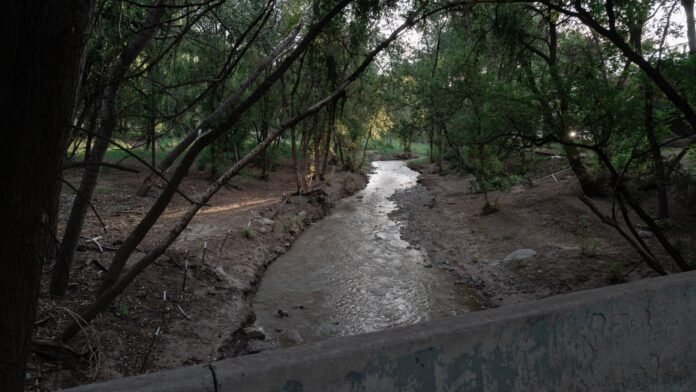
Just upstream of the closed race track, a mobile home park was mostly full. Children played in the street, and occupied trailers sat above the river. The park’s managers said they were following local rules. “I don’t think it’ll ever flood again like that,” said one. The Rio Ruidoso babbled. It looked welcoming. On a summer day, you could go put your toes in.
Google DeepMind Engineer Resigns in Protest of Pentagon Contract
Sofia Liguori, a research engineer working at DeepMind, resigned in protest this week from Google’s pioneering artificial intelligence laboratory. Unlike a wave of other AI researchers who have quit over fears AI might someday turn against humanity, Liguori stepped down over concern about her employer’s current practices.
Disenchanted and disturbed by Google’s military contracts with the U.S. and Israel, Liguori says she could no longer stand working at a company that was going to help kill people or help build technology that “automatically makes it easier to escalate the brutality of war.”
Liguori joined DeepMind in 2023 and began working on AI systems aimed at more efficiently routing power through the electrical grid, a peacetime engineering problem. But as she learned of Google’s Project Nimbus contract, which furnishes Israel’s military and top weapons manufacturers with a suite of advanced artificial intelligence tools, she began to question her role in the company, and the company’s role in the world. The day after Google announced its classified military AI contract with the Pentagon in April, Liguori staged a personal sick-out, using a combination of sick leave and holiday time off to cease her work.
In a letter she sent internally informing DeepMind and her colleagues of her resignation, Liguori urged them to “stay human” in the face of military work. “I no longer believe that our technology will have a net positive impact on society. I think there’s a fantasy world where AI can help decarbonize grids, cut waste, protect ecosystems, and benefit humanity,” she wrote. “But it’s not this world, and it’s not this type of general purpose AI we are racing to develop. Racing to deploy agentic AI in this society and historical moment is a terrible idea, and will definitely be a net evil.”
The Intercept spoke to Liguori, an Italian national living in London, where DeepMind is headquartered, about how she came to view her employer as dangerously powerful. During a series of interviews by phone and via text, which have been edited and condensed for length and clarity, she explained her moral opposition to military work, the role of unionization in dissent, and what hope engineers and scientists might have for influencing their companies.
What was it about DeepMind that made you want to work there?
I had a high opinion of DeepMind; it was a dream company. It had this aura of being a research-oriented place where you could sit close not just to computer scientists, but real scientists and researchers and people with backgrounds in biology, in physics, in mathematics, in ecology, in anthropology.
You joined in 2023, by which point the company had already been involved in Project Nimbus. Were you aware of that project at the time?
Not really. The first year when I joined, I was very new and very isolated in my team. Google DeepMind is a huge company and if you’re not in the right channels, you end up being very siloed. I didn’t know about Project Nimbus, but when the Gaza war escalated, I discovered it. I immediately looked for some internal resistance movement to join, but I didn’t find anything.
I discovered [Google employee advocacy group] No Tech for Apartheid, but I thought it was mainly a U.S. organization. I didn’t know how to connect with colleagues that share concerns, so the only thing that I did was buy a Palestine hoodie and go to the office with that.
In the summer of 2024, I went on maternity leave because my daughter was born, and during maternity leave I was watching news from Gaza every day. I was really suffering experiencing maternity and watching a livestreamed genocide, and every time I was thinking of my company’s complicity in that. I thought about not coming back to work at all.
When I was due to come back, I met a colleague that had basically taken my role in my team before maternity leave, and they were actually leaving for ethical reasons. They put me in contact with the union movement and No Tech for Apartheid. And so I found other colleagues fighting against this.
How and when did you learn of the company’s contracts with the U.S. military?
By the time they started engaging with the U.S. Department of War, [Editor’s note: July 2025] I was already involved in activism. By this winter we saw the GenAI.mil contract materializing, and for me, this was a very clear indication of the company’s intentions. At the same time Google ramped up the security level authorization for Cloud: IL6, which is the level required to handle classified workloads.
The combination of the two — signing this non-classified deal with the Department of War, and ramping up security level — really meant that we wanted to use AI for war, on the battlefield. Even if the internal narrative was, “No, don’t worry, it’s just for administrative purposes, just to process documents.”
What was happening internally?
Internally there was a lot of conversation in specific channels where people were complaining, but leadership never really answered anything. I had some of my posts deleted.
What had you written, and did you ever get any sort of answer as to why this stuff was deleted?
I had several posts deleted because they contained the word “genocide,” and I was told that genocide is an intrinsically violent word, and so I was violating internal policies. Even when my posts weren’t deleted, I often had conversations with my manager and HR telling me that my tone was not appropriate because I was too aggressive and that I should raise my concerns in different ways.
“I was told that genocide is an intrinsically violent word.”
They basically wanted us to send [internal HR] tickets to raise our concerns. The problem is that when you do that, you receive semi-automated answers with absolutely no content, nobody is engaged on the concern you have raised. There’s no discussion at all, you don’t even interact with a human. It’s a lot of administrative and bureaucratic steps you have to follow to raise concerns. What I wanted was discussion and what I wanted was very clear answers from leadership.
They tell you this is not the place to raise concerns, try to go through this other channel. This is the common technique. They always tell you to do something else, try to make you tired, and you will never get an answer.
[Editor’s note: The Intercept asked Google about Liguori’s criticism of both the contract and how discussion is handled internally. Spokesperson Tom Hewett responded: “We work with public sector organisations worldwide and follow a consistent process for reviewing and entering these contracts, including compliance with our acceptable use policies and AI principles. We also have dedicated channels for employees to safely raise any concerns – ranging from business ethics to misconduct – and have strict workplace policies in place to prevent retaliation of any kind.”]
I think the reason why you would be opposed to Project Nimbus is pretty straightforward: genocide. What were your specific concerns about or opposition to the Department of War contract?
I’m against the use of AI for targeting and in warfare in general, not only for autonomous weapons. I’m against AI for war, and I don’t think a commercial company like Google should have anything to do with that.
“AI for targeting is very dangerous; it creates a system where it’s easier to escalate the brutality of war.”
AI for targeting is very dangerous; it creates a system where it’s easier to escalate the brutality of war. The first problem is the opacity introduced in the definition of targets and the dehumanization that follows. In principle, if you have to define targets, if you want to define Hamas combatants, you have to think what it actually means and come up with a definition.
But with these systems, you can bypass the definition. The system itself comes out with a definition. You don’t even question it, you just blindly rely on the definition as the ultimate truth. The person just becomes a set of aggregated data points. All individuality is lost, all humanity is lost in in this process.
It becomes a system that dehumanizes people. It becomes a rubber stamp because the human brain cannot process all this information. You keep a person that formally approves it, but they don’t, they cannot, meaningfully evaluate the output. This links to the accountability gap: Everyone in the kill chain can plausibly say that they didn’t decide.
What did you do to protest the Department of War contract internally?
Mainly messaging on corporate channels to inform colleagues, and speaking with them in person. I tried to channel the widespread dissatisfaction and indignation over the contract into the collective movement we are building, into our union effort. [Editor’s note: DeepMind employees voted to unionize in May.] Many people still don’t know there are other colleagues organizing against these contracts and for a more ethical Google DeepMind.
When you are alone and you lose faith in your company, and you stop believing your work makes a positive difference, you can only become disillusioned and frustrated, and you ultimately end in acceptance and cynicism, or you leave. Finding you are not alone, and joining a collective movement, gives a much better option. It gave me the strength to stay, at least for a year.
I also co-organized a demonstration in February in front of the office. The scope was broader than just the Department of War, but the December GenAI.mil launch had given me a deep sense of urgency, and that’s why I organized the demonstration. I knew something like the classified deal was coming, and I knew this meant legitimizing Nimbus-style collaborations to become the standard. The demonstration was for Gaza and for any use of AI in war. We had banners with “No AI in the kill chain” and “No Gemini for Genocide.”
Has your work as a research engineer contributed to your concerns about this technology being used to kill? How has your technical knowledge informed your opposition?
Understanding how these systems work makes it easier to see where the problem is. Understanding statistical aggregation, and how easy it is to just delegate responsibility, delegate decision-making, makes a difference. But I think it’s more important to do some philosophical reasoning here.
Do you have concerns about the reliability of the technology?
I am concerned about unreliability. But I don’t think you should ever look at unreliability separate from a discussion of why AI in warfare is wrong by itself.
A lot of the time what I hear is a focus on error, for example, the Minab school attack. If we focus only on the error, we are basically saying that if there was no error, these systems for automated targeting are OK.
Were there people within Deep Mind who were supportive of this contract or military work generally?
Yes, it was actually a very debated topic. I think there is broad consensus on the Anthropic red lines, which are fully autonomous weapons and mass surveillance.
But on whether to use AI for military purposes, this is a much more debated topic, and a lot of people buy the narrative of us-versus-them: That we need to defend ourselves against Russia, against China, and so on.
What was your thought process on deciding to leave the company over this?
It was a very challenging year. I came back as a new mom with a full-time job, a baby to handle, I had some health issues, and I was committing to activism basically on the side. Many people told me, you can slow down, but I couldn’t. I couldn’t stay in the company and just go on with business as usual. I really felt we needed to stop the Department of War contract because I perceive that contract as normalizing what happened in Gaza — the kind of tech-powered, AI-powered, brutal war that was tested in Gaza was getting approved to become the standard of war.
“The kind of tech-powered, AI-powered, brutal war that was tested in Gaza was getting approved to become the standard of war.”
I don’t think petitions have a great effect in general. The [DeepMind] petition summarized my disillusionment from us not having done more during the year to prevent this from happening. For me, really, we should have gone on strike this year. We should have stopped working.
In the U.S., there is a lot of defense of these contracts on the basis that it’s important for national security. That might be persuasive if you’re American. But Americans are a pretty small minority on the planet. I’m curious what your perspective is on that kind of rationale as someone who lives in another country, who is a citizen of another country.
There’s been discussion about that as well. A lot of Europeans were actually scared of that, because the current Trump administration is not very friendly even to Europeans. What feels like national security for U.S., people feels like a threat for Europeans.
Are you aware of other colleagues at DeepMind who are going to follow what you’re doing and quit?
Some have quit already, some publicly and some silently. There have been many people leaving because of ethical reasons. Not all of them publicized it.
Do you think it’s possible for workers to change something like the Pentagon contract? What is the worker movement inside Google/DeepMind missing that would allow for that kind of change?
I think it’s possible, but it requires a real commitment and readiness to take some risk. Ultimately, I think we need a workforce ready to strike to oppose these contracts. Currently, many people are too scared to even express an opinion publicly. The company was very effective at creating a pervasive sense of fear, which induces self-censorship.
“The company was very effective at creating a pervasive sense of fear, which induces self-censorship.”
What I tried to show my colleagues this year was exactly that the boundaries we perceive and we retreat behind are not the real boundaries — that we can speak out and keep our jobs. Most of the times the reaction is intimidation in meetings, mentions of policy violations, but nothing else follows. Obviously, there are some boundaries, but they are much farther then the perceived ones.
I also took a day off and demonstrated in front of the office in February, together with University College London BDS [Boycott, Divestment, Sanctions movement] staff and a few other colleagues. I faced literally no consequences for that because it’s a trade union activity in my spare time, and in the U.K., we are protected for such an action. This can be a form of soft strike.
As I write in my letter, if we fail to challenge these restrictions, we internalize them and become diminished versions of ourselves. And I think that in an era of increasing surveillance and authoritarianism, that’s something to reflect on. I have felt much freer since I found the courage to speak out and take some risks. It’s empowering. Fighting this fear is a big part of our task in the union movement we are trying to create in Google DeepMind.
The next step would be a real strike. I always tell my union friends that if I see any Google workers strike, I can die happy.
Colorado Marijuana Regulators Failed to Protect Consumers From Potential Contamination, Audit Finds
The agency charged with regulating Colorado’s first-in-the-nation legal recreational marijuana market potentially put consumers at risk of using contaminated products, a new state audit found.
The report pointed to inconsistent oversight by the Marijuana Enforcement Division and loose state rules around testing marijuana products or contaminants. As a result, it found, nearly 75% of marijuana processed for eventual sale from 2023 through 2025 evaded testing for pesticides.
The audit, released Monday, identified a host of issues, including regulators’ failure to meet regular inspection schedules or to conduct sufficient random checks at dispensaries for contaminated products. It also found that delayed agency warnings to the public allowed potentially contaminated products to remain on shelves for months, sometimes years.
In one case highlighted by the newsrooms, it took 15 months for a manufacturer to discontinue production of a marijuana sleep aid pill despite consumers warning regulators that the product was harming their livers. The pills had herbal extracts that researchers say can cause liver damage.
Auditors said they did not identify evidence of “widespread health and safety issues” but did find that deficient regulations still left consumers vulnerable.
The audit found that unsafe products had remained on the market for as long as three years before the Marijuana Enforcement Division issued a public warning. The auditor’s review of the agency’s health and safety advisories found that, on average, from 2023 through 2025, contaminated products that were the subject of an advisory remained on shelves for more than seven months. That’s the same number of months the news organizations found contaminated products stayed on shelves before warnings were issued.
The audit also found that it took the agency three and a half months, on average, in 2025 to issue an advisory once it launched an investigation into potential contamination. Even after investigators determined an advisory was needed, it still took the agency a month on average to issue one.
“These issues limit MED’s ability to meet its core objective to identify product safety risks and to help ensure that licensed marijuana businesses meet product safety requirements,” the audit stated. “As a result, there is an increased risk that marijuana products sold in Colorado may have contaminants or that the potency listed on the labels is inaccurate.”
Series Timeline
May 15, 2026
We reported that a top Marijuana Enforcement Division official acknowledged in a meeting with industry representatives that the amount of chemically converted hemp being sold as marijuana is greater than the agency has publicly disclosed.
April 13, 2026
State regulators announced a plan to crack down on companies that illegally sell cheaper and potentially hazardous hemp products as marijuana, citing potential tax avoidance and “serious risks to public safety.”
Feb. 6, 2026
Colorado regulators discussed a proposal to do away with the current testing system that allows marijuana manufacturers to choose their own samples. Instead, independent labs or contractors would collect the samples.
May 14, 2021
After hemp companies figured out how to convert CBD into the high-inducing compound THC, Colorado became one of the first states to ban chemically converted hemp products, first with regulatory advisories and then with legislation.
Dec. 20, 2018
President Donald Trump signed the Farm Bill, which legalizes hemp. Congress’ intent was to help farmers along with people who believe hemp’s high levels of the nonintoxicating compound CBD can help with seizures, pain and sleep.
Jan. 1, 2014
Colorado became the first state to allow retail sales of marijuana for recreational use.
Colorado allows marijuana businesses to test far less frequently than required by state guidelines if they can show consistent compliance with testing rules. The reduced testing program results “in a significant portion of the marijuana product being sold in Colorado not undergoing testing to ensure it is safe,” the audit stated. Manufacturers also can rely on other testing exemptions, such as for certain marijuana-derived skin and body products, but there is “limited MED oversight” of how manufacturers determine they qualify for an exemption.
Auditors reported that a survey of MED investigators found that more than half said there are or may be widespread marijuana product safety issues in Colorado’s regulated market.
In a statement released Monday night, the Marijuana Enforcement Division emphasized that state auditors found no evidence “to support claims of widespread health and safety issues” with marijuana products for sale in Colorado, but the agency agreed the audit identified areas for improvement. It said that among other things, it would be assessing exemptions to tests currently allowed under state laws and regulations.
The state auditor’s review “allows us to take a critical look at how we can continue to carry out our work, consistent with our commitment to integrity, safety, and continuous operational improvement,” Dominique Mendiola, senior director of the MED, said in a statement.
The auditor’s report highlighted a criticism her agency has repeatedly sidestepped: the absence of independent collection of samples for safety testing. The Denver Gazette and ProPublica found that more than half of states with regulated marijuana markets rely on private labs or an independent third party to collect samples. Colorado marijuana businesses are free to collect their own samples submitted for testing.
The enforcement division’s own investigators told auditors that, as a result, Colorado relies largely on an honor code to ensure the safety of marijuana sold in the state’s dispensaries.
Auditors said that allowing businesses to select their own samples “increases the risk that businesses do not pick samples that are representative of the overall quality of their marijuana product.”
MED regulators at the start of the year said they planned to pursue an overhaul that would have required private lab personnel to collect samples, but they abandoned that effort after manufacturers said it would increase their costs. On Monday, Kyle Lambert, the enforcement division’s deputy senior director, told legislators that the agency opted against an overhaul this year, chiefly because he said it would be a geographic challenge to do away with self-sampling for rural businesses.
“It was decided now wasn’t the right time to propose that as a policy change,” Lambert said, adding that the agency still might revisit the issue.
State Sen. Byron Pelton, a Republican from Sterling, pushed back, saying it was a loophole he thinks the agency should consider closing.
“If I’m a shady character, I know which products I’m going to go sampling and which ones I’m not,” he said. “That’s a pretty gray area to me.”
The audit also questioned the agency’s reliance on businesses voluntarily recalling contaminated marijuana products, saying that “some of these recalls did not succeed at stopping the businesses from selling potentially unsafe product.”
Just last month, The Denver Gazette and ProPublica reported that a Colorado manufacturer voluntarily flagged 49 of its popular marijuana vapes for recall, nearly six weeks after a third-party lab notified the company and regulators that it detected methylene chloride, a chemical the Environmental Protection Agency has sought to ban for most uses because it can cause cancer. The MED issued a health and safety advisory a day after the publications first reported the manufacturer had warned dispensaries to stop selling the vapes, which consumers had been purchasing for over a year.
In “The Muqaddimah”, the 14th-century historian Ibn Khaldun wrote that “great dynasties often decline after three generations because they fail to produce capable successors.” Under Crown Prince Mohammed bin Salman, Saudi Arabia now asks this question precisely: Has he weakened the very dynasty he was meant to strengthen and secure?
The kingdom is under mounting pressure from both internal and external forces. Prince Mohammad’s key policies and bets, namely that he could defeat the Houthis and create a pliant puppet state in neighboring Yemen, that he could transform the Saudi economy to reduce its dependence on oil, and, crucially, that a Donald Trump-led America would be a reliable ally, are all failing at once.
Many now feel the best way forward is to transfer power, replace Prince Mohammed with a suitable successor, overhaul the country’s diplomacy and economic policies, and implement long-needed democratic reforms. Failing to do so could balkanize the kingdom into smaller entities run by competing princes and end Saudi Arabia as it currently exists.
External actors who covet the kingdom’s vast oil and mineral assets, including an estimated 114 million tonnes of rare minerals and uranium-bearing ores on top of massive fossil fuel reserves, would not hesitate to carve up the country.
Having failed in Iran so far, Saudi Arabia could be the next target, and perhaps an easier one. The refusal of US President Donald Trump and the Western powers to support Prince Mohammed against Yemen’s Houthis lends weight to this hypothesis.
Since assuming power, the crown prince has arguably done more harm than good for the kingdom. Crucially, he has numerous enemies while failing to ensure the nation’s security. Saudi Arabia spends roughly US$83 billion a year on defense, equivalent to about 6.5% of GDP and around 3% of total global military spending.
The October 10 Houthi missile strike on Riyadh’s international airport, killing at least 13 and making the kingdom unsafe for international travelers, shows how highly vulnerable the kingdom has become.
In 2015, when Prince Mohammed served as minister of defense, this expenditure reached as high as 13% of GDP. That year, in coordination with the United Arab Emirates (UAE), he launched a military campaign against Yemen, a conflict that dragged on for eight years. Bombardment and a blockade that caused shortages of food and medicines resulted in the deaths of approximately 700,000 Yemenis.
The Saudi kingdom has spent about $200 billion on defense, yet it has failed to prevail over a ragtag adversary with a military budget estimated at less than $6 to $7 billion. That, critics say, is because much of the military spending has gone toward protecting and propping up the crown prince’s regime rather than fortifying national security against external enemies.
The crown prince has also arguably squandered the kingdom’s wealth on boondoggle economic plans. Reports indicate that billions of dollars have gone to consultancy fees pumping up his blurry Vision 2030, which aims to diversify the Saudi economy away from dependence on fossil fuel exports.
Jamal Khashoggi, a critical journalist who was murdered and dismembered in Istanbul, had argued in his reporting and commentary that if these sweeping giga-projects failed, Saudi Arabia could become one of the poorest nations in the region.
The Wall Street Journal (WSJ), meanwhile, reported that a leaked audit report on NEOM, a massive smart-region megaproject in Saudi Arabia’s Tabuk Province launched in 2017, now effectively faces bankruptcy.
The report said closing The Line, a planned 170-kilometer linear city that has been scaled back as funds shifted toward 2030 World Expo and 2034 World Cup infrastructure, would cost Saudi Arabia up to $16 billion.
Meanwhile, the US-Israel war on Iran and related blockade of the Strait of Hormuz have hit Saudi Arabia especially hard. So, too, have the later blockade of the Bab el-Mandeb Strait and attacks on Saudi Arabia’s East-West oil pipeline by Houthis and Iraqi militias, both of which have prevented Saudi Arabia from exporting oil and depleted its most crucial revenue source.
The Saudi economy, earlier projected by the IMF to grow 4% in 2026, is now headed for a 3.3% contraction.
Another WSJ report said that, amid various security threats, Prince Mohammed frequently moves between different palaces and bunkers, presumably to avoid possible drone-launched assassination attempts. While the Houthis have not yet homed in on his location, the crown prince’s internal enemies and royal rivals might.
Experts note there is precedent for regicide. King Faisal, arguably the finest monarch the House of Saud ever produced, was killed by a member of his own family, allegedly at the instigation of foreign powers.
By tradition, the House of Saud passed power horizontally, from brother to brother among the sons of Ibn Saud, rather than vertically from father to son. With his father’s backing, the crown prince broke that practice in 2017 by sidelining the designated successor, then Interior Minister Mohammed bin Nayef, who reports say remains under house arrest to this day after the de facto palace coup.
Critics of Prince Mohammed viewed the move as a blatant power grab, and many suspect it could not have happened without the support, if not involvement, of the United States. (Ironically, the detained princes were accused by Bin Salman of contacts with foreign powers to carry out a coup.) What the crown prince might have promised in return is still unknown, but Washington rarely gives such favors for free.
To be sure, Prince Mohammed has staked out a more pragmatic policy in 2021, when he ended a blockade on Qatar and sought a deal with the Houthis. Before the October 7, 2023, Hamas attacks on Israel, which ignited the Gaza War, there were murmurs of a possible US-brokered deal that would have seen Saudi Arabia recognize Israel. Nobody is talking about such a deal now amid the fires of the Iran war.
While Vision 2030 foresaw a kingdom weaned from oil, Prince Mohammed’s actions have only intensified the kingdom’s economic burdens and concerns, increased dependence on that revenue, and weakened national security. Once among the world’s wealthiest nations, Saudi Arabia is in clear, if not rapid, decline as the crown prince drives the kingdom deeper into debt.
Today, no European or American nation is stepping forward to offer Saudi Arabia support as Houthi attacks put the kingdom under unprecedented fire. So far, only other Muslim nations have stepped forward. These nations, driven by different incentives and aims, could end up fighting one another, opening the way further for the formation of a possible “ Greater Israel.”
Saudi citizens, nearly 65% of whom are reportedly under 27 years old, should start to look past Prince Mohammed’s light talk about “freedom” and “modernization” and ask whom his policies really serve: the prince or the people? Never before has Saudi Arabia faced such clear risks of collapse from within while being pressed from without.
Dr. Zakir Hussain is a senior fellow at the Indian Council of World Affairs think tank. His research focuses on the Middle East, South Asia and the role of major powers. He was previously associated with the Institute for Defence Studies and Analyses (IDSA) and National Maritime Foundation (NMF), a New Delhi-based think tank of the Indian Navy.