<
article id=”post-951552″>
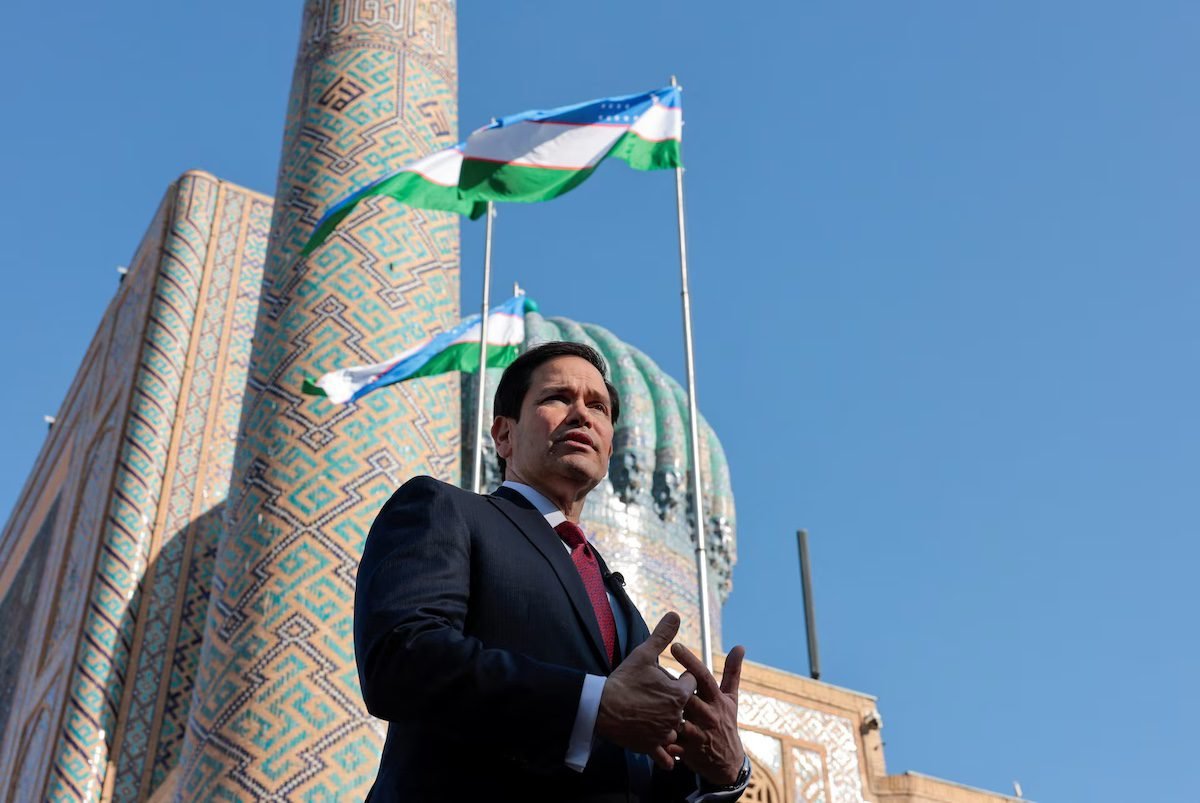
US Secretary of State Marco Rubio arrived in Samarkand on October 19 with nearly 300 American business leaders, seeking to deepen US commercial ties with Central Asia.
Washington’s renewed interest will matter less for how many agreements it produces than for whether American investment helps the region move beyond being merely a supplier of raw materials.
At the C5+1 meeting, Rubio promoted critical minerals, trade links and technological cooperation. Reuters reported that the visit produced few immediate public results, though US officials described it as a chance to build long-term relationships.
Washington is increasingly driven to diversify supply chains away from China, especially for industries that depend on strategic minerals.
For Kazakhstan, Kyrgyzstan, Tajikistan, Turkmenistan and Uzbekistan, the prize is potentially bigger than supplying American manufacturers. Investment could build domestic processing, create skilled jobs and strengthen their negotiating positions.
Russia remains tied to Central Asian economies through trade, labor migration, energy infrastructure and security arrangements. China has financed transport networks and built substantial commercial partnerships. The arrival of American companies will end neither.
And Rubio wisely acknowledged as much. Speaking in Samarkand, America’s top diplomat rejected the idea that Uzbekistan should stop working with Moscow or Beijing. Washington, he said, wanted American companies to compete, not to dictate whom its partners do business with.
Still, more trading partners do not automatically bring more economic independence. A country can sell minerals to several buyers and still remain dependent on foreign companies for processing, technology and market access.
Uzbekistan, for one, has recognized the challenge. At the Samarkand meeting, Foreign Minister Bakhtiyor Saidov called for cooperation spanning geological exploration, mineral processing and local industrial clusters. Tellingly, it is a proposal to build industries, not merely to secure supplies.
For American firms, the challenge is to make local processing commercially viable while securing reliable supplies. For Central Asian governments, it is to ensure that investment builds domestic capabilities and not just boosts exports.
To be sure, not every mineral can be processed economically near its source. Electricity prices, technology, infrastructure and scale determine where processing makes most commercial sense.
Washington should prioritize projects in which commercial incentives and regional development goals align. Joint processing ventures, workforce training and technology partnerships could serve both interests.
Central Asia’s five main economies also differ in the opportunities they offer. Kazakhstan and Uzbekistan have larger markets and more established industrial bases, while Tajikistan and Kyrgyzstan face greater infrastructure and financing constraints. American investment strategies should reflect those differences.
The Trans-Caspian corridor could offer another route between Central Asia and Europe, but its competitiveness depends on infrastructure investment and more efficient cross-border transport.
A September 2026 World Bank assessment projected that strategic infrastructure investment could more than triple trade volumes along the corridor and halve travel times by 2040, with larger potential gains if paired with relevant reforms.
The World Bank estimated that the corridor would need more than US$25 billion in physical infrastructure and another $30 billion in supporting investment through 2040.
These projections reflect the scale of the region’s challenge. Alternative trade routes require sustained financing, regulatory cooperation and reliable transport services, not simply diplomatic announcements.
Environmental pressures complicate the investment agenda. Water and electricity are scarce in the region, and mineral processing consumes both at scale. That means projects must weigh energy availability, water efficiency and environmental safeguards carefully alongside commercial returns.
Washington should judge success by productive capacity rather than by the number or value of mineral agreements. The relevant indicators will be whether projects secure financing, build commercially sustainable processing plants, train local workers and improve access to international markets.
Central Asian governments, meanwhile, should negotiate transparent invesstment terms and realistic commitments to local industrial development without creating projects that depend on permanent subsidies.
Rubio’s visit aimed to build on the C5+1 framework established in 2015. But what sets the latest US effort apart is its commercial emphasis and Washington’s growing concern about strategic supply chains.
Central Asian governments do not seek to swap dependence on Russia or China for dependence on the United States. Rather, they want stronger domestic industries and more leverage in dealing with all outside partners and customers.
The real test of Rubio’s initiative is not where Central Asia sells its minerals, but rather how much of their value Central Asians can keep.
Saima Afzal is a researcher specializing in South Asian security, counterterrorism, and broader geopolitical dynamics across the Middle East, Afghanistan, and the Indo-Pacific. She is currently a research scholar at Justus Liebig University, Germany.