21.9 C
London
Wednesday, August 19, 2026
Home Blog

How Ukraine’s strikes on Russian warehouses became a problem in Kyrgyzstan

0
how-ukraine’s-strikes-on-russian-warehouses-became-a-problem-in-kyrgyzstan
How Ukraine’s strikes on Russian warehouses became a problem in Kyrgyzstan

Ukraine’s campaign to target Russia’s e-commerce giant Wildberries has had impacts far beyond the Russian federation. For Russia, Wildberries is comparable to Amazon, accounting for about 50% of the country’s online retail market. But its market place is used by manufacturers as far afield as Central Asia.

Founded in 2004 as an online clothing retailer, it has 98,000 pick-up points and supplies a vast network connecting more than a million sellers with consumers across Russia, Belarus, Kazakhstan, Kyrgyzstan, Armenia, Georgia, Uzbekistan and Tajikistan.

In 2025, the Wildberries-Russ group recorded 6.1 trillion roubles (about £55 billion) in sales – up 49% on the previous year. Reuters estimates that Russian online marketplaces now handle goods and services worth the equivalent of 8.5% of the country’s GDP.

What makes Wildberries more than a retailer is its reach. Since 2009, it has offered equal prices for deliveries, no matter whether they are in the Russian heartland or as far as the Kamchatkan peninsula in the Russian far east, or Barentsburg in the high Arctic.

Ukraine justifies targeting Wildberries by pointing to the fact that since Russia’s full-scale invasion, the retailer has also become a military-adjacent commerce platform. It carries tactical clothing, body armour, medical kits and communications equipment. Recent investigations have also found first-person-view drones and drone components listed on the platform.

Until the company reportedly removed the relevant tags in July, searches for “everything for the SVO” (the Russian acronym for spetsialnaya voyennaya operatsiya, special military operation) produced military-related goods. This does not establish Wildberries as a military logistics provider. But it shows how wartime demand can respond through infrastructure originally built for civilian commerce.

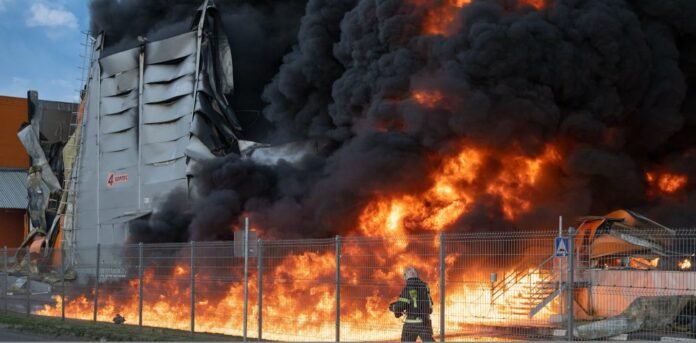
Since July 18, Ukrainian drone strikes have hit at least 20 Wildberries facilities, including three in the past week, damaging or destroying more than 1.18 million square metres of warehouse capacity as of August 7.


Read more: Ukraine assault on Russian retail giant Wildberries brings war home to consumers and retailers


Wildberries is especially vulnerable as it concentrates goods in large warehouses. This makes distribution effective but also creates targets that are directly felt by thousands of businesses and millions of consumers. A successful strike travels through the retailer’s commercial network long after the strike hits.

Cross-border trade

That network also crosses Russia’s borders. In Kyrgyzstan, Wildberries has become an important export channel for small and medium-sized businesses, particularly the country’s burgeoning clothing sector. In March 2026, Wildberries and Kyrgyz Export agreed to create a “Made in Kyrgyzstan” section on the platform across all eight of its markets.

A July survey cited by Kyrgyz business media found that 55% of Kyrgyz Wildberries entrepreneurs said the platform had enabled them to enter foreign markets.

The model has changed the geography of Kyrgyz trade. For decades, the massive Dordoi Bazaar in Kyrgyzstan’s capital, Bishkek, connected sewing workshops with wholesalers, traders and transport companies serving Russia and Kazakhstan.

But digital commerce has added another route: producers can sell directly to Russian consumers while using Wildberries’ warehouses for storage and fulfilment.

That arrangement also creates a new vulnerability. Once Kyrgyz sellers transfer their inventory to a Russian Wildberries warehouse, the goods are physically outside their control. A destroyed warehouse can therefore turn a Russian military strike into a loss for a Kyrgyz business.

Kyrgyz media have already documented such cases. After the first strikes, Kyrgyz sellers reported destroyed inventories and the risk of bankruptcy. One entrepreneur that I interviewed for this article estimated that the volume of goods in his business had fallen by half. A family acquaintance, he said, had lost inventory worth about US$42,000 (£32,200). Another seller went from offering roughly 100 product types to just four.

Around 800 Kyrgyz e-commerce retailers issued an appeal to the government to support them in their compensation claims. While these accounts cannot establish the overall scale of the Kyrgyz losses, they illustrate how quickly a disruption at a distant logistics node can reach businesses in Bishkek.

People shopping at the Dordoi Bazaar in Bishek, Kyrgyzstan.

Dordoi Bazaar in Bishek, Kyrgyzstan. imageBROKER/Oliver Foerstner

Tightening supply chain regulations with Russia have already created significant distress for Kyrgyz garment producers for whom Russia is the main market. The Wildberries attacks have exacerbated this stress, which the Wildberries attacks have exacerbated. In response, Kyrgyz authorities have announced financial support in terms of preferential loan agreements and a “tax holiday” for small and medium-scale garment producers from August 1 until the end of the year. Compensation, however, remains largely a promise.

Wildberries’ seller agreement treats damage caused by drones and other military activity as force majeure (an uncontrollable and unforeseeable event) which limits the company’s liability. As one seller told me, Wildberries may be more likely to compensate Russian sellers with direct ties to the company’s financial infrastructure. For Kyrgyz entrepreneurs, even those holding substantial inventories in Russian warehouses, the risk and loss are more likely to remain their own.

War comes to Kyrgyzstan

So, given the ongoing attacks on Wildberries warehouses across Russia, the question for Kyrgyz entrepreneurs is bigger than whether Wildberries can restore its Russian warehouses. It is whether concentrating inventory inside a foreign logistics network remains a viable business strategy during wartime. The people I interviewed for this article argue that alternative storage and shipment opportunities will eventually emerge, but given the sheer scale of the current cash flow gap and the lack of trust in the business, things are unlikely to return to how they were before the attacks.

One possible answer would be to keep more inventory in Kyrgyzstan, diversify fulfilment providers and expand domestic warehousing. Wildberries itself has announced testing alternative “partner hubs”, by relocating them in countries that are outside of Ukraine’s drone range. For Kyrgyzstan, this could reinforce its position as a logistics hub.

But decentralisation has limits. Cross-border friction between Kyrgyzstan and Kazakhstan tends to disrupt flows and lengthen delivery times, despite both countries being part of the same customs union. Building new warehouses also requires substantial time and investment – while a Russian company expanding its logistics infrastructure brings with it concerns about sanctions evasion.

This is not only an economic, but a wider geopolitical issue. While the e-commerce sector appeared to reduce the role of physical distance, in practice, it reorganises dependence around physical warehouses, roads, borders and political alliances. For Kyrgyzstan, the Wildberries strikes demonstrate that the logistics of war can reach Central Asia without a single missile or drone crossing the Kyrgyz border.


Hind Rajab Foundation has ‘no confidence’ in planned Israeli probe into girl’s killing

0
hind-rajab-foundation-has-‘no-confidence’-in-planned-israeli-probe-into-girl’s-killing
Hind Rajab Foundation has ‘no confidence’ in planned Israeli probe into girl’s killing

The Hind Rajab Foundation on Wednesday said it had “no confidence” in the Israeli army’s reported decision to launch a criminal probe into the killing of Hind Rajab and six of her relatives in 2024, Anadolu reports.

In a social media post, the foundation said the decision by Israel was “little more than a masquerade meant to deflect accountability and preserve its impunity.”

In 2024, five-year-old Hind Rajab was trapped in her family’s car after it came under Israeli fire in Gaza City.

She was later found dead after nearly two weeks of uncertainty regarding her fate.

Two Palestinian medics who had tried to rescue the girl were also found dead.

More than 73,000 Palestinians have been killed in the Gaza Strip, many of them children, since Israel launched its war on the coastal enclave in October 2023.

READ: Death of new commander puts spotlight back on Israeli battalion linked to killing of Hind Rajab in Gaza

All aboard Amtrak’s sleeker, cleaner new trains

0
all-aboard-amtrak’s-sleeker,-cleaner-new-trains
All aboard Amtrak’s sleeker, cleaner new trains

On Charlie Hamilton’s regular Amtrak rides from Seattle to Portland, Oregon, and Vancouver, British Columbia, he passes some of the country’s most spectacular vistas: the Puget Sound coast and the Skagit Valley. On clear days, he can even see Mount Rainier. But perhaps the most beautiful sight is not the natural wonders of the Pacific Northwest. It’s the cars and trucks inching along the highway.

“It’s nice to be able to be going along there and going faster than what people on Interstate 5 are doing. We kind of like that bit,” said Hamilton, who leads the train advocacy organization All Aboard Washington. 

Indeed, riding the train in the Pacific Northwest can take about as long as driving. The trip between Seattle and Portland takes about 3 hours and 30 minutes by either mode, even though the train makes six stops along the way.

Amtrak plans to begin rolling out 83 new trainsets, dubbed Airo, this fall, starting with eight on the Pacific Northwest’s Cascades route. The trains will eventually serve more than a dozen routes in places like New England, Pennsylvania, and much of the mid-Atlantic region. The $8-billion investment is expected to reduce trip times on multiple routes, though Amtrak did not say by how much, and the trains can reach speeds of up to 125 mph. The Cascades trains will also carry 317 passengers — significantly more than the current Cascades rolling stock — and will boost reliability and comfort, according to an Amtrak spokesperson.

Improved hardware could also help advance All Aboard Washington’s vision of more frequent rail service in the region. “Having trains once an hour would be very helpful, and the Airo trainsets would make it possible to do that,” Hamilton said. 

The Airo trains also represent a significant and long overdue refresh for Amtrak, which still has trains that date to the 1970s. The carrier has said the new hardware will provide “significant environmental benefits” while making the rider experience more pleasant. The rollout follows the introduction of new NextGen Acela trains on the Northeast Corridor last summer.

Amtrak’s refresh comes after the Biden administration made a historic $66 billion investment in passenger and freight rail through the Infrastructure Investment and Jobs Act. But it arrives at a tumultuous moment. Despite Amtrak setting ridership records for two consecutive years, the Trump administration has proposed severe cuts to passenger rail funding. Still, the federal government did announce $3 billion in funding, including $2 billion to purchase trains, for Amtrak in August.

Rail carries 8 percent of the world’s passengers, yet accounts for just 2 percent of global transportation energy demand. In that sense, the Airo trains will help make a clean form of transport even cleaner.

Alex Scott, a professor of supply chain management at the University of Tennessee-Knoxville, said rail’s efficiency comes in part from carrying many people at once. “If you can get a fully well-utilized rail car, be it humans or products, those are still more efficient than everybody going in different cars, even if they’re electric cars,” he said.

The trains, built in the U.S. by Siemens, feature electric and diesel propulsion, allowing them to operate on both conventional and electrified routes. While much of the U.S. passenger rail network remains unelectrified, employing new diesel-powered trains can still reduce emissions. “The locomotives they make now, even if they’re not electric, are a heck of a lot cleaner than the old ones, and so upgrading equipment, be it electric or not, is a good answer,” Scott said.

Airo locomotives meet the Environmental Protection Agency’s Tier 4 emissions standards — the agency’s strictest rules for locomotive engines — significantly reducing particulate matter and nitrogen oxide emissions.

Riders on the Northeast Regional route will climb aboard Airo trains in 2027. The new rolling stock will especially benefit riders traveling between Virginia and the Northeast who can wait as long as an hour at Union Station in Washington, D.C. while Amtrak swaps the diesel engine it uses south of the capital to the electric one it uses northbound to Boston. The new trains can quickly transition from diesel to electric power without changing locomotives. 

“It’s a win for the environment, it’s a win for the people that are sitting in traffic,” Virginia Passenger Rail Authority spokesperson Karina Romero said. “We definitely want more trains in Virginia.”

Virginia has invested $6 billion in its Transforming Rail in Virginia program. According to Romero, the combination of new trains and improved infrastructure will give riders a more reliable experience.

“You can put down fabulous infrastructure and great tracks,” she said, “but you’ve definitely got to have the equipment to roll on.”


A fantastical journey unfolds in gorgeous Wildwood trailer

0
a-fantastical-journey-unfolds-in-gorgeous-wildwood-trailer
A fantastical journey unfolds in gorgeous Wildwood trailer

In June, we highlighted a behind-the-scenes featurette on the making of Wildwood, director Travis Knight’s forthcoming stop-motion animated fantasy film. Laika Studios released an extended teaser in May, which racked up over 90 million views. And now we’ve got the gorgeous full trailer, set to a haunting cover of Avicii’s “Wake Me Up.”

The film is an adaptation of the 2011 novel by Colin Meloy—frontman of indie folk-rock band The Decemberists—and his wife, illustrator Carson Ellis. Meloy and Ellis live in Portland, Oregon, near Forest Park, where they often hike the trails. In Wildwood, they transformed that local landmark into a magical hidden world filled with talking animals and lurking threats, only accessible to people of The Wood—and select Outsider “half-breeds.”

Twelve-year-old Prue McKee discovers the forest while out walking with her baby brother, Mac. A murder of crows swoops down and carries him away, and Prue discovers the Wilderness while hunting for him. Her schoolmate, Curtis Mehlberg, follows her, and both are able to enter that magical world. Fantastical adventures ensue as the pair encounter a mysterious woman, Alexandra, who has lost her son, along with coyotes, bandits, and some pretty big secrets.

Per the official logline, “Wildwood is a sweeping, darkly magical adventure about a young girl who ventures into a dangerous hidden forest to rescue her brother—an odyssey shaped by love, power, and the courage to confront the unknown.” Knight has said Wildwood is Laika’s most ambitious project to date, featuring pitched battles and several aerial sequences. “We’ve had to build up the creative tools, the technology and our storytelling muscles to do this book justice,” he told Empire in 2024. The film required 136 sets and 231 practical puppets, augmented with some VFX.

Peyton Elizabeth Lee voices Prue, while Jacob Tremblay voices Curtis, and Carey Mulligan voices Alexandra. The cast also includes Angela Bassett as a giant golden eagle called the General, Jake Johnson and Maya Erskine as Prue’s parents, and Arthur Knight as her baby brother, Mac.

In addition, the film will feature Mahershala Ali as Brendan the Bandit King, Jemaine Clement as Roger Swindon, Awkwafina as a rat named Septima, Charlie Day as a coyote named Dmitri, Amandla Stenberg as Niamh, Tom Waits as Maxim, Tantoo Cardinal as Iphigenia, Richard E. Grant as the wise old Owl Rex, Marc Evan Jackson as Lars Svik, and Len Cariou as Richard. Rob Delaney, Ólafur Darri Ólafsson, and Blythe Danner will voice as-yet-undisclosed roles.

Wildwood opens in theaters on October 23, 2026.

Rahman’s India visit stalls, Hasina issue to blame

0
rahman’s-india-visit-stalls,-hasina-issue-to-blame
Rahman’s India visit stalls, Hasina issue to blame

For months, Bangladesh and India had been attempting that favorite diplomatic maneuver, the “reset,” a word suggesting that international relations, like an obstinate Wi-Fi router, can be repaired by switching everything off and starting again.

There was certainly plenty to reset. Sheikh Hasina had fallen, fled to India and left New Delhi sheltering the former ousted ruler around whom it had constructed much of its Bangladesh policy.

Then, on August 5 this year, Hasina spoke from Delhi. Her live audio appearance at a media event was only a voice down a line, but it proved remarkably effective diplomacy. It disrupted preparations for Prime Minister Tarique Rahman’s first visit to India since his February landslide without requiring Hasina to leave her undisclosed residence.

India had proposed August 21 and 22 for a state visit and invited Rahman to next month’s BRICS summit as BIMSTEC chairman. Dhaka prefers a bilateral visit in which Rahman arrives unmistakably as prime minister of Bangladesh rather than entering through the regional-organization service door.

Now that visit is on hold. Dhaka had warned India beforehand that allowing Hasina to conduct politics from Indian soil could damage efforts to improve relations. India did not stop the event. Afterward, New Delhi said it had neither organized the appearance nor endorsed Hasina’s remarks.

This is diplomatically tidy and politically useless. The Bangladeshi complaint is not that PM Narendra Modi personally connected the conference call. It is that India was warned, allowed it anyway, and provided political space to a former ruler convicted of crimes against humanity over the suppression of the 2024 uprising.

Rahman’s response has been clever because it is comparatively cheap. Bangladesh has not suspended trade, security cooperation or energy links. Officials continue talking. Dhaka has merely withheld something India wants: the symbolism of an early Modi-Rahman summit.

Domestically, the calculation is better still. Nothing travels faster through Bangladeshi politics than an allegation of excessive fondness for India. By declining to rush to Delhi after Hasina’s press appearance, Rahman can look simultaneously reasonable abroad and muscular at home: willing to talk to India, but not apparently waiting beside the telephone for India to call.

The policy also has a weakness. It is reactive. Hasina lives in India, meaning New Delhi controls how much political space she receives. Every interview or address can therefore oblige Dhaka to choose between outrage and studied indifference. Bangladesh risks allowing India — and, indirectly, Hasina — to set the tempo of its India policy.

For New Delhi, the calculation is becoming equally uncomfortable. India can maintain strategic ambiguity: neither extradite Hasina nor formally embrace her, keeping an old ally somewhere between guest, insurance policy and diplomatic bargaining chip. Or it can retain her sanctuary while quietly removing the microphone.

The latter increasingly makes sense. Hasina was valuable to India because she delivered things India wanted…action against northeastern insurgents, security cooperation, transit, connectivity and predictable relations. But an ally’s strategic value changes dramatically when the ally ceases to govern.

Hasina’s August appearance demonstrated both her remaining leverage and its limits. She briefly managed to derail the India-Bangladesh recalibration. Yet each successful disruption raises the question New Delhi would rather avoid: is sheltering Hasina worth allowing her to obstruct relations with the government that actually runs Bangladesh?

India cannot afford to confuse loyalty with strategy indefinitely. Bangladesh surrounds much of India’s northeast, shares a 4,100-kilometer border with it and matters to trade, transit, counterterrorism, power and Bay of Bengal connectivity. The Ganges water-sharing treaty expires this year. Geography, unlike politicians, cannot be sent into exile.

Nor does this mean India will abandon Hasina. It has longstanding ties with her and the Awami League, while extradition carries legal complications. The likelier compromise is sanctuary without a stage: Hasina may remain India’s guest, only to discover that hospitality does not necessarily include broadcasting facilities.

Indian High Commissioner Dinesh Trivedi appeared to hint at the need for movement on Tuesday, urging both countries to “move on” and promising Rahman an “honorable reception” when he visits India. He called the relationship a “partnership of equals” — language carefully tailored to post-2024 Bangladesh’s principal anxiety about India.

Eventually Rahman will probably have to go to Delhi. Bangladesh cannot build an India policy entirely around refusing invitations whenever Hasina speaks, any more than India can build a Bangladesh policy around a woman who no longer governs it.

For now, however, Dhaka’s gamble is sensible. It costs little, strengthens Rahman politically and tells India that the terms of engagement have changed. Hasina has shown she can still interrupt diplomacy from exile.

Her greater problem is that every interruption encourages India to calculate her cost. And foreign policy, unlike old friendships, eventually comes down to arithmetic.

Faisal Mahmud is a Dhaka-based journalist. He is the managing editor of Daily Waadaa, a national English daily in Bangladesh

Son Killed on First Day of Work After Falling from Garbage Truck Driven by His Dad

0
son-killed-on-first-day-of-work-after-falling-from-garbage-truck-driven-by-his-dad
Son Killed on First Day of Work After Falling from Garbage Truck Driven by His Dad


A South Carolina family is reeling from an unimaginable tragedy after a 32-year-old man died on his very first day at a new job — after falling from a garbage truck being driven by his own father.

John Derrick Dover, of Gaffney, was working with the Cherokee County Solid Waste Department on Monday, Aug. 17, when the horrifying accident unfolded.

Dover was one of two workers riding on the rear platform of a sanitation truck as crews emptied residential garbage carts, Cherokee County Coroner Dennis Fowler said.

At around 1:50 p.m., the truck was turning onto Hayes Road when Dover suddenly fell from the back of the vehicle and slammed onto the pavement.

He was rushed to Spartanburg Medical Center, but doctors were unable to save him.

Dover was pronounced dead at 3:26 p.m.

Making the tragedy even more devastating, officials revealed that it was Dover’s first day on the job — and his father was behind the wheel of the truck.

“This is a most tragic incident as it was Dover’s first day on the job,” Fowler said. “What’s even worse, the truck was being driven by his father. Our hearts and prayers are with this family.”

Officials have not yet released additional details about exactly how Dover fell or what injuries caused his death.

An autopsy is expected to be performed as the coroner continues investigating the fatal accident.

Cherokee County officials confirmed Dover’s death in a somber statement Tuesday, calling it a “heartbreaking loss” for the entire community.

“Cherokee County is deeply saddened by the loss of one of our employees, who passed away yesterday afternoon,” officials said.

The county said Dover had only just joined the Solid Waste Department and that investigators were still gathering information surrounding the accident.

Officials said they wanted to make sure any additional details released were accurate out of respect for Dover’s family and loved ones.

“We extend our heartfelt condolences to all who knew John and to those mourning his passing,” the county said.

The investigation into the tragic first-day accident remains ongoing.

UK-Ukraine drone partnership risks Putin’s wrath but will boost long-term security

0
uk-ukraine-drone-partnership-risks-putin’s-wrath-but-will-boost-long-term-security
UK-Ukraine drone partnership risks Putin’s wrath but will boost long-term security

When the UK allowed Ukraine to use British-supplied Storm Shadow cruise missiles against targets inside Russia in late 2024, Moscow predictably accused London of escalating the war and threatened retaliation.

Russia’s latest warnings over Kyiv’s use of British-made drones that “the deeper its involvement in the conflict… the higher the price it will pay” may therefore sound familiar. But there is an important difference: scale.

With a range of 250km, Storm Shadow has given Ukraine an extremely capable weapon for striking high-value targets behind Russian lines. But Britain and its allies possess finite inventories of the expensive cruise missile. Replenishing stocks takes time, money and industrial capacity, placing a practical ceiling on their use.

Long-range drones could loosen that constraint. They may carry smaller warheads and be considerably easier to intercept than a cruise missile but they are far cheaper and easier to manufacture. If Britain and Ukraine produce them in sufficient quantities, their significance will lie less in what any single drone can destroy than in the cumulative effect of repeated mass strikes deep inside Russia.

This does not make drones infinitely scalable. Production depends on components, manufacturing capacity and secure supply chains, while their effectiveness depends on overcoming Russian air defences and electronic warfare. But these differ from the finite inventories limiting cruise missiles.

The UK now has a substantial uncrewed-systems sector. Its drone programmes include the jet-powered Nyan, AR3, K3 Scout and Octopus, spanning long-range strike, surveillance, maritime autonomy and counter-drone warfare respectively. They are backed by the Uncrewed Systems Centre in Swindon, which the government describes as Europe’s “largest drone testing centre”.

Even so, no testing facility can replicate Ukraine’s situation: a live battlefield where designs are continuously evaluated against a capable enemy. According to aerospace manufacturer Tekever, this real-world experience has driven more than 100 upgrades to its AR3 surveillance drone.

Octopus takes this relationship further and is emerging as a model for UK drone manufacturing: take battlefield-tested Ukrainian designs, refine them with British engineering expertise, then mass-produce them in UK factories. Designed to counter the Iranian-designed Shahed drones Russia used against Ukrainian cities and infrastructure, Octopus is expected to be produced at a rate of thousands a month.

The UK government’s technology-sharing arrangements with Kyiv and co-leadership of the international Drone Capability Coalition extend this knowledge exchange to other systems.

This effectively inverts the traditional relationship between Ukraine and its western arms suppliers: no longer is Kyiv simply the customer. Ukraine increasingly contributes battlefield-tested designs and operational knowledge, while Britain can provide engineering expertise, industrial capacity, certification, capital and access to international markets.

But this is not the only arrangement Ukraine’s partners have adopted. Under the “Danish model”, European governments have financed weapons production in Ukraine itself, despite the risk of Russian attacks on these facilities.

Germany, meanwhile, has become the clearest example of Kyiv’s “Build with Ukraine” scheme, under which Ukrainian and German firms establish joint ventures to manufacture drones in Germany. Some of these are known as “resilience factories”, relying on local supply chains and workforces far away from the threat of Russian strikes and with the added deterrent of being manufactured on Nato soil.

Nevertheless, in aggregate, all these imported drones amount to just 5% of Ukraine’s drone consumption. For example, the UK’s “biggest ever drone package for Ukraine,” announced earlier this year, will amount to 150,000. This is far fewer than the 10 million drones Ukraine is seeking to domestically produce this year – even if most will be short-range battlefield systems rather than weapons capable of reaching deep into Russia.

Were the UK to increase its drone output, this would also strengthen its own military. The government’s recent defence investment plan outlined a drone-centric strategy across air, land and sea. This includes a Royal Navy “hybrid fleet” combining crewed warships with cheaper autonomous vessels.

Yet it remains unclear whether the funding matches this reliance on drones. Just £5bn has been earmarked across all three services, covering every type of uncrewed system and spread over four years. This raises doubts about whether production can reach the scale and speed the strategy requires.

The obstacles to scale

Government financing is only part of the equation though. Private investment is needed not only to keep smaller drone firms and their supply chains in business and to help them scale, but also to signal commercial credibility to prospective international customers.

A man cycles past a warehouse on fire after a drone strikes, Podolsk, Moscow Region, August 16 2026.

Ukraine’s campaign of long-range drone strikes on warehouses and logistics centres owned by Russian e-commerce giant Wildberries has been paricularly effective in recent weeks. EPA/stringer

At the same time, drone manufacturers remain dependent to varying degrees on Chinese batteries, motors, electronics and other components. On August 9 it was reported that cameras fitted to Royal Navy K3 Scout uncrewed vessels had been found communicating with an IP address in China, although the Ministry of Defence said these were non-sensitive signals.

The incident highlights one risk from Chinese components. Another is industrial reliance. Eliminating such dependencies would make many drones more expensive and difficult to produce. Leaving them untouched, however, creates security and supply risks during a crisis.

If Kyiv brings battlefield experience of which designs work, and Britain’s contribution is to turn those designs into secure, commercially viable and scalable industrial production, then the UK must overcome these constraints to make the desired drone surge succeed.

How might Russia respond?

Seen from Moscow, British support for Ukrainian long-range drones therefore presents a somewhat different problem from the earlier Storm Shadow decision. The issue is not simply that British technology can strike targets in Russia, but that British industrial capacity could help Ukraine sustain such attacks at greater scale.

Direct Russian military retaliation against Britain remains unlikely, given the obvious escalation risks of attacking a Nato country. A more plausible response is continued activity below the threshold of open conflict. Russia has already been accused of organising sabotage and arson against facilities linked to support for Ukraine, including warehouses in east London, logistics infrastructure in Germany, as well as hostile activity directed at defence industry executives.

In the medium term, the question is whether Ukraine and its partners can withstand this pressure and innovate, manufacture and strike quickly enough to impose costs faster than Russia can defend, repair, disperse and adapt. This contest will become increasingly important as winter approaches.

Google Pixel 11 series review: Is the magic fading?

0
google-pixel-11-series-review:-is-the-magic-fading?
Google Pixel 11 series review: Is the magic fading?

Google’s approach to making smartphones has changed a lot over the years. It started with Nexus phones aimed at the tinkerer and enthusiast niche back when there were countless companies making smartphones. Today, there are far fewer, and Google’s hyper-polished Pixel lineup is seeing less competition and higher sales. So maybe Google thinks it can just keep doing what works. The new Pixel 11 series is Google’s most refined yet, featuring sleek designs, smart software, and incredible screens. They’re also rather boring.

Google made precious few hardware changes in its 2026 phones, shaving off a fraction of a millimeter here and dropping a gram there. The design language has been the same now for three generations, all while prices continue to inch upward. And this year, Google’s hardware has actually regressed in a few key areas. Despite that, the Pixel 11 phones aren’t bad—they’re some of the best 2026 has to offer. But it feels like Google is forgetting that it’s not just competing against Apple and Samsung. It also has to compete against the Pixels of yesteryear.

The same old (but great) design

Just like last year’s Pixel 10 series, Google’s 2026 lineup includes three flat phones and one foldable. The flat Pixels are the same size, and even side-by-side, it’s hard to tell them apart from their predecessors. We’ve got almost identical aluminum and glass sandwich designs, which do admittedly look very nice. They still have Pixelsnap, too.

Specs at a glance: Google Pixel 11 series
Pixel 11 ($899) Pixel 11 Pro ($1,099) Pixel 11 Pro XL ($1,299) Pixel 11 Pro Fold ($1,899)
SoC Google Tensor G6 Google Tensor G6 Google Tensor G6 Google Tensor G6
Memory 12 GB 12 / 16 GB 12 / 16 GB 16 GB
Storage 256 GB / 512 GB 256 GB / 512 GB / 1 TB 256 GB / 512 GB / 1 TB 256 GB / 512 GB / 1 TB
Display 6.3-inch 1080×2424 OLED, 60-120Hz, up to 3000 nits peak 6.3-inch 1280×2856 LTPO OLED, 1-120Hz, up to 3600 nits peak 6.8-inch 1344×2992 LTPO OLED, 1-120Hz, up to 3600 nits peak External: 6.5-inch 1080 x 2342 OLED, 1-120Hz, up to 3600 nits peak; Internal: 8-inch 2076×2152 OLED, 1-120Hz, up to 3600 nits peak
Cameras 48 MP wide with Macro Focus, f/1.7; 13 MP ultrawide, f/2.2; 10.8 MP 5x telephoto, f/3.1; 10.5 MP selfie, f/2.2 50 MP wide, f/1.68; 48 MP ultrawide with Macro Focus, f/1.7; 48 MP 5x telephoto, f/2.8; 42 MP selfie, f/2.2 50 MP wide, f/1.68; 48 MP ultrawide with Macro Focus, f/1.7; 48 MP 5x telephoto, f/2.8; 42 MP selfie, f/2.2 48 MP wide, f/1.7; 10.5 MP ultrawide with Macro Focus, f/2.2; 10.8 MP 5x telephoto, f/3.1; 10 MP inner and outer selfie, f/2.2
Software Android 17 Android 17 Android 17 Android 17
Battery 4,985 mAh, up to 30W wired charging, Pixelsnap wireless charging up to 25W 4,850 mAh, up to 30W wired charging, Pixelsnap wireless charging up to 25W 5,115 mAh, up to 45W wired charging, Pixelsnap wireless charging up to 25W 4,806 mAh, up to 30W wired charging, Pixelsnap wireless charging up to 25W
Connectivity Wi-Fi 6E, NFC, Bluetooth v6, sub-6 GHz and mmWave 5G, USB-C 3.2 Wi-Fi 7, NFC, Bluetooth v6, Ultra-Wideband, sub-6 GHz and mmWave 5G, USB-C 3.2 Wi-Fi 7, NFC, Bluetooth v6, Ultra-Wideband, sub-6 GHz and mmWave 5G, USB-C 3.2 Wi-Fi 7, NFC, Bluetooth v6, Ultra-Wideband, sub-6 GHz and mmWave 5G, USB-C 3.2
Measurements 152.4 mm height×71.1 mm width×7.6 mm depth, 195.6 g 152.4 mm height×71.1 mm width×7.6 mm depth, 204.1 g 162.6 mm height×76.2 mm width×7.6 mm depth, 226.8 g Folded: 155.2 mm height×76.0 mm width×10.1 mm depth; Unfolded: 155.2 mm height×150.4 mm width×5.0 mm depth; 239 g
Colors Frost, Pistachio, Hibiscus, Obsidian Canyon, Olive, Fog, Obsidian (matte) Canyon, Olive, Fog, Obsidian (matte) Olive, Obsidian

The Pixel 11s feel extremely solid, and Google has finally managed to make the buttons less wobbly. The base model Pixel also has a flatter camera bar, which makes it a little more pocket-friendly. The three flat phones are all still eSIM-only in the US—the international versions and the Pixel 11 Pro Fold retain their SIM card slots.

The Pixel 11 Pro XL is Google’s biggest and best flat phone.

The Pixel 11 Pro XL is Google’s biggest and best flat phone. Credit: Ryan Whitwam

The Pixel 11 Pro and Pro XL keep the taller camera bar on the back, but it’s nice that the cameras are centered on the back, unlike Samsung phones. You can set a Pixel down on a table, and it’s stable enough to poke at. The Pixel 11 Pro Fold still has that off-center camera module, which makes it less stable.

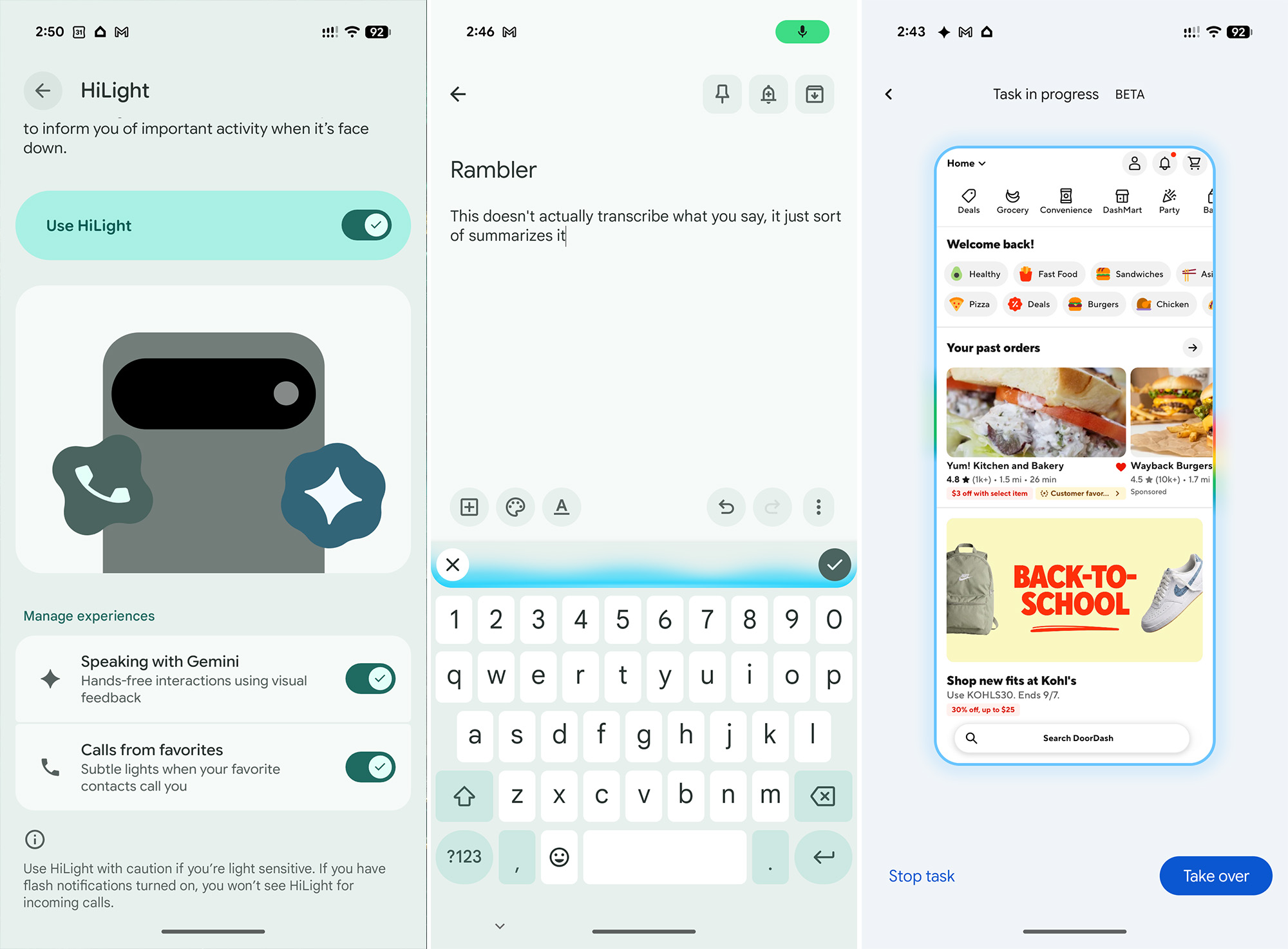
The back of the phone is also home to the Pixel 11’s new HiLight module. This ring of LEDs is inside the camera flash of the Pro phones to act a bit like an old-fashioned notification LED. However, it’s mostly tied to Gemini to indicate when the AI is listening or responding. It also lights up to tell you when one of your favorite contacts calls. And that’s it.

The Pixel 11 is the only new Pixel under $1,000.

The Pixel 11 is the only new Pixel under $1,000. Credit: Ryan Whitwam

HiLight only works when the phone is face down—if the accelerometer detects any other orientation, it won’t light up. So it really only makes sense if you’re using “OK Google” hotword detection and leaving your phone face down a lot. Annoyingly, you can’t even have the LEDs light up for text messages from your starred contacts.

It’s really a baffling addition to Google’s phones. It would be questionable even if it had all the functionality of a classic notification LED, but it barely does anything as it currently stands. Honestly, give me the thermometer back. That at least had a theoretical use, even if it didn’t come up very often. HiLight has been so hobbled that it might as well not exist. Google says more features will be added later, but why the slow drip? We had notification LEDs figured out 20 years ago.

HiLight on the Pixel 11 Pro XL.

HiLight just doesn’t do very much.

HiLight just doesn’t do very much. Credit: Ryan Whitwam

The displays on the Pixel 11 OLED screens are all fantastic, and Google says they’re twice as scratch-resistant now. While the base model stayed the same, all the other screens got a little brighter this year. These phones are perfectly legible in bright outdoor light, even the Pixel 11 that remained at 3000 nits. The other phones have a peak brightness of around 3600 nits. They are a bit more reflective than Samsung’s latest flagship phones, which have an anti-reflective quality, but the Pixels still look great. The Pixel 11 Pro Fold’s internal screen is a bit too reflective due to its plastic top layer, though. So far, Samsung is the only company that has worked to address that issue in foldables.

The Pixel 11 Pro Fold saw the biggest chassis change compared to last year’s model, but even here, the difference is minor. It’s a few tenths of a millimeter thinner, but that’s not enough to notice unless you have both phones to compare. It certainly doesn’t look or feel as supernaturally thin as the Galaxy Z Fold 8 Ultra, or even last year’s Z Fold 7. Oddly, the two halves of the phone are also slightly different (the side with the cover display is thicker). You can feel the difference when holding the phone, and while it doesn’t affect usability, it’s a little strange from a tactile perspective. The screen also still has a fairly deep crease compared to the Z Fold 8, which has almost none now.

Side view of Pixel 11 Pro Fold

The Pixel 11 Pro Fold is only a little thinner than last year’s version.

Pixel 11 Pro Fold and Galaxy Z Fold 8 ultra comparison

Samsung’s Galaxy Z Fold 8 Ultra (top) is substantially thinner than Google’s new foldable.

Google is, however, doing foldable durability right. The Pixel 11 Pro Fold is IP68 rated for water and dust protection, and the back panel is a new glass fiber composite that Google claims is “nearly impossible to crack.” Still, the Pixel foldable is much heftier than the latest foldables from Samsung or Motorola.

Very Google-y software

Google’s new Pixel phones ship with Android 17, not that you’d know from listening to Google. It doesn’t talk about Android much anymore, let alone Android version numbers. Regardless, Google has the best version of Android on its phones. While you do get the full suite of Google apps that you may not use, there’s no superfluous filler, sponsored placements, or duplicative apps. If you use Google’s products, the Pixel 11 series is ready to go out of the box.

Google’s apps, widgets, system UI, and home screen have a unified aesthetic that even Apple would envy. However, Google has oversimplified some things in recent updates, like surfacing suggested widgets instead of showing you the full list by default and using a larger, less dense home screen grid. Still, the Pixel build of Android has great vibes.

There’s a lot of AI in the Pixel 11, but you can avoid most of it.

There’s a lot of AI in the Pixel 11, but you can avoid most of it. Credit: Ryan Whitwam

It also has a ton of AI. There are hints of Gemini in numerous apps, but that’s also true when you access these products in a browser. The on-device AI features can be mostly ignored if you just don’t tap any of the buttons with the AI sparkles on them, but that’s getting harder.

For example, Gboard now has AI-assisted voice transcription built in for Pixel phones. When you tap the mic input button (which now has the telltale AI sparkle), you get a feature called Rambler. Rather than directly transcribing your words with all the mistakes intact, it essentially summarizes what you say to remove “ums” and streamline what you meant to say if you have to correct yourself. This works in the way that AI summarization tends to work, making you sound polished, stilted, and sometimes weirdly positive.

Gemini is also a key part of the experience even more so now that Google has announced Assistant will begin shutting down in the coming weeks. Like Samsung’s latest phones, the Pixel 11 series includes expanded AI automation in more than 40 apps, like Airbnb, Best Buy, DoorDash, Ebay, Delta, and more. It’s basically a robot that helps you buy things.

The story here is the same as it was on the Galaxy Z Fold 8 Ultra. Gemini is capable of navigating these apps with some difficulty. It usually gets where it needs to go, adding items to your cart or pre-booking a reservation. However, it takes much longer than it would if you did it yourself, and its decisions are sometimes suspect. You have to carefully evaluate what Gemini does in these apps, which makes the feature much less useful.

Pixel foldable on yellow background

The Pixel 11 Pro Fold does look nice even if it’s a bit chunky.

The Pixel 11 Pro Fold does look nice even if it’s a bit chunky. Credit: Ryan Whitwam

Google continues to offer seven years of OS updates, along with monthly security patches and quarterly Pixel Drop feature updates. This is on par with Samsung and a bit longer than almost everyone else. Google’s updates also arrive in a timely fashion, whereas even Samsung may take several months to roll out new versions of Android.

Performance compromises

Google is not interested in talking about smartphone performance in the traditional way. It readily admits the Tensor chips are not optimized for winning benchmarks, but it claims the new Tensor G6 offers 25 percent faster web browsing and up to 20 percent better power efficiency. This seven-core Arm chip sports the same middling GPU as last year’s G5, along with a new MediaTek modem.

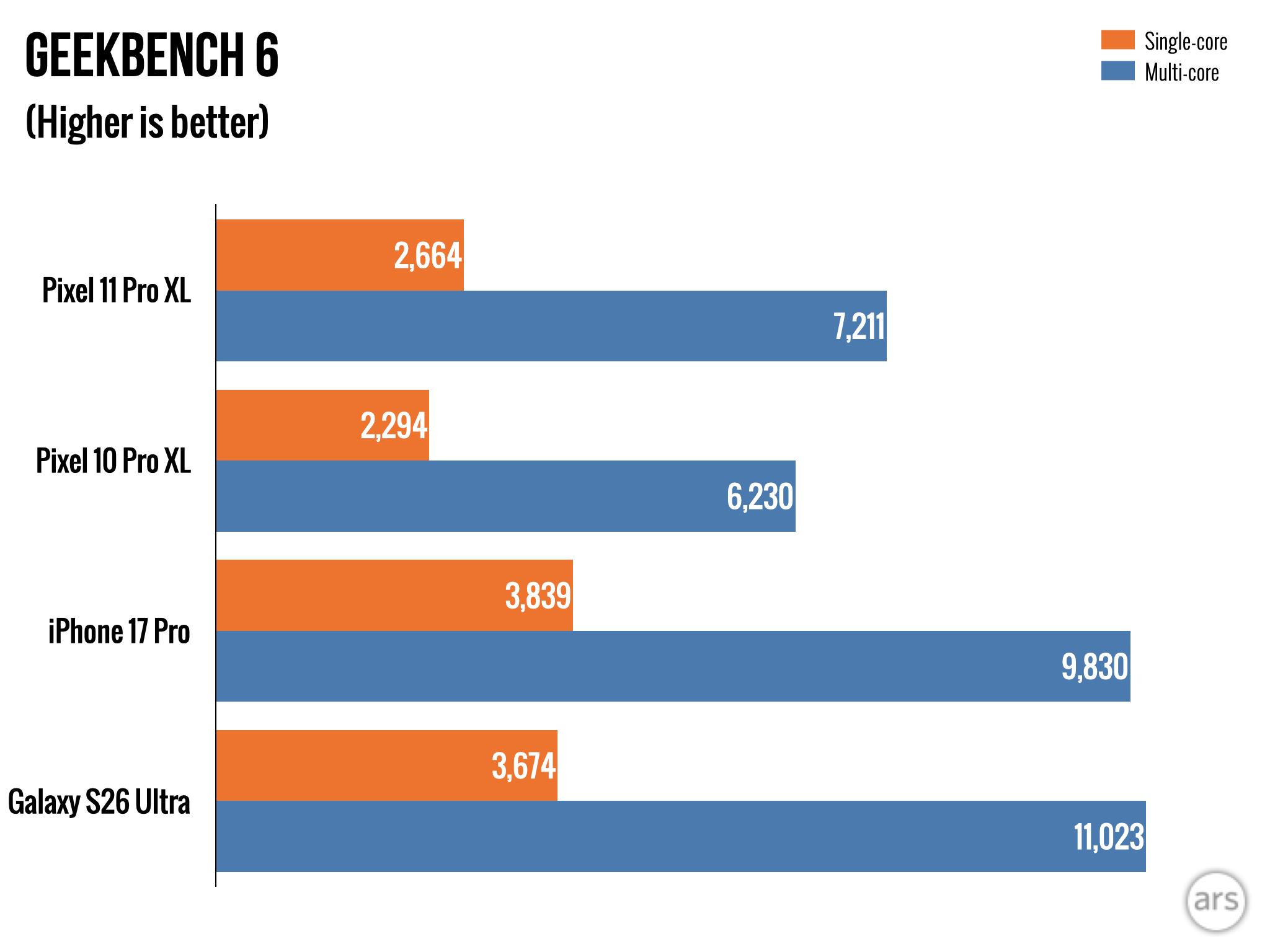
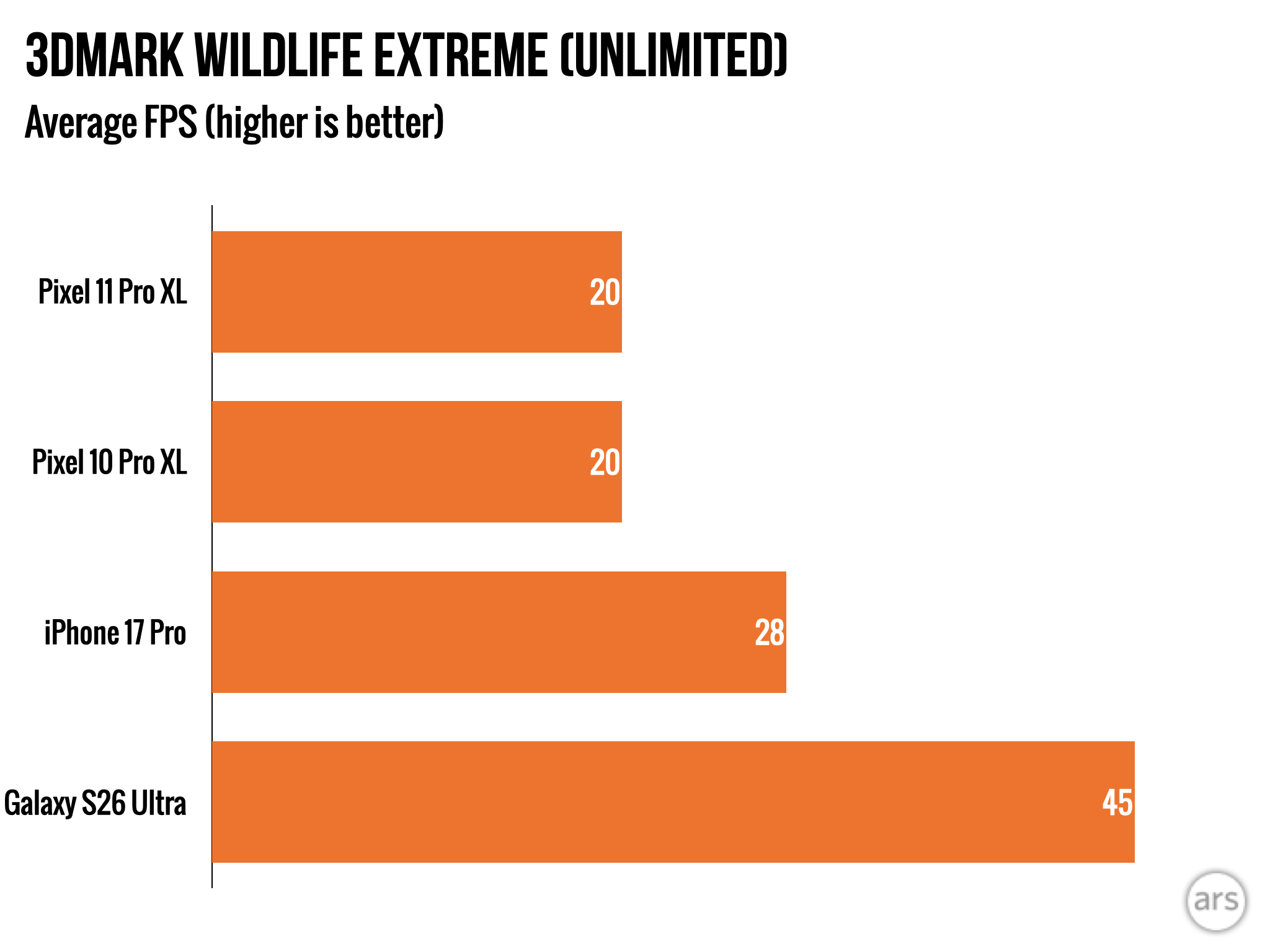
As expected, the Pixel 11 series doesn’t show well in benchmarks, trailing the flagship phones from other smartphone makers. But those are all just abstract numbers that might describe how the phone performs in some situations.

Pixel 11 geekbench chart

The Pixel 11 shows modest improvements in CPU tests.

Pixel 11 3dmark chart

The GPU performance is unchanged this year.

In daily use, the Pixel 11 phones feel great. Animations are fluid, touch response is instant, and apps open quickly. Google’s phones can feel faster than even the Galaxy S26, which is sometimes inconsistent despite being the fastest on paper. Google’s chip is also more thermally stable than high-end Qualcomm chips, losing under 25 percent of its performance during extended use.

Gaming is more of a problem for Google, though. The company is still using the same PowerVR GPU in the new Tensor chip, which is markedly slower than what you get in high-end chips from Qualcomm or Apple. Consequently, if you’re playing graphically intensive games like Genshin Impact or the mobile port of Red Dead Redemption, you will get lower frame rates with the Pixel. For the simpler, free-to-play games most people play, the Pixel is plenty powerful.

It is notable that Google has backtracked on RAM in the Pixel 11. Previously, Google cited the need for running bigger on-device AI models as a reason to upgrade base SKU Pixel phones to 16GB of RAM. However, the 2026 Google phones start at 12GB, and you have to upgrade to get 16GB. That means you’re looking at a minimum of $1,219 for the Pixel 11 Pro with 512GB of storage and 16GB of RAM.

Heavier apps and games may close more quickly on the 12GB versions of the Pixel 11, but the difference has been minimal in my testing. However, should you have to make that kind of compromise with a phone that costs $100 more than its predecessor? Probably not. That said, Google’s phones are generally better at keeping apps in memory than, say, Samsung, which only has 12GB of RAM in its $2,100 foldable.

Battery life is also complicated with the Pixel 11 series. All the batteries are slightly smaller across the board this year. The flat phones are less than 100 mAh smaller, but the Pixel 11 Pro Fold dropped more than 200 mAh compared to last year’s foldable. Yet Google is claiming similar battery life this year, somewhere between 24 and 30 hours, depending on the model.

The Pixel 11 Pro (pictured) and 11 Pro XL have faster 45 W charging now.

The Pixel 11 Pro (pictured) and 11 Pro XL have faster 45 W charging now. Credit: Ryan Whitwam

In my time with the Pixel phones, they haven’t seemed to run dry faster. So that’s good… sort of. Ideally, we should be seeing battery life expanding beyond this “about one day” window we’ve been stuck in forever. Very few phones have managed to do that, and Google doesn’t seem interested in making the kind of changes (See: OnePlus’ last hurrah) that would support substantially longer battery life.

There is some good news in the battery department. The Pixel 11 Pro and Pro XL have finally gotten a charging boost, now topping out at 45 W instead of 30 W. The base model and Fold are still at the lower wattage, but now all of them at least have 25 W wireless charging with a compatible Qi 2.2 pad.

Insta-ready cameras

Google’s camera hardware has gotten a few minor tweaks this year. The Pixel 11 Pro and Pro XL have all the same setup—a 50 MP primary, 48 MP 5x telephoto, and a 48 MP ultrawide. However, the main and telephoto sensors are new components that promise better optical quality. The Pixel 11 and 11 Pro Fold have a new 48MP primary sensor. The foldable has the same 10.8 MP 5x telephoto and 13 MP ultrawide from last year, and the flat phone has a new 13 MP ultrawide and the same 10.8 MP telephoto as the Fold.

The Pixel 11 Pro offers Google’s best cameras in a smaller form factor.

The Pixel 11 Pro offers Google’s best cameras in a smaller form factor. Credit: Ryan Whitwam

Most of the changes are in the software controlling those cameras. In general, these changes are clever and could be nice to have for certain situations, but they’re not game changers.

There’s a new feature called Magic Capture that lets you outsource the shutter button to the on-device AI. Once you activate this mode, the phone starts recording a video. When it determines the moment is right, it can snap full-quality still photos as well. This works well in theory, but it’s not infallible. Generally, if the scene isn’t too busy and your subject is around the middle of the frame, the AI will reliably snap a photo. This works a lot of the time—I’ve gotten some genuinely cool shots with Magic Capture, but it also sometimes misses the moment. If a photo is important, I’m going to do the leg work of tapping the shutter myself.

11 Pro and 11 Pro XL photos:

Outdoor light and shadow

Macro

Primary

5x telephoto

Google also says the Pro phones have a new Instant Night Sight feature, but calling it “instant” may be overselling it a little. You’ll still get a timer telling you to hold the phone still, but the captures are noticeably faster. That could be the difference between a blurry photo and something usable. So while it’s not as fast as a regular photo (and certainly not instant), it’s still a nice upgrade.

However you’re taking photos with the Pixels, the results will be impressively sharp. With quick captures and powerful processing, even moving subjects are clear. Even the most expensive phones from Samsung and Apple struggle here. Google’s dynamic range is also better than you’ll see on other devices, resolving details in light and shadow very well.

Pixel 11 and Pixel 11 Pro Fold photos:

Outdoor light, fast movement

Macro

Primary

5x telephoto

However, Pixel photos have a specific look, and it might not be ideal for every situation. With the Pixel 11, Google has debuted Camera Looks to address the situation, but it’s a little confusing. There are new default styles, like natural and shadows, that are retained each time you open the camera. Then there are the more dramatic filter-like looks you access by swiping in the viewfinder. This includes options like velvet, digi, and editorial. You can imagine this like something akin to film simulations on Fujifilm cameras. You can also edit any of the looks to your liking, changing sliders for highlights, tint, grain, and more.

Camera Looks:

Editorial

Minimal

While they’re a bit clunky to access, Camera Looks give you a ton of new shooting options on Pixel phones. They’re perfect if you’ve gotten tired of the super-sharp processed look of smartphone photos.

A rebuilding year?

The Pixel 11 phones are good devices. The regression on RAM is a bummer, but the 12GB phones still feel very fast and keep apps in memory well enough for all but the most picky buyers. Likewise, the slightly smaller batteries are less than ideal, but the battery life doesn’t seem to have taken a dive.

Additions like Camera Looks and stronger displays are nice, but they’re probably not worth an upgrade for current Pixel users. And HiLight doesn’t even figure in. If you have a Pixel 10, Pixel 9, or even something older, you don’t need to run out and buy a Pixel 11. These phones are still more than serviceable, and they have years of support left. With such minor updates in 2026, Google is essentially competing against its older phones.

Left to right: Pixel 11, Pixel 11 Pro, Pixel 11 Pro XL, Pixel 11 Pro Fold

Left to right: Pixel 11, Pixel 11 Pro, Pixel 11 Pro XL, Pixel 11 Pro Fold Credit: Ryan Whitwam

If you’re due for an upgrade, either because your current phone is in a bad way or you’re thinking about switching to Pixel, you’ll probably like what the Pixel 11 has to offer. However, you’d probably like the Pixel 10 just as much. You’ll probably be able to find last year’s model at a discount, and it still has six years of software support left. Again, Google is a victim of its own success here.

And what about Google’s foldable? That’s a tougher sell. Even in the US, Google has stiff competition. Both Samsung and Motorola offer foldables that are thinner and faster and have longer battery life. These phones all cost about the same and get similar levels of support, but Google’s software is a bit better overall. Still, I’d probably choose a Galaxy Z Fold 8 with its more compact frame over the Pixel 11 Pro Fold right now, even if it’s a little more expensive.

The good

  • Excellent OLED screens with even higher brightness
  • Foldable is more durable and still IP68
  • Long update support
  • Still a nice design for the third year in a row
  • Great cameras with new Camera Looks

The bad

  • Higher prices
  • Smaller batteries
  • Less RAM
  • eSIM only in the US
  • Even greater focus on AI features you may not want

The ugly

  • HiLight does almost nothing

Espresso Prices in Italy Jump Nearly 25% in Five Years, Study Finds

0
espresso-prices-in-italy-jump-nearly-25%-in-five-years,-study-finds
Espresso Prices in Italy Jump Nearly 25% in Five Years, Study Finds


A cup of espresso at an Italian bar now costs nearly a quarter more than it did five years ago, according to a new study, and industry analysts warn that a major earthquake in Colombia could add further pressure to coffee prices.

The Center for Consumer Training and Research (Crc), working with the consumer advocacy group Assoutenti, released the study analyzing price increases for espresso through 2026. Researchers also flagged new supply risks after a magnitude 7.4 earthquake in Colombia disrupted coffee export logistics from one of the world’s top-producing countries.

Using official data from Italy’s Ministry of Enterprises and Made in Italy (Mimit) collected across the country’s provinces, the study found the average espresso now costs 1.29 euros, up 25 cents from 2021 — a 24.2% increase. Prices varied widely by region, the Crc reported.

Bolzano had the highest average price, at 1.51 euros per cup, followed by Pescara at 1.49 euros. Eleven provinces met or exceeded 1.40 euros per espresso, including Ferrara, Belluno, Ravenna, Trieste, Parma, Trento, Padova, Treviso and Udine.

At the other end of the scale, Messina had the lowest average price, at 1.06 euros, followed closely by Catanzaro at 1.08 euros. Aosta, Siracusa, Varese, Rome and Pistoia were the only other provinces with average prices below 1.20 euros.

Looking at five-year trends, Pescara recorded the steepest increase, with prices up 49% since 2021, followed by Parma (41%), Bari (39.5%) and Naples (37.8%) — the city widely regarded as coffee’s spiritual home in Italy.

The smallest increases were in Aosta, up just 6.7% over five years, along with Cagliari, Biella and Reggio Emilia, which each saw increases of roughly 15%, the Crc said.

Furio Truzzi, president of the Crc’s scientific committee, said the price increases are not being driven by the cost of raw coffee. Robusta coffee, he noted, is trading at about $3,900 per ton, down from a 2025 peak of $5,600. Arabica prices have similarly fallen to around $3.20 per pound, down from more than $4 a year ago.

Instead, Truzzi attributed the higher prices to rising energy and operating costs for bar owners, which are then passed on to customers.

Assoutenti President Gabriele Melluso said Italian coffee habits are shifting as a result. Sales of whole-bean coffee rose 33% in Italy in 2026, he said, as more consumers move away from pods and capsules. Melluso said that trend, combined with the steady rise in bar prices, could eventually challenge the dominance of espresso at the bar — long considered an essential daily ritual for millions of Italians.

India’s Israel arms ties enter a riskier new phase

0
india’s-israel-arms-ties-enter-a-riskier-new-phase
India’s Israel arms ties enter a riskier new phase

For decades, India-Israel defense relations were straightforward. Israel possessed military technologies, weapons systems and operational expertise that India wanted, while India offered one of the world’s largest defense and weaponry markets. That equation is now changing at warp speed.

India is no longer simply a major customer of Israeli military technology. It is increasingly becoming a manufacturer, joint-venture partner and supplier within Israel’s defense-industrial ecosystem.

This transformation extends beyond bilateral relations, connecting Indian industrial capacity more directly to the security architecture of a Middle East already strained by the Gaza war and wider regional confrontation pitting the US and Gulf states against Iran and its proxies.

A July 2026 Amnesty International investigation offers a detailed picture of this shift. Using shipment-level trade data, Amnesty identified at least 2,596 shipments of weapons, ammunition, parts and components from India to Israel between October 7, 2023 and November 30, 2025.

These included at least 390,516 small-arms parts, 564,970 components of explosive ordnance and 298 military-vehicle components. The significance lies less in the numbers than in what they reveal about the changing structure of the relationship.

From arms buyer to industrial partner

India remains one of the world’s largest importers of major weapons, even as New Delhi pushes aggressively to localize defense production.

India was the world’s second-largest importer of major arms in 2021–25, accounting for 8.2% of global imports, according to the Stockholm International Peace Research Institute (SIPRI). Russia supplied 40% of India’s imports, France 29% and Israel 15%, the same data shows.

The relationship now is increasingly two-way. Amnesty identified Indian private companies, state-owned enterprises and India-Israel joint ventures supplying Israeli defense manufacturers.

Among them are PLR Systems, involving Adani Defence & Aerospace and Israel Weapon Industries; Alpha Elsec Defence & Aerospace Systems, linked to Elbit Systems; and state-owned Munitions India Limited.

Amnesty traced machine-gun parts, components related to 155mm high-explosive artillery ammunition, warheads for Sky Striker loitering munitions and armored-vehicle components, among others. The rights organization says it excluded shipments likely intended for civilian use and components likely associated with anti-missile defense.

In sum, Israel-India defense cooperation is supporting New Delhi’s push for domestic manufacturing, while Indian factories are becoming integrated into Israeli supply chains. The traditional buyer-seller relationship is evolving toward defense-industrial interdependence.

Gaza changes the calculation

Under different circumstances, this transformation might have attracted less international attention. But the Gaza war and the US-Israel conflict with Iran have fundamentally changed the political and legal environment surrounding military transfers to Israel.

Amnesty, for one, argues that continued transfers risk contributing to serious violations of international law and has called for them to stop. The International Court of Justice, meanwhile, is weighing whether Israel is responsible for genocide as defined under international law in Gaza.

But India faces a strategic dilemma regardless of that eventual legal decision and its consequences. New Delhi has traditionally sought to maintain relationships across competing political and strategic camps in the Middle East and elsewhere as part of its non-aligned foreign policy tradition. It has developed close security ties with Israel while preserving key relations with Gulf states, Iran and the Palestinians.

The Middle East is central to India’s energy security and trade, while millions of Indian citizens live and work across the Gulf. India also has major economic relationships with Saudi Arabia and the UAE, retains strategic interests involving Iran and its Chabahar Port, and continues officially to support a negotiated two-state solution to the Israeli-Palestinian conflict.

Deeper involvement in Israel’s wartime defense supply chain makes that balancing act more difficult to maintain. The more India’s industrial base becomes connected to Israel’s war-geared defense economy, the harder it becomes to keep these relationships in separate diplomatic compartments.

Strategic autonomy becomes harder to demonstrate when diplomatic balance coexists with material integration into one side’s wartime defense supply chain.

More than an arms trade relationship

Defense-industrial cooperation binds countries together differently from conventional arms purchases.

Buying a missile, radar or drone is largely transactional. Joint manufacturing, technology transfer and integrated supply chains create deeper relationships involving factories, intellectual property, subcontractors, investment and long-term commercial interests.

For India, the partnership supports its ambition to expand indigenous defense production and reduce dependence on imported finished systems. For Israel, India offers manufacturing capacity, industrial scale and one of the world’s largest defense markets.

These mutual interests make the relationship more resilient, but they also create exposure. Further escalation involving Gaza, Iran or another regional theater could increase scrutiny of Indian companies and policymakers over where Indian-manufactured military products ultimately go.

India should not, however, be mistaken for Israel’s principal external supplier of major weapons. SIPRI estimates that the United States accounted for 68% of Israel’s major-arms imports in 2021–25, Germany for 31% and Italy for 1.3%.

This does not contradict Amnesty’s findings. The two datasets measure different dimensions of the relationship. SIPRI tracks transfers of major conventional weapons, while Amnesty’s shipment-level investigation covers ammunition, parts, components and other military-related goods.

The latter can therefore reveal supply-chain integration that does not appear prominently in major-arms statistics.

A wider Middle East calculation

This all has consequences beyond India and Israel. Regional military competition increasingly operates through networks of drones, missiles, electronics, components, technology partnerships and co-production. India’s growing integration with Israel adds another major Asian industrial power to this architecture.

At the same time, New Delhi is seeking greater influence across the Gulf and wider Middle East. It wants closer economic relations with Saudi Arabia and the UAE, connectivity through projects linking India with the Middle East and Europe, access through Iran’s Chabahar port and a stable regional environment for energy and trade.

A prolonged regional confrontation involving Israel makes these interests increasingly difficult to separate from India’s defense relationship with the country.

For New Delhi, the issue therefore extends beyond whether individual export licenses comply with domestic law. The larger strategic question is how deeply India wants its emerging defense-industrial ambitions connected to conflicts in the Middle East.

To be sure, India has clear reasons to maintain defense cooperation with Israel. Israeli technology has contributed to Indian military modernization, while joint production supports New Delhi’s ambition to become a major defense manufacturer.

But deeper industrial integration brings consequences that a conventional buyer-seller relationship did not. India-Israel defense relations have therefore entered a potentially fraught new phase. India is no longer merely buying Israeli military power – it is increasingly participating in the industrial system that produces it.

For a country seeking greater influence across Asia and the Middle East, the challenge is whether India can deepen its integration into Israel’s defense economy without undermining the strategic autonomy that has long defined its independent foreign policy.

Saima Afzal is a researcher specializing in South Asian security, counterterrorism, and broader geopolitical dynamics across the Middle East, Afghanistan, and the Indo-Pacific. She is currently a research scholar at Justus Liebig University, Germany.

0FansLike
0FollowersFollow
0FollowersFollow
0SubscribersSubscribe
- Advertisement -
Google search engine

Recent Posts