Netanyahu says he intends to attend UN General Assembly despite NYC Mayor’s arrest threats
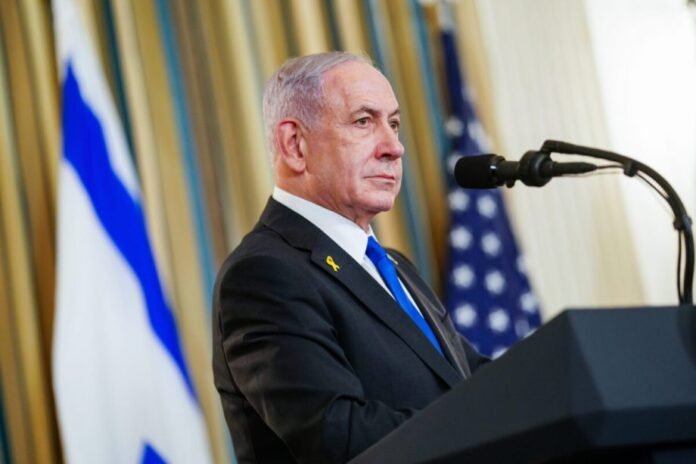
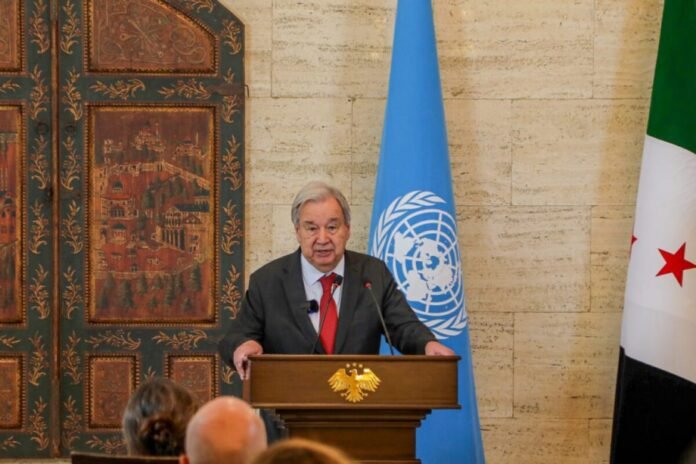
Israeli Prime Minister Benjamin Netanyahu said Sunday that he plans to attend the UN General Assembly in New York, dismissing recent calls for his arrest by New York City Mayor Zohran Mamdani, Anadolu reports.
“I’m not concerned, and I certainly intend to do so,” Netanyahu told Fox News about the September gathering. He added that he has appeared at the high-level diplomatic gathering almost every year during his tenure, unless there are security conditions that barred him from doing so.
The remarks follow Mamdani’s characterization of Netanyahu as a “war criminal” and he is not welcome in the city. Mamdani previously urged Washington to join the International Criminal Court (ICC) to execute existing warrants against the Israeli leader.
US President Donald Trump, however, has vowed that Netanyahu “will not be arrested” while visiting the United States.
The ICC issued arrest warrants in November 2024 for Netanyahu and former Israeli Defence Minister Yoav Gallant over allegations of war crimes and crimes against humanity in Gaza.
Golden, cheesy Spinach Zucchini Chickpea Bake filled with tender vegetables, hearty chickpeas, pesto, and fresh basil.
Spinach Zucchini Chickpea Bake is the kind of cozy vegetable dinner that still feels bright and fresh. Tender zucchini, hearty chickpeas, and wilted spinach are folded into a creamy pesto-ricotta mixture. Then, everything is finished with bubbling mozzarella and juicy cherry tomatoes. Roasting the zucchini first prevents a watery casserole, while lemon zest lifts every rich, cheesy bite.
This easy vegetarian bake works beautifully as a satisfying meatless main or a generous side dish. It has plenty of protein, colorful vegetables, and enough golden cheese to make everyone reach for seconds. The edges turn lightly crisp, the center stays creamy, and little pockets of pesto keep the flavor lively. Serve it with warm crusty bread, a simple green salad, or nothing more than a spoon. Some dinners simply do not need much help disappearing.
Golden, cheesy Spinach Zucchini Chickpea Bake filled with tender vegetables, hearty chickpeas, pesto, and fresh basil.
Recipe Yield: 6 servings
INGREDIENTS
1 (15-oz) can chickpeas, rinsed, drained, and patted dry 3 medium zucchini, about 1½ lb, sliced into ⅓-inch rounds or half-moons 8 oz baby spinach 1 cup cherry tomatoes, halved 1 small yellow onion, finely chopped 3 garlic cloves, minced 1 cup whole-milk ricotta ⅓ cup prepared basil pesto 2 tbsp extra-virgin olive oil, divided ¾ tsp fine sea salt, divided ½ tsp black pepper, divided 1 tsp dried oregano 1 large egg 1 tbsp fresh lemon juice 1 tsp finely grated lemon zest ¼ tsp crushed red pepper flakes ½ cup finely grated Parmesan, divided 1½ cups shredded low-moisture mozzarella, divided 2 tbsp chopped fresh basil, for serving
INSTRUCTIONS
1. Preheat and prepare: Preheat oven to 425°F (220°C). Lightly grease a 2½-qt baking dish or 9-inch square baking dish. Line a large sheet pan with parchment.
2. Roast the zucchini: Toss zucchini with 1 tbsp oil, ½ tsp salt, ¼ tsp pepper, and oregano. Spread in one layer and roast for 10 minutes.
3. Add the tomatoes: Arrange tomatoes cut-side up beside the zucchini. Roast for another 8–10 minutes, until the zucchini is lightly golden and its surface looks dry. Reduce oven to 400°F (200°C).
4. Cook the aromatics: Meanwhile, heat remaining 1 tbsp oil in a large skillet over medium heat. Cook onion for 4–5 minutes, until softened. Add garlic and cook for 30 seconds.
5. Wilt the spinach: Add spinach in batches with remaining salt and pepper. Cook for 3–4 minutes, stirring often, until wilted and no liquid remains. Remove from heat and cool for 5 minutes.
6. Make the creamy filling: Whisk ricotta, pesto, egg, lemon juice, lemon zest, red pepper flakes, ¼ cup Parmesan, and ¾ cup mozzarella until combined.
7. Combine the bake: Fold in the chickpeas, spinach mixture, and all but a few zucchini pieces. Spread evenly in the prepared baking dish.
8. Finish the top: Arrange reserved zucchini and roasted tomatoes over the filling. Sprinkle with remaining mozzarella and Parmesan.
9. Bake until golden: Bake uncovered for 25–30 minutes, until bubbling, lightly golden, and set in the center. The center should reach 165°F (74°C). Broil for 1–2 minutes for deeper golden spots.
10. Rest and serve: Let the bake rest for 10 minutes. Finish with chopped basil and serve warm.
Helpful Tips to Perfect This Recipe
Remove excess vegetable moisture: Roast the zucchini until its surface looks dry. Also cook the spinach until no liquid remains in the skillet. These steps prevent a watery bake.
Use the right cheeses: Whole-milk ricotta creates the creamiest filling, while low-moisture mozzarella melts without releasing excess liquid. Drain unusually wet ricotta before using.
Dry the chickpeas well: Patting the chickpeas dry helps them absorb the pesto and seasonings. It also prevents extra moisture from collecting in the casserole.
Allow the bake to rest: Give it a full 10 minutes before serving. The creamy center will settle, making each portion easier to lift and serve.
Rate This Recipe
Tried this recipe? Your rating helps others and means so much.
For three-quarters of a century, the Middle East operated inside an American frame. Washington was not the only actor, but it was the reference point — the guarantor whose fleets, bases, and diplomatic weight set the outer boundaries of what regional rivals could do to one another.
That frame is not gone, exactly. But it has thinned, and what is emerging in its place is less a new order than the return of an old condition: a genuine multipolar contest among regional powers, hedging outside powers, and a Washington that intervenes selectively rather than presides continuously.
The vacuum that isn’t empty
It has become a cliché to describe American retrenchment as leaving a “vacuum.” The metaphor is misleading. Vacuums imply nothing rushes in to fill them evenly; in practice, the space vacated by a retreating hegemon is claimed unevenly, by whichever regional actor has the most capacity and the clearest interest at that moment.
In the post-hegemonic Middle East, that has meant three simultaneous, overlapping contests rather than one successor order.
One, a Gulf contest for economic and diplomatic primacy. Saudi Arabia and the UAE have spent the past decade building foreign policies independent of, and at times openly at odds with, Washington’s preferences — de-escalating with Iran, hedging with China, buying arms wherever the terms are best.
This is not “anti-Americanism.” It is what realist theory would predict of any capable state once a patron’s guarantees become less certain: diversification of dependence.
Two, a struggle over Iran’s regional position, conducted less through direct state-to-state war than through proxies, sabotage, and the occasional overt strike, with the underlying question never fully resolved: does a chastened, economically squeezed Iran retrench into its borders, or does it reinvest in the deterrent architecture — nuclear latency chief among them — that a weaker conventional position makes more, not less, attractive?
Three, a reordering of Israel’s regional relationships, in which normalization with parts of the Arab world proceeds simultaneously with unresolved, arguably worsening, conflict over the Palestinian question — a contradiction that outside powers have generally preferred to manage rather than resolve, because resolution was never actually a prerequisite for the diplomatic normalization to proceed.
None of this required an American withdrawal. It required only that regional actors stop assuming Washington’s veto was permanent.
What post-hegemony does and doesn’t mean
It is worth being precise about what has not happened. The United States retains more military capacity in and around the region than any other outside power, and it has shown, repeatedly, a willingness to use it — carrier groups, airstrikes, sanctions regimes that other economies still cannot fully evade.
Post-hegemony does not mean American absence. It means the end of American presumption — the assumption, held both in Washington and in regional capitals for decades, that outcomes in the Middle East were ultimately Washington’s to arbitrate.
The realist critique of the old hegemonic project was never that American power was insufficient to the task.
It was that the task itself — stabilizing a region through permanent forward deployment, open-ended security guarantees and periodic wars of choice — generated more instability than it resolved, at a cost disproportionate to any American interest at stake.
Iraq is the textbook case; Libya and the long Syrian entanglement are footnotes to the same argument. A superpower that binds its credibility to outcomes it cannot fully control eventually finds its credibility hostage to actors — client states, insurgencies, rival powers — with far more at stake locally than Washington has globally.
The China and Russia questions, deflated
Much American commentary treats Gulf hedging toward Beijing and Moscow as evidence of a rival hegemonic project displacing the American one. This overstates both China’s appetite and Russia’s capacity.
Beijing has shown persistent interest in commercial access and energy security, and almost no interest in the security-guarantor role the United States has played — no basing structure, no defense treaties, no willingness to referee Sunni-Shia or Arab-Israeli disputes.
Russia, degraded by its war in Ukraine, retains influence through arms sales and its Syrian foothold but lacks the reserve capacity to underwrite anyone’s security in a crisis.
What both offer regional states is not a replacement patron but negotiating leverage against the incumbent one — exactly the diversification a rational middle power seeks once it doubts an existing patron’s permanence.
Uncomfortable realist conclusion
The likely trajectory is not a stable new equilibrium but a rockier, more expensive, more diplomatically improvised regional politics — with wars managed rather than prevented, deterrence relationships that shift with each crisis and outside powers, the United States included, drawn back in episodically rather than continuously.
That is not a comforting picture. But it may be the honest one, and honest pictures are a better basis for policy than the nostalgic assumption that American primacy in the Middle East was ever cost-free, or that its erosion is a crisis to be reversed rather than a condition to be managed.
The question for American policymakers is not how to restore the old frame. It is whether Washington can define a narrower set of genuine interests — nonproliferation, freedom of navigation, denying any single power exclusive control of Gulf energy flows — and pursue those without re-assuming the guarantor’s chair for everything else.
That is a harder discipline than either full withdrawal or full re-engagement. It is also, on the realist premise, the only one likely to be sustainable.
This article was originally published on Leon Hadar’s Global Zeitgeist and is republished with kind permission. Become a subscriber here.
Bret Michaels is recovering after a painful health scare forced him into emergency surgery — but not before the Poison frontman powered through three concerts while battling what he described as “intense” pain.
The 63-year-old rocker revealed in a Facebook update Wednesday that he had been hospitalized after a kidney stone failed to pass on its own for seven days. Michaels said the pain eventually became too severe, forcing doctors to operate.
Writing from his hospital bed, Michaels said the experience left him with “complete gratitude” for the doctors, nurses and hospital staff who helped care for him.
“The pain became intense but, as usual, I played through Charleston, Grantville, and a special private show at Fairchild AFB in Spokane for veterans, active duty and their families,” Michaels wrote.
According to the “Every Rose Has Its Thorn” singer, he was taken to the hospital immediately after the Spokane performance when the pain became too much to continue ignoring.
“The operation has been done and is complete & I’m out of post-op recovery,” he told fans, adding that he is doing everything he can to recover and get back on stage once he receives a clean bill of health.
Michaels also used the moment to reflect on the importance of the people who help others through health emergencies, saying he is “wise enough to know how important family, friends, fans, doctors and nurses play such a vital role in our everyday health.”
The health scare comes in the middle of a busy stretch for Michaels, who is currently scheduled to return to the stage on July 31 in Belleville, Illinois. His North American tour dates are expected to continue through September.
Michaels had also been scheduled to perform as part of Freedom 250 Presents: The Great American State Fair, a concert series affiliated with President Trump that ran from June 25 through July 10. However, he pulled out of the event in May, saying the show had changed from what he originally believed it would be.
“When this opportunity was originally presented to my team, it was described as a celebration of our country through music and a chance to honor our veterans, active military, first responders, teachers and hardworking Americans from all walks of life,” Michaels wrote at the time.
The singer, whose father was a veteran, said he has always been proud to support military families. But he explained that the event had become “much more divisive” than what he agreed to join, and that concerns had been raised about the safety of his fans, band, crew, family and himself.
For now, Michaels appears focused on healing after his emergency procedure — and, true to form, getting back in front of fans as soon as doctors allow it.
Missiles, Mobilization, and Tehran: Can the Houthis Wage a Wider War?
The Houthis’ latest attacks on Saudi oil tankers, renewed strikes on Saudi territory, and threats to maritime traffic have revived a question: Can the Iran-backed group sustain a prolonged conflict on multiple fronts?
In Do the Houthis Have the Capacity To Wage a Multi-Front War?, The Media Line’s Khaled Al-Ansi examines the military, political and logistical calculations shaping the Houthis’ strategy as fighting with Saudi Arabia intensifies and regional tensions continue to mount.
The immediate flashpoints include ballistic missile and drone attacks on Abha International Airport, a declared maritime “blockade” against Saudi shipping and disputes over Sanaa International Airport, where the Houthis insist on direct flights between Sanaa and Tehran.
Political analyst Abdul Salam Mohammed argues that these issues are part of a broader regional strategy directed by Iran’s Islamic Revolutionary Guard Corps. He says major Houthi military decisions, including attacks deep inside Saudi Arabia and disruptions to maritime navigation, remain closely tied to Tehran’s regional objectives.
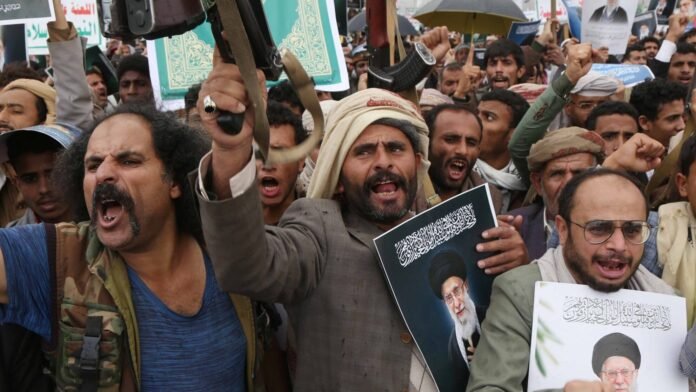
The Houthis insist they are prepared for a prolonged confrontation. A source working with the movement’s General Mobilization Forces told The Media Line that the Houthis possess an integrated command structure, advanced missiles, drones, attack drone boats and autonomous underwater vehicles capable of sustaining a war of attrition. The source declared, “The Ansar Allah [Houthis] are fully ready for this war,” while warning that “Bab al-Mandab, Saudi airports, and every other target are awaiting zero hour.”
Those claims are difficult to verify independently. Houthi-affiliated sources estimate the movement commands more than 200,000 registered fighters, another 250,000 personnel tied to mobilization units and broader tribal support. Yemen’s internationally recognized government, meanwhile, says it has reorganized its forces under a unified command and now fields about 400,000 fighters, although that figure also remains unverified.
Mohammed argues the conflict’s trajectory may ultimately depend less on the Houthis than on Saudi Arabia. If attacks on airports, energy infrastructure and shipping continue, he believes Riyadh could abandon its more restrained approach and fully back a government offensive toward Sanaa with direct US support, potentially opening a far broader phase of the war.
Rubio’s Paranoid Cuba Report Designed to “Justify a Military Attack on Cuba,” Says Democratic Rep.
A report published this week by the State Department is the latest weapon employed by the Trump administration in its campaign for aggressive intervention in Cuba, according to members of Congress and experts on the beleaguered Caribbean island nation.
Despite Cuba being severely hobbled by in the throes of a humanitarian crisis engineered by U.S. sanctions and fuel blockades, the new report paints the country as a major threat.
The report appears to be the brainchild of Secretary of State Marco Rubio, a first-generation Cuban American who has made the overthrow of the Cuban government a top priority under the second Trump administration.
Published Monday without a listed author, the report says Cuba is the “capital of 21st century communism,” ideologically immovable, and a permanent enemy committed to the destruction not just of the U.S. but also of “Western civilization” through the spread of “Third Worldism.”
If that sounds like a throwback to the long-settled Cold War, that’s because it is — something critics of the report in Congress seized upon.
Whatever truths the report contains, they’re largely overshadowed by a feverish paranoia about the alleged reach of Cuban intelligence into American civil society, according to Rep. Mark Pocan, D-Wis., days after returning from a fact-finding trip to Cuba.
“It may be the stupidest, most fantastical, most biased thing I’ve ever read from a governmental agency,” Pocan said in a statement Tuesday. “This report focuses on the 1960s & 70s with no clear connection to today. Yet somehow, the State Department uses this report to say that this impoverished nation is responsible for everything from Black Lives Matter to Antifa, the anti-ICE protests and more.”
Rep. Delia Ramirez, D-Ill., who went on the fact-finding mission with Pocan, said the report was aimed at manufacturing consent for an invasion of the island — and to crack down on dissent at home.
“While criticizing the regime in Cuba, it instead attacks Americans’ constitutional rights to free speech and free assembly.”
“This report was intentionally designed to instill fear of the Cuban people and to justify a military attack on Cuba,” Ramirez told The Intercept. “It’s hypocrisy at its finest, because while criticizing the regime in Cuba, it instead attacks Americans’ constitutional rights to free speech and free assembly.”
In sketching a broad, anti-American conspiracy in nearly dozens of left-wing social movements, organizations, and educational institutions, the report also functions as a broadside on civil society in the U.S — and hardly for the first time.
“Cuba is not a new cudgel,” said Miriam Pensack, a historian at Princeton University specializing in Latin America and the Caribbean. “The Cuban revolution was a galvanizing event for the way that the United States thought about its national security, really until the end of the Cold War. And it still has an ideological utility, even as the country is limping along.”
Center of Global Conspiracy
Running 100 pages, the report lays out what its authors describe as a decadeslong effort by Cuba to foment revolutionary movements throughout the world and to build a latter-day “axis of evil” by allying with other governments opposed to U.S. interests, including the current-day governments of Iran, Russia, China, and North Korea.
“Even as it expands and revitalizes its network within the next generation of American left-wing activists, it has also forged new partnerships — or deepened and repurposed old ones — with other foreign governments and movements around the world,” the report warns. “The regime continues to act as a force multiplier for a much broader anti-American coalition, positioning itself as a staging ground for a wide range of foreign adversaries to conduct operations against the United States.”
Cuba, the authors allege, is “less a nation-state than an all-encompassing intelligence and subversion operation, focused around its existential revolution against the United States.”
The report goes on to list a slew of left-wing groups and individuals as accomplices, both witting and unwitting, of this intelligence operation, including the Democratic Socialists of America, Code Pink, Los Angeles Mayor Karen Bass, and leftwing streamer Hasan Piker.
In a section stretching nearly five full pages on the National Lawyers Guild, a long-standing right-wing bugaboo, the report’s authors describe the venerable progressive law association as “one of the most persistently relevant — and insidious — organizations in Cuba’s U.S. network.”
Posting to X for the first time since March, the organization quipped, “We have been called much worse, by much better.”
Academic Freedom at Home
The report took aim at universities in the U.S. for maintaining exchange programs and partnerships with Cuban universities, implying that such programs functioned as a feeding ground for Cuban agents looking to recruit spies and fellow travelers.
The report singled out Harvard University, pointing to trips by faculty to Cuba as recently as 2017.
The Cuban government “would probably argue that it was U.S. universities that were trying to penetrate Cuban institutions and to foment subversion there!”
If anything, however, the Cuban government has been wary of exchange programs with American schools, according to Alejandro de la Fuente, a professor of Latin American history and economics at Harvard who chairs the university’s Cuba Studies Program and took part in a trip to Cuba in 2017 that is mentioned in the report.
“They did their best to delimit those exchanges as much as possible because they understood that knowledge production requires freedom and a plurality of viewpoints — precisely what they do not allow,” de la Fuente told The Intercept in an email Wednesday. “Indeed, they would probably argue that it was U.S. universities that were trying to penetrate Cuban institutions and to foment subversion there!”
Born in Cuba, De la Fuente is hardly an apologist for the Cuban government, at whose feet he laid the blame for the country’s collapse. He acknowledged that Cuban intelligence may have targeted American students and academics in the past, but scoffed at the underlying thesis of the report that Cuba continues to pose a grave threat to the U.S.
“The ineptitude and corruption of the regime have destroyed the country’s economy and society, to the point that the very existence of the nation is in danger,” de la Fuente said. “Can a country like this pose a threat to the national security of the United States today? The answer, any reasonable observer would agree, is emphatically no.”
“War on the Cuban People”
Cuba has made no secret of its support for revolutionary movements throughout the 20th century. And it was a vital partner to left-wing governments in Latin America in the 21st century.
With Cuba today crippled by sanctions and fuel shortages, however, Ramirez, the member of Congress, said the report’s notion of the country as a central node in some threatening conspiracy was a “fiction.”
Accusations about Cuba’s extensive reach into protests against U.S. Immigration and Customs Enforcement, antifascist organizing, and Black Lives Matter don’t square with the reality of the severe crisis that has gripped Cuba. In early January, the Trump administration tightened its embargo of the country into a virtual blockade on all fuel arriving in Cuba.
Already weakened by internal tensions and by decades of economic sanctions imposed by the U.S., the island nation has in recent months been plunged into repeated, extended blackouts; its tourism-dependent economy has effectively collapsed; and its citizens face a daily question of where to find their next meal.
Her voice on the verge of tears as she described the humanitarian crisis she witnessed on the island, Ramirez forcefully rejected the notion that the U.S. has anything to fear from Cuba.
“Under no circumstances, at any moment during my trip, did I see anything to make me believe that Cuba poses an existential threat to the United States,” Ramirez said. “On the contrary, what I witnessed was a war on the Cuban people by the United States, and specifically by Donald Trump and Marco Rubio.”
Car rams crowd at Berlin Pride event, killing one and injuring 16
A manhunt is underway in Berlin after a car drove into a crowd attending the city’s Christopher Street Day Pride celebrations on Saturday night, killing one person and injuring at least 16 others.
The incident happened at around 10pm on Lennéstrasse, where the vehicle struck pedestrians before crashing into a tree. The driver then reportedly fled the scene.
Berlin police said they had identified a suspect, named as 21-year-old Abdul B., who is “known to police” and believed to have links to Islamist circles. Officers released an image of the suspect and warned the public not to approach him, saying he may be armed and dangerous.
Three people remain in a life-threatening condition.
German Chancellor Friedrich Merz condemned the incident as a “despicable act”, saying hundreds of thousands of people had gathered peacefully to celebrate tolerance and diversity. He described the attack as an assault on society.
The Pride parade was cancelled following the incident.
The UN returns to Damascus at the edge of reconstruction
Seventeen years. That is how long it has been since a sitting United Nations Secretary-General last set foot in Damascus. When António Guterres’ plane touches down on Syrian soil, it will not be a ceremonial gesture. It is the diplomatic ignition point of Syria’s post‑Assad metamorphosis—a collapsed state now being re‑stitched through UN‑brokered legitimacy, Gulf‑conditioned constitutional engineering, Turkish‑regulated border sovereignty, and a covert Western–Syrian intelligence liaison that keeps the Islamic State’s remnants buried in the Badiya desert.
Yet for all the diplomatic choreography, one uncomfortable truth lingers: this nation of 23 million remains a house of cards, and any external anchor that slips could send it crashing back into the abyss.
The numbers tell a story of unspeakable ruin. Fourteen years of war have decimated Syria’s bureaucratic institutions. The economy has contracted by an estimated 85 per cent since 2011. Ninety per cent of Syrians now live below the poverty line. Reconstruction costs hover between $216 billion and $400 billion—twenty times the size of Syria’s GDP. Some 5.5 million people remain internally displaced, while 15.6 million continue to require humanitarian assistance. This is not a transition. This is a resurrection attempt on a patient flatlining for over a decade.
Guterres’ visit marks the moment Syria shifts from pariah to project. The UN Security Council has already lifted sanctions on Hay’at Tahrir al‑Sham, the former Al Qaeda affiliate whose cadres now control the country.
The Secretary‑General will address the newly minted People’s Assembly, conferring upon this insurgent‑turned‑government the symbolic mantle of statehood. But legitimacy conferred from without is not legitimacy earned within.
President Ahmed al‑Sharaa has appointed almost exclusively family members and longtime HTS loyalists to control key economic and security decisions. The “Idlibization” of Damascus—where former insurgent commanders retain operational control over intelligence apparatuses and revenue streams—creates a state that thinks like an insurgency, viewing politics as a continuation of war by other means.
The external scaffolding holding this fragile edifice together is as intricate as it is precarious. French President Emmanuel Macron’s July visit—the first by an EU head of state since Assad’s fall—brought with it the CEOs of TotalEnergies and CMA CGM, positioning Damascus as a pivotal transport link between the Mediterranean and the Gulf. Days later, al‑Sharaa sat across from Donald Trump at the NATO Summit in Ankara, securing explicit American backing for sanctions relief.
The Kirkuk‑Baniyas oil pipeline—a dormant 800‑kilometre corridor with an estimated rehabilitation cost of $4.5 billion to $8 billion and a planned capacity of 2 million barrels per day—has become the material artery of this new geopolitical order.
Yet pipelines do not build nations. The Golan Heights remains the primary geopolitical flashpoint capable of derailing everything. After the fall of Assad, Israeli Prime Minister Benjamin Netanyahu declared the 1974 disengagement agreement “collapsed” and ordered the army to occupy the buffer zone. Israeli forces have since carried out repeated incursions into southern Syria. Guterres’ planned visit to the UNDOF mission is not a photo opportunity—it is a desperate attempt to prevent the border from detonating into regional warfare.
The constitutional architecture designed to hold this fractured polity together is both ingenious and fragile. The proposed bicameral quota system allocates fifty of one hundred Senate seats to minorities—fifteen each for Alawites and Christians, twelve for Druze, five for Ismailis and Shia, and three for ethnic minorities.
Any legislation touching personal status laws, religious endowments, or cultural rights requires a two‑thirds majority in the Senate and a majority within each directly affected communal block. This is consociationalism as constitutional straitjacket—a mechanism designed to prevent hardline Islamist overreach.
But these protections are not internally generated; they are externally demanded by Gulf states as a condition for reconstruction aid. This is sovereignty by conditionality, where the internal social contract is underwritten by Saudi and Emirati sovereign wealth funds.
If the pipeline revenues dry up, does the constitutional architecture evaporate with them?
Observers warn that Syria’s new rulers are already mirroring the habits of the old regime, that the post‑Assad state remains extraordinarily fragile, and that no coherent roadmap for political transition exists. This is not a transition; it is a permanent state of probation.
Three trajectories lie ahead. The optimistic path—where the pipeline flows, the intelligence channels remain functional, and the minority veto satisfies Gulf conditions—could transform Syria into a strategic transit hub anchoring regional stability.
The status quo path—a Syria that muddles through, with pockets of stability and pockets of violence, never fully collapsing but never fully recovering. And the pessimistic path—where constitutional guarantees prove hollow, sectarian warfare resumes, or a Golan miscalculation triggers regional conflagration.
Guterres’ arrival in Damascus is a profound act of diplomatic faith. The UN is betting that extending international legitimacy will help produce the internal conditions for pluralism and security that justify it. But legitimacy is not a gift; it is a continuous performance.
The Syrian state is not sovereign in the classical sense—it is sovereign only through its connections: to Gulf capital, to Turkish veto power, to Western intelligence networks, to UN recognition. This is externally scaffolded sovereignty, and scaffolds are not foundations.
The question that haunts Damascus this July is not whether Syria can transition. It is whether the international community has the patience, the resources, and the strategic clarity to hold the scaffolding steady long enough for the nation to rebuild itself from within. Seventeen years of diplomatic absence cannot be undone in a single visit. But it can begin. And in Syria, beginning is everything.
The views expressed in this article belong to the author and do not necessarily reflect the editorial policy of Middle East Monitor.
Digital wallets have moved beyond salary payments to everyday purchases, reshaping commerce in northwest Syria while raising questions about access, security, and reliability
[IDLIB] Hassan leaves his home for the market in Sarmada, north of Idlib, to buy his family’s daily groceries. This time, he doesn’t check whether he has cash in his wallet. Instead, he simply grabs his smartphone.
At a vegetable stall, he selects tomatoes, cucumbers and peppers. Once the vendor totals the bill, Hassan scans the QR code displayed at the shop, enters the amount and taps “Send.” Within seconds, a notification confirms the transaction, and the vendor nods to signal that the payment has been received.
For years, Idlib has been associated with airstrikes, displacement camps and waves of fleeing civilians, becoming synonymous with one of the Syrian war’s most devastated front lines. Today, however, a different reality is taking shape. Residents are increasingly using a smartphone app called Sham Cash to pay for bread, vegetables, coffee and medicine, reflecting a shift in how money moves through an economy long shaped by war and limited banking services.
“The app has made financial transactions much easier since it was launched,” Hassan told The Media Line. “We can now buy our daily needs or sell our goods without having to rely on paper money in many cases.”
Customer in Idlib pays for items using app. (Salma Abdulrahman / The Media Line)
The practice is not limited to food markets. At a nearby café, Ahmad orders a cup of coffee. When it is ready, he pulls out his phone, scans the payment code, and completes the transaction in seconds. Ahmad, who was visiting Sarmada from Damascus, said the experience remains unusual elsewhere in Syria. “This level of convenience in payments doesn’t exist in any other Syrian city I’ve visited,” he told The Media Line. “So far, the app hasn’t spread this widely outside this region.”
Flower shops, pharmacies, retail stores and gyms increasingly accept digital payments alongside cash, reflecting the growing role of electronic payments in everyday life. Residents of Idlib do not claim that cash has disappeared from the markets, but many say they can now complete most of their daily purchases using digital methods.
The app’s adoption expanded significantly after it became the platform for paying salaries to public-sector employees and retirees, transforming it from a money-transfer service into a tool used for daily shopping, bill payments and other services. Idlib’s financial landscape has long been distinct from the rest of Syria.
After Idlib fell outside the control of the former Assad government, the Turkish lira became widely used in local markets alongside the US dollar, while the Syrian pound played a more limited role than in many other parts of the country. Today, as Syria’s transitional government seeks to reinforce use of the Syrian pound, the region is witnessing another financial shift with the growing adoption of digital payment applications, making smartphones an increasingly essential part of everyday commerce.
In the past, we had to stand in line for hours to collect our pensions. Now the money arrives on my phone while I’m at home.
According to a government source who spoke to The Media Line, the app now serves about 1.25 million public employees and retirees who receive their salaries through the platform. Nofal Al-Ahmad, a retiree from Idlib, said his daily routine has changed since he began receiving his pension through the app. “In the past, we had to stand in line for hours to collect our pensions,” he told The Media Line. “Now the money arrives on my phone while I’m at home, and I can immediately use it to buy what I need without carrying cash.”
The app has also become an integral part of store owners’ business operations. Mohammad Al-Qasim, a veterinary pharmacist in Idlib, said he prefers receiving payments through Sham Cash because it simplifies financial transactions with suppliers. “Most of my customers are sheep and cattle breeders, and a large percentage of them pay through the app,” he told The Media Line. “Like most business owners in Idlib, we receive payments this way and later transfer money to suppliers. The app has become an essential part of our daily transactions.”
Abu Khaled, who owns a candy store in Sarmada, said digital payments have become routine for his customers. “Most customers pay for sweets through the app,” he told The Media Line. “It has become part of people’s daily lives, and after getting used to it, it no longer makes sense not to use it.”
Not everyone, however, has embraced the shift. Umm Mahmoud, who receives her husband’s pension through Sham Cash, said the app makes collecting the payment easier, but she still prefers holding cash. “As soon as the pension arrives on my phone, I go directly to a money exchange office to withdraw it,” she told The Media Line. “I trust paper money more.”
I feel more secure when I have cash in hand
Government employee Akram Al-Qasim shares that view. While he acknowledged that the app has simplified financial transactions, he said he still withdraws his salary in cash immediately after receiving it. “I feel more secure when I have cash in hand,” he told The Media Line. “That’s why I withdraw my salary as soon as it arrives.”
The discussion extends beyond personal preferences for digital or cash payments to the uneven adoption of the technology across Syria. Hamza Zidan, who owns a company selling loudspeakers in Idlib, said the difference becomes obvious whenever he travels to other Syrian provinces. “I travel between Aleppo, Homs and Damascus,” he told The Media Line. “Whenever I ask to pay through Sham Cash, vendors are often surprised, or refuse because they don’t use it.”
Gym member pays with app. (Salma Abdulrahman / The Media Line)
As the app’s use continues to expand, the company behind Sham Cash says it is working to improve its services and strengthen its technical infrastructure. Mahmoud Al-Sheikh, a Sham Cash employee, told The Media Line that recent updates include improvements to the user interface, an expansion of cash withdrawal and deposit services through the addition of Al-Haram and Al-Fouad exchange companies, and enhanced security features such as fingerprint or PIN authentication.
Other updates include the option to hide account balances and support for multiple languages. He said that the company is also working to improve the app’s performance, particularly in areas with weak internet connectivity, while expanding its network of merchants and the range of services available through the platform.
Al-Sheikh warned that fake social media pages and groups posing as the app’s technical support team have sought users’ personal information, including email addresses and passwords. He said Sham Cash does not request such information through social media and urged users to ignore and report fraudulent accounts. Despite the app’s growing popularity, users still face challenges, particularly internet outages and technical disruptions that can delay transactions.
In March 2026, the app experienced a several-hour outage amid reports that it had been targeted by a cyberattack. Sham Cash denied that any user data had been compromised, saying the disruption was caused by a technical issue that was later resolved.
Umm Saeed recalled an encounter that surprised her while shopping at a market in Idlib. “A woman stopped me and asked for help,” she told The Media Line. “I told her I wasn’t carrying any cash because I use the Sham Cash app. To my surprise, she pulled out her phone, opened a QR payment code and asked me to transfer the money through the app.” The story illustrates just how far digital payments have spread, extending beyond stores and businesses into situations where many people would never have expected to see them.
From vegetable vendors and cafés to pharmacies, flower shops and candy stores, the smartphone has become more than a communication device. For many residents of Idlib, it now serves as a digital wallet accompanying them through their daily lives—a transformation that remains rare elsewhere in Syria.
Meteorite Crashed into a House Containing ‘Extraterrestrial’ Clues
A meteorite that smashed through the roof of a New Jersey home is now giving NASA scientists a rare look at the earliest days of the solar system — and the possibility that some of life’s key ingredients were already moving through space billions of years ago.
The space rock crashed into a house in Hillsborough, New Jersey, in Somerset County, on July 16, 2024, according to a new study published in Science Advances and authored by multiple NASA scientists. What could have been dismissed as a bizarre freak accident quickly became a major scientific opportunity, thanks to the homeowners’ careful response.
According to NASA, one of the residents is an amateur astronomer and immediately understood that the object might be scientifically important. Rather than handling it casually or throwing it away, he collected the meteorite fragments with protective gloves and safely preserved them until they could be turned over for study.
That quick thinking allowed researchers to examine a rare, freshly recovered meteorite that had a documented fireball path across the sky. Scientists used video footage of the meteorite’s trajectory, along with detailed lab analysis, to trace where the rock likely came from in the asteroid belt.
“When we have both a documented fireball and a quick recovery of its meteorite, we can learn not only what the rock is made of, but where it came from in the asteroid belt,” said Peter Jenniskens, the study’s lead author and a meteor astronomer at NASA’s Ames Research Center in California’s Silicon Valley and the SETI Institute, according to NASA.
Inside the meteorite, scientists found something especially intriguing: evidence that ancient salty water once moved through the asteroid the rock came from. Using powerful microscopes, researchers discovered deposits left behind by brine, offering clues about the watery history of the asteroid long before the meteorite broke away and eventually slammed into the New Jersey home.
Even more striking, the study’s authors found that the salty water contained amino acids that are rare on Earth and are believed to be “likely extraterrestrial in origin.”
Those findings could help scientists better understand how water shaped rocky objects in the young solar system, and how some of the building blocks associated with life may have formed or traveled through space long before Earth became the planet we know today.
“If you follow the water through the solar system, you’re actually following life,” said Mike Zolensky, a meteorite researcher and co-author of the study, according to NASA.
“Following the history of water through the solar system is an essential part of understanding the origin of life,” he added.
The discovery makes the meteorite more than just a space rock that punched a hole through someone’s roof. It is a preserved fragment of ancient cosmic history, one that may help scientists piece together what conditions were like when the solar system was still forming billions of years ago.
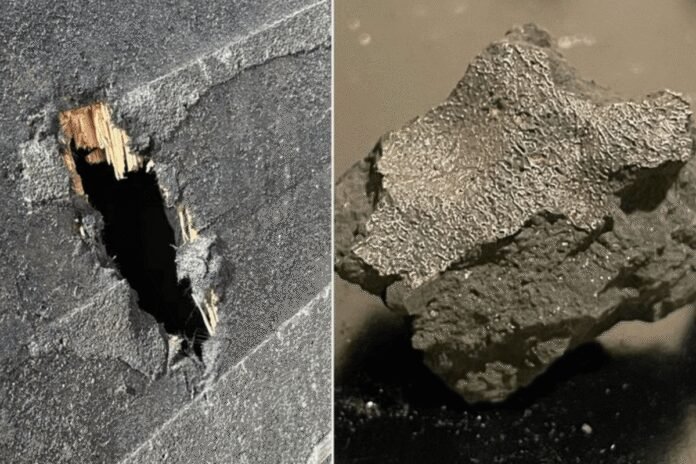
Photos credited to M. Kirschner and M. Hankey of the American Meteor Society show both the rooftop hole where the meteorite landed and the meteorite itself.
The homeowners, who have chosen to remain anonymous, told ABC 6 that they understood almost immediately how unusual the event was.
“We knew almost immediately that what happened to us was incredibly rare and we felt a responsibility to preserve the meteorite for the scientific community,” the homeowners said in a statement to the outlet.
They said the experience still feels hard to believe.
“It’s still surreal to think that this meteorite traveled through space for millions of years before ending its journey in our home,” they added. “The entire experience has been incredible, and we’re honored to have played a small part in advancing scientific understanding through its study.”