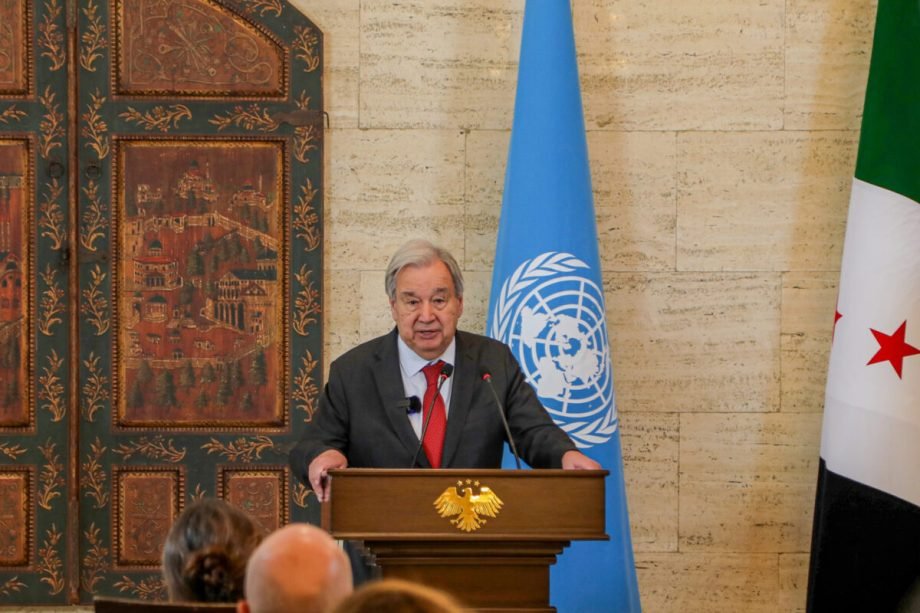
Seventeen years. That is how long it has been since a sitting United Nations Secretary-General last set foot in Damascus. When António Guterres’ plane touches down on Syrian soil, it will not be a ceremonial gesture. It is the diplomatic ignition point of Syria’s post‑Assad metamorphosis—a collapsed state now being re‑stitched through UN‑brokered legitimacy, Gulf‑conditioned constitutional engineering, Turkish‑regulated border sovereignty, and a covert Western–Syrian intelligence liaison that keeps the Islamic State’s remnants buried in the Badiya desert.
Yet for all the diplomatic choreography, one uncomfortable truth lingers: this nation of 23 million remains a house of cards, and any external anchor that slips could send it crashing back into the abyss.
The numbers tell a story of unspeakable ruin. Fourteen years of war have decimated Syria’s bureaucratic institutions. The economy has contracted by an estimated 85 per cent since 2011. Ninety per cent of Syrians now live below the poverty line. Reconstruction costs hover between $216 billion and $400 billion—twenty times the size of Syria’s GDP. Some 5.5 million people remain internally displaced, while 15.6 million continue to require humanitarian assistance. This is not a transition. This is a resurrection attempt on a patient flatlining for over a decade.
Guterres’ visit marks the moment Syria shifts from pariah to project. The UN Security Council has already lifted sanctions on Hay’at Tahrir al‑Sham, the former Al Qaeda affiliate whose cadres now control the country.
The Secretary‑General will address the newly minted People’s Assembly, conferring upon this insurgent‑turned‑government the symbolic mantle of statehood. But legitimacy conferred from without is not legitimacy earned within.
President Ahmed al‑Sharaa has appointed almost exclusively family members and longtime HTS loyalists to control key economic and security decisions. The “Idlibization” of Damascus—where former insurgent commanders retain operational control over intelligence apparatuses and revenue streams—creates a state that thinks like an insurgency, viewing politics as a continuation of war by other means.
The external scaffolding holding this fragile edifice together is as intricate as it is precarious. French President Emmanuel Macron’s July visit—the first by an EU head of state since Assad’s fall—brought with it the CEOs of TotalEnergies and CMA CGM, positioning Damascus as a pivotal transport link between the Mediterranean and the Gulf. Days later, al‑Sharaa sat across from Donald Trump at the NATO Summit in Ankara, securing explicit American backing for sanctions relief.
The Kirkuk‑Baniyas oil pipeline—a dormant 800‑kilometre corridor with an estimated rehabilitation cost of $4.5 billion to $8 billion and a planned capacity of 2 million barrels per day—has become the material artery of this new geopolitical order.
Yet pipelines do not build nations. The Golan Heights remains the primary geopolitical flashpoint capable of derailing everything. After the fall of Assad, Israeli Prime Minister Benjamin Netanyahu declared the 1974 disengagement agreement “collapsed” and ordered the army to occupy the buffer zone. Israeli forces have since carried out repeated incursions into southern Syria. Guterres’ planned visit to the UNDOF mission is not a photo opportunity—it is a desperate attempt to prevent the border from detonating into regional warfare.
The constitutional architecture designed to hold this fractured polity together is both ingenious and fragile. The proposed bicameral quota system allocates fifty of one hundred Senate seats to minorities—fifteen each for Alawites and Christians, twelve for Druze, five for Ismailis and Shia, and three for ethnic minorities.
Any legislation touching personal status laws, religious endowments, or cultural rights requires a two‑thirds majority in the Senate and a majority within each directly affected communal block. This is consociationalism as constitutional straitjacket—a mechanism designed to prevent hardline Islamist overreach.
But these protections are not internally generated; they are externally demanded by Gulf states as a condition for reconstruction aid. This is sovereignty by conditionality, where the internal social contract is underwritten by Saudi and Emirati sovereign wealth funds.
If the pipeline revenues dry up, does the constitutional architecture evaporate with them?
Observers warn that Syria’s new rulers are already mirroring the habits of the old regime, that the post‑Assad state remains extraordinarily fragile, and that no coherent roadmap for political transition exists. This is not a transition; it is a permanent state of probation.
Three trajectories lie ahead. The optimistic path—where the pipeline flows, the intelligence channels remain functional, and the minority veto satisfies Gulf conditions—could transform Syria into a strategic transit hub anchoring regional stability.
The status quo path—a Syria that muddles through, with pockets of stability and pockets of violence, never fully collapsing but never fully recovering. And the pessimistic path—where constitutional guarantees prove hollow, sectarian warfare resumes, or a Golan miscalculation triggers regional conflagration.
Guterres’ arrival in Damascus is a profound act of diplomatic faith. The UN is betting that extending international legitimacy will help produce the internal conditions for pluralism and security that justify it. But legitimacy is not a gift; it is a continuous performance.
The Syrian state is not sovereign in the classical sense—it is sovereign only through its connections: to Gulf capital, to Turkish veto power, to Western intelligence networks, to UN recognition. This is externally scaffolded sovereignty, and scaffolds are not foundations.
The question that haunts Damascus this July is not whether Syria can transition. It is whether the international community has the patience, the resources, and the strategic clarity to hold the scaffolding steady long enough for the nation to rebuild itself from within. Seventeen years of diplomatic absence cannot be undone in a single visit. But it can begin. And in Syria, beginning is everything.
The views expressed in this article belong to the author and do not necessarily reflect the editorial policy of Middle East Monitor.