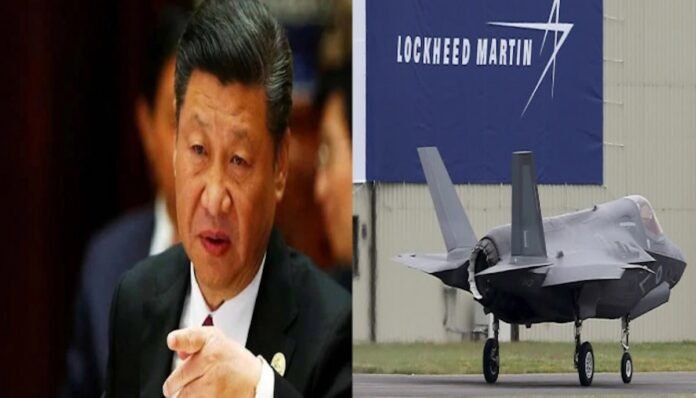
China hit back at Washington on Monday with a sweeping two-pronged retaliation, barring government departments from buying products from 46 US defense contractors and blacklisting 10 American companies from receiving Chinese dual-use exports.
The Ministry of Finance announced that procurement entities are prohibited from purchasing products manufactured by the 46 US firms, a list headed by Lockheed Martin Corporation and Raytheon Missiles & Defense. The restrictions, which exempt US-funded enterprises operating within Chin, took effect immediately.
At the same time, the Chinese Commerce Ministry added 10 US entities to its export control list under China’s Export Control Law, barring Chinese exporters from supplying them with dual-use items. The list includes rare earth miners MP Materials Corp and USA Rare Earth, alongside drone and defense electronics makers such as Red Cat Holdings, Teal Drones and Ball Aerospace & Technologies Corp.
“The move is in response to the US move to expand its so-called China military-industrial entity list and is aimed at protecting China’s national security and honoring non-proliferation commitments,” said a spokesperson of the Commerce Ministry.
Chinese state media described the measures as retaliation after Washington added dozens of Chinese firms to its list of alleged military-linked companies, a roster that now includes Alibaba, BYD and Baidu. Several of those firms have rejected the designations as baseless.
“The two measures unveiled on the same day are a response to Washington’s repeated weaponization of unilateral sanctions and entity lists to suppress Chinese enterprises, including its groundless addition of Chinese firms to its so-called military-industrial entity list,” Li Yong, an executive council member of the China Society for WTO Studies, told the Global Times on Monday. “If such US malpractices are left uncurbed, they will only escalate.”
“China’s control measures feature well-defined boundaries, targeting only items tied to military supplies and military manufacturing,” he said. “In stark contrast, the US arbitrarily broadens its crackdown scope, fabricating fictitious military links for companies with zero military relevance as an excuse to target China’s high-tech sector.”
He said Washington’s move to target leading Chinese firms across multiple sectors laid bare its true intention to curb China’s technology industry behind a national security facade.
The escalation comes weeks after United States President Donald Trump visited Beijing on May 14-15 for a summit with Chinese President Xi Jinping that both sides described as productive. The Trump administration said China agreed to purchase more American agricultural products and aircraft as part of the talks. However, the goodwill proved short-lived.
On June 8, the Pentagon announced the largest-ever expansion of its Chinese military company list, increasing the roster to 188 entities from 134 last year. The update swept in prominent civilian technology names including Alibaba, BYD and Baidu, extending the blacklist well beyond the defense sector and deepening concern in Beijing that Washington was using national security designations to target China’s commercial technology industry.
Chinese commentators say Beijing’s two retaliatory measures were calibrated to maximize pressure on US defense contractors and rare earth suppliers while sparing foreign firms with active commercial operations in China.
“The first eight companies cover America’s small drone ecosystem, aerospace payload chains, army tactical vehicle platforms and underwater surveillance systems,” says a Henan-based columnist using the pen name “Sanding Sugar.” “Their products demand extreme consistency in material quality, including permanent magnet performance, high-purity indium coatings and specialty ceramic stability. China is the dominant supplier of these critical minerals, and such a supply chain cannot simply be replaced overnight.”
“The more revealing sanction targets are MP Materials and USA Rare Earth, the two flagship companies in America’s push to rebuild its rare earth supply chain,” he says. “Blacklisting them does not stop them from mining critical mineral ores, but prevents them from obtaining China’s processed rare earth materials, separation products and magnet precursors. America’s plan to revive its rare earth sector just hit a compliance wall. America’s plan to revive its rare earth sector just hit a compliance wall.”
On the Finance Ministry’s ban covering 46 US firms, the writer says that Beijing wants to send two signals to the US:
- The ministry now embeds all 46 names into screening systems across every provincial finance department and central budget unit, making the prohibition an automatic check on every purchase approval.
- The ban also explicitly exempts US-funded enterprises operating inside China, so businesses like Apple’s component suppliers or medical equipment makers operating in the Chinese market will be exempted.
Xi Kunlun, a Hunan-based columnist, says Beijing’s intent was to split American firms into two camps, rewarding those with genuine commercial operations in China while punishing those tied to the US defense and rare earth sectors.
“This retaliation carries a deeper message than simple payback. China is telling Washington that suppressing Chinese companies comes at a price,” he says. “The US targeted China’s drone industry, so China put American drone makers on its Entity List. The US labels Chinese technology companies as military firms, so China blacklisted the equivalent American firms.”
“China is also playing its trump card, its massive domestic procurement market, cutting off the channels through which targeted US firms have profited from Chinese government spending,” he said. “If Washington wants to talk, come with respect. If it wants to fight, China will oblige.”
‘Decoupling is unrealistic’
Some observers say Beijing’s latest measures are more symbolic than a step toward full decoupling, noting that the 10 blacklisted US firms have little need to source raw materials and equipment from China, while Chinese government agencies had already largely stopped purchasing American defense products a long time ago. They say Beijing must also be careful that its retaliatory measures do not deter the foreign investment it badly needs.
In the first five months of this year, foreign direct investment into China fell 8.6% year-on-year to 327.29 billion yuan (US$45.3 billion), according to the Commerce Ministry. The ministry did not break down the figures by country but noted that investment from Saudi Arabia, Malaysia, Switzerland and the US had increased, suggesting that inflows from most European and Asian economies may have declined.
A Shanxi-based writer says that some Chinese companies, including Xiaomi and semiconductor equipment maker Advanced Micro-Fabrication Equipment Inc, had successfully petitioned to be removed from the Pentagon’s military company list after completing legal challenges.
“But to be honest about the shortcomings, Washington still sets the tone on military and security affairs and can pull its European and allied partners into lockstep. It is unrealistic for China to decouple with the West,” he says. “Western markets cannot be replaced quickly, emerging markets cannot yet fill China’s order gap, and some overseas trading partners will quietly avoid blacklisted Chinese firms rather than risk falling foul of US rules.”
Read: Japan seeks G7 price floors to break China’s rare earth grip
Follow Jeff Pao on X at @jeffpao3





 more than 800 group working across 49 states to oppose some
 7 percent of voters in a recent survey said they trust tech CEOs to make decisions that affect their lives.






