Dozens of new robot arms have been installed at General Motors’ flagship electric vehicle factory in Detroit—even as 1,300 workers remain out of work following what was supposed to be a temporary layoff. The latest automation push has spurred union pushback over a potentially existential issue for automakers and their workers.
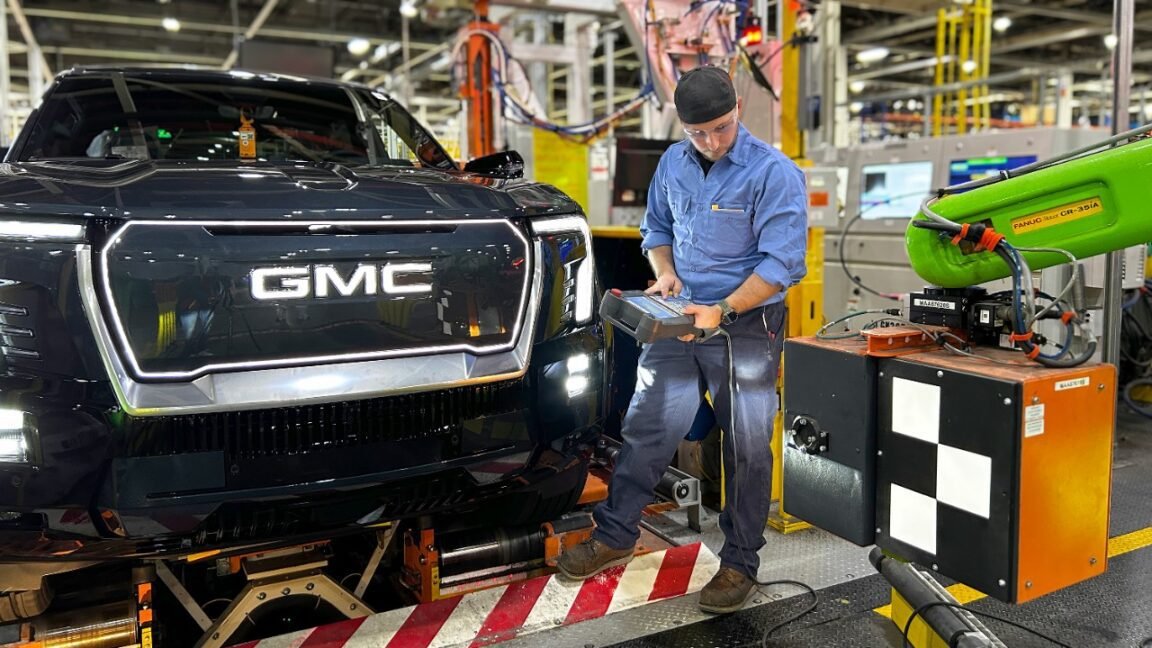
General Motors installed approximately 50 robot arms at GM’s Factory Zero plant in Detroit, Michigan, according to reporting by Crain’s Detroit Business. Made by the Japanese robotics company FANUC, the robots are designed to help attach various components to vehicles during the assembly line process. But leaders at United Auto Workers (UAW), the primary US union for autoworkers, reacted with anger to the new robotic presence, given how GM has not yet called back any of the workers affected by supposedly temporary layoffs in March.
More than 1,000 union members are still “laid off indefinitely,” James Cotton, president of UAW Local 22, told The Detroit News. He said that the company could bring some of those members back to work instead of installing the 50 robots.
The temporary layoffs were preceded by permanent layoffs involving another 1,200 workers at GM’s Factory Zero in October 2025.
Many automakers, including Stellantis NV and Ford Motor Company, have deployed assembly-line robots, such as Fanuc robot arms, as they push to automate more of their US operations. Hyundai Motor Company plans to deploy Atlas humanoid robots made by Boston Dynamics—which Hyundai acquired in 2020—to start working in the automaker’s flagship EV facility in Georgia by 2028.
Andrew Bergman, a Local 22 member and union organizer who was among those laid off by GM, described corporate leaders in the automotive industry as prioritizing profits over human workers.
“Technological development has the capability of making work safer for the working class and enabling workers to have a shorter work week without losing pay,” Bergman told The Detroit News. “But in the bosses’ and billionaires’ hands it’s used to pad profits and lay off workers.”
The Detroit News also highlighted how corporate leaders and workers conveyed “strikingly different messages” about AI, robotics, and automation during separate gatherings held in Detroit during the same week of June.
While the Reindustrialize Summit featured startup founder speeches about how robots could “empower our industrial base with superhuman manufacturing,” the UAW Constitutional Convention featured UAW president Shawn Fain warning against “the threat of humanoid robotics and mass automation” undermining worker employment and wages at a time of rising wealth inequality.
Dark factory rising
Efforts to automate more US factories come as companies in East Asia have already charged ahead in establishing multiple “dark factory” sites—facilities featuring near-complete automation with a small human staff to provide oversight and troubleshooting.
The Japanese robotics company FANUC is itself one of the original dark factory pioneers that has operated a “lights out” factory since 2001. In other words, the FANUC robot arms being deployed by GM and other companies to automate automotive production were themselves primarily built by other robots.
But the latest dark factory pioneers are primarily Chinese companies, including many automakers. The Chinese automotive brand Jetour has a dark factory churning out SUVs in the city of Fuzhou in China’s Fujian province, while the luxury EV maker Zeekr has a dark factory in Ningbo City in China’s Zhejiang province capable of producing up to 300,000 cars per year, according to The Wall Street Journal.
The Chinese smartphone maker Xiaomi uses more than 700 robots at its EV Hyperfactory in Beijing to help produce a new electric vehicle every 76 seconds, according to The EV Report. Xiaomi already had another heavily automated dark factory in Beijing capable of churning out 10 million phones annually.
But as the Institution of Mechanical Engineers pointed out, leaning too heavily into fully automated factories can create new vulnerabilities and issues. Humans are often better at quickly identifying problems on the production line that can quickly spiral out of control in a fully automated system. Cybersecurity also becomes an even greater issue for heavily automated, AI-powered facilities featuring primarily robotic workforces. Still, many companies are betting that the lower labor costs and increased production capacities are worth it.
China’s manufacturing industry had deployed 2 million industrial robots by 2024, adding 295,000 robots in that year alone. By comparison, Japan installed 44,500 industrial robots, and the United States installed 34,200 such robots in 2024. Meanwhile, China’s latest five-year plan puts AI and robotics at the heart of the government’s economic blueprint for the country as it looks ahead to 2030.
Such automation efforts may give Chinese automakers a significant edge in competitiveness as global EV adoption continues to rise—although US automakers have already been retreating from EV production in the wake of the Trump administration’s decisions to abolish the federal tax credit for EV buyers and freeze a federal EV charging infrastructure program.