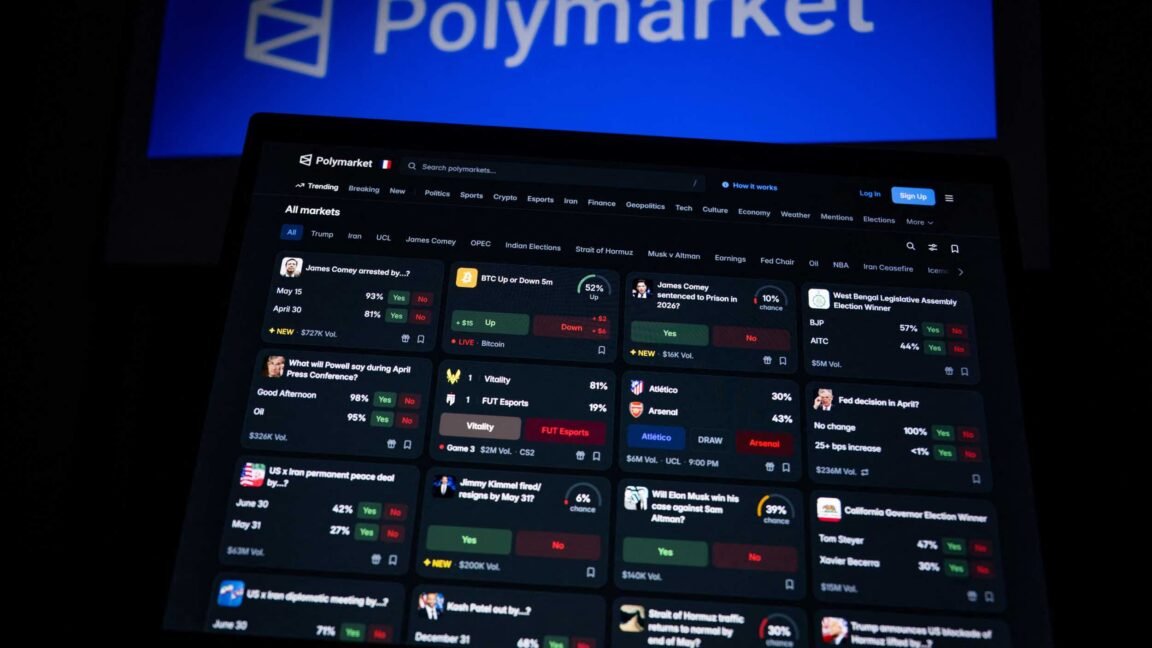
Polymarket paid dozens of social media users to film themselves making fake bets for a promotion that aimed to convince people they can strike it rich on the prediction market, according to a Wall Street Journal investigation published on Saturday.
“In its push to draw users to its unregulated platform, Polymarket has flooded social media with videos like [George] Makihara’s, which appear genuine at first glance,” the article said. “In reality, Polymarket built near-perfect copies of its website, then instructed creators to make simulated trades on those dummy sites and hide that they were being paid by Polymarket.”
Makihara, a college student, posted a video in January “that showed him winning $100,000 on a wager that President Trump would publicly say the word ‘McDonald’s’ that month.” But trade data showed that no one on Polymarket won such a bet in January, according to the Journal. This was one of 145 bets that Makihara appeared to place on Polymarket between January and May, but all of those bets were fake, the article said.
“Many of the videos share a template: The creators open Polymarket, place a bet, and frequently refer to their winnings as ‘free money.’ Dozens of social-media creators have posted videos with almost identical formats,” the Journal reported. “Polymarket sends creators bullet-point guidance on what to say, according to creators who have worked with the company and a recruiting website.”
Polymarket’s main platform barred in US
The promotion reportedly targeted US residents by paying creators only when at least 60 percent of their viewers were in the United States. Polymarket’s main platform technically hasn’t been available in the US since 2022, when the Commodity Futures Trading Commission (CFTC) determined Polymarket was operating an illegally unregistered exchange. Polymarket’s main website is restricted to view-only mode in the United States, but users can get around the block by using a virtual private network to change their apparent location.
Polymarket is to bring its main exchange back to the US, but also offers a more limited, US-regulated version of its trading service through a mobile app. Polymarket launched the app last year after acquiring QCX, a firm that is licensed by the CFTC and now operates under the name Polymarket US.
The Journal said it reviewed 1,105 videos made by 10 creators and identified fake bets totaling $1.9 million. While most of the videos were of fake bets being placed, there were 118 videos of “creators reacting to outdated footage or fake headlines suggesting they’d won.”
Those 118 videos showed creators winning almost $900,000, but the bets in reality would have lost over $166,000, the report said. The Polymarket “campaign racked up more than 140 million views on TikTok, YouTube and Instagram,” the report said, citing data from analytics provider Tubular.
Polymarket “hired and worked closely with” a marketing firm that enlisted a “social-media army to repost content made by 10 Polymarket creators in particular, Makihara among them,” the article said. The Journal said it reviewed “nearly 20,000 messages from a chat group for Polymarket’s online content-creating contractors, and instructional documents and videos prepared for them.”
Videos used fake “poiymarket” site
Video creators were reportedly told to make their posts seem “personal and organic,” to ensure that the word “Polymarket” did not appear in their account names, and to not disclose that they were paid. Creators were reportedly paid $2,000 to $3,000 a month.
“These creators didn’t initially identify themselves as paid by Polymarket, although one offered a $20 bonus code in his social-media bio. The creators started adding ‘@polymarket partner’ to their bios after the Journal started asking the company about its marketing operation,” the article said.
The Journal said it identified various discrepancies between the real Polymarket site and the fake ones used by creators. “One password-protected website has the creatively misspelled URL poiymarket.com, which is indistinguishable from polymarket.com when the ‘i’ is capitalized,” the report said.
The Journal report said a person familiar with the matter confirmed that Polymarket itself built poiymarket.com. “The ‘poiymarket’ website was taken down after the Journal reached out to Polymarket for comment,” the article said.
Creators told the Journal that they sent videos to Polymarket for review and that Polymarket asked for videos to be reshot if they were too obviously fake. Despite that precaution, some videos “contained short glimpses of URLs indicating the sites were test environments for Polymarket engineers.”
Polymarket pledges “comprehensive audit”
When contacted by Ars today, Polymarket did not specifically address the WSJ’s findings but said it is conducting an audit of its promotional content.
“As the world’s leading prediction market, we are committed to maintaining accurate, fair, and transparent markets,” the Polymarket statement said. “We are part of a rapidly growing industry and are constantly evaluating ways to improve how we’re engaging and earning the trust of our audience. As part of that commitment, we are conducting a comprehensive audit of active promotional content to ensure it complies with our standards, as well as applicable regulatory and legal disclosure requirements.”
While false and misleading promotions can be punished by the Federal Trade Commission, the Trump administration has tried to limit regulation of prediction markets. The CFTC has been suing states that try to impose strict rules on prediction markets to ensure that the entities remain under the more permissive federal regulatory scheme. Polymarket and its rival Kalshi both have Donald Trump Jr. as an advisor, and a Trump Jr.-backed venture capital firm invested in Polymarket.