11.4 C
London
Wednesday, June 10, 2026
Home Blog

Momentum Builds to Rein In Domestic Spying Law — Whether or Not Bill Pulte Survives as Intel Chief

0
momentum-builds-to-rein-in-domestic-spying-law-—-whether-or-not-bill-pulte-survives-as-intel-chief
Momentum Builds to Rein In Domestic Spying Law — Whether or Not Bill Pulte Survives as Intel Chief


For years, centrist Democrats like Sen. Mark Warner of Virginia dismissed claims that a key National Security Agency surveillance program could be abused to spy on Americans.

Then President Donald Trump tapped Bill Pulte — an unqualified housing official accused of misusing sensitive databases to pursue the president’s political vendettas — to oversee the nation’s spy agencies. That got the centrist Democrats’ attention.

Warner, who serves as ranking member of the Select Committee on Intelligence, voted with every Senate Democrat except for Pennsylvania Sen. John Fetterman last week against advancing the renewal of the NSA program authorized by Section 702 of the Foreign Intelligence Surveillance Act, or FISA.

In the face of pushback from Democrats and some Republicans, Trump declined to back down on his choice. Instead, he said Tuesday that he was moving up the effective date of Pulte’s appointment to lead the Office of the Director of National Intelligence to June 19.

Sen. Ron Wyden, D-Ore., a longtime critic of Section 702, said that there’s unprecedented support for reforming the law.

“I have been doing this a while,” Wyden, who is on the Senate Select Committee on Intelligence, told The Intercept on Tuesday. “I am the longest serving member of SSCI in history, and I’ve never had this kind of bipartisan support.”

That doesn’t, however, mean that reform efforts hinge on Pulte’s political fate. Though the announcement narrowed the odds that the spying program will be renewed before it expires Friday, the fracas over Pulte has revealed a deep divide among Democrats that could keep the issue alive.

Centrists such as Warner would still vote to renew Section 702 if Pulte is sacked. Other Democrats, like Wyden, say that Pulte’s selection only exacerbated long-standing issues such as the lack of a warrant requirement for searching through the NSA’s data.

“Firing Pulte doesn’t fix the problem,” Wyden told reporters on Tuesday. “There have to be reforms.”

Section 702 has been the subject of an intense behind-the-scenes squabble since Congress passed a short-term, 45-day extension of the program in April.

The law allows the FBI and other agencies, including ODNI, to pore through Americans’ communications collected abroad without a warrant. Ostensibly, there are safeguards in place to prevent those agencies from targeting specific Americans — but courts have repeatedly found widespread violations of those rules.

For years, civil liberties advocates have sought to create a warrant requirement that would require the FBI and other agencies to go to a judge to read through Americans’ communications.

That idea has proven a nonstarter for defenders of Section 702 such as Warner, who argue that it would create insurmountable logistical obstacles for agents hoping to prevent terror attacks. Warner has long allied with Republicans to push back on the warrant proposal.

Compromise Flop

Since April, a bipartisan coalition of civil liberties supporters in Congress has managed to block a long-term reauthorization of Section 702. In recent weeks, Warner helped craft what was billed as a compromise proposal intended to win over enough of the critics to allow the passage of a long-term renewal of the law.

Then, Trump said on June 3 that he would appoint Pulte to serve as temporary director of national intelligence, to replace departing chief Tulsi Gabbard.

The announcement immediately soured centrist Democrats’ plans to help secure passage of a FISA extension. Pulte, whose net worth is at least $190 million, is a private equity firm founder who became a minor internet celebrity for giving away money on Twitter. Then Trump appointed him last year to serve as director of the Federal Housing Finance Agency and chair of mortgage giants Fannie Mae and Freddie Mac.

In those roles, Pulte helped launch housing fraud probes of Trump nemeses including Sen. Adam Schiff, D-Calif., and Democratic New York Attorney General Letitia James. He is being investigated by the Government Accountability Office for allegedly misusing confidential government databases for information on the president’s foes.

“There were already sensitive negotiations that were ongoing,” House Minority Leader Hakeem Jeffries, D-N.Y., told PBS NewsHour on Tuesday. “And then Donald Trump chose to elevate this partisan political hack, Bill Pulte, into this position of great sensitivity, effectively tossing a hand grenade in the midst of these negotiations as we approach the deadline to potentially renew surveillance authority.”

The compromise deal floated by Warner and others had never impressed privacy advocates. They said the changes it made to the law mostly layered on more layers of internal oversight, which would not stop a determined Trump flunky from abusing the NSA’s spying powers.

Even calling it a “deal” was misleading, said Elizabeth Goitein, senior director of the liberty and national security program at the Brennan Center for Justice, a nonprofit working on law and policy.

“The members who drafted this legislation, basically Trump allies plus Sen. Warner — all longtime opponents of 702 reform who are in complete alignment with each other on the fundamental points of debate — they were the members who drafted the legislation,” she said on a conference call Tuesday. “Members who support reform were shut out.”

Push and Pulte

While Warner and other Democratic supporters of the program voted against putting its renewal on the Senate agenda last week, that boiled down to a repudiation of Pulte instead of a sudden change of heart on the program.

“Pulte is the major stumbling block for people like myself and Mark Warner, who are generally supportive because of the importance of the program,” Sen. Angus King, an independent who caucuses with the Democrats, told The Intercept on Tuesday. “But we can’t in good conscience hand the keys to the country’s most significant car to a teenager.”

In the Republican caucus, a faction of members with libertarian tendencies support adding a warrant requirement. Some longtime supporters of the program, on the other hand, have dismissed the significance of Pulte’s appointment.

“He’s an interim guy, he’ll be there for weeks to a couple months, so I don’t understand why it’s a big issue anyway,” said Sen. James Lankford, R-Okla., who serves on the Intelligence Committee.

Privacy advocates are largely aghast at the appointment of Pulte, but they hope the expiration of Section 702 will create space for reform. They were heartened on Tuesday when Jeffries gave some of his strongest statements yet in support of overhauling the law.

“Donald Trump needs to withdraw his decision to elevate Bill Pulte,” Jeffries said on PBS. “That’s a starting point, not an ending point. And then we can see if we can responsibly get to a place where there are enough reforms built into the law to provide guardrails and protect the American people.”

Reformers have a smorgasbord of reform proposals. Wyden wants to create a warrant requirement not only for searches of NSA data, but also one for searches of sensitive information available on the open market, such as location tracking from commercial data brokers.

Wyden said he senses a rare opportunity, pointing to support from Republicans such as Sen. Mike Lee of Utah, and said, “Both of us have bipartisan bills with almost all of the provisions we’re talking about.”
The lost West Bank

0
the-lost-west-bank
The lost West Bank

With heavyweight Middle East wars going on in Lebanon and Iran, the low-intensity continual takeover of the West Bank by Israel hardly makes a ripple on the world geopolitical scene.

The Israeli government has unleashed multiple weapons to subdue the West Bank, a territory long coveted by Israeli expansionists as the key to creating a Greater Israel between the Jordan River and Mediterranean. The Israeli public seems okay with the takeover so long as it doesn’t ‘t reach formal annexation. Control is seen as fair game.

To solidify control over the West Bank, which is home to 3.3 million Palestinians, Israel is establishing new settlements for its own citizens, evicting Palestinians from their residences, letting vandals attack rural Arab communities and intensifying military raids on towns across the territory.

In tandem with these activities, the government of Prime Minister Benjamin Netanyahu is establishing institutions to directly govern a third of the area – effectively annexation

Through military force, 80 percent of the entire West Bank will be under de facto Israeli control, Israeli and Palestinian observers say. The remaining 20 percent will be governed by the Palestinian National Authority, an institution set up in 1994 in advance of creation of a Palestinian state.

The moves to tighten control followed the October 7, 2023, invasion of southern Israel by Hamas, the Islamic group that ran the Gaza Strip. Israel’s counterattack has put about 60 percent of the territory into its hands. Low-intensity warfare in the West Bank ran parallel to the more intense Gaza conflict.

With the other wars going on in the Middle East – in Lebanon, in Iran – the West Bank situation seems a kind of geopolitical orphan on the world stage.

Domination of the West Bank is in line with Netanyahu’s long-held desire to both colonize and govern it. The West Bank is key to creation of Greater Israel, a goal of his Likud Party since its founding a half century ago. Religious-nationalist parties that  shore up Netanyahu’s ruling coalition share the objective.

The Hamas 2023 attack has provided unwavering support for Netanyahu’s West Bank moves. About 58 percent of Israelis back his expansion of settlements there.

There is a caveat: the same percentage opposes outright annexation. The combination provides Netanyahu with a kind of opening: he has a free hand to tighten control over the West Bank, so long as he doesn’t formally annex it. Instead, he simply creates what Israeli officials call “facts on the ground” that simulate annexation in all but name.

Israel has fashioned a West Bank landscape that amounts to de facto annexation: Walls and fences, barbed wire and watchtowers, the expanding number of settlements and a road system for settler-only traffic. All create separate but unequal space between the 3.3 million Palestinian residents and the Israeli population of 540,000.

“Israel’s far-right government is restructuring the occupation of the West Bank, shifting governing powers from military to civilian agencies in order to gradually institute permanent control,” wrote International Crisis Group,  which researches warfare and offers advice on avoiding it.

“With Israeli law reaching further into the territory and space for Palestinian independence shrinking, much of the territory has, in effect, already been annexed,” ICG concluded.

Israeli settler violence against Palestinians is also cementing their separate but unequal status. Settlers frequently raid isolated farm house and have set several on fire.  The Israeli army stands by idly.

Last month, a settler was videotaped trying to beat a sheepdog to death with a pair of sticks. Mobs steal sheep from their pens in the style of Wild West cattle rustlers.

“Settler attacks are far from isolated,” wrote B’tselem, a leading Israeli human rights organization. “Post October 7, 2023, environment has seen an escalating settler violence, which has gone from primarily involving vandalism and property destruction to now being marked by kidnapping, prolonged abuse and apparent military complicity.”

In a March report, the United Nations Human Rights Office said, “Settler violence continued in a coordinated, strategic and largely unchallenged manner, with Israeli authorities playing the central role in directing, participating in or enabling this conduct, making it difficult to distinguish between state and settler violence.”

Prosecution of marauding settler is rare. Among the few known cases took place in June 2024, when two West Bank settlers were sentenced to prison terms of a maximum three years for attacking a Palestinian family in the town of Huwara with axes.

In February this year, Israeli prosecutors announced charges against settler Yinon Levi for the 2025 shooting death of Awdah Hathaleen, who was trying to stop the bulldozing of a Palestinian village by settlers. His killing was recorded on film and was central event portrayed by the Oscar-winning documentary “No Other Land.”

Yesh Din, an Israeli human rights group, reported that 90 percent of complaints filed by Palestinians about settlers harassment between 2005 and 2025 were closed with no charges being filed. “Israeli security forces routinely accompanied ​settlers and acted as a shield for the violence,” the report said.

At least seven Palestinians were killed and 832 injured in 2025 with near-daily ​attacks continuing into this year, according to the United Nations. “The increasing participation of Israeli security forces in settler attacks amounts to a de facto collapse of the distinction between settlers and soldiers,” the report said.

Israeli diplomats in Geneva rejected the report and accused the UN body of relying on “unsubstantiated allegations.”

Numerous bureaucratic demands on Palestinians are buttressing Israel’s hold on the West Bank. His cabinet recently legalized 50 nominally renegade “outposts” and declared them authorized settlements—meaning they will be granted government financial support. There are currently 141 certified settlements in the West Bank and more than 300 “outposts.”

This month, the government announced plans to demand written proof of land ownership by Palestinians dating from the periods of either Ottoman Empire or Jordanian rule. Much of the land was held communally, without paperwork, so such documents don’t exist.

Israeli is also expropriating Palestinian vacant property on the ground it is needed for military purposes or to make room for communications equipment.

Foreign governments friendly to Israel cling to the “two-state solution,” though for many years they have made no effort to make it a reality. US President Donald Trump, Israel’s allies in all its wars, has mentioned the West Bank only to demand Israel not formally annex it.

Tehran, a major sponsor of Hamas, disdains the Palestinian National Authority as weak and ineffective. In recent years, Iran funneled money to armed groups in the northern West Bank, which is the heart of Palestinian resistance to Israel’s presence in the West Bank.

However, that effort has been weakened by the ouster of the allied government of Bashar al-Assad and its replacement by a Sunni Islamic government trying to woo Western support for economic help.

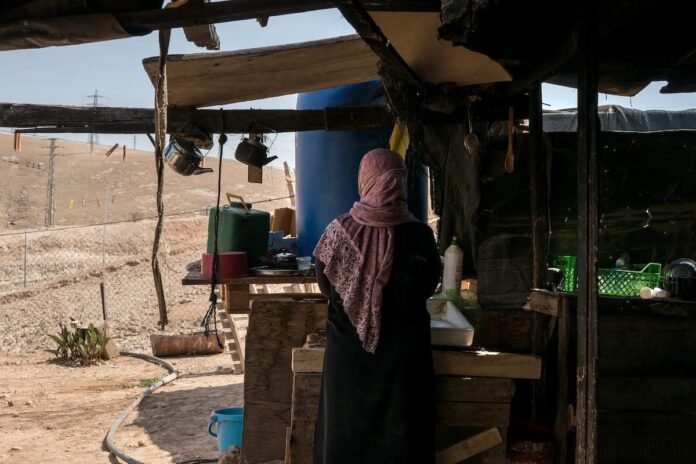
The latest display of the expansionist drive to displace is underway just east of Jerusalem inside the West Bank. The Palestinian Bedouin village of Khan al-Ahmar, population 300, is under threat of demolition.

It sits close to a highway that runs from Jerusalem east into the West Bank, passing a major settlement called Maale Adumim, onward toward the Palestinian city of Jericho before arriving near Israeli border settlements along the Jordan River.

Finance Minister Bezalel Smotrich, a staunch expansionist, wants to remove Khan al-Ahmar in order to clear the way for construction along the road to Maale Adumim. The construction would create an unbroken string of Israeli settlements and cut the north-south route that connects the southern West Bank with the north.

The goal, according to Smothrich, is to permanently divide the West Bank in half. In effect there could no longer be a contiguous Palestinian state.

“The Palestinian state is being erased from the table not with slogans but with actions.” Smotrich, who lives in a West Bank settlement, told reporters. “This reality finally buries the idea of a Palestinian state. There is nothing to recognize and no one to recognize.”

Though east-west division has been considered by a variety of Israeli governments for many years, Smotrich had a testy personal reason for promoting it now.

On March 19, he heard that the International Criminal Court in the Hague was soon to issue an arrest warrant naming him for his role in expanding Israel’s hold on the West Bank.

During a press conference Smotrich called the move an “act of war” and responded by ordering the evacuation of Khan al-Ahmar. “I promise all our enemies, this is only the beginning,” he added.

The ICC issued the arrest warrant on April 2. Bulldozers have yet to be sent to Khan al-Ahmar.

EU Moves to Strengthen Defence Industry as Security Challenges Mount

0
eu-moves-to-strengthen-defence-industry-as-security-challenges-mount
EU Moves to Strengthen Defence Industry as Security Challenges Mount


European Parliament and Council negotiators have reached a provisional agreement on a package of measures designed to strengthen the European Union’s defence readiness by accelerating investment, simplifying procurement procedures and reducing regulatory barriers for the defence industry.

The legislative package, part of the EU’s “Omnibus V” simplification measures, seeks to support up to €800 billion in defence investment over the next four years under the ReArm Europe Plan/Readiness 2030 initiative.

The agreement includes measures to speed up approval procedures for defence-related projects such as the construction of new production facilities and the expansion of existing sites. Under the deal, national authorities will have a default period of 42 working days to decide on permit applications once they are deemed complete.

In exceptional cases involving complex projects or concerns related to environmental protection or worker safety, authorities may extend the deadline by up to 60 additional working days. The total duration of the permit-granting process would be capped at 102 working days.

If authorities fail to issue a decision within the applicable deadline, the principle of tacit approval would apply. Member states would also be required to establish single points of contact for defence project developers, introduce digital tracking systems and report annually to the European Commission on permitting activity.

The agreement also seeks to facilitate the movement of defence-related products across the EU by introducing a new general transfer licence. Member states will be required to publish these licences, providing greater certainty for companies operating across borders.

On defence procurement, negotiators agreed to raise the threshold for applying EU procurement rules, extend the maximum duration of framework agreements from seven to ten years and provide greater flexibility for member states to carry out joint procurement projects.

Parliament and Council also committed to examining future measures that could give the European Commission a greater role in facilitating intra-EU transfers of defence products and considering EU preference criteria in procurement.

The package includes changes to the European Defence Fund (EDF) aimed at simplifying its management and implementation. The revised rules prioritise projects demonstrating high standards of excellence, quality and efficiency while expanding support for small and medium-sized enterprises.

Negotiators also agreed to extend enhanced EDF funding provisions to projects developed under the Structure for European Armament Programme (SEAP), which forms part of the European Defence Industry Programme.

In a move intended to deepen cooperation with Kyiv, the agreement allows costs linked to testing activities carried out in Ukraine, an EU candidate country, to qualify for EDF funding.

The deal additionally confirms that member states may apply certain exemptions from EU environmental and chemical regulations when justified on defence grounds.

The provisional agreements must now receive formal approval from both the European Parliament and the Council before becoming law.

The European Commission first presented the Defence Readiness Omnibus package in June 2025 as part of broader efforts to strengthen Europe’s defence technological and industrial base, increase cooperation among member states and improve the bloc’s ability to respond to growing security challenges.

Logitech’s foldable mouse is for people who refuse to carry a mouse with them

0
logitech’s-foldable-mouse-is-for-people-who-refuse-to-carry-a-mouse-with-them
Logitech’s foldable mouse is for people who refuse to carry a mouse with them

I see it often. Hardworking professionals in cafés, airports, or parks hunched over a laptop while carefully dragging their fingers over their PC’s trackpad to navigate some email, project, or alert that can’t be ignored. They would prefer a mouse to a trackpad, but are reluctant to travel with one.

When you’re on the go, carrying a mouse can seem burdensome or unnecessary. But I’d argue that it’s worth the boost in efficiency and comfort when navigating your computer, tablet, or phone. For the people who refuse to carry a bulky mouse with them, even when they plan to use their computer away from their desk, I’m glad Logitech launched the Mobi Fold, a foldable, wireless mouse. But I’d still push reluctant mobile mouse users toward something even more comfortable.

Logitech’s Mobi Fold

Logitech Mobi Fold going into someone's back pocket

The mouse’s PAW3222 sensor supports 400-4,000 DPI in 100-DPI increments.

The mouse’s PAW3222 sensor supports 400-4,000 DPI in 100-DPI increments. Credit: Logitech

The Logitech Mobi Fold released today for $80 folds in half so that it’s easy to carry around. Logitech’s announcement claimed that it found that “while 72 percent of professionals own a mouse, only 26 percent actually use one when working in public places.” The announcement didn’t explain Logitech’s methodology, but it seems that someone at the Swiss company has also grimaced at the awkwardly bent wrist of people using laptop trackpads in public.

Logitech’s foldable mouse can get extremely compact, thanks to its distinct hinge, which is encased in accordion-shaped silicone. The hinge pivots at approximately 130 degrees, The Verge reported today.

Profile view of the Mobi Fold when folded

The mouse is 0.83 (height) x 2.24 inches (width) x 2.6 inches (depth) when folded.

The mouse is 0.83 (height) x 2.24 inches (width) x 2.6 inches (depth) when folded. Credit: Logitech

Logitech says the Mobi Fold senses when it’s lifted, at which point its buttons will stop working to avoid accidental inputs while you’re folding it. The mouse’s scroll function, which is provided by a touch panel, and tracking will still work during this time.

The Mobi Fold embraces its bendy nature and, sensibly, automatically turns on when opened up and turns off when it’s folded shut. Long battery life is critical to how travel-friendly a mouse is, and this auto-power feature should help users conserve battery, especially compared to traditional wireless mice. It’s easy to forget to flip a wireless mouse’s power switch before putting it in a bag.

A datasheet (PDF) for the device claims the Mobi Fold “is made to withstand 50,000 folds and unfolds.” Logitech said that it tested this “under controlled conditions until wear or functional issues appeared.”

Comfort concerns

Logitech Mobi Fold

The mouse also comes in off-white and sand colors.

The mouse also comes in off-white and sand colors. Credit: Logitech

The Mobi Fold seems to have a good grip on portability, including around ease-of-use and battery life. But the tented shape of the mouse doesn’t look particularly comfortable, especially for long-term use.

When folded, the mouse makes a nearly 90-degree angle that your palm will have to rest on. I find the most comfortable mice to be the ones that fill out the spherical opening of my palm, and the Mobi Fold doesn’t fit. Similarly shaped mice, like the Dell MS700 and Microsoft Surface Arc Mouse, are a bit more forgiving here, offering more of a rounded, arched shape when in use.

Side view of the Surface Arc mouse

The Surface Arc mouse doesn’t fold in half but can flatten.

Dell MS700 Bluetooth Travel Mouse

Dell’s MS700 twists instead of folding or flattening.

The Mobi Fold’s buttons aren’t as tactile as other mice. The left- and right-click buttons are flat, and Logitech replaced the scroll wheel with a touch panel. Under the touch panel are two buttons with discernible travel that can be programmed with Logi Options+ software. But because the mouse doesn’t have onboard memory, the device won’t remember programmed inputs unless you program the mouse with Options+ on the paired computer. Logitech devices have become more software-dependent in this way, which is a shame considering how easy it is to use many of the company’s wireless devices with multiple systems.

My preferred travel mouse

When it comes to travel mice, my yearslong go-to has been Logitech’s MX Anywhere 3 (or the newer, quieter Anywhere 3S). It weighs more than the Mobi Fold (3.49 ounces versus 2.79 ounces) and takes up more space (13.69-cubic-inches compared to the Mobi Fold’s 4.83-cubic-inches when folded). But the rounded hump and more advanced and tactile scroll wheel are worth the extra girth.

Logitech’s announcement today claimed that the Mobi Fold reduces “muscle strain by 22 percent compared to a laptop trackpad,” but I suspect the MX Anywhere 3 could reduce strain further. And its button layout brings familiarity and tactility.

The MX Anywhere 3 is 3.96 x 2.56 x 1.35 inches. Like the Mobi Fold, it lacks onboard memory.

The MX Anywhere 3 is 3.96 x 2.56 x 1.35 inches. Like the Mobi Fold, it lacks onboard memory. Credit: Scharon Harding

The MX Anywhere 3’s battery should last longer too. Logitech claims the Bluetooth mouse can last for up to 70 days without a charge compared to 30 days for the Mobi Fold. Although, the Mobi Fold has an exemplary advantage in its replaceable, rechargeable battery.

The Mobi Fold is the more portable, but the MX Anywhere 3 is still plenty tiny. When it comes to mouse comfort and usability, sometimes more really is more.

Beloved Country Musician Dies at 67

0
beloved-country-musician-dies-at-67
Beloved Country Musician Dies at 67


Country music fans are mourning the loss of one of the most familiar and beloved voices in the business.

Bill Cody, the longtime WSM radio personality and Grand Ole Opry announcer who helped wake up generations of country fans, has died. He was 67.

WSM Radio announced Cody’s death Tuesday in Nashville, sending shockwaves through the country music world.

For more than 30 years, Cody was a comforting voice to millions of listeners who tuned in from their homes, cars, trucks and workplaces. Since 1994, he had been a staple on Nashville’s legendary WSM-AM, where he hosted the popular morning show Coffee, Country & Cody.

He also became one of the voices most closely tied to the Grand Ole Opry, the legendary stage that has helped define country music for nearly a century.

No official cause of death has been released.

However, Cody’s health had become a major concern in recent weeks. Members of the country music community had been asking for prayers after his daughter revealed he was in critical condition and needed heart and kidney transplants.

After news of his death broke, tributes poured in from some of the biggest names in country music.

“There might be someone somewhere in the world who loved country music as much, but nobody loved country music more than Bill Cody,” Garth Brooks wrote.

Dierks Bentley called Cody one of the genre’s great pillars.

“Country music has lost one of its pillars,” Bentley wrote. “Bill was just as important to the fabric of our music and city as any artist, songwriter or musician. No one loved country music, its history and its characters more than Bill Cody.”

Ty Herndon also shared an emotional tribute, saying Cody did far more than simply work in country music.

“Bill Cody was one of those rare people who didn’t just work in Country Music — he lived it, protected it, and loved it with every fiber of his being,” Herndon wrote.

He praised Cody as a trusted voice, a champion of artists and a keeper of country music’s stories.

“Whether you were a superstar or a struggling songwriter with a dream, Bill made you feel like you mattered,” Herndon added.

Cody’s journey into broadcasting began when he was just 17 years old. According to Variety, he answered a help-wanted ad at a Kentucky radio station and launched a career that would eventually make him one of the most respected voices in country radio.

Born Trent Clutts, he later adopted the name Bill Cody on the air as a nod to his childhood hero, Buffalo Bill Cody.

Over the decades, Cody became more than a radio host. To many country fans, he was a trusted friend who knew the music, loved the history and respected the people behind the songs.

His work earned him major honors along the way. He was inducted into the Country Music Disc Jockey Hall of Fame in 2008 and received a star on Nashville’s Music City Walk of Fame in 2024.

Cody is also set to be inducted posthumously into the Tennessee Radio Hall of Fame later this year.

The Grand Ole Opry will honor Cody’s memory during Saturday night’s live broadcast. WSM also plans to air a special marathon featuring memorable moments from Coffee, Country & Cody.

For country music fans, Cody’s death marks the end of an era.

He was not just a man behind a microphone. He was part of the heartbeat of Nashville.

3-Ingredient Strawberry Lemonade Sorbet

0
3-ingredient-strawberry-lemonade-sorbet
3-Ingredient Strawberry Lemonade Sorbet
Close-up of 3-Ingredient Strawberry Lemonade Sorbet in a white bowl with fresh strawberries on a white marble background.
Bright, refreshing, and bursting with berry flavor, this homemade strawberry lemonade sorbet is summer in a scoop.

Print Friendly, PDF & Email

3-Ingredient Strawberry Lemonade Sorbet is one of those simple desserts that instantly makes a warm day feel a little brighter. Sweet strawberries and fresh lemon juice come together to create a refreshing frozen treat with a vibrant lemonade twist. The texture is smooth, fruity, and wonderfully refreshing, while the honey adds just enough sweetness to let the fresh berries shine.

Even better, this homemade sorbet needs only three ingredients and no special equipment. Freezing the strawberries first creates a naturally creamy consistency and keeps the flavor fresh and bright.

Whether you enjoy a scoop after dinner or serve it during the hottest days of summer, this cheerful dessert always feels like a little celebration. One taste and you’ll understand why simple recipes are often the most memorable.


Close-up of 3-Ingredient Strawberry Lemonade Sorbet in a white bowl with fresh strawberries on a white marble background.
Bright, refreshing, and bursting with berry flavor, this homemade strawberry lemonade sorbet is summer in a scoop.

Recipe Yield: 6 servings

INGREDIENTS

1 lb fresh strawberries, hulled and sliced
⅓ cup honey
3 Tbsp fresh lemon juice

INSTRUCTIONS

1. Freeze the strawberries:
Arrange the sliced strawberries in a single layer on a baking sheet or plate. Freeze for at least 4 hours, or until completely firm.

2. Let the berries soften slightly:
Remove the strawberries from the freezer and let them sit at room temperature for 5 minutes. This helps them blend more easily.

3. Blend until creamy:
Add the frozen strawberries, honey, and lemon juice to a food processor. Blend until smooth and creamy, stopping occasionally to scrape down the sides.

4. Freeze until scoopable:
Transfer the mixture to a freezer-safe container. Cover and freeze for 1–2 hours, or until firm enough to scoop.

5. Serve and enjoy:
Let the sorbet stand at room temperature for about 5 min before serving. Scoop into bowls and enjoy.


Helpful Tips to Perfect This Recipe

Use fully ripe strawberries for the sweetest flavor.
Naturally sweet berries create the best strawberry lemonade sorbet and require no additional ingredients.

Allow the berries to soften slightly before blending.
Five minutes at room temperature helps the food processor create a smoother texture.

Don’t skip the final freeze.
An extra hour or two in the freezer gives the sorbet a beautiful scoopable consistency.

South Korean ballot controversy sparks a new youth movement

0
south-korean-ballot-controversy-sparks-a-new-youth-movement
South Korean ballot controversy sparks a new youth movement

Citizens protesting the ballot paper shortage incident during the local elections wave South Korean flags while demanding a revote in front of a Seoul vote-counting station on June 7. Photo: Chosun Ilbo / Park Seong-won

A week after South Korea’s local elections, the country’s political conversation is shifting in an unexpected direction.

On June 10, a public opinion survey showed support for the conservative People Power Party at 41.6%, slightly ahead of the Democratic Party’s 40.4%, despite the Democratic Party’s victories in many major local races only days earlier.

The result suggested that public attention may already be shifting away from the electoral outcome itself and toward the controversy surrounding how the election was administered.

Reports of ballot shortages at polling stations across the country have transformed what initially appeared to be isolated incidents into a broader institutional challenge.

From election result to election process

On June 5, the National Election Commission reported shortages at 50 polling locations nationwide. Three days later, it revised the figure upward to 91.

The changing figures themselves have become part of the controversy, fueling public skepticism and raising questions about election administration.

According to Chosun Ilbo, election authorities in Seoul’s Songpa District prepared ballots equivalent to approximately 51% of registered voters, while Ongjin County in Incheon prepared enough ballots to cover 100% of eligible voters.

The report noted that local election offices exercised substantial discretion because no nationally standardized printing guideline had been clearly established.

Courts have reportedly ordered the preservation of election materials while investigators examine how such disparities occurred.

Whether the explanation is administrative incompetence, procedural failure or something more serious, many citizens are asking how such a breakdown could occur in one of Asia’s most technologically advanced democracies.

The youth take to the streets

The most striking development may be who is asking those questions.

Since election day, crowds of up to thirty thousand demonstrators have gathered daily near Jamsil Sports Complex, close to one of the most heavily publicized polling locations affected by ballot shortages.

Multiple reports indicate that voters in their twenties and thirties constitute a substantial portion of the crowds.

For longtime observers of South Korean politics, this is unusual. Large-scale street mobilization has not traditionally been associated with conservative causes or concerns about election administration.

Yet many participants appear motivated less by ideology than by concerns about electoral transparency and institutional accountability.

One longtime conservative rally participant in her 40’s described being surprised by the unusually young crowd and by students voluntarily cleaning protest sites after demonstrations.

She later donated to the movement, saying the concerns voiced by young participants felt personal because her own daughter had recently entered university.

Whatever the ultimate cause of the ballot shortages, the controversy has clearly energized a demographic that many political parties have struggled to engage.

Beyond the conservative base

The issue is also beginning to spread beyond traditional conservative constituencies.

The student government of Chonnam National University recently joined a nationwide declaration criticizing the ballot shortage controversy.

That development is notable because the university is in the Jeolla region, long one of the Democratic Party’s strongest political bases.

Participation from institutions traditionally associated with progressive politics suggests the controversy is expanding beyond conservative circles and becoming a broader debate about confidence in electoral institutions.

Some younger participants have described the movement as a “second democratization movement,” reflecting growing frustration with institutional accountability.

The language may be dramatic, but it points to a growing perception among some younger voters that institutional accountability, rather than partisan loyalty, is becoming the defining issue.

Whether the ballot shortages ultimately prove to be the result of administrative incompetence, procedural failures or deeper institutional weaknesses, the political effects are already visible.

A generation of younger South Koreans that has often appeared disengaged from traditional politics is now demanding greater transparency from public institutions. That may become the most significant legacy of the controversy.

Hanjin Lew is a South Korean political commentator specializing in alliance politics and East Asian security affairs.

Iran Tells UN Maritime Body 54 Seafarers Were Killed in Conflict-Linked Incidents

0
iran-tells-un-maritime-body-54-seafarers-were-killed-in-conflict-linked-incidents
Iran Tells UN Maritime Body 54 Seafarers Were Killed in Conflict-Linked Incidents


Iran told the International Maritime Organization on Wednesday that 54 seafarers had been killed in conflict-related maritime incidents and restrictions affecting Iranian shipping, presenting the figures during a committee meeting in London as Tehran sought to document the human and operational toll of the fighting.

Speaking at the 76th session of the International Maritime Organization’s Technical Cooperation Committee, Iran’s representative said 66 seafarers had been wounded, and seven others were still missing. The representative said 28 seafarers had been taken hostage, with five still being held.

According to the Iranian submission, 360 vessels were affected during the period, including 253 that were sunk or otherwise destroyed. Iran said the incidents and restrictions disrupted ships, crews, ports, search-and-rescue services, emergency response systems, vessel traffic monitoring, communications networks, and other maritime safety infrastructure.

Tehran also reported damage to four maritime operations buildings, four vessel traffic service control stations, and eight communications relay units. The Iranian representative described those facilities as essential to navigation, emergency coordination, and management of maritime traffic.

The figures were presented against the backdrop of growing concern over shipping near the Strait of Hormuz and the Gulf of Oman, where months of conflict and maritime restrictions have raised risks for commercial vessels and global energy flows. The Strait of Hormuz is one of the world’s most important oil and gas transit routes, making disruptions there a concern far beyond the region.

In a June 8 document submitted to the committee, Iran cited a US measure titled “US To Blockade Ships Entering or Exiting Iranian Ports” and said related restrictions had interfered with commercial shipping, port access, voyage planning, navigational safety, and the movement of vessels and crews.

The International Maritime Organization has been tracking confirmed incidents in the region, though Iran’s wider casualty and vessel-loss figures were presented as Tehran’s own account.

UN officials urge Russia to free Indigenous climate advocate

0
un-officials-urge-russia-to-free-indigenous-climate-advocate
UN officials urge Russia to free Indigenous climate advocate

Ten U.N. officials are calling on Russia to immediately release Daria Egereva, an Indigenous international climate advocate, and her colleague Natalia Leongardt, both of whom have been jailed for six months on terrorism charges, ahead of a key court hearing this week. 

Egereva, who is Indigenous Selkup from Russia, is co-chair of the International Indigenous Peoples Forum on Climate Change, which represents Indigenous peoples’ perspectives at United Nations gatherings. Russian authorities arrested her and Leongardt on December 17, just weeks after Egereva returned from the COP30 climate conference. Leongardt, a former intern at the U.N. headquarters in Geneva, has spent her career working on educational programs for Indigenous peoples in Russia.

The two face accusations of participating in a terrorist group due to their past involvement in the Aborigen Forum, an informal network of Indigenous advocates that the Russian government shut down two years ago. But U.N. experts say they’re concerned the arrests are reprisals for participating in U.N. meetings and are part of a broader shift in Russia to crack down on civil society freedoms including Indigenous activism. 

“We urge your Excellency’s Government to immediately and unconditionally release Ms. Egereva and Ms. Leongardt from detention, to drop all charges against them as stemming from their peaceful human rights activities, and to ensure that they are able to continue their legitimate human rights work and their cooperation with the United Nations’ bodies and mechanisms without fear of intimidation or reprisals,” read the letter from the U.N. officials, who included the U.N. special rapporteurs for the environment, Indigenous peoples, and human rights in the context of climate change. 

Their letter, sent in April, was made public last week by the U.N. Russian officials do not appear to have responded. Egereva and Leongardt are expected to appear in court on Thursday in Moscow, where they could be sentenced to as long as two decades in prison. Their imprisonment has brought international condemnation, with more than 100 organizations calling for their release at April’s U.N. Permanent Forum on Indigenous Issues in New York City. 

Egereva in particular has been a fixture in international climate discussions and was arrested in December shortly after returning from COP where she spoke publicly on the importance of having more Indigenous women participate in climate talks. “Women are one of the most vulnerable groups within Indigenous peoples, so we are working to ensure that Indigenous women are included in all climate negotiations affecting their rights, and their interests, and their priorities,” she said at COP on November 21.

Read Next

Egereva was expected to be in Germany this week for the Bonn Climate Change Conference, where officials are preparing for another COP climate gathering this fall. Her incarceration prompted the International Indigenous Peoples Forum on Climate Change to vote Tuesday to extend Egereva’s term, making her a third co-chair until her release. That unprecedented move was made in solidarity with her detainment, as typically there are only two co-chairs.

The U.N. officials wrote that since her arrest in December, Egereva has been denied regular phone calls and visits with her husband and children. “Over recent months, she has only been able to see her husband at three court hearings, during which Federal Penitentiary Service of Russia (FSIN) officers prohibited any personal communication or contact,” their letter said. 

The same officials are worried not only about the conditions that Egereva and Leongardt are enduring, but also the impact their detainment could have on U.N. participation. “We are concerned about the chilling effect on Indigenous advocacy, international cooperation and engagement with the United Nations, and human rights defenders’ work that their prosecution is prone to generate,” the letter states. 

Friends and colleagues of Egereva and Leongardt say that their work exemplified routine advocacy on behalf of Indigenous peoples and was not extremist or reflective of the “terrorism” allegations. 

“We want everyone to see that they are part of a huge network and that the work they’ve been doing is completely legitimate, completely within regular diplomatic channels,” said Kate Finn, a citizen of the Osage Nation and executive director of the Tallgrass Institute who has worked with Egereva at the U.N. “It’s being framed by the Russian government as terrorist activity, but it’s activity that Indigenous women do every day for the U.N. system these days.”


Lebanese army death toll rises to 30 after soldier dies from wounds in Israeli strike

0
lebanese-army-death-toll-rises-to-30-after-soldier-dies-from-wounds-in-israeli-strike
Lebanese army death toll rises to 30 after soldier dies from wounds in Israeli strike

Relatives mourn during a funeral ceremony for Eli Nikola al-Huri, a Lebanese army captain who lost his life in an Israeli airstrike and was laid to rest in his hometown of Kafr Cera, east of Sidon, Lebanon, on June 8, 2026. [Mohammad Abushama - Anadolu Agency]

Relatives mourn during a funeral ceremony for Eli Nikola al-Huri, a Lebanese army captain who lost his life in an Israeli airstrike and was laid to rest in his hometown of Kafr Cera, east of Sidon, Lebanon, on June 8, 2026. [Mohammad Abushama – Anadolu Agency]

The death toll for the Lebanese army rose to 30 on Wednesday after a soldier died from wounds sustained in an Israeli airstrike in southern Lebanon nearly three months ago, Anadolu Agency reports.

A military statement said Mohammed Suleiman Al-Ahmad died from injuries he suffered in an Israeli strike that targeted him in the Qaqaait al-Jisr area of the Nabatieh district March 17.

With his death, the number of Lebanese soldiers killed since March has risen to 30, according to official figures.

The announcement came as Lebanon reported an increase in casualties from ongoing Israeli attacks.

Figures released Wednesday said the death toll from Israeli attacks on Lebanon since March 2 has risen to 3,696, with 11,413 injured.

Israeli attacks continue on a near-daily basis despite a fragile ceasefire that took effect April 17 and was later extended by the US until early July.

READ: Israeli strikes in Lebanon kills 10 people, including 3 Lebanese army members

0FansLike
0FollowersFollow
0FollowersFollow
0SubscribersSubscribe
- Advertisement -
Google search engine

Recent Posts