With heavyweight Middle East wars going on in Lebanon and Iran, the low-intensity continual takeover of the West Bank by Israel hardly makes a ripple on the world geopolitical scene.
The Israeli government has unleashed multiple weapons to subdue the West Bank, a territory long coveted by Israeli expansionists as the key to creating a Greater Israel between the Jordan River and Mediterranean. The Israeli public seems okay with the takeover so long as it doesn’t ‘t reach formal annexation. Control is seen as fair game.
To solidify control over the West Bank, which is home to 3.3 million Palestinians, Israel is establishing new settlements for its own citizens, evicting Palestinians from their residences, letting vandals attack rural Arab communities and intensifying military raids on towns across the territory.
In tandem with these activities, the government of Prime Minister Benjamin Netanyahu is establishing institutions to directly govern a third of the area – effectively annexation
Through military force, 80 percent of the entire West Bank will be under de facto Israeli control, Israeli and Palestinian observers say. The remaining 20 percent will be governed by the Palestinian National Authority, an institution set up in 1994 in advance of creation of a Palestinian state.
The moves to tighten control followed the October 7, 2023, invasion of southern Israel by Hamas, the Islamic group that ran the Gaza Strip. Israel’s counterattack has put about 60 percent of the territory into its hands. Low-intensity warfare in the West Bank ran parallel to the more intense Gaza conflict.
With the other wars going on in the Middle East – in Lebanon, in Iran – the West Bank situation seems a kind of geopolitical orphan on the world stage.
Domination of the West Bank is in line with Netanyahu’s long-held desire to both colonize and govern it. The West Bank is key to creation of Greater Israel, a goal of his Likud Party since its founding a half century ago. Religious-nationalist parties that shore up Netanyahu’s ruling coalition share the objective.
The Hamas 2023 attack has provided unwavering support for Netanyahu’s West Bank moves. About 58 percent of Israelis back his expansion of settlements there.
There is a caveat: the same percentage opposes outright annexation. The combination provides Netanyahu with a kind of opening: he has a free hand to tighten control over the West Bank, so long as he doesn’t formally annex it. Instead, he simply creates what Israeli officials call “facts on the ground” that simulate annexation in all but name.
Israel has fashioned a West Bank landscape that amounts to de facto annexation: Walls and fences, barbed wire and watchtowers, the expanding number of settlements and a road system for settler-only traffic. All create separate but unequal space between the 3.3 million Palestinian residents and the Israeli population of 540,000.
“Israel’s far-right government is restructuring the occupation of the West Bank, shifting governing powers from military to civilian agencies in order to gradually institute permanent control,” wrote International Crisis Group, which researches warfare and offers advice on avoiding it.
“With Israeli law reaching further into the territory and space for Palestinian independence shrinking, much of the territory has, in effect, already been annexed,” ICG concluded.
Israeli settler violence against Palestinians is also cementing their separate but unequal status. Settlers frequently raid isolated farm house and have set several on fire. The Israeli army stands by idly.
Last month, a settler was videotaped trying to beat a sheepdog to death with a pair of sticks. Mobs steal sheep from their pens in the style of Wild West cattle rustlers.
“Settler attacks are far from isolated,” wrote B’tselem, a leading Israeli human rights organization. “Post October 7, 2023, environment has seen an escalating settler violence, which has gone from primarily involving vandalism and property destruction to now being marked by kidnapping, prolonged abuse and apparent military complicity.”
In a March report, the United Nations Human Rights Office said, “Settler violence continued in a coordinated, strategic and largely unchallenged manner, with Israeli authorities playing the central role in directing, participating in or enabling this conduct, making it difficult to distinguish between state and settler violence.”
Prosecution of marauding settler is rare. Among the few known cases took place in June 2024, when two West Bank settlers were sentenced to prison terms of a maximum three years for attacking a Palestinian family in the town of Huwara with axes.
In February this year, Israeli prosecutors announced charges against settler Yinon Levi for the 2025 shooting death of Awdah Hathaleen, who was trying to stop the bulldozing of a Palestinian village by settlers. His killing was recorded on film and was central event portrayed by the Oscar-winning documentary “No Other Land.”
Yesh Din, an Israeli human rights group, reported that 90 percent of complaints filed by Palestinians about settlers harassment between 2005 and 2025 were closed with no charges being filed. “Israeli security forces routinely accompanied settlers and acted as a shield for the violence,” the report said.
At least seven Palestinians were killed and 832 injured in 2025 with near-daily attacks continuing into this year, according to the United Nations. “The increasing participation of Israeli security forces in settler attacks amounts to a de facto collapse of the distinction between settlers and soldiers,” the report said.
Israeli diplomats in Geneva rejected the report and accused the UN body of relying on “unsubstantiated allegations.”
Numerous bureaucratic demands on Palestinians are buttressing Israel’s hold on the West Bank. His cabinet recently legalized 50 nominally renegade “outposts” and declared them authorized settlements—meaning they will be granted government financial support. There are currently 141 certified settlements in the West Bank and more than 300 “outposts.”
This month, the government announced plans to demand written proof of land ownership by Palestinians dating from the periods of either Ottoman Empire or Jordanian rule. Much of the land was held communally, without paperwork, so such documents don’t exist.
Israeli is also expropriating Palestinian vacant property on the ground it is needed for military purposes or to make room for communications equipment.
Foreign governments friendly to Israel cling to the “two-state solution,” though for many years they have made no effort to make it a reality. US President Donald Trump, Israel’s allies in all its wars, has mentioned the West Bank only to demand Israel not formally annex it.
Tehran, a major sponsor of Hamas, disdains the Palestinian National Authority as weak and ineffective. In recent years, Iran funneled money to armed groups in the northern West Bank, which is the heart of Palestinian resistance to Israel’s presence in the West Bank.
However, that effort has been weakened by the ouster of the allied government of Bashar al-Assad and its replacement by a Sunni Islamic government trying to woo Western support for economic help.
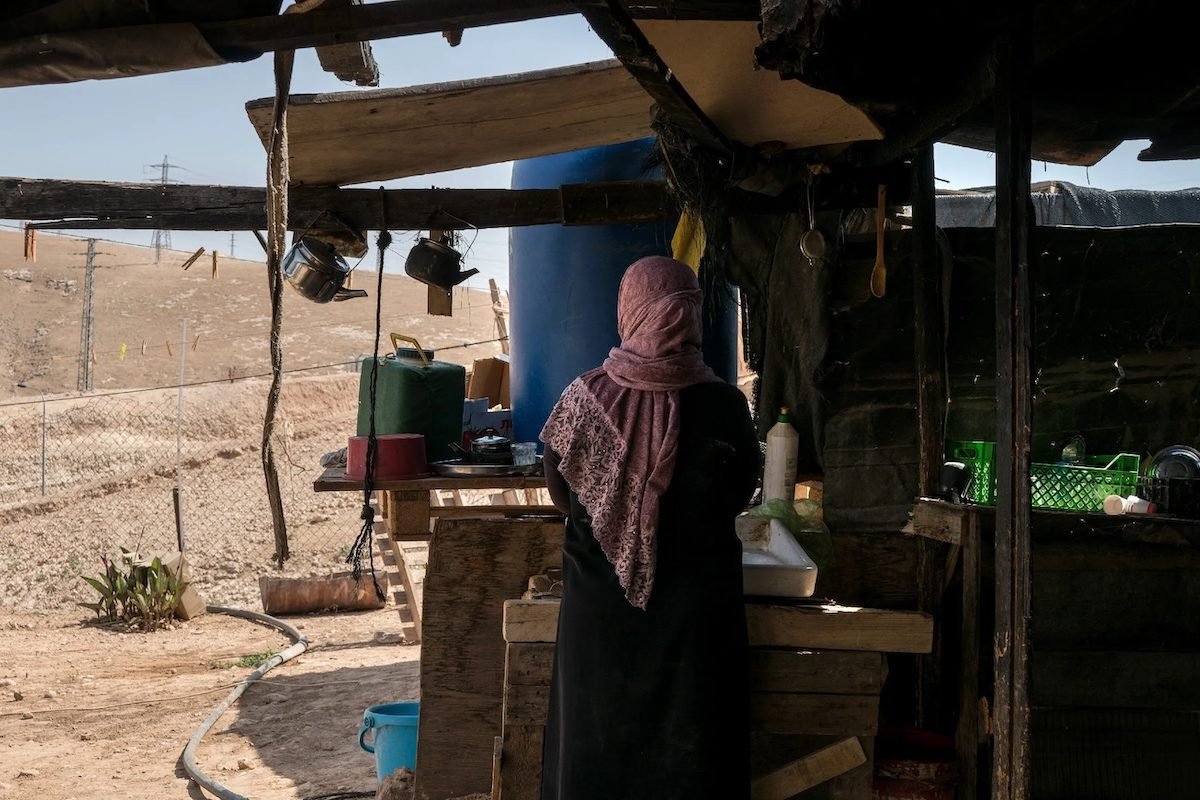
The latest display of the expansionist drive to displace is underway just east of Jerusalem inside the West Bank. The Palestinian Bedouin village of Khan al-Ahmar, population 300, is under threat of demolition.
It sits close to a highway that runs from Jerusalem east into the West Bank, passing a major settlement called Maale Adumim, onward toward the Palestinian city of Jericho before arriving near Israeli border settlements along the Jordan River.
Finance Minister Bezalel Smotrich, a staunch expansionist, wants to remove Khan al-Ahmar in order to clear the way for construction along the road to Maale Adumim. The construction would create an unbroken string of Israeli settlements and cut the north-south route that connects the southern West Bank with the north.
The goal, according to Smothrich, is to permanently divide the West Bank in half. In effect there could no longer be a contiguous Palestinian state.
“The Palestinian state is being erased from the table not with slogans but with actions.” Smotrich, who lives in a West Bank settlement, told reporters. “This reality finally buries the idea of a Palestinian state. There is nothing to recognize and no one to recognize.”
Though east-west division has been considered by a variety of Israeli governments for many years, Smotrich had a testy personal reason for promoting it now.
On March 19, he heard that the International Criminal Court in the Hague was soon to issue an arrest warrant naming him for his role in expanding Israel’s hold on the West Bank.
During a press conference Smotrich called the move an “act of war” and responded by ordering the evacuation of Khan al-Ahmar. “I promise all our enemies, this is only the beginning,” he added.
The ICC issued the arrest warrant on April 2. Bulldozers have yet to be sent to Khan al-Ahmar.