First Trump, now Putin – all roads lead to Xi Jinping
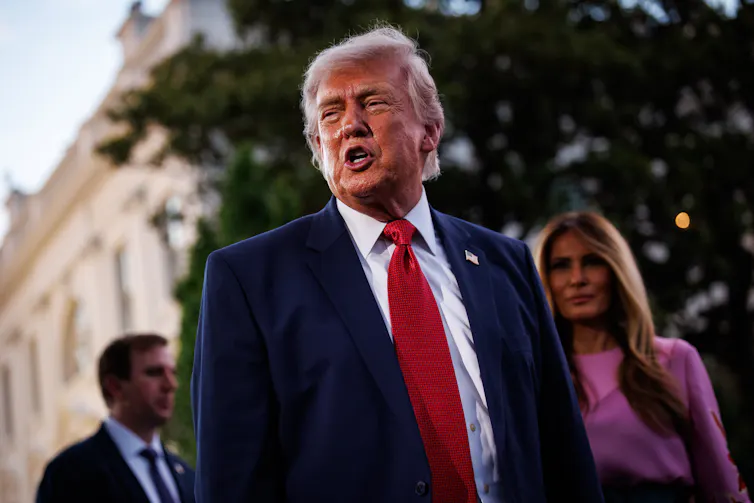
The red carpet at Beijing Capital International Airport has had something of a workout in recent months. In addition to Donald Trump’s visit from May 13-15 and Vladimir Putin over the past couple of days, a parade of world leaders, including five out of seven G7 leaders, has made the trip to Beijing to visit the Chinese president, Xi Jinping.
Meanwhile, Pakistan’s prime minister, Shehbaz Sharif, arrives on Friday and Serbia’s president, Aleksandar Vučić, is scheduled to begin a four-day visit on Sunday May 24.
In terms of diplomacy, at the moment all roads appear to lead to Xi Jinping.
Putin, specifically, has made more than 20 trips to see the leader he called his “dear friend” (Xi reciprocated by calling Putin his “old friend”, read into that what you will). The pair made all the customary noises you’d expect, talking up the notions of their “partnership”, “mutual respect”, “friendship” and “trust”.
But when it came down to it, writes Stefan Wolff, professor of international security at the University of Birmingham, Putin left without the one thing he really wanted: the finalisation of a deal around the Power of Siberia 2 pipeline. Once built, this will enable Russia to sell up to 50 billion cubic metres of natural gas from its arctic fields directly to China.
This is a big deal for Russia, given the sanctions on its oil trade as a result of the war in Ukraine.
Overall, Putin’s trip reinforced what has becoming ever clearer over the past few years. That China’s vision of a new order is not tripartite and does not involve Putin’s Russia as equal partner. Whether it’s a duet with the US is another matter. Even if it is now, it won’t be for long, Wolff concludes.
Marcin Kaczmarski, an expert in Russia-China relations at the University of Glasgow, explains the asymmetry in the partnership between the two countries. Essentially, it boils down to the fact that Xi has far more capacity to help Russia than Putin has to offer China.
As Putin was arriving, details of some of the “fantastic trade deals” Trump had struck during his own visit to China were emerging. China has committed to buying 200 Boeing jets as well as billions of dollars of soybeans and other agricultural products.
Interestingly, while China said that reducing tariffs would be part of the plans, the US has said nothing about this. And while the US readout after the visit mentioned that China would address shortages of the rare earth minerals it controls, Beijing’s report, in turn, reportedly failed to mention this.
So while the US president’s trip was “cordial” it was also “underwhelming”. The fact remains, writes Maria Ryan, an expert in US foreign policy at the University of Nottingham, that the US and China are now the two global superpowers and their interests are bound to diverge. So visits such as Trump’s to Beijing last week – and Xi’s forthcoming trip to the US in the autumn – are all about managing their rivalry and controlling the areas where the two might come into conflict.
Ryan concludes that despite the cordiality, this meeting will have done nothing to diminish the long-term rivalry between Washington and Beijing, particularly in the Asia-Pacific region.
Based on his reported comments, Xi Jinping is clearly alive to that rivalry and took pains to remind the US president, with a pointed, if friendly, historical reference to what he called the “Thucydides trap”. Trump will no doubt have remembered the Greek historian from a reference made by Canadian prime minister, Mark Carney, in February.
But, confusingly for those of us who are not scholars of the classics, while Carney was referring to Thucydides’s aphorism that “the strong can do what they can, and the weak must suffer what they must”, Xi was taking as his example the Peloponnesian War between the military might of Sparta and the rising power of Athens, which lasted 30 years and effectively destroyed both city states.
Americans are increasingly turning against the war in Iran and the president that launched it, if Donald Trump’s poor domestic approval ratings are any guide. But the US president’s foreign policy adventures have been worrying many US allies for a lot longer, according to polling expert Paul Whiteley.
‘Unreliable’ and ‘dangerous’ : the world’s verdict on Donald Trump.EPA/Samuel Corum/pool
Whiteley reports on a survey taken by Pew Research about a year ago which found that people in 24 mostly European countries, but also countries in Asia, Africa, the Middle East and Latin America, have little confidence that the US president will do the right thing and see him as “dangerous”.
As Whiteley observes, there’s a fair correlation between proximity and lack of confidence in the US president and, increasingly, America itself. The US will need to work hard to regain the trust it has lost over the past 16 months, he believes.
Meanwhile in the Middle East the ceasefire between the US and Israel and Iran limps on, despite claims and counter claims of violations and threats by the US president to end it. Meanwhile in Russia, both sides reportedly breached unilateral ceasefires proposed around the May 9 commemoration of the defeat of Nazi Germany.
In Lebanon, Israel is reported to have repeatedly breached the ceasefire, choosing to blame Hezbollah – which is insists is not a party to the truce. And in Gaza it feels as if no day passes without reports of deaths, despite a ceasefire being in place there since October last year.
Modi-Meloni Meeting Puts Italy at Center of India’s Europe Strategy
Rome has become a useful European partner for India as both countries seek deeper cooperation on trade, technology, ports, defense, and the India-Middle East-Europe Economic Corridor
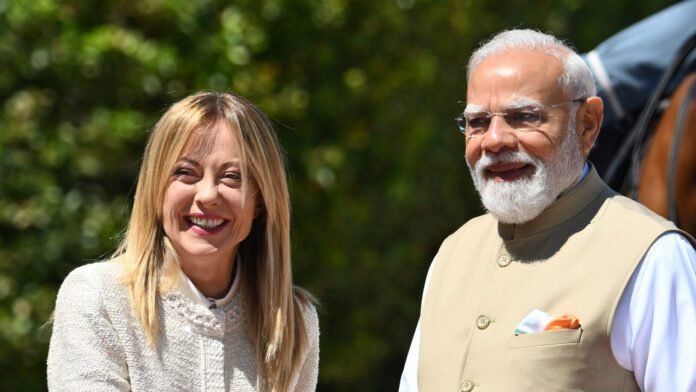
Indian Prime Minister Narendra Modi’s five-nation tour from May 15 to 20 moved through the United Arab Emirates, the Netherlands, Sweden, Norway, and Italy, but Rome gave the trip its clearest strategic message. The stop in Italy showed how New Delhi is trying to widen its options in a more fragmented world by combining trade, technology, defense, connectivity, and corridor politics into a single diplomatic approach.
In Rome, India and Italy elevated their relationship to a Special Strategic Partnership and adopted a joint declaration that stretched across trade, investment, supply chains, critical minerals, clean technologies, semiconductors, ports, maritime security, defense industrial cooperation, innovation, space, migration, and the India-Middle East-Europe Economic Corridor (IMEC). They also reaffirmed their aim of raising bilateral trade to €20 billion by 2029.
That upgrade gives Italy a more important place in India’s Europe strategy than the usual diplomatic courtesy visit. Italy is a major EU economy, a Mediterranean state, a NATO member, and one of the Western governments that has shown a strong political interest in IMEC. For India, Rome is a useful bridge to Europe and a possible gateway to the Mediterranean route that New Delhi wants to turn into a strategic asset.
The official India-Italy declaration was unusually dense in practical detail. The two governments said they wanted to build resilient supply chains, expand industrial and technology partnerships, and deepen cooperation in sectors including textiles, clean technologies, semiconductors, automotive, energy, tourism, pharmaceuticals and medical technologies, digital technologies, steel, ports, and infrastructure. They also called for stronger links among stock exchanges, investment funds, banks, insurers, and other financial institutions.
The relationship is also being built through institutions, not just headlines. The leaders agreed to hold annual meetings, including on the sidelines of multilateral events, and to use the Joint Strategic Action Plan 2025-2029 as the main operational framework for the relationship. That plan had already been adopted in 2024, but the Rome declaration gave it renewed political force and placed it at the center of bilateral follow-up.
IMEC sat at the center of the meeting. Modi and Italian Prime Minister Giorgia Meloni reaffirmed their commitment to the corridor, described its transformational potential, and encouraged the first IMEC ministerial meeting to take concrete steps in 2026. The declaration presents the project as a route not only for goods, but for a wider set of commercial, digital, and strategic links between India, the Gulf, and Europe.
The maritime dimension was just as important. India and Italy welcomed a memorandum of understanding on maritime transport and ports and directed their ministries to create a joint working group to implement it. They also agreed to launch a dialogue on Maritime Security to improve cooperation, coordination, information sharing, and best practices. The message was clear: connectivity is not being treated as a separate technical subject, but as part of a security agenda.
The technology agenda followed the same pattern. The leaders announced the creation of INNOVIT India, an innovation hub in India aimed at strengthening the two countries’ innovation ecosystems, supporting startup acceleration, improving market access and business matching, and deepening university collaboration and talent mobility. The declaration identifies fintech, healthcare, semiconductors, logistics and supply chains, agritech, energy, quantum computing, and artificial intelligence as priority fields.
They also highlighted cooperation in supercomputing, renewable energy, green hydrogen, the sustainable blue economy, and space. That breadth is one reason the meeting mattered: it was not just a symbolic reset. It was a practical attempt to connect industrial policy, advanced technology, and strategic geography into a single relationship.
For Rajat Ganguly, editor-in-chief of the Journal of Asian Security and International Affairs, the Rome stop fits a larger shift in Indian foreign policy. “I see this as India’s growing confidence in what I call a polyalignment foreign policy,” he told The Media Line. “What this effectively means is that India does not want to get pushed into one particular corner or another. A lot of people are saying that India should be more strongly in favor of BRICS against the US. This is not India’s approach to foreign policy right now. India wants to be a good partner with multiple actors.”
India does not want to get pushed into one particular corner or another
BRICS is a grouping of major emerging economies seeking greater economic and diplomatic influence in a more multipolar global order. It was launched by Brazil, Russia, India, and China with a first formal leaders’ summit in 2009; South Africa joined in 2010, and the bloc expanded again in 2024 and 2025 to include countries such as Egypt, Ethiopia, Iran, the United Arab Emirates, and Indonesia.
Ganguly said the logic is evident in India’s ability to keep different relationships separate, even when they point in different directions. “You could have India-US on one side, India-Russia on one side. … India is very close to Israel, but India is also very close to Iran,” he said. “From India’s point of view, that is probably the most useful thing: to have multiple partners, multiple friends, and not allow the difficulties between friends, let’s say, to affect their relationship with India. Iran and Israel are a classic example. India wants to have beneficial relations with both.”
That logic helps explain why Italy matters to New Delhi. Ganguly described Italy as an important trade partner and a pro-India voice inside the European Union. “Italy is a very important trade partner, and you may remember this new trade route from India to the Gulf, then on to Israel, then Greece and Italy into Europe,” he said. “If you look at it from that point of view, then obviously Italy is very, very important for India. Italy is also a voice within the European Union that is very pro-India.”
You could have India-US on one side, India-Russia on one side. … India is very close to Israel, but India is also very close to Iran
The personal chemistry between Modi and Meloni also plays a role, in Ganguly’s view. “I think Meloni’s position on many different things probably aligns quite well with Modi and his ideas,” he said. “As two prime ministers, they are probably quite aligned in terms of their political ideology, in terms of their outlook for the world, for Europe, and for India. From Modi’s point of view, Europe is very important as an alternative power center.”
He also argued that Meloni has tried to show independence even from leaders she once strongly supported. “Meloni used to be a very big Trump supporter,” Ganguly said. “But what she is also asserting is that she is autonomous. She supports Trump when it is good for Italy. But if she is required to criticize Trump because Trump is doing things that are not good for Italy, she will do that,” adding, “What it shows is that she has got a spine, that she is not going to bend backward for anybody.”
Leo Goretti, associate dean at Rome Business School, places India in a somewhat different but overlapping frame. He described the country as a “swing country” in the global system, standing between the democratic West and a broader group of states seeking to reshape the international order from outside its traditional center.
He painted India as “halfway between the link with the democratic and Western world and the positioning within a front of countries that somehow claim a reform of the multilateral system, of the international liberal order, starting from the outside, like the BRICS.” In his view, India is a key country, and trying to maintain a dialogue, a partnership relationship, if not friendship or even an alliance with India, is crucial for Western countries.
For Goretti, the India connection also gives Meloni a chance to project Italy as more than a reactive European middle power. “All this means that at this moment India can actually represent an interlocutor through which Meloni can try to relaunch the country’s foreign policy, which in recent months has seen Italy in a rather difficult situation, more reactive than proactive,” he told The Media Line.
He was careful not to portray that as a break with the West. “In my opinion, this Italian government also contains different positions on this issue,” Goretti said. “I believe that the perspective of Prime Minister Meloni is a perspective that she has coherently carried out over time: the search for a united Western front. I consider it an extremely complicated perspective, if not impossible, with Trump actually translating it into concrete politics.”
Goretti added that Meloni’s approach remains tied to a Western framework even if Washington no longer seems fully invested in the same idea. “My impression is that Meloni’s position tends to be continuous in this effort to keep the Western front united,” he said, “while emphasizing the fact—and this is the paradox—that the main exponent of that front, the United States, does not seem at this moment to be interested in this type of politics, and hence all the frustrations and failures of the case.”
Meloni’s position tends to be continuous in this effort to keep the Western front united
He also pointed to pressure points inside the Italian right, where some smaller currents favor a more openly multipolar reading of world politics. “There are minority components, let’s say, in the area of the radical right, both inside and outside the government, that probably have a perspective much more linked to this ideal of a multipolar world, in which … one tries to navigate between the Russian power policy, the American one, potentially also the Chinese one, etc.,” he said. “But I believe that this is a component that, at this moment, is quite a minority, which, however, is destined to become more and more noisy before the next elections.”
The Rome meeting took place the same week that BRICS foreign ministers met in New Delhi and failed to issue a joint statement due to disagreements over the Middle East. Reuters reported that rivals Iran and the UAE were among the countries unable to agree on a common text, and India issued only a chair statement that referred to “differing views among some members” on West Asia and the Middle East.
That episode underlined the limits of treating BRICS as a coherent anti-Western bloc. “India, as one of the founding members, is the classical balancer,” Ganguly said, adding that “India is basically saying that BRICS should not be like a Cold War institution, where it is almost zero-sum politics: that BRICS is anti-America, anti-West, and therefore BRICS is in conflict with the West and with the US. We do not want that.”
India is basically saying that BRICS should not be like a Cold War institution, where it is almost zero-sum politics
He noted that the bloc’s internal differences are becoming harder to manage as its membership grows. “Right now, there are 10 members, and it was not possible to get all 10 members to agree on a joint communique at the end of the meeting, particularly because the UAE and Iran did not see eye to eye,” he said. “Therein lies the problem: India’s perception of BRICS is very different from Russia’s and China’s. It is also very different from Iran’s and the UAE’s, for example.”
For Goretti, that broader uncertainty is pushing both India and Europe to diversify their partnerships. He argued that the transatlantic relationship no longer looks as stable or automatic as it once did, which is why countries such as Italy are looking harder at India and other middle powers. The answer, in his view, is not to abandon the West but to avoid overdependence on a single power axis.
That is where the India-EU relationship becomes relevant to the Italy story. The European Commission says negotiations on the Free Trade Agreement (FTA) concluded on January 27, 2026, and that the agreement would eliminate or reduce tariffs on over 96% of EU goods exports while saving around €4 billion a year in duties. The commission also says the EU and India relaunched negotiations in 2022 for a separate Investment Protection Agreement and an Agreement on Geographical Indications.
The Rome declaration folded that wider European track into the bilateral relationship by welcoming the conclusion of the FTA negotiations and the India-EU Comprehensive Strategic Agenda. It also backed the India-EU Trade and Technology Council as a platform for cooperation in trade, critical technologies, and economic security.
Even with all that ambition, IMEC remains the hardest piece of the puzzle. India and Italy both described the corridor as transformational, but the project depends on stability across the Gulf and the eastern Mediterranean, where conflict and disruption remain live risks. The declaration expressed deep concern over the situation in West Asia and the Middle East, welcomed the ceasefire announced on April 8, 2026, and called for de-escalation, dialogue, diplomacy, freedom of navigation, and the resumption of global flows through the Strait of Hormuz.
Goretti said that if instability continues across Yemen, Hormuz, and Iran, the corridor will remain difficult to realize. “It is certain that if there is an arc of instability and war that involves Yemen, the Strait of Hormuz, and Iran, this represents a huge problem for such an ambitious project,” he said. He also noted that current disruptions already affect routes between India and Europe.
That is the basic tension at the heart of the Modi-Meloni meeting. The strategic direction is clear. The relationship is broader than before. The institutional structure is more serious than in earlier phases. But the route on which much of the wider vision depends still runs through one of the most volatile regions in the world. Italy can help give the project political backing, but it cannot by itself provide the stability needed to make it work at full scale.
Ganguly argued that India’s westward push will continue through a chain of relationships rather than a single corridor. “India’s presence in the Middle East is going to grow through the UAE, through Israel, and through very, very good ties with Saudi Arabia now,” he said. “From the Middle East, there will be Cyprus and Greece, and then into Italy and into Europe.”
He said the common thread is that India does not see these relationships as mutually exclusive. “India would say, no, no, no, each relationship is completely independent,” he said. “What we use to judge each relationship is whether it is good for India. And only India will decide what is good for India.”
That is why the Rome stop stood out. It was not simply a friendly meeting between two leaders with some political chemistry. It was a practical move in a larger strategy of diversification, corridor-building, and strategic autonomy. India and Italy are trying to connect trade, technology, defense, mobility, and maritime security in a single framework, while also fitting that framework into broader India-EU and Indo-Mediterranean politics.
What remains uncertain is how much of that ambition can be implemented in a geopolitically strained environment. The declaration is detailed. The targets are concrete. The cooperation is broad. But the stability needed to support IMEC, smooth trade flows, and sustained maritime access still depends on a region where conflict can quickly spill across borders and disrupt plans.
For Europe, that is part of a larger shift. Goretti said the last year and a half has been a wake-up call for those who believed the transatlantic relationship would remain the unquestioned backbone of foreign and security policy. He argued that Europe now needs to broaden its portfolio of partners, including India, the Gulf states, Brazil, and other middle powers, to avoid being squeezed into a pure US-China rivalry.
That broader logic is the real frame for Modi’s tour. The Gulf still matters for energy and connectivity. The Netherlands still matters for trade and technology. Sweden and Norway still matter for innovation and green transition. Italy matters because it links all of those themes to the Mediterranean and to the question of how Europe and Asia will connect in the years ahead.
The meeting in Rome, then, was less about one friendship than about an emerging pattern. India and Italy are both trying to hedge against uncertainty by deepening ties, widening options, and building practical cooperation around supply chains, advanced technology, and connectivity. Whether that framework becomes a functioning alternative to older routes and older assumptions will depend less on diplomatic declarations than on the ability of the wider region to avoid another round of disruption.
False Testimony Sent Tony Carruthers to Death Row. Tennessee Wants to Kill Him Anyway.
Earley Story will never forget the name Alfredo Shaw.
As a longtime employee at the Shelby County Jail in downtown Memphis, Story had seen the young man come in and out of the detention facility known as 201 Poplar since the 1980s. Shaw acted cocky, but there was fear in his eyes. Story, a devout Christian, occasionally had conversations with him about God.
In 1994, Shaw became a witness in a grisly triple homicide. A local drug dealer, along with his mother and a teenage friend, had been abducted, murdered, and buried in a freshly dug grave at a cemetery in South Memphis. Prosecutors arrested 25-year-old Tony Carruthers, who had recently gotten out of prison. There was nothing directly tying him to the crime — and he swore that he had nothing to do with it. But Shaw claimed that Carruthers confessed to him. In 1996, a jury sentenced Carruthers to die.
Like most people, Story assumed Carruthers was guilty. But in January 1997, Story himself was accused of a crime he swore he did not commit. He was arrested and charged with selling drugs to an undercover officer. There was no evidence against Story — in fact, the presiding judge initially threw out his case for lack of probable cause. But in 1999, he was tried, convicted, and given probation. The main witness against him was Shaw.
Story was convinced he’d been framed. Over the previous decade he’d become known as a whistleblower, documenting violence and abuse at the jail. This made him a target for retaliation. “I had some enemies within the sheriff’s department,” he said.
“We’re not the only ones he’s done this to.”
Story lost his job and his pension as a result of his conviction. He had been fighting to clear his name for 20 years when, one week before Christmas 2017, he got an envelope in the mail from Riverbend Maximum Security Institution in Nashville. That return address was written in elaborate script below the name “Tony Von Carruthers.”
The envelope contained records confirming what Story had long known to be true: Shaw had been a paid confidential informant. Although this had been an open secret in Memphis for decades, the Shelby County District Attorney’s Office repeatedly denied it. “I have talked to the prosecutors who tried your client and neither is aware of any situation where Alfredo Shaw acted as a paid informant for anybody,” the office had written to Carruthers’s post-conviction attorneys.
The enclosed documents chronicled drug buys Shaw made on behalf of the sheriff’s department between 1991 and 1997. Conspicuously absent was the date when Story supposedly sold drugs to Shaw. Story believed that this should exonerate him. But the courts disagreed.
Story did not know precisely why Carruthers mailed him the records. Nor did he know the truth behind Carruthers’s innocence claim. But when he heard that Tennessee had set an execution date for Carruthers, he was deeply disturbed. No one, he says, should be executed based on the testimony of Alfredo Shaw.
“I’d hate to see him murdered, put to death, when there’s so many open ends,” he said.
Tony Carruthers is scheduled to die by lethal injection on Thursday morning at 10 a.m.
He has maintained his innocence for 32 years.
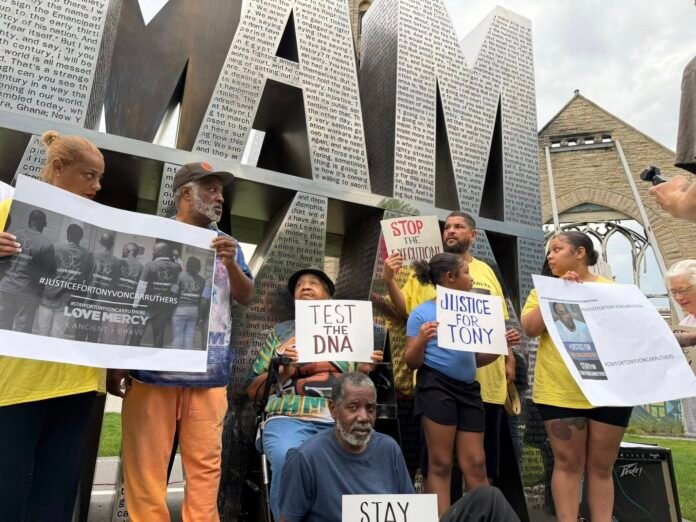
On Monday, Carruthers’s supporters, including family members and advocates from the American Civil Liberties Union, delivered a stack of petitions to the office of Tennessee Gov. Bill Lee at the state Capitol in Nashville. Despite mounting calls for Lee to stop the execution, on Tuesday he announced that he would not intervene.
In a clemency petition, his attorneys describe Carruthers’s case as a travesty of justice: a death sentence based on lies and a flimsy narrative that was bankrupt from the start. Among those who have spoken out against the execution is Story, now 72. He is joined by another ex-jailer, Bernard Kimmons, who also says he was wrongfully convicted of selling drugs based on Shaw’s testimony. Wearing “Save Tony Carruthers” T-shirts, the men told a Memphis news station that Shaw has a track record of putting innocent people in prison. “We’re not the only ones he’s done this to,” Kimmons said.
False testimony by jailhouse informants is a leading cause of wrongful convictions, often used to fill the gaps in cases where the state’s evidence is weak. The Innocence Project has found that roughly a quarter of death row exonerations are in cases involving a jailhouse snitch.
In Carruthers’s case, no physical evidence implicated him in the murders. Fingerprints from the crime scene have never been linked to anyone, and a blanket found buried with the victims has been shown to have an unknown male DNA profile. Some of the most horrifying details of the crime have also been discredited in the decades since Carruthers’s trial. The case remains infamous in Memphis because of the ubiquitous claim that the victims were buried alive. But this has long been debunked. Although a medical examiner said at trial that the victims suffocated to death, he later retracted his testimony — and other experts have said there was never anything to support it.
These red flags — a lack of physical evidence, unreliable witnesses, and bogus forensic testimony — are all-too familiar features of wrongful convictions. But Carruthers’s case is uniquely shocking in another way: He was sent to death row after acting as his own lawyer at trial. Carruthers’s attorneys have long argued that this doomed Carruthers from the start. They write in his clemency petition that he has a long history of undiagnosed mental illness and “was not competent to stand for trial, much less competent to represent himself.”
Carruthers’s self-representation was especially self-sabotaging where Shaw, the jailhouse snitch, was concerned. By the time Carruthers went to trial in 1996, Shaw had recanted his statements implicating Carruthers in an explosive TV interview, and prosecutors decided against calling Shaw as a witness. But in a perverse irony, Shaw ended up testifying anyway — not for the state, but for the defense. “In an effort to show that the prosecution had secured the indictment with an untrue story,” the clemency petition explained. “Mr. Carruthers believed he had to call Alfredo Shaw to the stand.”
The result was so disastrous that a judge later reversed the conviction of Carruthers’s co-defendant, concluding that Carruthers’s self-representation had violated his co-defendant’s right to a fair trial. That man, James Montgomery, got out of prison in 2015.
To Carruthers’s sister, Tonya, who joined the petition delivery in Nashville — and who said she plans to witness her brother’s execution — the past 32 years have been a living nightmare. She argues that her brother’s conviction was a case of guilt by association — and that his own record made it easy for him to take the fall for a crime he did not commit.
For decades, she said, the press adopted the state’s narrative of the case without examining the obvious problems with the case. “He was already portrayed as a monster in the media before his trial ever started.”
The triple murder that sent Carruthers to death row began as a missing persons case. Forty-three-year-old Delois Anderson lived in North Memphis with her son Marcellos Anderson, her niece Laventhia, and Laventhia’s two young daughters. She worked at a bank during the day and took classes at night.
On the evening of February 24, 1994, Laventhia would later testify, she came home to an empty house. It looked like Delois had been home. “Her car was there. Her purse was there. Her keys were there,” Laventhia said. In Delois’s bedroom, a pack of cigarettes and lighter were in their usual spot, and she had apparently served herself a plate of greens for dinner.
Laventhia figured her aunt had stepped out and would return soon. But that didn’t happen; Laventhia never saw her again.
Around 2:40 a.m. the next morning, a sheriff’s deputy in Mississippi responded to a call about a car on fire just south of the Tennessee state line. The vehicle, a white Jeep Cherokee with gold trim, was traced to a Memphis man who said he had lent it to Marcellos Anderson, nicknamed Cello.
Within a week, news broke that a suspect had led police to a grave of a woman who had been recently buried at the Rose Hill cemetery in South Memphis. Authorities got permission to exhume the body. Under the casket, beneath some wooden planks, were the remains of Anderson, his mother, and 17-year-old Frederick Tucker. Their hands were bound together; Delois Anderson had a pair of socks wrapped around her neck. Tucker and Marcellos Anderson had been shot.
The murders were front-page news in Memphis, where frenzied media coverage soon turned into bad press for law enforcement officials. Police had two main suspects in custody: Carruthers and a man named James Montgomery — the brother of the man who led authorities to the bodies. But Montgomery’s brother had since fled the state, leaving prosecutors without a key witness. With no other evidence against the two defendants, a judge threw out the first-degree murder charges.
Prosecutors scrambled, urging police to “get out and beat the bushes,” as one assistant district attorney would later testify. Before long, a new witness came forward: 28-year-old Alfredo Shaw.
On March 27, Shaw gave a tape-recorded statement to a pair of sergeants with the Memphis Police Department. He said that Carruthers carried out the murders on behalf of a pair of drug dealers who had been robbed by Anderson and Tucker. In fact, he said, Carruthers had tried to enlist him in the crime. “I stated to Tony that I did not want to be involved in that,” Shaw said.
Shaw claimed that he and Carruthers were in the back of the jail’s law library when Carruthers divulged how it went down: He and Montgomery had gone to Anderson’s house in search of the stolen money but only encountered his mother, Delois. They demanded she call her son, who returned to the home with the teenage Tucker. “Carruthers told me they put the gun to Marcellos and made them all go get in the Cherokee,” Shaw said. Carruthers and Montgomery then drove the three victims to Mississippi, where Carruthers shot Anderson and Tucker and set the jeep on fire. They then drove Delois, who was still alive, to the cemetery along with the two bodies, which they threw into the grave. Delois was screaming, Shaw said. So Montgomery pushed her into the grave, too.
Two days later, Shaw repeated the story to a grand jury.
In the two years between the indictment and the trial, however, Shaw began to have second thoughts. In February 1996, he contacted a local TV reporter and, with his identity concealed, recanted his statements on Memphis’s Channel 13. He said that he had been coerced and coached by Shelby County Assistant District Attorney Gerald Harris, who offered him money and promised to dismiss pending criminal charges against him.
Harris appeared in the TV segment too. He told the news station that Shaw was not credible. “I’m not gonna put that kind of witness on,” he said. Like all criminal defendants, Carruthers “has got a right to a fair trial.”
Carruthers and Montgomery were tried together in April 1996. Rather than the murder-for-hire plot Shaw described, prosecutors argued that the men wanted to take over the local drug trade. The theory was constructed entirely from circumstantial evidence, with witnesses testifying that said they saw the men with the victims at some point on February 24, 1994.
“It was all just stories,” Carruthers’s sister Tonya recalled. She attended the trial every day with their mother, describing it as a media circus and a hostile atmosphere. “Our family name became the scourge of the community,” she said. “We were not treated well at all in court.”
Tonya had spoken to her brother shortly after the murders. She remembers him being extremely upset. Although he ran in the same circles as Anderson and did not get along with him, he would never have killed him, she said — and he certainly would not have done anything to hurt his mother. Carruthers’s own daughter was related to the Anderson family through his ex-girlfriend. “If I knew that was gonna happen,” Tonya remembers him saying, “I would’ve done anything I could to stop it.”
Presiding over the trial was Shelby County Criminal Court Judge Joseph Dailey. Case records show that Dailey became convinced that his life was in danger due to reported death threats that swirled around the case from the start. He imposed a gag order on the press to prevent reporters from printing witnesses’ names, as well as unprecedented security measures in the courtroom and at his home.
Dailey was also fed up with Carruthers before the trial began. One by one, defense attorneys appointed to the case told the judge that their client was erratic and abusive and asked to be removed. Dailey ultimately refused to appoint any more attorneys, leaving Carruthers to represent himself. “He is the person who put himself in this position,” Dailey later said while denying Carruthers a retrial.
Several of the state’s witnesses knew Carruthers from prison. One man testified that he had worked with Carruthers on a work detail that included doing shifts in a cemetery — and that Carruthers remarked that hiding a body in a grave would be a good way to get away with a murder. “If you ain’t got no body, you don’t have a case,” he said. Another witness testified about a pair of letters Carruthers sent from prison, in which he boasted ominously about a “master plan” to settle scores on the streets. “Everything I do from now on will be well organized and extremely violent,” he wrote.
Carruthers pointed out that the letters did not actually implicate him in the killings. “He can’t say if I was just in prison just bragging or just running off at the mouth,” he told Dailey. But the judge allowed the letters as evidence.
The state had already rested its case on April 24, 1996, when Carruthers called Alfredo Shaw to the stand. His goal was to show that, as a jailhouse snitch, Shaw falsely implicated him in the murders in exchange for money and favors. But Dailey blocked Carruthers from questioning Shaw about being a confidential informant. The resulting testimony was a disaster for Carruthers.
Shaw testified that he contacted homicide detectives through a Crime Stoppers hotline after hearing about the murders on the news. Carruthers then presented him with his previous statements to police and to the grand jury, creating the impression that Shaw had been consistent in his accounts. When he tried to pivot to show that Shaw had disavowed his previous statements, it backfired. Shaw explained that he only wavered in his accounts because he’d been afraid for his life.
Carruthers and Montgomery were swiftly convicted. In his closing argument urging jurors to sentence the men to die, Harris emphasized the suffering of the victims as they slowly suffocated. “This woman, Delois Anderson, is in a grave, in a pit, alive,” he said. “The tragedy of it is that as she actually breathed in her last breath she was in effect killing herself, bringing things into her body, dirt being on top of her.” It was hard to imagine a more horrifying scene.
After a few hours, the jury came back with a death sentence.
Carruthers had been on death row for well over a decade when an investigator with his federal lawyers in Nashville did a deep dive into his life and background. Such investigations are a critical step in modern capital defense: One of the first things a lawyer is supposed to do to uncover any evidence of trauma, abuse, or mental illness — the kind of mitigating factors that can persuade a jury to spare a client’s life.
None of the attorneys originally appointed to represent Carruthers had undertaken such an investigation. And Carruthers was not able to do such work on his own behalf.
“Perhaps the most prominent issue affecting Tony’s family is that of severe mental illness,” the investigator later wrote in a report. Relatives across generations had schizophrenia and bipolar disorder and Carruthers displayed symptoms of both. When he was 14, his mother, Jane Carruthers, admitted him to a local hospital for a psychiatric evaluation. He stayed for five days.
Before long, Carruthers was in and out of juvenile jails. Staff at one facility recommended that he be placed “in a structured therapeutic environment,” but this was easier said than done. His mother was a single parent raising four children; while she worked hard all her life, she struggled to afford the family’s basic needs, let alone cover the kind of care her son might have needed.
“She was extremely hard-working,” Tonya said about her mother, who died a few years ago. “Oftentimes she worked two jobs.” For years she did overnight shifts at the Sheraton hotel in downtown Memphis, where Tonya remembered having occasional meals. Although Tonya described many challenges throughout their childhood, she went on to thrive in a way that her brother never did. Carruthers had anger issues, his sister told the investigator, which worsened as he got older.
After Carruthers turned 20 — an age where mental illness commonly manifests — he became increasingly manic and volatile. On one occasion, according to the report, Carruthers was accused of setting a fire at a house where he was staying. After being restrained and placed in a police car, Carruthers “ate the vinyl off the left rear passenger door, spitting chunks of it on the floor,” according to a police report. A Memphis officer still remembered the episode years later, describing it as a kind of “psychosis.”
At the time, such episodes were attributed to drugs or alcohol. But Carruthers’s legal team was certain that undiagnosed mental illness played a role. Although he repeatedly refused to cooperate with evaluations that could have yielded more specific diagnoses, defense experts nonetheless concluded that he had a type of schizoaffective disorder, whose symptoms included “pervasive delusions and paranoia.”
This was consistent with Carruthers’s behavior at trial, which jurors found off-putting, as well as his ongoing hostility toward his defense attorneys. To date, his case records are filled with declarations, transcripts, and countless letters documenting the fraught relationship with lawyers who were ill-equipped to represent Carruthers — and who Carruthers believed were conspiring against him.
After he was sent to death row, Carruthers became fixated on a belief that he was going to win a lucrative lawsuit against his lawyers. One state post-conviction lawyer memorialized a meeting in which Carruthers showed him a photograph of a green 2006 Jaguar; Carruthers said he planned to buy it with the proceeds from his civil litigation. “He was totally serious about this,” the lawyer wrote. “Tony also told me that it would be okay if the staff poisons him to death, because then his daughter will get a lot of money from the state, and that is his biggest concern.”
Carruthers has always rejected the suggestion that he was not competent to stand trial. While Tonya does not deny that he has shown symptoms of mental illness, she also points out that his paranoia is, in fact, well-founded given what happened in his case.
Decades after Carruthers was sentenced to die, both James Montgomery and Alfredo Shaw gave statements to his defense investigators saying that Carruthers did not participate in the crime. Montgomery pointed at a different man, who died in 2002, as the person who helped kidnap and kill the victims. But the courts refused to allow testing that might confirm this claim.
Shaw, meanwhile, met with a defense investigator on three different occasions while in federal prison in 2011. According to the investigator, he repeated what he had told the TV reporter in 1996, adding that, after the interview aired, police and prosecutors threatened to go after him if he did not revert to his original account. Shaw became visibly tense and upset as he spoke, the investigator wrote.
“I testified falsely at trial because I was fearful that the District Attorney’s Office would retaliate against me.”
The investigator summarized Shaw’s account in a declaration. “I testified falsely at trial because I was fearful that the District Attorney’s Office would retaliate against me,” it read. But Shaw said he was too scared to sign it.
It would take another six years for Carruthers’s attorneys to obtain the first batch of records confirming that Shaw was a paid informant — the same ones that Earley Story later received in the mail. And it was not until 2024 that they obtained additional records casting light on Shaw’s history as a confidential informant, not only for the sheriff’s department, but also for the Memphis Police Department as well. The records showed once again that Shaw was a paid snitch, with every incentive to lie on the stand. By then, Carruthers’s appeals had long been exhausted.
On the eve of his execution, the full story behind Carruthers’s case now stands to be buried with him. The state may put Carruthers to death, Tonya said, but families on both sides still deserve to know the truth of what happened in 1994.
In the meantime, she wants the public to know that he is not the killer who was portrayed in the press. “Please let people know that my brother is not a monster.”
Update: May 21, 2026
The execution of Tony Carruthers was postponed on Thursday, May 21, after several failed attempts to find a vein for lethal injection. According to legal witnesses, officials spent more than an hour trying to set an IV line “while Mr. Carruthers groaned in pain.” The execution was ultimately halted after Tennessee Gov. Bill Lee announced a one-year reprieve.
Maria DeLiberato, senior counsel at the ACLU’s Capital Punishment Project, expressed relief at the governor’s decision. “We will fight to ensure that the state never again attempts to put Mr. Carruthers and his family through this torture,” she said. “More than 130,000 people have signed petitions joining us in this fight, including exonerees who once faced wrongful convictions themselves. We will also continue to push the governor to use this moment to allow the forensic testing that should have happened long ago.”
In a text message, Carruthers’ sister Tonya thanked God and her brother’s supporters, including his legal team, “who will be working to free him from death row for a crime that he did not commit.”
Stunning aerial footage still best thing about Top Gun at 40
When the action film Top Gun hit the big screen in 1986, critical reviews were mixed, but audiences were thrilled. The film racked up $358 million globally, making it the highest-grossing film of that year. Its success spawned a few video games and a critically acclaimed blockbuster 2022 sequel, Top Gun: Maverick, and the eye-popping flight sequences definitely boosted enlistment numbers for the US Navy. Those scenes are still the best thing about Top Gun, 40 years later.
(Spoilers below because it’s been 40 years.)
The film was inspired by a 1983 article in California magazine detailing the lives of fighter pilots at Naval Air Station Miramar in San Diego (aka “Fightertown USA”) and featuring plenty of aerial photography alongside the text. Producers Jerry Bruckheimer and Don Simpson tapped Jim Cash and Jack Epps Jr. to write the screenplay, with Epps sitting in on declassified classes at the academy and even taking a flight aboard an F-14.
Tony Scott, then a relative newcomer with just one feature film (1983’s The Hunger) to his name, was hired to direct. However, he had shot a commercial for Saab featuring one of the company’s cars racing against a Saab 37 Viggen fighter jet, so the producers figured he had the chops for Top Gun.
The film wastes no time getting us in the air. Our hero, Maverick (Cruise) and his radar intercept officer, Goose (Anthony Andrews) are flying maneuvers in an F-14A Tomcat in the Indian Ocean, along with Maverick’s wingman, Cougar (John Stockwell) and his RIO. They encounter two hostile MiG-28s (a fictitious craft represented in the film by the Northrup F-5). Maverick scares one away with a well-timed missile lock, but the other MiG locks onto Cougar before getting chased away by Maverick. Just to make sure we understand how Maverick got his nickname, the pilot inverts his plane and flies directly above the hostile MiG, giving his adversary the finger as Goose snaps a commemorative Polaroid.
Cougar, however, is badly shaken by the encounter—so much so that he freezes up and can’t land his plane. So Maverick defies orders to land immediately (they are low on fuel) and flies back to Cougar to lead him safely back to the carrier. That earns Maverick a reprimand and establishes him as a cocky, arrogant rule-breaker with a fierce loyalty to his fellow pilots. Despite this, because Cougar has “lost the edge” and quits his commission, Maverick and Goose get to take his place at the titular Top Gun.
Highway to the danger zone
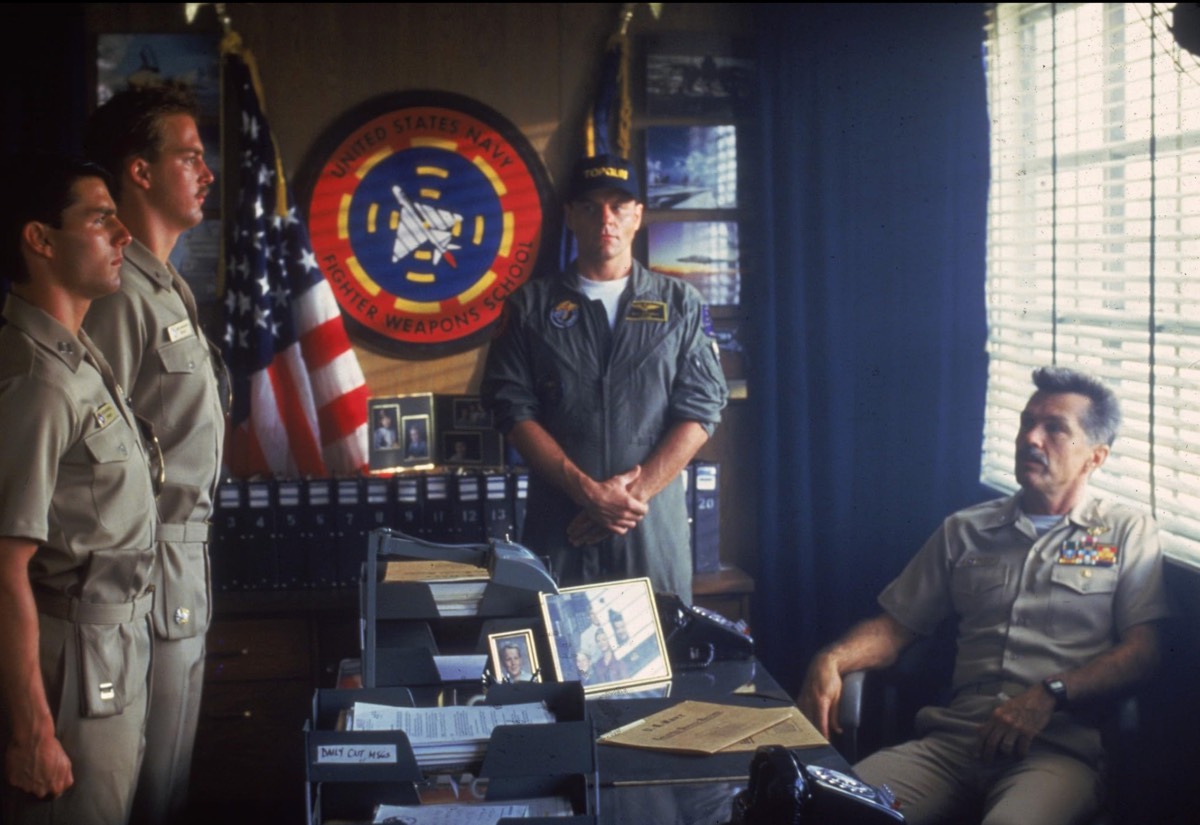
Lt. Pete “Maverick” Mitchell (Tom Cruise) gets his shot at the Top Gun academy.
Lt. Pete “Maverick” Mitchell (Tom Cruise) gets his shot at the Top Gun academy.
Maverick’s BFF and radar intercept officer is LTJG Nick “Goose” Bradshaw (Anthony Edwards).
Maverick’s BFF and radar intercept officer is LTJG Nick “Goose” Bradshaw (Anthony Edwards).
“You’ve lost that lovin’ feeling”: Maverick leads a group serenade to Charlie (Kelly McGillis) in a bar, hoping to score.
“You’ve lost that lovin’ feeling”: Maverick leads a group serenade to Charlie (Kelly McGillis) in a bar, hoping to score.
Maverick’s BFF and radar intercept officer is LTJG Nick “Goose” Bradshaw (Anthony Edwards).
“You’ve lost that lovin’ feeling”: Maverick leads a group serenade to Charlie (Kelly McGillis) in a bar, hoping to score.
Charlie turns out to be a Top Gun instructor.
The flight sequences are the best part of the film.
Maverick’s got the flying chops, the abrasive confidence, and nerves of steel, but can he learn to set his ego aside and be a team player? His archrival, Tom “Iceman” Kazansky (Val Kilmer), doesn’t think so, especially when Maverick abandons his wingman in a training run to make a showy, aggressive pass at an instructor’s plane. Everyone ends up failing the exercise because of it. Iceman thinks Maverick is dangerous—which the latter naturally tries to turn into an asset: “I am dangerous.”
Lt. Commander Rick “Jester” Heatherly (Michael Ironside) shares Iceman’s concerns, admitting that while Maverick’s flying is impressive, he might not trust him in actual combat. And training for combat is why they’re all there.
This is an ’80s blockbuster, so of course Maverick ultimately redeems himself and saves the day in an actual air skirmish—and also gets the girl, a civilian Top Gun instructor named Charlie (Kelly McGillis). But first, he suffers a major personal loss. Maverick and Goose accidentally fly through the jet wash of another plane, both engines flame out, and they go into a flat spin that not even Maverick can recover from.
The pair eject, but Goose hits the jettisoned canopy of the aircraft, and the impact kills him. Maverick isn’t to blame but nonetheless feels responsible. The loss chastens him just enough to take the edge off his insubordinate recklessness.
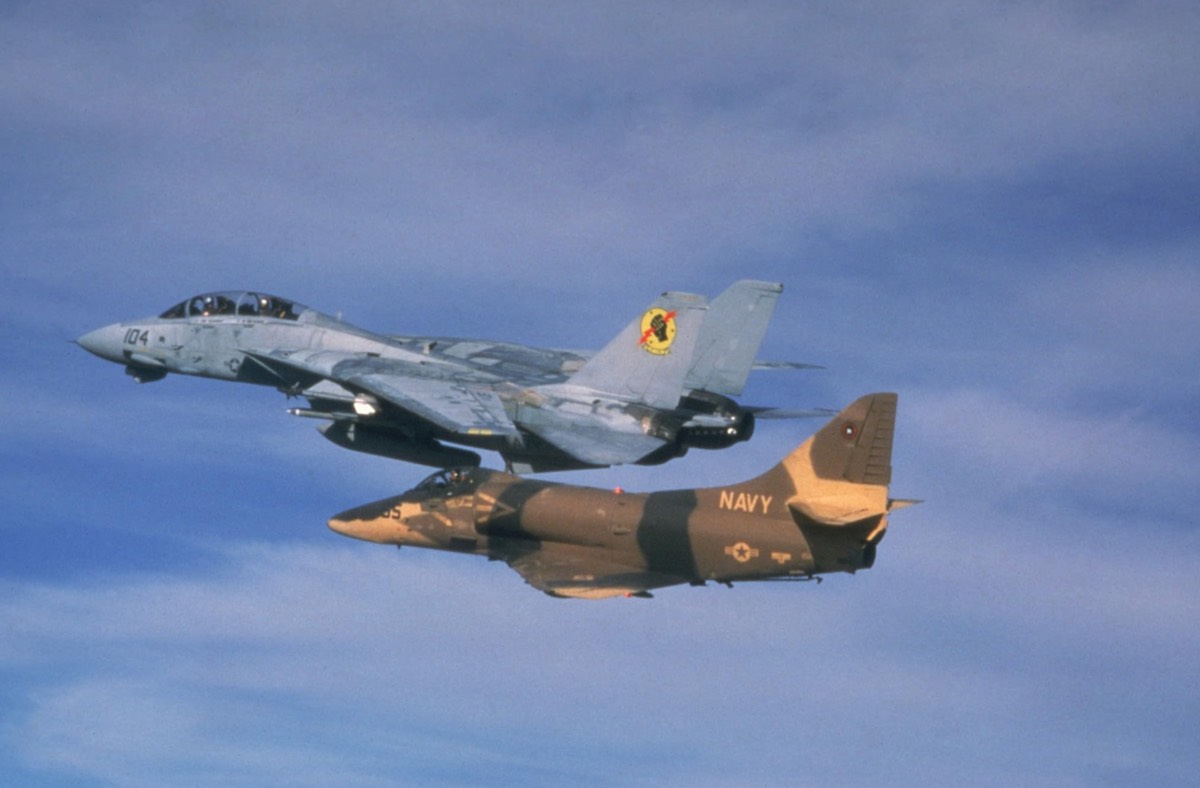
We all know that the best thing about Top Gun continues to be those incredible, pulse-pounding in-flight sequences and gorgeous orange-hued shots of crew and grounded planes at the base and on aircraft carriers. Scott shot most of the air footage from a Learjet, augmented by mounted cameras inside the F-14 cockpits and exteriors. That’s why he shot the whole thing in Super-8: The larger anamorphic lenses wouldn’t fit in the cockpits. The US Navy supplied aircraft, carriers, and crews, and the flight deck footage captured normal operations, with nothing staged.
The stunt pilots included future NASA astronaut Scott Altman, who performed the aforementioned infamous “flipping the bird” maneuver and the tower-buzzing moments. There was one casualty: aerobatic pilot Art Scholl, who performed a lot of the in-flight camera work. Scholl fell afoul of the flat spin maneuver; he couldn’t recover and crashed his biplane into the Pacific Ocean near Carlsbad, California. Neither his body nor the plane was ever recovered, but Scott dedicated the film to Scholl.
From rebel to hero
Maverick and Goose are reprimanded for buzzing the control tower (again).
Maverick and Goose are reprimanded for buzzing the control tower (again).
Iceman (Val Kilmer) confronts Maverick about abandoning his wingman.
Iceman (Val Kilmer) confronts Maverick about abandoning his wingman.
Maverick and Goose are reprimanded for buzzing the control tower (again).
Iceman (Val Kilmer) confronts Maverick about abandoning his wingman.
Maverick puts his grief aside to congratulate Iceman on winning the Top Gun award.
Maverick puts his grief aside to congratulate Iceman on winning the Top Gun award.
Maverick finally earns Iceman’s trust in a bona fide dogfight.
Maverick finally earns Iceman’s trust in a bona fide dogfight.
Maverick puts his grief aside to congratulate Iceman on winning the Top Gun award.
Maverick finally earns Iceman’s trust in a bona fide dogfight.
The film’s weaknesses are… well, almost everything else.
Confession: I’ve never been a huge Cruise fan, particularly in his early career. He didn’t really come into his own until much later; Tropic Thunder, Minority Report, Edge of Tomorrow, and Magnolia are my favorite of his roles, and he acquitted himself admirably in the excellent Top Gun: Maverick.
I still find his performance in the original abrasive and insincere. It takes skill as an actor to make a character like Maverick genuinely likable, and Cruise was not at that level yet in the mid-’80s, coasting on his boyish good looks instead. The film tries to include some vulnerable moments to show the sensitive soul lurking behind the swagger, mostly in scenes with Charlie, but it’s a shallow sentimentality and not very effective. The uninspired dialogue doesn’t help.
As for Charlie, the character started out as an aerobics instructor in the earliest script drafts and was then changed from a fellow officer to a civilian contractor/astrophysicist at the Navy’s request—otherwise, her romance with Maverick would count as fraternization. (The character was inspired by mathematician Christine “Legs” Fox, a civilian specialist in tactical development for aircraft carrier defense at Miramar.)
But while it might not be fraternization—and the film takes pains to show Charlie giving a brutally objective assessment of Maverick’s piloting despite their involvement—sleeping with a student is certainly unprofessional and would probably have gotten her fired in real life. So this is a very dated Hollywood depiction of a female career scientist.
Equally dated is the famous bar scene where Maverick, Goose, and several other drunken officers serenade Charlie—not yet introduced as their instructor—with “You’ve Lost That Lovin’ Feeling” because they’ve made a bet that Maverick can seduce her. It’s supposed to be charming, but the scene plays more aggressively in 2026, particularly when Maverick literally follows Charlie to the ladies’ room, leers at her, and suggests that they could do it right there on the sink.
She shoots him down, and he deserves it. The scene was even problematic 35 years ago—the US Department of Defense Office of Inspector General citedTop Gun’s influence as a contributing factor in the 1991 Tailhook scandal.
Top Gun also has its fair share of technical errors and Navy protocol violations, despite the best efforts of technical advisor Rear Admiral Pete “Viper” Pettigrew—depicted by Tom Skerritt in the film as CDR Mike “Viper” Metcalf. But one expects that in a Hollywood blockbuster. If you want verisimilitude, I highly recommend the National Geographic documentary series, Top Guns: The Next Generation.
Much like C.S.I. did for forensics and The X-Files‘ Dana Scully did for the FBI, Top Gun (and Top Gun: Maverick) are still the best recruitment tools the US Navy could hope for, on the strength of that glorious aerial footage alone. Just be prepared to do the actual hard work if the films inspire you to become a fighter pilot.
Michael Keating, the British actor best known to millions of TV fans for his roles in EastEnders and the cult sci-fi series Blake’s 7, has died. He was 79.
Keating’s agent, Dan Ireson, confirmed the sad news Thursday, May 21, saying the actor had “passed away recently.” No further details about his cause of death were immediately released.
The veteran performer leaves behind a long career that stretched across decades, from classic British dramas to one of the BBC’s most beloved soap operas.
Keating was born in Edmonton, England, and began building his career in the late 1960s and 1970s.
Before becoming a familiar name to sci-fi fans, he appeared in a string of television shows, including Special Branch, Merry-Go-Round, Omnibus, The Dragon’s Opponent and even the iconic Doctor Who.
But his breakout moment came in 1978, when he landed a major role in Blake’s 7, the BBC space drama about rebels fighting against a brutal totalitarian regime that had taken control of Earth.
Keating played Vila Restal, a quick-witted petty thief with a sharp tongue and a knack for survival. The role made him a fan favorite, and he became the only cast member to appear in all 52 episodes of the series.
While Blake’s 7 made Keating a cult TV legend, many viewers later came to know him from EastEnders.
Keating played Reverend George Stevens on the long-running BBC soap from 2005 to 2017.
His character served as the vicar in Walford, often appearing during some of the show’s biggest and most emotional moments. Reverend Stevens presided over christenings, weddings and funerals, putting Keating at the center of many dramatic storylines over the years.
In total, he appeared in 54 episodes of the soap.
Keating never left Blake’s 7 behind.
Decades after the original series ended, he returned to the role of Vila Restal for several audio productions, including The Liberator Chronicles, The Classic Adventures and The Worlds of Blake’s 7.
His work behind the microphone introduced him to a new generation of fans while giving longtime viewers another chance to hear one of the show’s most beloved characters.
Peter Anghelides, an audio producer for Blake’s 7, remembered Keating as a joy to work with.
“I would sit at the back of the Audio Sorcery control room hooting with laughter at his comic timing in our recordings,” Anghelides said in a statement released by Big Finish Productions.
He also shared a sweet memory of Keating joking about naming a fictional planet after TV director and producer Vere Lorrimer — an idea Anghelides later worked into a script, much to Keating’s delight.
“What a joy it was to work with Michael,” Anghelides added. “His cheery presence on studio days was always most welcome.”
Keating’s death marks the loss of a familiar face from British television history.
To sci-fi fans, he was the unforgettable Vila Restal — the thief who somehow always survived.
To soap viewers, he was the calm and steady Reverend George Stevens, guiding Walford residents through their most emotional milestones.
And to the actors, writers and producers who worked alongside him, he was remembered as warm, funny and full of life.
US sending 5,000 troops to Poland as it draws down forces in Germany
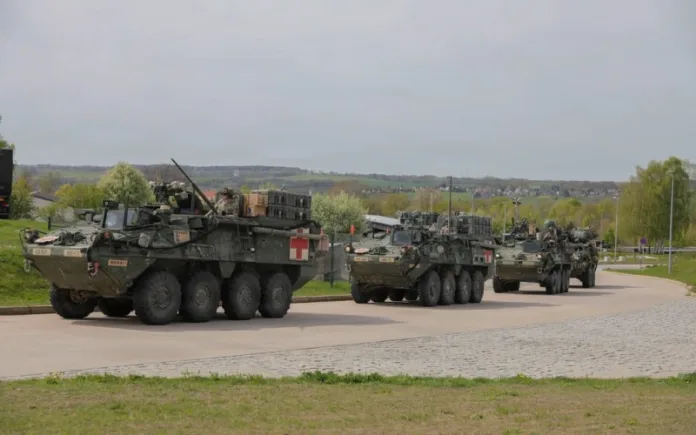
President Donald Trump said that the U.S. would deploy an additional 5,000 troops to Poland, an apparent reversal of his moves to reduce the presence of American forces in Europe to punish NATO for a lack of support with the Iran war.
Trump made the troop announcement in a social media post with few details, suggesting it was connected to the election last year of nationalist President Karol Nawrocki. The announcement came shortly after his administration abruptly canceled a large training exercise in Poland — later saying it had only been delayed — and said it would withdraw 5,000 troops from Germany.
The Pentagon referred questions to the White House, which did not immediately respond to a request for clarification about the announcement.
A Polish official and a NATO representative, granted anonymity to discuss internal dynamics, said they were taken aback by the decision, which the administration did not discuss with allies in advance.
Trump has long been a critic of NATO and demanded that European nations increase their spending on the organization. He also repeatedly expressed anger over the refusal of some member nations to support the U.S. and Israel’s war with Iran.
Vice President JD Vance later dismissed the reports in a Tuesday press conference, telling reporters the planned deployment had been delayed but not canceled after Republican lawmakers condemned the move.
That came after the Pentagon announced plans to withdraw 5,000 troops from military bases in Germany earlier this month following Trump’s clash with the country’s leader over the Iran war. Nawrocki said earlier this month that he would ask Trump to send the troops to his country. Estonia, Lithuania, Latvia and Romania also jockeyed for an increased U.S. military presence in their countries following the announcement.
“Based on the successful Election of the now President of Poland, Karol Nawrocki, who I was proud to Endorse, and our relationship with him, I am pleased to announce that the United States will be sending an additional 5,000 Troops to Poland,” the president said in his social media post. “Thank you for your attention to this matter!”
Nawrocki, who was elected in June 2025 with the support of the nationalist Law and Justice party, has largely aligned with the Trump administration since taking office — setting him on a collision course with the country’s pro-EU prime minister, Donald Tusk.
Tusk had previously said that Poland would take “any opportunity” to increase the U.S. military presence in the country but warned against “poaching” troops from other allies in Europe. Polish officials discussed the presence of U.S. troops in their territory with Trump administration officials in Washington this week, according to a Polish readout of the meeting.
Polish Foreign Minister Radosław Sikorski, meanwhile, told a defense conference in Warsaw earlier this month that additional U.S. forces would “be welcome in Poland” regardless of where they were originally deployed.
POLITICO previously reported that U.S. defense officials were stunned by Trump’s initial announcement that he would be pulling troops out of Germany — which strongly contrasted a monthslong review by the Pentagon of its global troop footprint. The move came after German Chancellor Friedrich Merz said publicly that Washington was “being humiliated by the Iranian leadership.”
Still, Trump has suggested that the cuts could go even further, telling reporters that “we’re cutting a lot further than 5,000” troops in Germany.
Board of Peace envoy says there is ‘no recovery’ in Gaza despite ceasefire gains
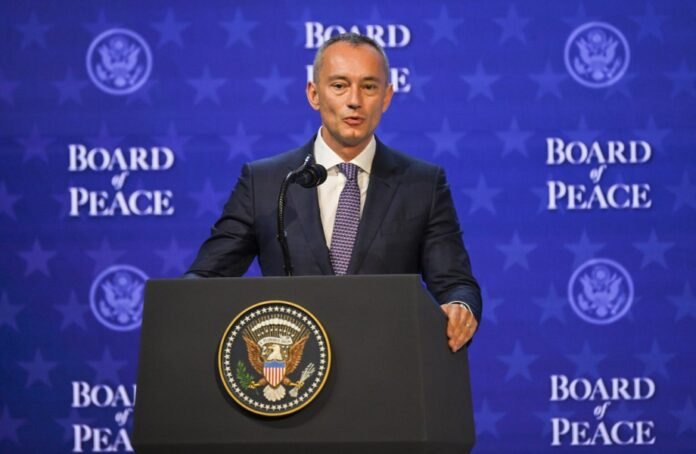
A senior Board of Peace official said Thursday that there is “no recovery” in Gaza despite some progress under a ceasefire deal, Anadolu reports.
Nickolay Mladenov, high representative for Gaza, told the UN Security Council that mass destruction, displacement and humanitarian challenges continue to define conditions on the ground.
“When I last appeared before you, the framework for the decommissioning of weapons in Gaza had been agreed among the guarantors and presented to the parties, and I told you the engagement was serious. The first written report on the implementation of Security Council Resolution 2803 (2025) of the Board of Peace is now before you,” he said.
Noting that there had been limited but important improvements since the ceasefire took hold, he said, “The guns have largely fallen silent across Gaza for the first time in two years. Every hostage has been returned to their family.”
“The number of people receiving food assistance has risen from 400,000 to roughly 2 million. None of this was inevitable. None of it should be taken for granted,” he added.
Warning against describing the situation as a recovery, Mladenov said, “I will not stand before this Council and call this recovery, because there is no recovery.”
He described the scale of destruction as unprecedented, noting widespread infrastructure collapse across the enclave.
READ: UN official says renewed Gaza war would have ‘disastrous consequences’ for civilians
“Some 70 million tons of rubble lie where homes and schools and hospitals used to stand, much of it mixed with unexploded ordnance,” he noted.
Mladenov said more than 1 million people remain without permanent shelter and are living in tents or damaged buildings.
At the same time, unemployment has reached extreme levels, and basic services remain severely degraded, he said.
Although the ceasefire is largely holding, he said it is “holding in a way that is not perfect. There are daily violations.”
He added that continued restrictions and delays are undermining humanitarian access and confidence in the process, stressing that civilians bear the cost of the delay in Gaza.
US deputy UN envoy Tammy Bruce welcomed the report by the Board of Peace. “The United States does have the pleasure of applauding the accomplishments of the Board of Peace over the recent months and the steps toward establishing the Office of the High Representative, the International Stabilization Force, and the National Committee for the Administration of Gaza,” she said.
“As we have just heard today, there are still significant challenges to overcome in the reconstruction and rebuilding of Gaza and securing enduring safety, stability, and prosperity,” said Bruce, explaining that challenges can be overcome by working together.
“A future of peace, freedom, personal and economic in the Middle East is in all of our interests. We must work together to make it happen. The United States will continue to work with Israel, its neighbors, and our partners on the Board of Peace to achieve that goal,” she added.
READ: Trump’s Gaza ‘peace’ board in turmoil as funding pledges fail to materialise
Zillow loses thousands of listings in fight over “hidden” homes
On Wednesday, Zillow abruptly lost access to thousands of property listings in the Chicago area after filing a lawsuit accusing a private listing network owner of colluding with the nation’s largest brokerage to harm consumers by hiding homes.
According to the Chicago Sun-Times, hopeful Chicagoland home buyers browsing Zillow and Trulia suddenly saw significantly fewer listings. On Zillow, a nearly 5,000-home market dropped to about 1,700.
Thorough home buyers diligently checking every possible resource can still turn to other platforms, like Redfin and Realtor.com, which currently host between 5,000 and 8,000 listings, the Sun-Times noted.
But in an antitrust lawsuit filed last week, Zillow claimed that everybody buying or selling a home will be harmed if the alleged collusion goes unchecked.
Specifically, Zillow alleged that Midwest Real Estate Data LLC (MRED) and Compass, two “powerful players in the real estate industry,” have conspired to create “barriers to information that harm or threaten harm to sellers, buyers, and competitors by hiding real estate listings behind a velvet rope in a Private Listing Network (PLNs).”
As Zillow has alleged, MRED—Chicago’s multiple listing service (MLS) provider—“entered into a conspiracy” with Compass—Chicago’s dominant brokerage—to block platforms like Zillow from taking steps to increase transparency of available listings in the area.
“Rather than share all of its listings transparently—as its competitors do—Compass has sought to anticompetitively benefit from its dominance by hiding listings from anyone who is not working with a Compass agent in a PLN,” Zillow’s complaint alleged.
This allegedly “allows Compass to lure prospective home buyers to its brokerage with the promise of access to listings hidden behind a registration wall” and then maximize opportunity for profit by engineering “deals where its agents represent both sides of the transaction.”
In a statement to Ars, Zillow said that “Chicagoland home buyers and sellers today have far worse access to the housing market than they had yesterday, because their local MLS decided one mega-brokerage’s profits mattered more than their ability to achieve the American Dream.”
Zillow has requested a preliminary injunction to end the suppression of listings and other unlawful attempts to allegedly manipulate the home-buying market to disadvantage platforms that are pushing for more transparency.
Firms defend private listings
Challenging that, MRED has recently moved to force the legal fight into arbitration, alleging that Zillow’s antitrust claims are “meritless” and amount to little more than a contract dispute. The company also claimed that Zillow’s alleged harms are “self-inflicted,” since the platform knew that choosing to block nine listings of previously hidden homes would trigger a violation cutting off access to 43,000 listings.
In a press release, MRED said that Zillow lost access to its listings due to breaching its contract. The company also criticized Zillow, writing that “in a striking lesson in irony, Zillow has chosen not to display 43,000 MRED listings because it demands the right, and has filed a federal antitrust lawsuit to secure that right—to exclude nine listings it disfavors.”
Asked for comment, Compass told Ars that the legal fight “is about whether homeowners have a choice in how they market their homes, or whether Zillow can set a one-size-fits-all policy for the industry.”
“Restricting listing visibility and penalizing agents for exercising lawful and strategic marketing options undermines consumer choice,” Compass said.
Defending sellers’ choice in how they market their homes, Compass said that it commends MRED for “enforcing policies that protect both consumer choice and the fiduciary obligations agents owe their clients. Buyers in Chicago should not be deprived of access to listings because a platform disagrees with how a homeowner chooses to market their property.”
Zillow Preview launch complicates fight
The real estate industry fight escalated in April 2025, when Zillow claimed that it “took a competitive stand” to protect consumers by adopting new Listing Access Standards designed to throw a wrench in schemes like the alleged MRED/Compass conspiracy.
Zillow hoped that by threatening to block “listings that had been previously marketed privately to only a select group of buyers and were withheld from all market participants” from appearing on its websites, the market might shift to hide fewer listings.
But after Compass failed to secure an injunction blocking Zillow’s new policy, Compass and MRED allegedly teamed up “to threaten loss of access to all of MRED’s listings if a competitor did not display one of MRED’s or Compass’s competing PLN listings,” Zillow claimed. They did this, Zillow alleged, understanding that Zillow cannot afford to lose access to all Chicago-area listings and would have to revert to its prior standards.
And they soon followed through on that threat. In early May, after Zillow suppressed nine listings for failing to adhere to its Listing Access Standards, Zillow got a warning threatening to terminate its access to MRED’s listing feed “if Zillow did not display” some of the Compass listings that violated Zillow’s policies.
In its motion to compel arbitration, MRED accused Zillow of filing the lawsuit out of its “dissatisfaction” with its contract terms and “insecurity about continuing to generate revenue.” The company claimed that any harm that Zillow experienced is “completely self-inflicted, readily avoidable, and can be remedied at any time by simply complying with the same clear and longstanding license agreements under which it has operated for years.”
Reached for comment, MRED’s spokesperson also pointed to an article calling out Zillow’s seeming hypocrisy for challenging MRED’s private listing network while launching Zillow Preview, a pre-market listing network.
But Zillow insists that Zillow Preview is “not at all the same” as MRED’s alleged scheme. In a statement to Ars, Zillow defended its pre-market listing product as “available for any buyer to see and aligned with our transparency standards.”
“Private listings networks are just that—private, and only available to buyers working with a specific brokerage or agent,” Zillow said. “The goal of Preview is to help sell the house. The goal of PLNs is to hide the house to force more buyers into working with your brokerage.”
Home buyers in the US have in the past few years faced hardships, including “persistently high mortgage rates and home prices,” since the housing inventory has never returned to pre-pandemic levels, a 2026 Experian forecast said. While inventory is expected to modestly increase this year, Zillow’s legal fight suggests some brokerages may be motivated to increasingly hide new listings to increase profits.
Zillow worries that the MRED/Compass plan will inevitably block platforms that are promoting more transparency from competing with powerful private listings network providers. That will disadvantage both buyers and sellers in major markets like Chicago, Zillow alleged.
“Defendants’ conspiracy harms home buyers and sellers by incentivizing brokerages to withhold listings from the market only until the listing fails to sell privately, thus erecting barriers to information, exacerbating the accessibility and affordability crisis, and reducing the pool of buyers and listings that makes the real estate market efficient and competitive,” Zillow alleged.
In its complaint, Zillow said that MRED and Compass “control over 99 percent of the market for Chicagoland real estate listing platforms.” Allegedly, they’ve worked “in lockstep” and “in secret” to “leverage MRED’s monopoly power and control over Chicagoland listing feeds to force competitors like Zillow to display unwanted private listings, abandon pro-consumer listings policies, and block nascent competing offerings that preference access over exclusivity.
“MRED and Compass have colluded to turn back the clock on consumer transparency at the exact moment American families can least afford it, cutting off competition, hiding homes and engineering a market that extracts more from buyers and sellers so Compass can pocket more on every deal,” Zillow told Ars.
The United Arab Emirates is racing to finish a new crude oil pipeline that would let more of its exports bypass the Strait of Hormuz, with Abu Dhabi National Oil Company Chief Executive Officer Sultan Ahmed Al Jaber saying Wednesday that the project is nearly halfway complete and on track for 2027. The push comes as regional conflict has turned one of the world’s most important energy waterways into a strategic pressure point.
“Today, it’s already almost 50 percent complete, and we are accelerating its delivery toward 2027,” Al Jaber said during a livestreamed Atlantic Council event.
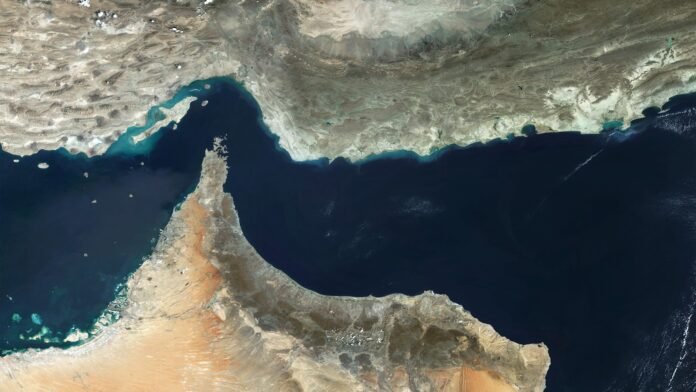
The new west-east pipeline is intended to expand the UAE’s ability to ship crude through Fujairah, on the Gulf of Oman, without sending tankers through the narrow Strait of Hormuz. The existing Habshan-Fujairah pipeline can carry up to 1.8 million barrels per day, and the new project is expected to double ADNOC’s export capacity through Fujairah once it begins operating.
The Strait of Hormuz, between Iran and Oman, is one of the world’s most sensitive maritime choke points. Oil and liquefied natural gas from Gulf producers routinely pass through it toward Asia, Europe, and other markets. Any disruption there can quickly ripple through energy prices, shipping costs, and inflation.
“Too much of the world’s energy still moves through too few choke points,” Al Jaber said, adding that the UAE has spent more than a decade building infrastructure to reduce that vulnerability.
The project has gained urgency since joint US-Israeli strikes on Iran in February triggered Iranian restrictions on traffic through the Strait of Hormuz. Energy flows have been disrupted, and Gulf states have faced renewed pressure to protect export routes that sit within range of Iranian missiles, drones, and naval forces.
For the UAE, Fujairah is the escape hatch. It gives Abu Dhabi direct access to the Indian Ocean side of the Arabian Peninsula, outside the strait. That does not remove the country from regional danger, but it gives ADNOC more room to maneuver if Hormuz tightens again.
The pipeline is also a political message in steel: Gulf oil producers are preparing for a world in which energy security depends not only on production, but on routes that cannot be closed by a single crisis.
AT&T sues California in attempt to shut off old phone network
AT&T sued California yesterday over the state’s refusal to let the carrier stop providing phone service to all potential customers in its wireline network territory. AT&T is also asking the Federal Communications Commission to declare that California cannot enforce its rules and to let AT&T stop providing service to about 199,000 phone customers.
“California requires AT&T to spend $1 billion each year to maintain a century-old telephone network that almost no one uses,” AT&T said in a lawsuit filed in US District Court for the Southern District of California. “The copper wires that once served every home now serve just three percent of households in AT&T’s California territory, with consumers fleeing every day to modern broadband services that are more affordable, reliable, and energy-efficient.”
In June 2024, the California Public Utilities Commission (CPUC) rejected AT&T’s request to eliminate the Carrier of Last Resort (COLR) obligation that requires it to provide landline telephone service to any potential customer in its service territory. AT&T has said it’s received relief from COLR obligations in 20 of the 21 states in its wireline service territory, all except California.
“The federal government and virtually all States where AT&T historically offered POTS [Plain Old Telephone Service] have now eliminated outdated regulatory obstacles, allowing AT&T to begin powering down its POTS network and increasing its investments in modern communication technologies. California stands alone in resisting this progress,” AT&T’s lawsuit said.
AT&T complained that its “barely used copper network is an easy mark for criminals—California has already suffered about 2,000 outages from copper thefts this year—and drains the power grid of over 100 million kilowatt-hours each year.”
AT&T won’t upgrade all lines to fiber
AT&T has argued for years that California is preventing it from replacing copper with more modern technology. But California officials say AT&T is allowed to upgrade the copper lines with better technology.
“The Commission does not have rules preventing AT&T from retiring copper facilities. Furthermore, the Commission does not have rules preventing AT&T from investing in fiber or other facilities/technologies to improve its network,” the CPUC said in its 2024 decision against AT&T. The CPUC said the state’s “COLR rules are technology-neutral and do not distinguish between voice services offered… and do not prevent AT&T from retiring copper facilities or from investing in fiber or other facilities/technologies to improve its network.”
AT&T doesn’t want to upgrade all copper customers to fiber. It has told investors it intends to build fiber home Internet in much of its wireline footprint, prioritizing the most densely populated and thus most profitable areas. But in about half of its wireline territory, AT&T has a “wireless first” plan in which copper phone lines would be replaced only by wireless technology.
The CPUC in 2024 noted that members of the public raised concerns about “the unreliability of voice alternatives such as mobile wireless or VoIP.” The agency said that by dismissing AT&T’s request to withdraw as the Carrier of Last Resort, “the CPUC reaffirms its commitment to safeguard access to essential services and maintain regulatory oversight of the telecommunications industry.”
We contacted the CPUC and California Attorney General Rob Bonta’s office about AT&T’s lawsuit today and will update this article if we receive comment.
AT&T seeks FCC preemption
AT&T’s lawsuit said it wants to replace copper lines with fiber and wireless offerings, and that both fiber and wireless are good enough to meet residents’ needs. Wireless options include the nationwide AT&T mobile service and AT&T Phone-Advanced, a VoIP service that relies on the mobile network. AT&T said that “the FCC has repeatedly found [AT&T Phone-Advanced] to be an adequate replacement for POTS.”
Under Chairman Brendan Carr, the FCC has been inclined to grant the wishes of carriers seeking to ditch old networks. AT&T’s lawsuit cites a March 2026 order in which the FCC made it easier for carriers to discontinue copper networks and asserted that state rules are subject to preemption if they conflict with the FCC’s discontinuance authorizations and authority.
The FCC order spoke generally of preemption but did not make determinations about specific state rules. AT&T asked the court for “a declaration that any California law or regulation that interferes with AT&T’s ability to grandfather POTS, as authorized by the FCC in the NMO [Network Modernization Order], is unlawful,” and “injunctive relief to preclude California officials from applying those laws or regulations to prevent or slow AT&T from grandfathering POTS.”
AT&T’s lawsuit said that although the FCC “granted AT&T permission to stop signing up new customers” for POTS, California’s COLR “rules require AT&T to continue offering POTS even after the FCC has authorized the service to be phased out. Under basic preemption principles, those COLR rules cannot stand.”
AT&T yesterday also submitted petitions asking the FCC to intervene directly in California. One petition asks for permission to discontinue copper-based service to 184,000 residential customers and another asks for permission to discontinue copper service to 15,000 business customers.
Two other AT&T petitions asked the FCC for forbearance and preemption orders that would effectively block enforcement of California’s COLR rules and other phone mandates, such as a requirement to participate in the California Lifeline discount program. AT&T said it has about 40,000 Lifeline subscribers left in California, with that number having plummeted due, in part, to a 2016 FCC order that let AT&T stop offering Lifeline to new consumers in most counties.