Rome has become a useful European partner for India as both countries seek deeper cooperation on trade, technology, ports, defense, and the India-Middle East-Europe Economic Corridor
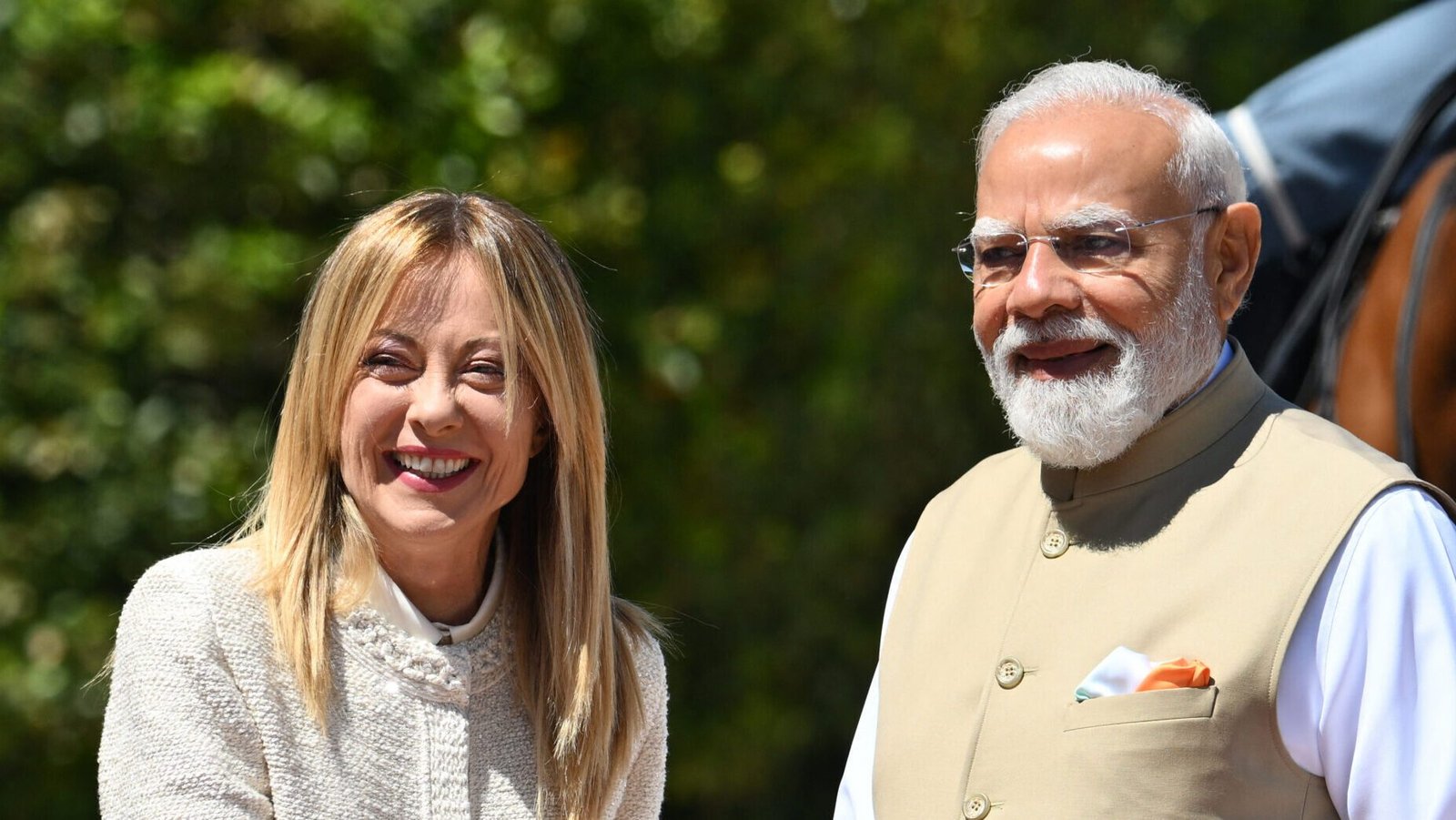
Indian Prime Minister Narendra Modi’s five-nation tour from May 15 to 20 moved through the United Arab Emirates, the Netherlands, Sweden, Norway, and Italy, but Rome gave the trip its clearest strategic message. The stop in Italy showed how New Delhi is trying to widen its options in a more fragmented world by combining trade, technology, defense, connectivity, and corridor politics into a single diplomatic approach.
In Rome, India and Italy elevated their relationship to a Special Strategic Partnership and adopted a joint declaration that stretched across trade, investment, supply chains, critical minerals, clean technologies, semiconductors, ports, maritime security, defense industrial cooperation, innovation, space, migration, and the India-Middle East-Europe Economic Corridor (IMEC). They also reaffirmed their aim of raising bilateral trade to €20 billion by 2029.
That upgrade gives Italy a more important place in India’s Europe strategy than the usual diplomatic courtesy visit. Italy is a major EU economy, a Mediterranean state, a NATO member, and one of the Western governments that has shown a strong political interest in IMEC. For India, Rome is a useful bridge to Europe and a possible gateway to the Mediterranean route that New Delhi wants to turn into a strategic asset.
The official India-Italy declaration was unusually dense in practical detail. The two governments said they wanted to build resilient supply chains, expand industrial and technology partnerships, and deepen cooperation in sectors including textiles, clean technologies, semiconductors, automotive, energy, tourism, pharmaceuticals and medical technologies, digital technologies, steel, ports, and infrastructure. They also called for stronger links among stock exchanges, investment funds, banks, insurers, and other financial institutions.
The relationship is also being built through institutions, not just headlines. The leaders agreed to hold annual meetings, including on the sidelines of multilateral events, and to use the Joint Strategic Action Plan 2025-2029 as the main operational framework for the relationship. That plan had already been adopted in 2024, but the Rome declaration gave it renewed political force and placed it at the center of bilateral follow-up.
IMEC sat at the center of the meeting. Modi and Italian Prime Minister Giorgia Meloni reaffirmed their commitment to the corridor, described its transformational potential, and encouraged the first IMEC ministerial meeting to take concrete steps in 2026. The declaration presents the project as a route not only for goods, but for a wider set of commercial, digital, and strategic links between India, the Gulf, and Europe.
The maritime dimension was just as important. India and Italy welcomed a memorandum of understanding on maritime transport and ports and directed their ministries to create a joint working group to implement it. They also agreed to launch a dialogue on Maritime Security to improve cooperation, coordination, information sharing, and best practices. The message was clear: connectivity is not being treated as a separate technical subject, but as part of a security agenda.
The technology agenda followed the same pattern. The leaders announced the creation of INNOVIT India, an innovation hub in India aimed at strengthening the two countries’ innovation ecosystems, supporting startup acceleration, improving market access and business matching, and deepening university collaboration and talent mobility. The declaration identifies fintech, healthcare, semiconductors, logistics and supply chains, agritech, energy, quantum computing, and artificial intelligence as priority fields.
They also highlighted cooperation in supercomputing, renewable energy, green hydrogen, the sustainable blue economy, and space. That breadth is one reason the meeting mattered: it was not just a symbolic reset. It was a practical attempt to connect industrial policy, advanced technology, and strategic geography into a single relationship.
For Rajat Ganguly, editor-in-chief of the Journal of Asian Security and International Affairs, the Rome stop fits a larger shift in Indian foreign policy. “I see this as India’s growing confidence in what I call a polyalignment foreign policy,” he told The Media Line. “What this effectively means is that India does not want to get pushed into one particular corner or another. A lot of people are saying that India should be more strongly in favor of BRICS against the US. This is not India’s approach to foreign policy right now. India wants to be a good partner with multiple actors.”
India does not want to get pushed into one particular corner or another
BRICS is a grouping of major emerging economies seeking greater economic and diplomatic influence in a more multipolar global order. It was launched by Brazil, Russia, India, and China with a first formal leaders’ summit in 2009; South Africa joined in 2010, and the bloc expanded again in 2024 and 2025 to include countries such as Egypt, Ethiopia, Iran, the United Arab Emirates, and Indonesia.
Ganguly said the logic is evident in India’s ability to keep different relationships separate, even when they point in different directions. “You could have India-US on one side, India-Russia on one side. … India is very close to Israel, but India is also very close to Iran,” he said. “From India’s point of view, that is probably the most useful thing: to have multiple partners, multiple friends, and not allow the difficulties between friends, let’s say, to affect their relationship with India. Iran and Israel are a classic example. India wants to have beneficial relations with both.”
That logic helps explain why Italy matters to New Delhi. Ganguly described Italy as an important trade partner and a pro-India voice inside the European Union. “Italy is a very important trade partner, and you may remember this new trade route from India to the Gulf, then on to Israel, then Greece and Italy into Europe,” he said. “If you look at it from that point of view, then obviously Italy is very, very important for India. Italy is also a voice within the European Union that is very pro-India.”
You could have India-US on one side, India-Russia on one side. … India is very close to Israel, but India is also very close to Iran
The personal chemistry between Modi and Meloni also plays a role, in Ganguly’s view. “I think Meloni’s position on many different things probably aligns quite well with Modi and his ideas,” he said. “As two prime ministers, they are probably quite aligned in terms of their political ideology, in terms of their outlook for the world, for Europe, and for India. From Modi’s point of view, Europe is very important as an alternative power center.”
He also argued that Meloni has tried to show independence even from leaders she once strongly supported. “Meloni used to be a very big Trump supporter,” Ganguly said. “But what she is also asserting is that she is autonomous. She supports Trump when it is good for Italy. But if she is required to criticize Trump because Trump is doing things that are not good for Italy, she will do that,” adding, “What it shows is that she has got a spine, that she is not going to bend backward for anybody.”
Leo Goretti, associate dean at Rome Business School, places India in a somewhat different but overlapping frame. He described the country as a “swing country” in the global system, standing between the democratic West and a broader group of states seeking to reshape the international order from outside its traditional center.
He painted India as “halfway between the link with the democratic and Western world and the positioning within a front of countries that somehow claim a reform of the multilateral system, of the international liberal order, starting from the outside, like the BRICS.” In his view, India is a key country, and trying to maintain a dialogue, a partnership relationship, if not friendship or even an alliance with India, is crucial for Western countries.
For Goretti, the India connection also gives Meloni a chance to project Italy as more than a reactive European middle power. “All this means that at this moment India can actually represent an interlocutor through which Meloni can try to relaunch the country’s foreign policy, which in recent months has seen Italy in a rather difficult situation, more reactive than proactive,” he told The Media Line.
He was careful not to portray that as a break with the West. “In my opinion, this Italian government also contains different positions on this issue,” Goretti said. “I believe that the perspective of Prime Minister Meloni is a perspective that she has coherently carried out over time: the search for a united Western front. I consider it an extremely complicated perspective, if not impossible, with Trump actually translating it into concrete politics.”
Goretti added that Meloni’s approach remains tied to a Western framework even if Washington no longer seems fully invested in the same idea. “My impression is that Meloni’s position tends to be continuous in this effort to keep the Western front united,” he said, “while emphasizing the fact—and this is the paradox—that the main exponent of that front, the United States, does not seem at this moment to be interested in this type of politics, and hence all the frustrations and failures of the case.”
Meloni’s position tends to be continuous in this effort to keep the Western front united
He also pointed to pressure points inside the Italian right, where some smaller currents favor a more openly multipolar reading of world politics. “There are minority components, let’s say, in the area of the radical right, both inside and outside the government, that probably have a perspective much more linked to this ideal of a multipolar world, in which … one tries to navigate between the Russian power policy, the American one, potentially also the Chinese one, etc.,” he said. “But I believe that this is a component that, at this moment, is quite a minority, which, however, is destined to become more and more noisy before the next elections.”
The Rome meeting took place the same week that BRICS foreign ministers met in New Delhi and failed to issue a joint statement due to disagreements over the Middle East. Reuters reported that rivals Iran and the UAE were among the countries unable to agree on a common text, and India issued only a chair statement that referred to “differing views among some members” on West Asia and the Middle East.
That episode underlined the limits of treating BRICS as a coherent anti-Western bloc. “India, as one of the founding members, is the classical balancer,” Ganguly said, adding that “India is basically saying that BRICS should not be like a Cold War institution, where it is almost zero-sum politics: that BRICS is anti-America, anti-West, and therefore BRICS is in conflict with the West and with the US. We do not want that.”
India is basically saying that BRICS should not be like a Cold War institution, where it is almost zero-sum politics
He noted that the bloc’s internal differences are becoming harder to manage as its membership grows. “Right now, there are 10 members, and it was not possible to get all 10 members to agree on a joint communique at the end of the meeting, particularly because the UAE and Iran did not see eye to eye,” he said. “Therein lies the problem: India’s perception of BRICS is very different from Russia’s and China’s. It is also very different from Iran’s and the UAE’s, for example.”
For Goretti, that broader uncertainty is pushing both India and Europe to diversify their partnerships. He argued that the transatlantic relationship no longer looks as stable or automatic as it once did, which is why countries such as Italy are looking harder at India and other middle powers. The answer, in his view, is not to abandon the West but to avoid overdependence on a single power axis.
That is where the India-EU relationship becomes relevant to the Italy story. The European Commission says negotiations on the Free Trade Agreement (FTA) concluded on January 27, 2026, and that the agreement would eliminate or reduce tariffs on over 96% of EU goods exports while saving around €4 billion a year in duties. The commission also says the EU and India relaunched negotiations in 2022 for a separate Investment Protection Agreement and an Agreement on Geographical Indications.
The Rome declaration folded that wider European track into the bilateral relationship by welcoming the conclusion of the FTA negotiations and the India-EU Comprehensive Strategic Agenda. It also backed the India-EU Trade and Technology Council as a platform for cooperation in trade, critical technologies, and economic security.
Even with all that ambition, IMEC remains the hardest piece of the puzzle. India and Italy both described the corridor as transformational, but the project depends on stability across the Gulf and the eastern Mediterranean, where conflict and disruption remain live risks. The declaration expressed deep concern over the situation in West Asia and the Middle East, welcomed the ceasefire announced on April 8, 2026, and called for de-escalation, dialogue, diplomacy, freedom of navigation, and the resumption of global flows through the Strait of Hormuz.
Goretti said that if instability continues across Yemen, Hormuz, and Iran, the corridor will remain difficult to realize. “It is certain that if there is an arc of instability and war that involves Yemen, the Strait of Hormuz, and Iran, this represents a huge problem for such an ambitious project,” he said. He also noted that current disruptions already affect routes between India and Europe.
That is the basic tension at the heart of the Modi-Meloni meeting. The strategic direction is clear. The relationship is broader than before. The institutional structure is more serious than in earlier phases. But the route on which much of the wider vision depends still runs through one of the most volatile regions in the world. Italy can help give the project political backing, but it cannot by itself provide the stability needed to make it work at full scale.
Ganguly argued that India’s westward push will continue through a chain of relationships rather than a single corridor. “India’s presence in the Middle East is going to grow through the UAE, through Israel, and through very, very good ties with Saudi Arabia now,” he said. “From the Middle East, there will be Cyprus and Greece, and then into Italy and into Europe.”
He said the common thread is that India does not see these relationships as mutually exclusive. “India would say, no, no, no, each relationship is completely independent,” he said. “What we use to judge each relationship is whether it is good for India. And only India will decide what is good for India.”
That is why the Rome stop stood out. It was not simply a friendly meeting between two leaders with some political chemistry. It was a practical move in a larger strategy of diversification, corridor-building, and strategic autonomy. India and Italy are trying to connect trade, technology, defense, mobility, and maritime security in a single framework, while also fitting that framework into broader India-EU and Indo-Mediterranean politics.
What remains uncertain is how much of that ambition can be implemented in a geopolitically strained environment. The declaration is detailed. The targets are concrete. The cooperation is broad. But the stability needed to support IMEC, smooth trade flows, and sustained maritime access still depends on a region where conflict can quickly spill across borders and disrupt plans.
For Europe, that is part of a larger shift. Goretti said the last year and a half has been a wake-up call for those who believed the transatlantic relationship would remain the unquestioned backbone of foreign and security policy. He argued that Europe now needs to broaden its portfolio of partners, including India, the Gulf states, Brazil, and other middle powers, to avoid being squeezed into a pure US-China rivalry.
That broader logic is the real frame for Modi’s tour. The Gulf still matters for energy and connectivity. The Netherlands still matters for trade and technology. Sweden and Norway still matter for innovation and green transition. Italy matters because it links all of those themes to the Mediterranean and to the question of how Europe and Asia will connect in the years ahead.
The meeting in Rome, then, was less about one friendship than about an emerging pattern. India and Italy are both trying to hedge against uncertainty by deepening ties, widening options, and building practical cooperation around supply chains, advanced technology, and connectivity. Whether that framework becomes a functioning alternative to older routes and older assumptions will depend less on diplomatic declarations than on the ability of the wider region to avoid another round of disruption.