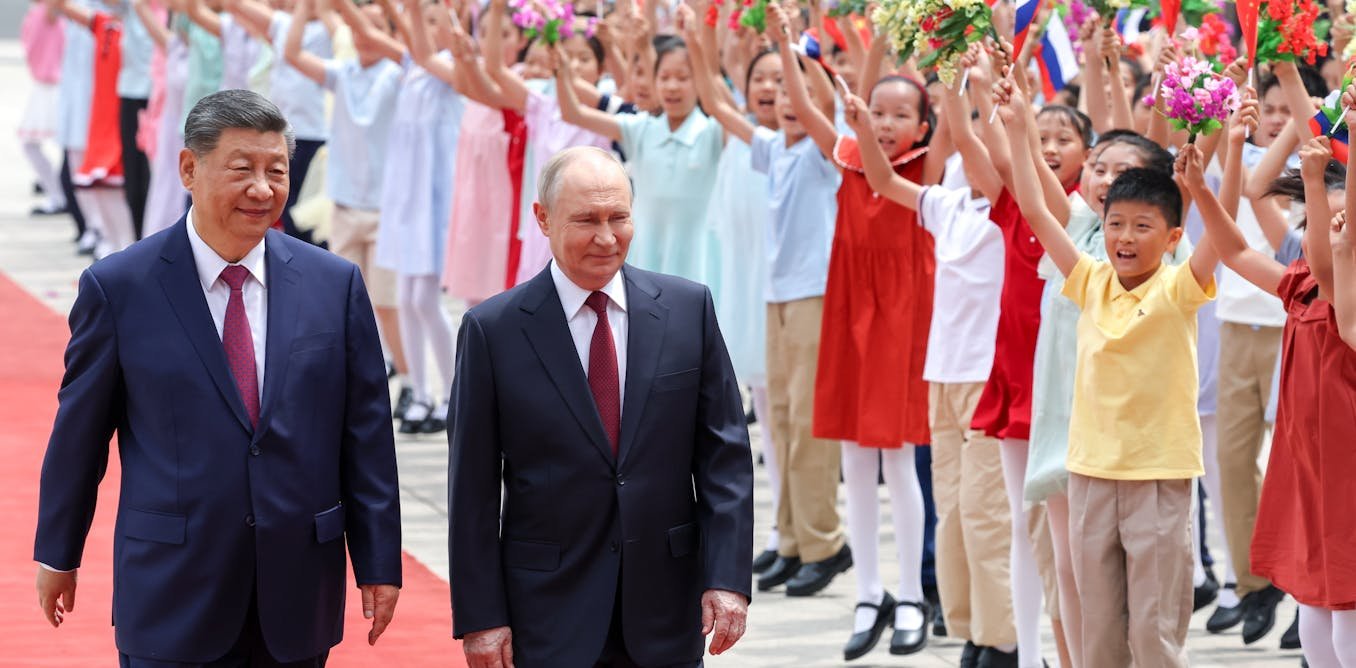
The red carpet at Beijing Capital International Airport has had something of a workout in recent months. In addition to Donald Trump’s visit from May 13-15 and Vladimir Putin over the past couple of days, a parade of world leaders, including five out of seven G7 leaders, has made the trip to Beijing to visit the Chinese president, Xi Jinping.
Meanwhile, Pakistan’s prime minister, Shehbaz Sharif, arrives on Friday and Serbia’s president, Aleksandar Vučić, is scheduled to begin a four-day visit on Sunday May 24.
In terms of diplomacy, at the moment all roads appear to lead to Xi Jinping.
Putin, specifically, has made more than 20 trips to see the leader he called his “dear friend” (Xi reciprocated by calling Putin his “old friend”, read into that what you will). The pair made all the customary noises you’d expect, talking up the notions of their “partnership”, “mutual respect”, “friendship” and “trust”.
But when it came down to it, writes Stefan Wolff, professor of international security at the University of Birmingham, Putin left without the one thing he really wanted: the finalisation of a deal around the Power of Siberia 2 pipeline. Once built, this will enable Russia to sell up to 50 billion cubic metres of natural gas from its arctic fields directly to China.
This is a big deal for Russia, given the sanctions on its oil trade as a result of the war in Ukraine.
Overall, Putin’s trip reinforced what has becoming ever clearer over the past few years. That China’s vision of a new order is not tripartite and does not involve Putin’s Russia as equal partner. Whether it’s a duet with the US is another matter. Even if it is now, it won’t be for long, Wolff concludes.
Marcin Kaczmarski, an expert in Russia-China relations at the University of Glasgow, explains the asymmetry in the partnership between the two countries. Essentially, it boils down to the fact that Xi has far more capacity to help Russia than Putin has to offer China.
Read more: Xi and Putin tout ‘new type’ of world order in Beijing – but is their alliance really that strong?
As Putin was arriving, details of some of the “fantastic trade deals” Trump had struck during his own visit to China were emerging. China has committed to buying 200 Boeing jets as well as billions of dollars of soybeans and other agricultural products.
Interestingly, while China said that reducing tariffs would be part of the plans, the US has said nothing about this. And while the US readout after the visit mentioned that China would address shortages of the rare earth minerals it controls, Beijing’s report, in turn, reportedly failed to mention this.
So while the US president’s trip was “cordial” it was also “underwhelming”. The fact remains, writes Maria Ryan, an expert in US foreign policy at the University of Nottingham, that the US and China are now the two global superpowers and their interests are bound to diverge. So visits such as Trump’s to Beijing last week – and Xi’s forthcoming trip to the US in the autumn – are all about managing their rivalry and controlling the areas where the two might come into conflict.
Ryan concludes that despite the cordiality, this meeting will have done nothing to diminish the long-term rivalry between Washington and Beijing, particularly in the Asia-Pacific region.
Read more: Trump’s ‘cordial’ Beijing trip has not changed superpower rivalry
Trap for unwary presidents
Based on his reported comments, Xi Jinping is clearly alive to that rivalry and took pains to remind the US president, with a pointed, if friendly, historical reference to what he called the “Thucydides trap”. Trump will no doubt have remembered the Greek historian from a reference made by Canadian prime minister, Mark Carney, in February.
But, confusingly for those of us who are not scholars of the classics, while Carney was referring to Thucydides’s aphorism that “the strong can do what they can, and the weak must suffer what they must”, Xi was taking as his example the Peloponnesian War between the military might of Sparta and the rising power of Athens, which lasted 30 years and effectively destroyed both city states.
Neville Morley, a professor in classics at the University of Exeter, puts Xi’s warning into its modern context.
How Trump’s America looks to the outside world
Americans are increasingly turning against the war in Iran and the president that launched it, if Donald Trump’s poor domestic approval ratings are any guide. But the US president’s foreign policy adventures have been worrying many US allies for a lot longer, according to polling expert Paul Whiteley.
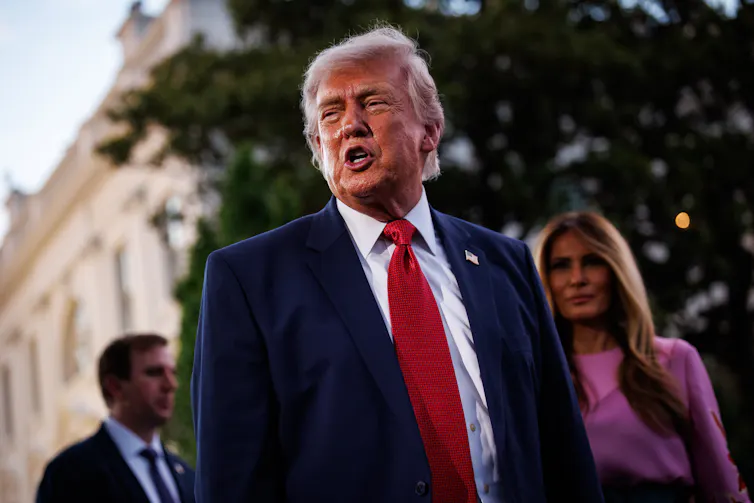
Whiteley reports on a survey taken by Pew Research about a year ago which found that people in 24 mostly European countries, but also countries in Asia, Africa, the Middle East and Latin America, have little confidence that the US president will do the right thing and see him as “dangerous”.
As Whiteley observes, there’s a fair correlation between proximity and lack of confidence in the US president and, increasingly, America itself. The US will need to work hard to regain the trust it has lost over the past 16 months, he believes.
Why do so many ceasefires fail?
Meanwhile in the Middle East the ceasefire between the US and Israel and Iran limps on, despite claims and counter claims of violations and threats by the US president to end it. Meanwhile in Russia, both sides reportedly breached unilateral ceasefires proposed around the May 9 commemoration of the defeat of Nazi Germany.
In Lebanon, Israel is reported to have repeatedly breached the ceasefire, choosing to blame Hezbollah – which is insists is not a party to the truce. And in Gaza it feels as if no day passes without reports of deaths, despite a ceasefire being in place there since October last year.
Laura Wise, an expert in conflict resolution at the University of Edinburgh explains why lasting ceasefires are so elusive.
Read more: From Iran to Ukraine, lasting ceasefires remain elusive