A recent call by Ukraine’s former defence minister, Mykhailo Fedorov, for new national elections in Ukraine – which would be the first to take place in the country since 2019 – has sparked a renewed debate about whether it is possible to hold a legitimate vote in wartime.
Under normal circumstances, Ukraine’s parliamentary elections would have been held in October 2023. Presidential elections would have followed in March 2024. But the circumstances are, of course, far from normal.
Almost a fifth of Ukraine is occupied by Russian troops, millions of people are displaced and citizens across the country are subject to daily missile and drone attacks.
Fedorov’s argument is that Ukraine is a free European state fighting to defend democracy. It should not be the Russian president, Vladimir Putin, who decides when Ukrainians get to choose their leaders, he argues.
On the face of it, it seems a simple argument. What sets a democracy aside from an autocracy is that its leaders are genuinely accountable to the electorate and periodically face the voters in open, free and fair elections. But is it as simple as that?
Fedorov’s argument has reignited a debate that has echoes of talking points routinely aired by Putin, who has questioned Ukrainian president Volodymyr Zelensky’s continued legitimacy. The US president, Donald Trump, has also claimed that Ukraine is “using war not to hold an election”.
But in international terms, it is in fact not unusual for elections to be postponed when a country is under attack. Postponing elections in emergency situations until it is possible to hold them with full integrity can sometimes be justified on democratic grounds. During the second world war, for example, Britain postponed its 1940 election until 1945, focusing instead on defeating the threat to democracy itself from Nazi Germany.
The Ukrainian constitution declares that the state’s most important task is to defend the country’s sovereignty and territorial indivisibility. According to Zelensky, this is precisely what would be endangered by holding elections now.
Should Ukraine hold elections?
The arguments against holding elections while the war is still ongoing are threefold.
First, elections would rest on shaky legal ground. Article 83 of Ukraine’s constitution automatically extends parliament’s term under martial law. Article 19(1) of the Law on the Legal Regime of Martial Law also prohibits presidential, parliamentary and local elections during wartime.
Any election held against these provisions would almost certainly be challenged as illegal by the losing side. Despite Putin and Trump’s insinuations, the mandates of Zelensky and the current parliament remain fully legal.
Second, as the Council of Europe noted in 2022, it is doubtful that Ukraine could currently hold elections that meet domestic and international democratic standards. This is not due to any lack of desire to do so, but due to the war itself.
Elections require functioning infrastructure, accurate voter rolls, clearly defined electorates and territorial boundaries, fair competition and genuine opportunities to vote and stand for election. These are hard to guarantee while under full-scale attack.
With millions internally displaced or abroad, and Ukrainians in the Russian-occupied regions unable to vote and in many cases stripped involuntarily of their Ukrainian citizenship by Russia, accurate voting lists would be hard to compile. Voting itself would also be challenging, as around a quarter of polling stations and nearby public buildings have been damaged.
Ukrainians living abroad may also struggle both to vote and to stand for election. Many military personnel would find this similarly difficult as they would not be able to leave the front line. These issues would need time to resolve fairly and proportionately.
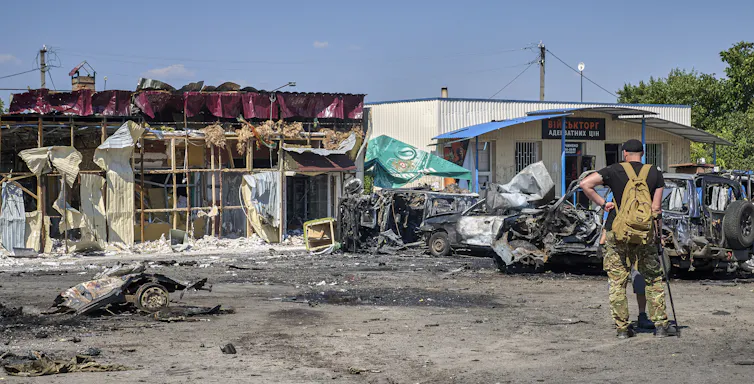
Third, holding an election would require Ukrainians to redirect political energy and economic and military resources away from the struggle for state survival to ensuring the security of the electoral process.
One of Russia’s war aims is the removal of the Ukrainian government from power. And it is unlikely to watch passively while an election unfolds. Russia continues to fire hundreds of missiles at Ukraine each day that could target polling places or campaign events. This makes it impossible to hold a genuinely open election campaign and ensure the safety of candidates and voters.
It is also highly likely that Russia would attempt to influence the process through disinformation, propaganda and tacit support of certain candidates – as it has done in other neighbouring countries.
Ahead of elections in 2025, Moldovan president Maia Sandu warned of a Russian-backed operation to interfere with the vote. This included recruiting orthodox priests to sway voters towards supporting Russia-aligned political parties, as well as extensive algorithm manipulation on TikTok. Moldova’s ruling pro-European Party of Action and Solidarity ultimately won the election.
It perhaps seems paradoxical, but Ukrainian democracy may be stronger in the meantime without elections. There has been a wide political agreement from all parts of the Ukrainian political spectrum since Fedorov made his remarks that the legitimacy of the government would not be strengthened if it was elected through elections deemed illegal under national law, incomplete in terms of the people enfranchised and potentially manipulated by outside forces.
Securing state sovereignty remains Ukraine’s first priority for the preservation of a democratic European future.