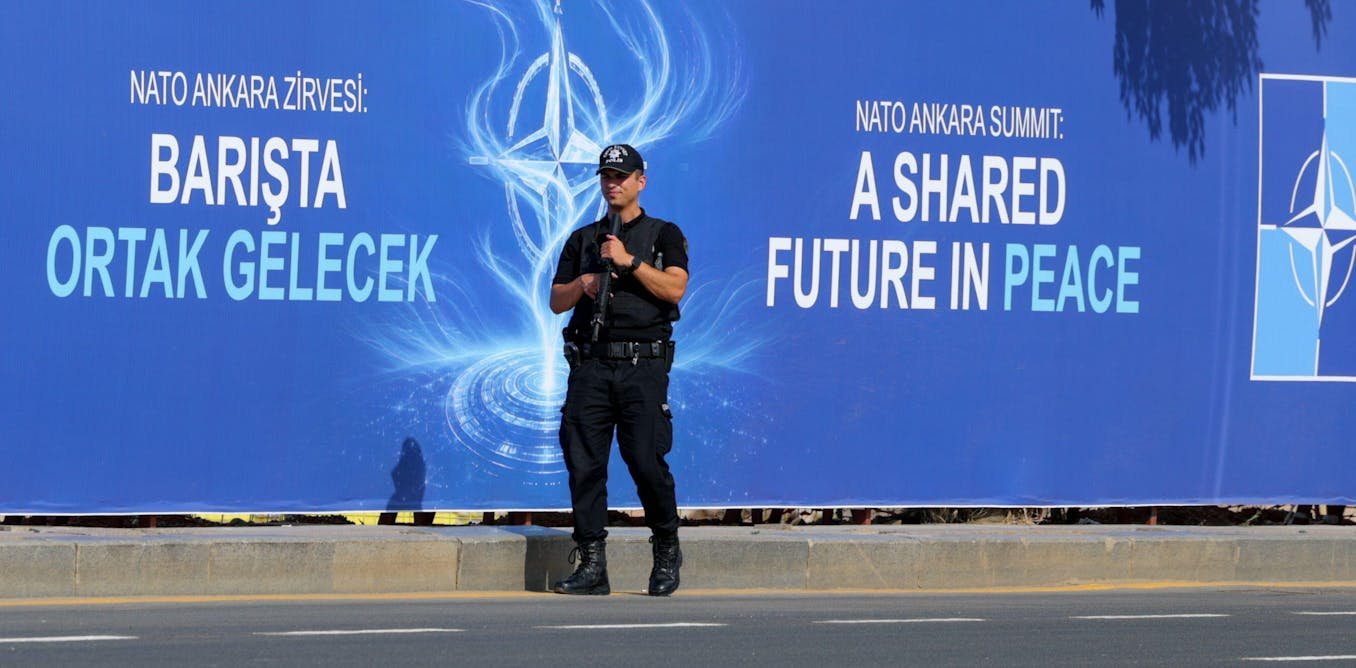
Two massive Russian attacks on Kyiv in less than a week, renewed Iranian threats in the Strait of Hormuz, and a security crackdown in Turkey are just three of the immediate issues shaping the context of the Nato summit in Ankara on July 7-8.
While Ukraine and Iran will be on Nato’s agenda, the authoritarian drift of its host, Turkish president Recep Tayyip Erdoğan, will be politely overlooked. But as ever, the summit outcome will be determined by the position of the United States.
At last year’s Hague summit, the Nato-sceptical US president, Donald Trump, was placated by the allies’ commitment to spend 5% of their GDP annually on defence by 2035. The challenge this year will be to demonstrate sufficient progress towards that goal, while also addressing Trump’s vision of “Nato 3.0” – involving, according to his secretary of war, Pete Hegseth, “a balanced alliance with Europe in the lead for its own defence”.
Progress towards defence spending appears reasonably on track. In 2025 alone, the Atlantic Council notes: “European allies and Canada increased defence spending by 20% from the previous calendar year.” Six Nato allies (the three Baltic states plus Denmark, Poland and Norway) spent more on defence as a share of GDP than the US. Germany, not among that group in 2025, nonetheless has big ambitions. In absolute terms, it is now Nato’s second biggest defence spender.
The allies have also made strenuous efforts to wean themselves off American-sourced defence systems. But bumps in the road remain. Whereas in 2025, all the Nato allies (bar Iceland, which has no armed forces) met Nato’s 2024 standard of spending 2% of GDP on defence, this will not be repeated in 2026. The Czech government and Hungary are likely to dip below the target. And many spending commitments still need to translate into concrete capabilities. Europe’s defence industries are working flat out, but are at the limits of how fast they can absorb new investment.
The success of the summit may just be down to luck and the volatile mood of the US president. Trump seems unable to accept that the Nato allies have made genuine progress in defence. He claimed just days before departing for Ankara it was “ridiculous” that the US continues to support a “one-sided” Nato. That grievance appears to be one reason the meeting may withdraw its endorsement of Albania – a low-spending Nato member – as the 2027 summit venue.
Things could also prove tricky on another of Trump’s pet complaints – the lack of Nato support for the US-Israeli war with Iran. The Nato secretary general, Mark Rutte (who chairs the summit), seems determined to avoid getting too deeply into discussion of the situation.
But if it does intrude, safety will likely be found in the formulation recently agreed by the G7 – welcoming the US-Iran deal, condemning Iran’s nuclear ambitions and supporting a Franco-British led maritime operation in the Strait of Hormuz. Don’t expect a Nato coordinating role in any operation, however. On that, there is no allied consensus.
United approach on Ukraine war
There will be greater scope at the summit for dealing with Russia’s war against Ukraine and the broader threat to European security that emanates from the Kremlin. The Trump administration has grown increasingly distrusting of Putin and, in parallel, more impressed with the Ukrainian war effort.
This has translated into some positives for Ukraine: the country’s president, Volodymyr Zelensky, will be at the summit, attending the Nato-Ukraine Council and the Ukraine Defence Contact (Ramstein) Group meetings, which coordinate western support for Ukraine.
He will be hoping for more concrete commitments similar to British and German defence packages for Ukraine. Nato’s Prioritised Ukraine Requirements List (Purl) initiative, launched last summer, has also already been a big success in keeping arms and other military aid flowing to Ukraine.

That initiative will be reaffirmed at Ankara, signalling a clear commitment to Ukraine-Europe defence links. But the allies still lack a consensus on offering Nato membership to Ukraine. The US is adamantly against it. So a pathway to accession will not be spelled out at the summit.
Where’s China?
Other items missing from the agenda at Ankara will also reflect the Trump administration’s priorities. It’s no surprise that climate change and Women Peace and Security – a UN-led initiative which recognises and fosters women’s contribution to peacekeeping – have fallen out of favour. Both issues figured in Nato communiques during the Biden period – both disappeared from last year’s Hague summit declaration. Don’t expect a mention at Ankara.
More curious, though, is the lowered priority given to China. Nato’s 2019 London declaration contained Nato’s first ever summit-level statement on China, recognising that the nation’s growing influence brought challenges as well as opportunities – a move engineered by the first Trump administration. Then, Nato’s relevance to the US was judged by how it was positioned in the emerging era of “strategic competition”.
Under Biden a similar logic applied, reinforced by the 2024 Washington summit’s description of China as the “decisive enabler of Russia’s war against Ukraine”. And yet China disappeared from the 2025 Hague declaration. It was not discussed at Nato’s recent foreign and defence ministerials. Neither is it expected to figure at Ankara.
Why not? The Trump administration’s recent efforts at accommodation with China are part of the answer. Other allies too are happy to see China sidelined from Nato’s business. France, easily perturbed by a globalist Nato, had always been a sceptic when it comes to including China in Nato’s agenda. Many east European allies, meanwhile, see a China focus as distracting Nato from Russia. And big exporters like Germany need to keep Beijing sweet, given the shrinkage of their Russian market.
The summit declaration will again be short to avoid controversy. But like an iceberg, much lies below the surface. The detailed work of moving to “Nato 3.0” was already agreed at the Nato defence ministerial in mid June. Most of the gaps in Nato’s European defence plans occasioned by recent US force announcements have already been plugged.
The summit will give rise to much noise, but Nato’s ongoing adaptation to the new reality engendered by shifting US priorities suggests a high degree of underlying resilience.