Political analyst Amer Sabaileh tells The Media Line that authorities have overlooked years of growing extremist sentiment, while another Jordanian commentator expresses confidence in the kingdom’s social cohesion
The killing of nine people during a funeral at a Greek Orthodox church in southern Jordan has raised questions about the spread of religious extremism, the effectiveness of the kingdom’s security policies, and the future of coexistence between its Muslim and Christian communities.
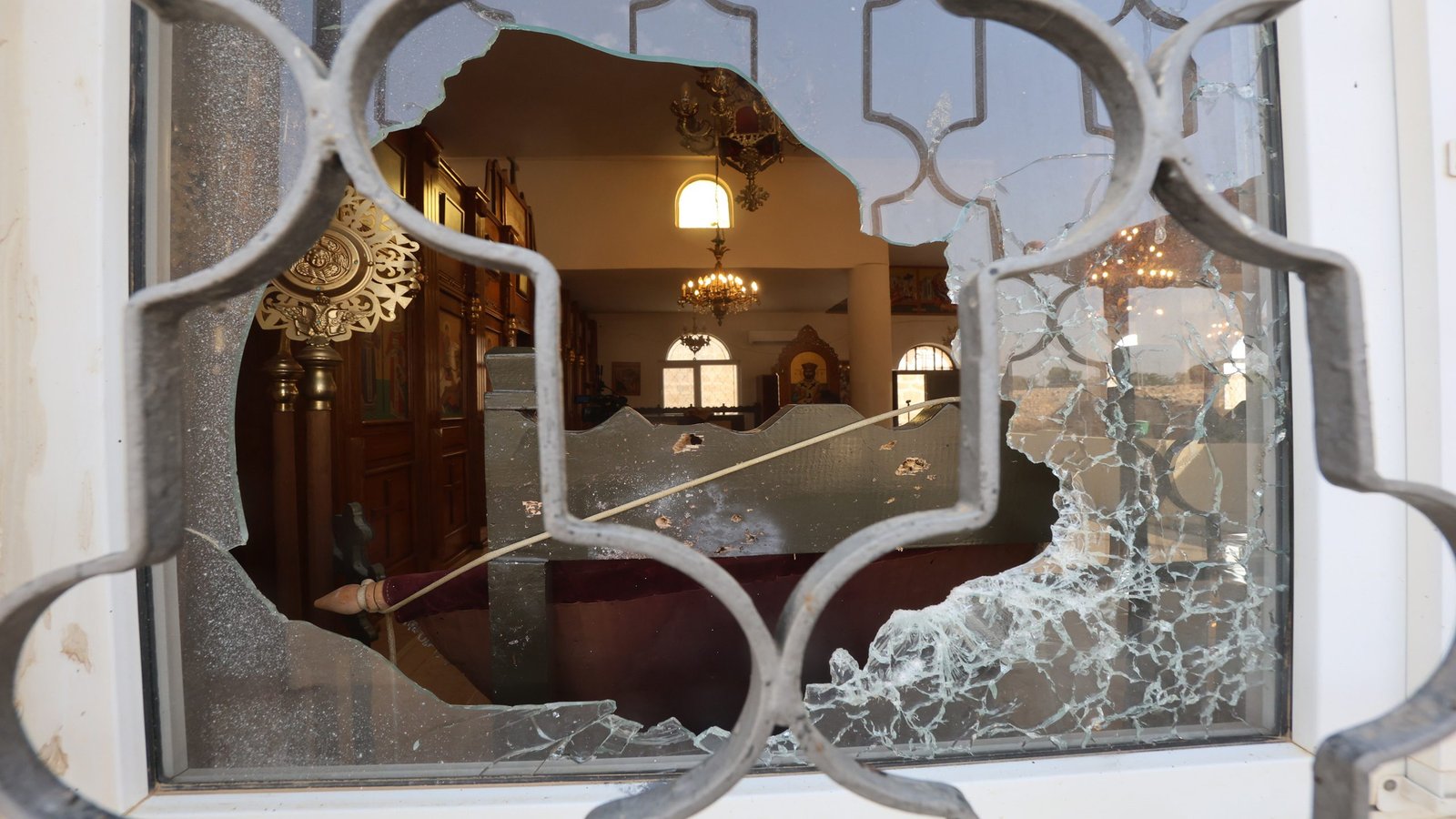
The attack occurred on Friday, October 23, at Saint George’s Church in the village of Hmoud, in Karak Governorate, leaving nine people dead and approximately 40 wounded. Gunmen opened fire on mourners gathered for a funeral, turning a religious ceremony into one of the deadliest attacks against Jordan’s Christian community in recent years.
Surveillance footage showed at least three armed men approaching the church and opening fire. Witnesses described several minutes of shooting as people attempted to escape or take shelter inside the building. Jordanian authorities launched a security operation to locate the perpetrators, while the government declared three days of national mourning.
Sahar al-Halsa told Reuters that she hid behind a pillar as gunfire erupted. When she emerged, she found her cousin Assem wounded. He briefly opened his eyes before dying.
As of Sunday, the attackers remained at large, and no organization had claimed responsibility. Jordanian authorities described the shooting as an act of extremist terrorism but had not publicly established the perpetrators’ identities, organizational affiliations, or precise motives.
King Abdullah II condemned the attack and ordered security forces to pursue those responsible with an “iron fist.” During a National Security Council meeting on Saturday, the monarch ordered a comprehensive security assessment, measures to improve preparedness, and a review of policies aimed at countering extremist ideology and addressing its underlying causes. He also called for action against misinformation that could exploit the attack to deepen divisions.
Prime Minister Jafar Hassan attributed the violence to extremist ideology and pledged to hold those responsible accountable. Jordanian officials have also emphasized that the country’s Christian community is an integral part of its national identity.
The killings have shaken a country often regarded as one of the more stable states in the Middle East, where the monarchy has long emphasized religious moderation and coexistence among different communities.
The attack has brought competing assessments of radicalization in Jordanian society into sharper focus, raising the question of whether the violence represents an isolated extremist operation or a warning of deeper problems.
For Rami Bassem Haddad, a Jordanian Christian media personality, the choice of target strongly suggests an ideological motive intended to undermine national stability.
“The targeting of the Church of Saint George in the town of Hmoud, in the Karak Governorate, is interpreted as a terrorist attack bearing the hallmarks of an extremist, takfiri (exclusionist/hard-line) ideology. Its primary objective is to strike at the model of religious coexistence and destabilize Jordan’s internal security,” Haddad told The Media Line.
He argues that targeting a Christian place of worship, particularly during a funeral, carries significance beyond the immediate victims. In his assessment, extremist organizations frequently seek to undermine relationships between communities by attacking religious institutions and civilians.
Although the religious setting has reinforced suspicions of sectarian motivation, investigators have yet to establish whether the assailants operated independently, belonged to a domestic extremist network, or maintained connections with organizations abroad.
Jordanian political analyst Amer Sabaileh offers a more critical assessment, questioning whether Jordan’s longstanding reputation for religious moderation accurately reflects developments within its society.
Today, I believe that Jordan should wake up from the illusion it has created by being a moderate island
“Today, I believe that Jordan should wake up from the illusion it has created by being a moderate island,” Sabaileh told The Media Line.
“Over the years, you can easily see that society was radicalizing. Despite this, no one did anything. No one wanted to touch on these issues,” he added.
Sabaileh argues that extremist attitudes have been developing domestically for years and that public institutions have failed to confront them adequately. In his view, the problem extends beyond threats posed by organizations such as ISIS or al-Qaeda and requires examining the social environment in which radical ideas circulate.
“But I believe that Jordan is seriously suffering from very strong social salafism. And this social salafism, unfortunately, does not exclude the system itself,” he said.
His criticism extends to what he describes as insufficient cultural and economic development in parts of the country. He believes limited opportunities and excessive reliance on religious institutions have contributed to an environment vulnerable to radicalization.
These are Sabaileh’s assessments of broader social developments, rather than findings established by the investigation into Friday’s shooting.
Karak has experienced extremist violence before. In December 2016, gunmen carried out a series of attacks targeting security personnel and civilians in and around the city’s historic Crusader castle. Ten people, including seven security officers, two Jordanian civilians, and a Canadian tourist, were killed. Four attackers also died. ISIS subsequently claimed responsibility.
Friday’s shooting has renewed concerns about whether extremist networks may have survived in the region despite years of security operations. However, there is no confirmed evidence linking the perpetrators of the church attack to those responsible for the 2016 violence.
Haddad cautions against drawing conclusions before the current investigation is completed.
“As for any potential link to the previous Karak cell, we should leave that assessment to the security services—pending the arrests and the subsequent release of investigation reports—noting that His Majesty the King is following the matter closely and personally.”
He also points to the difficulties security agencies face in preventing attacks carried out by small groups or decentralized networks.
“Attacks on ‘soft’ civilian targets—such as gatherings outside places of worship in villages—are among the most challenging operations to prevent through intelligence, as they do not involve the kind of large-scale weaponry or logistics that would typically arouse suspicion prior to execution,” he said.
Sabaileh, however, disputes the suggestion that radicalization necessarily develops without visible warning signs.
“We rely a lot on signals. Society gives you a signal, and we got a preventive signal,” he said.
He alleges that extremist rhetoric had circulated openly on social media before the attack and that authorities should have responded more effectively. He also made claims concerning the suspected backgrounds and connections of the perpetrators that have not been independently verified.
Those allegations raise questions about whether the attackers operated without attracting security attention or whether earlier indications of radicalization went unaddressed. The available evidence does not establish that security agencies had actionable warnings of the attack.
For Sabaileh, identifying and arresting the perpetrators would address only part of the problem. He believes Jordan must also confront the ideological environment in which extremist violence can develop.
The attack has also reopened debate over the position of Christians in Jordan and the resilience of relations between the kingdom’s religious communities.
Christians account for approximately 2% of Jordan’s population but have a longstanding presence in public life. They serve in government, political institutions, and the armed forces, and nine seats in the House of Representatives are reserved for Christian candidates.
Following the attack, Christian and Muslim religious leaders condemned the violence and called for unity. Christian leaders emphasized their solidarity with Jordan’s Christians and expressed confidence that the attack would not undermine the country’s tradition of religious coexistence.
For Haddad, these reactions reflect a shared Jordanian identity that transcends religious differences.
“Indeed, I would like to point out that Jordan enjoys a unique situation characterized by strong social cohesion, brotherhood, and mutual respect for various religions and beliefs,” he said.
He rejects defining Jordanian Christians primarily by their relatively small demographic size.
I would like to clarify an important point: while we Christians in Jordan are relatively few in number, we are by no means a ‘minority’
“I would like to clarify an important point: while we Christians in Jordan are relatively few in number, we are by no means a ‘minority,’” he said.
Haddad pointed to Christians’ participation in Parliament, the Cabinet, and the military as evidence of their place in Jordanian society. At the same time, he acknowledged that hostility toward Christians exists within certain segments of society.
“That said, there are misguided elements—acting in a subtle, underhanded manner—who seek to foster sentiment against us; such actions are certainly not welcomed,” he said.
Sabaileh takes a different view, arguing that expressions of solidarity, while important, cannot substitute for structural changes aimed at strengthening equal citizenship.
He questions whether repeated appeals to religious harmony adequately address the concerns of Christians who, he believes, have become increasingly alienated from aspects of Jordanian public life.
“They no longer feel at ease, even in front of a bureaucratic system,” he said.
“Because you no longer feel identified in this society. Unfortunately, this is a reality we have been living for more than 30 years. No one says anything,” he added.
Sabaileh believes Jordan needs stronger civic institutions that ensure citizens are treated equally regardless of religion.
“You have to come up with a national project, not a religious one,” he said.
I don’t care what religion you are; I care that you are a Jordanian citizen
“I don’t care what religion you are; I care that you are a Jordanian citizen,” he added.
His emphasis on citizenship contrasts with Haddad’s greater confidence in the monarchy and the existing institutional framework for protecting religious pluralism.
Despite their differences over the strength of Jordan’s social cohesion, both men identify radicalization as a problem requiring attention beyond the investigation into the church shooting.
Haddad points particularly to the influence of online platforms and the exposure of younger generations to extremist messaging.
“However, in my view, a lack of cultural awareness—compounded by the unfettered openness of social media—has led a significant number of young people to embrace takfiri (extremist/exclusionary) ideologies, without any sense of awareness or responsibility,” he said.
Sabaileh also emphasizes the influence of public rhetoric but places greater responsibility on the state for recognizing and responding to changes in social attitudes.
He argues that religious identity should not take precedence over citizenship, constitutional authority, and equal treatment under the law.
“Unfortunately, this is the lack of a national project. You see that when the national identity is weakened, immediately the religious identity tries to take up space, to occupy it. This is the risk,” he said.
Sabaileh advocates stronger civic institutions and greater investment in cultural education, rather than relying primarily on religious authorities to counter extremist ideology.
The king’s instructions to review counter-extremism policies present an opportunity to assess the effectiveness of Jordan’s existing approach. While the monarchy has called for a more comprehensive response to radicalization, Sabaileh questions whether a framework heavily dependent on religious institutions can produce the changes he considers necessary.
Haddad, meanwhile, insists that investigators should establish the facts before conclusions are drawn about the perpetrators and their possible affiliations.
“We are currently awaiting an official statement to determine whether this cell is linked to other groups that have already carried out—or were preparing to carry out—further operations,” he said.
As mourners gathered on Sunday to bury victims of the attack, Jordan faced two immediate challenges: bringing the perpetrators to justice and addressing concerns about the security of its Christian communities.
For Haddad, the violence will not fundamentally alter relations between Jordan’s religious communities.
“I should also emphasize that our society—comprising both Christian and Muslim tribal components—remains united around the King, and we categorically reject such incidents,” he said.
He expressed confidence that Jordanian society would emerge from the violence with its social cohesion intact.
“This crime will only serve to make us stronger and more resilient,” he said.
Sabaileh is considerably less optimistic about the country’s ability to move forward without substantial changes.
“If the royal family and generally the state don’t immediately take concrete steps towards this change, I think it will be a lost and useless battle. But if they now face reality as it is and admit that they have done everything wrong and start with strength, without shyness, with a clear vision, I think it will be easy. But I don’t see any hope, unfortunately,” he concluded.