Bangladesh has spent 55 years avoiding military alliances. It may now be contemplating the rather more complicated business of joining one.
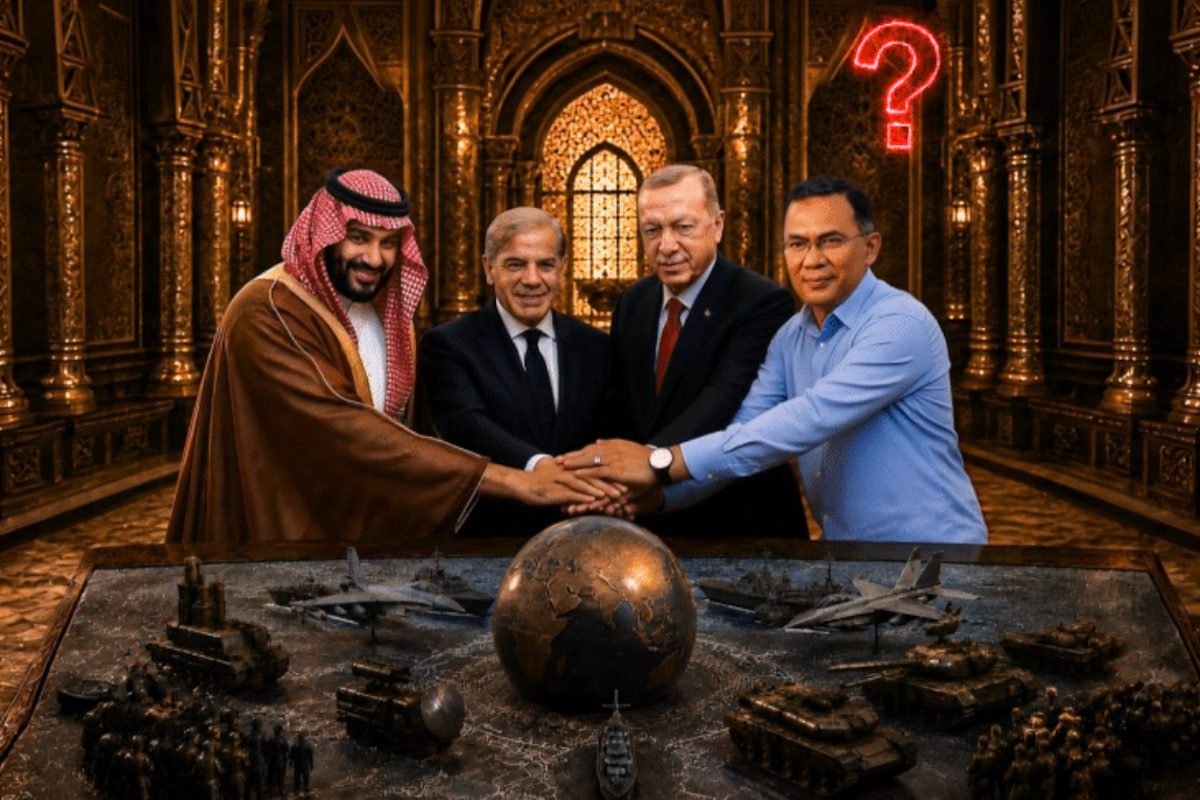
Humaiun Kobir, the state minister for foreign affairs, said this week that Bangladesh had expressed interest in the Mecca Joint Defense Agreement, signed by Saudi Arabia, Turkey and Pakistan on August 7.
The collective security pact nominally treats an armed attack on any one member as an attack on all three. They signed the agreement amid the upheaval in West Asia following the widening Iran conflict and attacks by the Iran-backed Houthis.
Kobir had said earlier Bangladesh viewed joining an economic or defense framework involving the three countries “positively”, provided it served the national interest. Another junior minister has made similar sounds.
Saudi Arabia, Reuters reported, has invited Bangladesh to join. Membership would thus mean something considerably more serious than another summit photograph.
Since achieving independence in 1971, Bangladesh has made a virtue of strategic promiscuity without strategic marriage. Its foreign policy has been formally non-aligned, allowing Dhaka to buy Chinese weapons, trade heavily with the West, send workers to the Gulf, accept Japanese infrastructure money, cooperate with India and maintain cordial relations with countries that dislike one another.
It has joined international organizations, peacekeeping operations and cooperative security arrangements, but no treaty-bound collective-defense alliance comparable to the Mecca pact.
To date, this has worked rather well for Bangladesh. Non-alignment is especially convenient when surrounded by larger countries and would prefer their quarrels not to become yours.
But non-alignment is easier when the world itself is less aligned. The emerging international order is becoming increasingly transactional and increasingly divided. The Americans are assembling partnerships. China has its strategic networks. India is constructing its own web of security relationships.
Turkey is expanding its influence well beyond its immediate neighborhood. Saudi Arabia is behaving less like a wealthy client state and more like a regional power. Pakistan, meanwhile, remains a formidable military actor with nuclear weapons and a talent for making itself strategically relevant.
Dhaka may conclude that permanently sitting in the geopolitical waiting room is no longer necessarily the safest option. The Mecca pact is attractive precisely because its three founding members are countries with which the new Bangladesh government has substantial interests.
Saudi Arabia is central to Bangladesh’s labor economy and energy security and holds enormous religious significance for its overwhelmingly Muslim population. Dhaka has already joined a Saudi-led maritime security arrangement intended to protect shipping around the Red Sea and Gulf of Aden from Houthi attacks. Kobir has said the relationship with Riyadh should now become strategic rather than remain centered on Hajj and Umrah.
Turkey offers defense technology. Ankara has become a major supplier of drones, armored vehicles, missiles and other relatively affordable military hardware. For Bangladesh, which is trying to modernize its armed forces without becoming wholly dependent on China, Turkey is an obvious partner.
Then there is Pakistan. Relations between Dhaka and Islamabad, frozen for much of Sheikh Hasina’s rule, have thawed rapidly since her fall in August 2024. Trade, diplomatic exchanges and military contacts have expanded. Kobir has publicly described renewed engagement with Pakistan as normal diplomacy.
For India, the Mecca pact does not arrive in isolation. It lands after two years in which nearly every comfortable assumption India once held about Bangladesh has been disturbed. Hasina was India’s closest strategic partner in Dhaka. Her removal did not merely change a government; it removed the central pillar of India’s Bangladesh policy.
Hasina then fled to India, where her continued political and media activity has become an enduring source of irritation between the two governments. Dhaka has repeatedly complained about her activities from Indian territory.
Meanwhile, Bangladesh has reopened doors India preferred closed.
Pakistan is back in diplomatic play. Turkey is more prominent. China remains deeply embedded in Bangladesh’s defense and infrastructure sectors. Even the ruling BNP has established closer institutional contact with Beijing: in June it signed its first memorandum of understanding with the Chinese Communist Party.
From Dhaka, this can be described as diplomatic diversification. From New Delhi, it resembles a guest rearranging the furniture while the owner is away.
India’s anxiety, to be sure, is not entirely paranoia. Pakistan remains its principal military adversary. Turkey’s relations with India have deteriorated substantially, particularly because of Ankara’s support for Pakistan and its position on Kashmir. A military grouping containing both countries acquiring a member almost entirely surrounded by India on three sides would inevitably ring alarms in New Delhi.
Indian commentary has called the prospective Bangladeshi move a “red line.” The strategic concern is straightforward: Bangladesh joining a collective-defense framework involving Pakistan could potentially introduce an external military dimension into India’s eastern neighborhood.
Bangladesh should not dismiss this simply because India dislikes it. Geography is an irritatingly permanent feature of foreign policy. Pakistan is almost 2,000 kilometers away. Turkey and Saudi Arabia are farther still. India shares a 4,096-kilometer border with Bangladesh and surrounds it on three sides. No defense agreement can amend the atlas.
There are other complications. What exactly would Bangladesh be obliged to do if Iran attacked Saudi Arabia? What happens if Turkey becomes involved in another conflict in Syria? More awkwardly, what would the collective-defense clause mean during an India-Pakistan confrontation?
Bangladesh has good relations with Iran, too. Joining a security architecture created partly amid fears of Tehran and its regional allies could damage a relationship from which Dhaka currently derives no obvious benefit in sacrificing. Critics have already warned that deeper military involvement in West Asia could undermine Bangladesh’s carefully balanced diplomacy.
There is thus a distinction between closer strategic cooperation with the Mecca trio and formal membership of their defense pact.
Bangladesh has compelling reasons to deepen relations with all three. More Saudi investment and labor access would be welcome. Turkish defense cooperation makes strategic sense. Normal relations with Pakistan are the ordinary prerogative of a sovereign state.
None requires Bangladesh automatically to promise that an attack on any of them is an attack on itself. That is where the new government’s “Bangladesh First” doctrine will face its first serious examination. A foreign policy based on national interest sounds wonderfully uncomplicated until several national interests point in different directions.
Joining the Mecca pact might give Bangladesh new strategic leverage and demonstrate that Dhaka no longer accepts an India-centric definition of its foreign relations. It might also exchange five decades of useful ambiguity for military obligations in West Asia and fresh hostility from the only great power Bangladesh cannot move farther away from.
India, for its part, will have to adjust to an uncomfortable fact. Post-Hasina Bangladesh is going to have closer relations with Pakistan, Turkey and China whether New Delhi approves or not. Treating every such relationship as an anti-Indian conspiracy may eventually produce precisely the alignment India fears.
But Bangladesh has an equally uncomfortable fact to confront. Strategic autonomy means being free to join an alliance. It also means being sufficiently confident not to need one.
For half a century, Bangladesh has managed the useful trick of being everyone’s friend without becoming anyone’s military ally. The Mecca pact offers benefits but at the potential cost of the very independence Dhaka has spent 50 years protecting.
Faisal Mahmud is a Dhaka-based journalist.