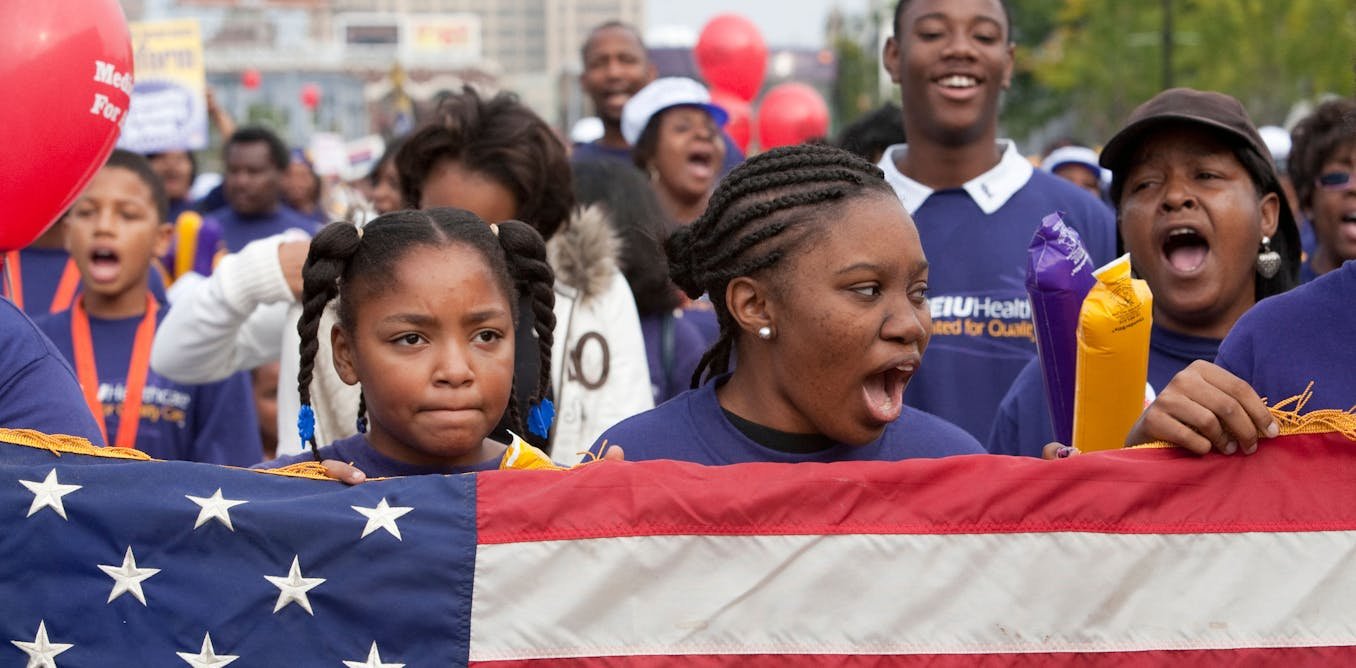
As the United States celebrates its 250th anniversary, there is a tension between those who want to remember an uncomplicated past and those who would remember that freedom is a constant struggle. It’s a right that must be fought for and defended.
And amid all the hoop-la over the celebrations, the nation risks forgetting that since the War of Independence, African Americans have played a crucial role defining and expanding American liberty.
The Declaration of Independence promised “all men are created equal”. And yet when Thomas Jefferson – himself an enslaver – penned those words, there were around half a million enslaved people living in the 13 colonies.
Black Americans saw the contradictions at the heart of the Revolutionary era, and they sought to redefine liberty. During the Revolutionary War, thousands of enslaved Americans sought freedom – sometimes by joining the British, and sometimes by serving the Patriot cause.
They often used the pen, as well as the sword, to link the nation’s fight for freedom to their own. The poet Phillis Wheatley, born in west Africa and enslaved in Boston, published a poem in 1772 comparing her enslavement to tyrannical British rule. A group of Black Bostonians presented petitions to the Massachusetts legislature calling for the abolition of slavery, using the language of natural rights and words and phrases from the Declaration of Independence.
Ultimately, Black patriots were betrayed by a new nation that was founded on competing visions of freedom. For Black Americans, liberty did not just mean self-government and freedom from British rule. It also required emancipation, citizenship, and equal rights. While there was gradual abolition in northern states, in the south slavery expanded and the institution was seemingly protected by the federal constitution.
But African Americans refused to accept an interpretation of freedom which excluded them. At Colored Conventions across the country, activists asserted they were true defenders of the Revolution’s principles and, as such, their treatment was a betrayal of those ideals. “The Constitution is Anti-Slavery”, one such convention concluded.
The great orator and formerly enslaved abolitionist, Frederick Douglass, on the anniversary of Independence in 1852, asked: “What, to the American slave, is your 4th of July?” Speaking to his white audience, he explained: “This Fourth July is yours, not mine. You may rejoice, I must mourn.”
To the slave, commemorating independence revealed the limits of America’s vaunted liberty and equality.
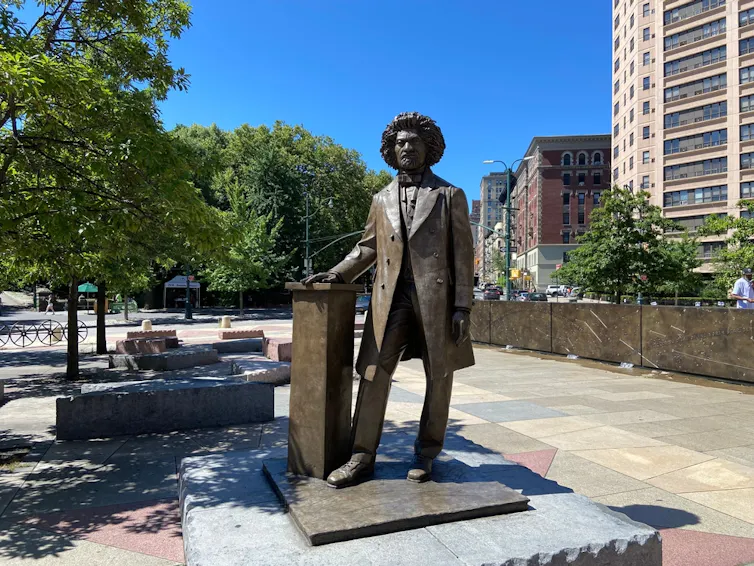
After emancipation, African Americans used revolutionary principles to demand full citizenship rights. In 1870, Black men were given the vote by the 15th Amendment, and African Americans were afforded the protections and privileges of citizenship. But again they were betrayed, and these rights were dismantled through violence and the erosion of those constitutional protections.
As the strictures of segregation tightened around them, African Americans continued to use memories of American liberty. Black people had always defended American democracy, explained civil rights leader Mary McLeod Bethune in a 1939 speech. “We have given our blood in its defense – from Crispus Attucks on Boston Commons to the battlefields of France,” she said, invoking the spectre of the Black hero of the War of Independence. And yet, for Bethune, Black people fought not for what America was “but for what we know she can be”.
Martin Luther King: cashing the check of justice
It was this belief in a better America that drove many in the Black freedom movement. Standing on the steps of the Lincoln Memorial, 100 years after Emancipation, Martin Luther King Jr not only remembered the slain president’s proclamation, but also the founders who preceded him.
The Constitution and the Declaration of Independence were a “promissory note” that guaranteed all people their inalienable rights, he said. And while the country had defaulted on its promise, King refused to believe “that the bank of justice is bankrupt,” and so he and thousands of others had “come to cash this check”.
The cheque was cashed, for at least some of the balance, with the passage of the Civil Rights Act in 1964 and the Voting Rights Act a year later.
But as America marks its 250th anniversary, the “bank of justice” is looking increasingly short of funds. There is a concerted effort to forget the contradictions of American liberty. The Trump administration is curating a commemoration that emphasises unity and patriotism, with an uncomplicated retelling of the nation’s history, that downplays slavery and racial division.
The Freedom Trucks illustrate Trump’s “Freedom 250” initiative, in which, according to journalist Ed Pilkington, America is represented as a “God-given force for freedom led by Judeo-Christian white men”.
The founding fathers are unreservedly celebrated, with no acknowledgement that some were slave owners. While an exhibit highlights Douglass’s Fourth of July speech, it doesn’t discuss his condemnation of the hypocrisy of celebrating freedom while millions were enslaved.
Black rights under threat
Now the US is poised for another celebration of American exceptionalism. But it’s one that ignores the complexities and contradictions of the nation’s founding. And it’s taking place as the hard-won achievements of the Black freedom struggle are being rolled back, as the Voting Rights Act is gutted, and Black political representation in the south comes under attack.
Just as in the antebellum era of the 1800s, at the height of Reconstruction in the late 19th century, and during the nadir of Jim Crow in the 20th, it is essential that America’s founding is remembered as the beginning of an unfinished struggle for liberty.
And it is important to remember that when they fought in the Revolutionary War (and all the wars that followed), wrote petitions, made proclamations and organised protests, African Americans gave meaning to the nation’s founding principles and documents.
As historian, Annette Gordon-Reed argues, what matters is not Jefferson’s intentions when writing the Declaration, but what others have done to give those words purpose and life.
If the founders did not mean to include them in the Constitution’s preamble, then through their tireless labour, activism, and remembering, African Americans have fought to make sure they too are contained in “We the people”.