Jeffrey Miller’s newest novel, The Tree at Panmunjom, begins in the summer of 1976, as a soldier fresh out of basic training named Bill Davis arrives in South Korea and finds himself assigned to Camp Kitty Hawk just before serving a tense 24-hour shift at the nearby Demilitarized Zone’s Joint Security Area.
On arrival at the DMZ, Davis asks his fellow soldiers, “How long before this starts feeling normal?” The reply, “I’ll let you know when it does,” elicits chuckles from his more seasoned comrades. Then comes the real answer: “You get used to the routine. But normal’s not part of the package.”
The novel brings to life the events of 50 years ago that ultimately led to Camp Kitty Hawk being given a new name: Camp Bonifas.
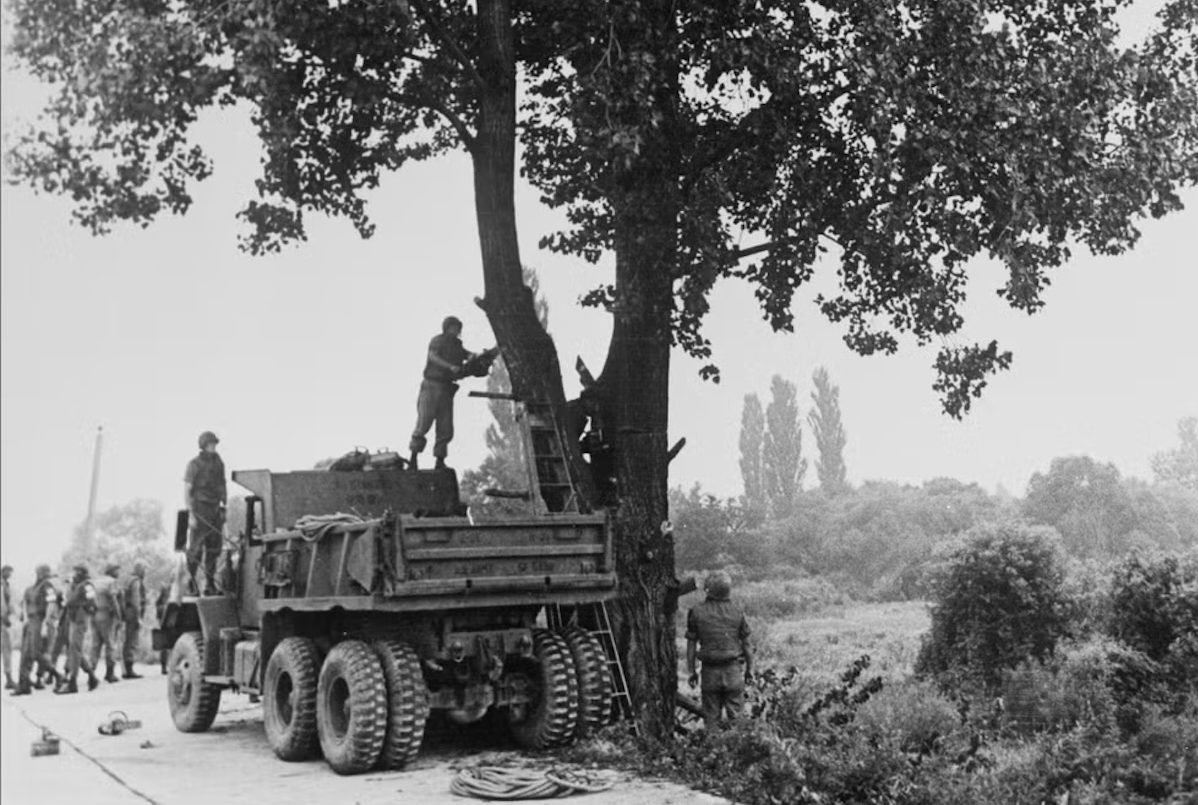
On August 18, 1976, an operation to trim a tree in the Joint Security Area ended with the murder of American officers Captain Arthur Bonifas and First Lieutenant Mark Barrett by North Korean soldiers. In response, three days later, in an operation fraught with the possibility of sparking hostilities, a joint American-South Korean task force cut down the tree as helicopters, fighters and bombers massed overhead.

The novel begins with a poetic meditation on the life of the tree whose “roots trespassed freely beneath a line men would kill to defend” before introducing readers to the geography and day-to-day atmosphere of the DMZ through the eyes of the newly arrived Davis.
Miller, a Korea Times columnist who has been writing for the paper since 1999, has published about 15 novels so far, many inspired by his decades of living in Korea. This latest work does an admirable job of immersing readers so deeply that they swelter in the summer heat, jostle about in the two-and-a-half ton trucks as they carry soldiers over bumpy roads to the Joint Security Area and feel the sunshine as it passes between overhead clouds and dapples the mountains visible through the summer haze.
As Davis gradually becomes accustomed to the routines of guard duty in the JSA, a growing undercurrent of tension ebbs and flows until it finally explodes in violence. From that point, more than halfway through the novel, the scenes shift away from Davis to follow the thread of decision-making from the highest offices to the farthest-flung of military bases as a response is formulated and carried out. In this way it shifts from an intimate portrait of one man’s service on the frontline to a larger Cold War geopolitical thriller before finally returning to Davis and revealing the lingering weight of these events upon him.
As Miller described it, he wanted the book to be “more than historical fiction” and to “feel authentic” in order to convey the “extraordinary burden carried by those who stood watch in one of the most dangerous places on Earth … knowing that a single misunderstanding could change history.”
The novel grew out of Miller’s experience covering the 25th anniversary of the incident for The Korea Times in 2001. At that time, Lieutenant Colonel William Miller (no relation), commander of the Joint Security Area, invited him to attend the commemoration and arranged several special tours of the JSA, which allowed him “to walk the ground where these events unfolded” and “provided an invaluable understanding of Panmunjeom and its history.”
To write the nearly 3,000-word article, he interviewed a number of soldiers who witnessed events that The Tree at Panmunjom describes. Among them were Capt. Bonifas’s driver and guard, Mark Luttrull, who “felt some degree of responsibility” for not being present when Bonifas was killed, and who “was probably the only person who volunteered” to be on the ground when the tree was finally cut down, an operation that carried such a potential for disaster that soldiers were ordered to prepare the nearby Camp Liberty Bell for destruction by rigging it with explosives so that it could be detonated if hostilities broke out.
One of the soldiers involved, Wayne Johnson, told the author that many in his unit thought “something might happen and there was about a 50-50 chance that we wouldn’t make it out.”
According to Miller, Wayne Kirkbride’s book DMZ: A Story of the Panmunjom Axe Murder was an important source of information, but “most of what I learned about the JSA was from Bill Ferguson,” a soldier who witnessed the Axe Murder Incident and gave him a firsthand account of life in the JSA. As Miller put it, “His recollections brought a human dimension to the history that no official report could ever capture.”
One cannot read Miller’s descriptions of F-4 fighter jets taking off, with “heat blasting outward in shimmering sheets,” the sound “rattling hangar doors, driving through the body” without suspecting that he brought his own service in the US Air Force to bear upon the novel — something Miller confirmed.
“In 1978, I was stationed at George Air Force Base in the Mojave Desert” working in Maintenance Control “and we had F-4s, F105s and F111s,” he said. “Every morning I’d watch one aircraft after another take off,” so the scenes involving them “were easy to write.”

Readers interested in Korean or military history, as well as anyone looking for a compelling historical page-turner, will find much to admire in The Tree at Panmunjom. It is at once an in-depth portrait of service on the DMZ, an examination of one young man’s growth and a Cold War geopolitical thriller.
At one point, Miller’s main character Davis asks whether anyone will even remember or care about what happened in August 1976. Miller answers that question by giving a vivid new account of those events and the people who lived through them.
“The Tree at Panmunjom” is available on Amazon.
Matt VanVolkenburg has a master’s degree in Korean studies from the University of Washington. He is the blogger behind populargusts.blogspot.kr, and co-author of Called by Another Name: A Memoir of the Gwangju Uprising.
This article, originally published by Korea Times, is republished with permission.