The astronauts flying aboard the Artemis II mission to the Moon last month took a lot of pictures, and a few dozen of the best ones were released during and shortly afterward the flight.
But it wasn’t until last weekend that NASA released the whole trove of more than 12,000 images, dumping them onto the Gateway to Astronaut Photography. The astronauts used three different cameras on the mission: a Nikon D5, a Nikon Z9, and an iPhone 17s. There are some hits and misses in the archive, plus some new gems.
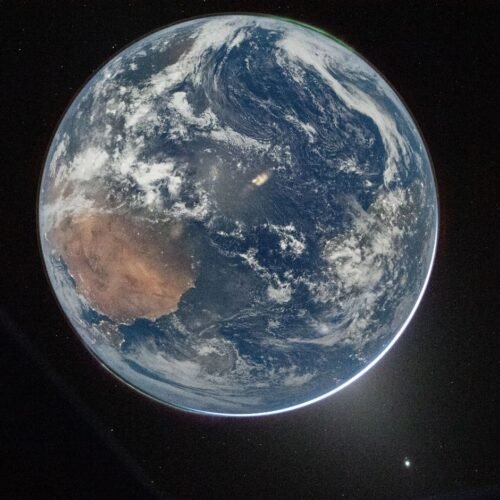
One of the early highlights during the mission was the “Hello, world” image captured by Artemis II Commander Reid Wiseman as the Orion spacecraft left Earth on its outbound journey toward the Moon.
In the newly released archive, there are dozens more images from this sequence. On Wednesday, Andy Saunders—known for processing a trove of Gemini and Apollo images into gorgeous books—shared a composite of these images that he processed and animated into a stunning new visual.
This is incredible. The new @NASA image release from #Artemis includes a sequence of ‘Hello World’ still photographs.
I’ve been processing / animating them and here’s what the original didn’t show us:Satellites, including their solar arrays, lightning storms
and dancing aurora! pic.twitter.com/fiCdXIhXyt— Andy Saunders – Apollo Remastered (@AndySaunders_1) May 6, 2026
The animation is sped up by a factor of 30, with the sequenced images covering 1 minute and 20 seconds in real time.
“There are 17 separate photos in the sequence—there were more, but at different exposures and Earth started to drift off-shot in some—so this was the best consecutive sequence,” Saunders told Ars via email. “I applied some color and contrast adjustments to each individual frame then animated them. They’re great resolution, so I could then zoom in on the most interesting parts.”
Those interesting parts include lightning storms, aurorae, and satellites. The latter present an interesting phenomenon: It appears the solar arrays on the satellites are visible. This seems unlikely, though, as the scale in the image means these arrays would have to be on the order of a kilometer wide, which is not the case. It is possible that the solar array’s appearance may be an optical effect due to Orion’s window.
In any case, the new imagery offers yet another stunning view of our world, which is active not just on the surface but in the heavens above.