
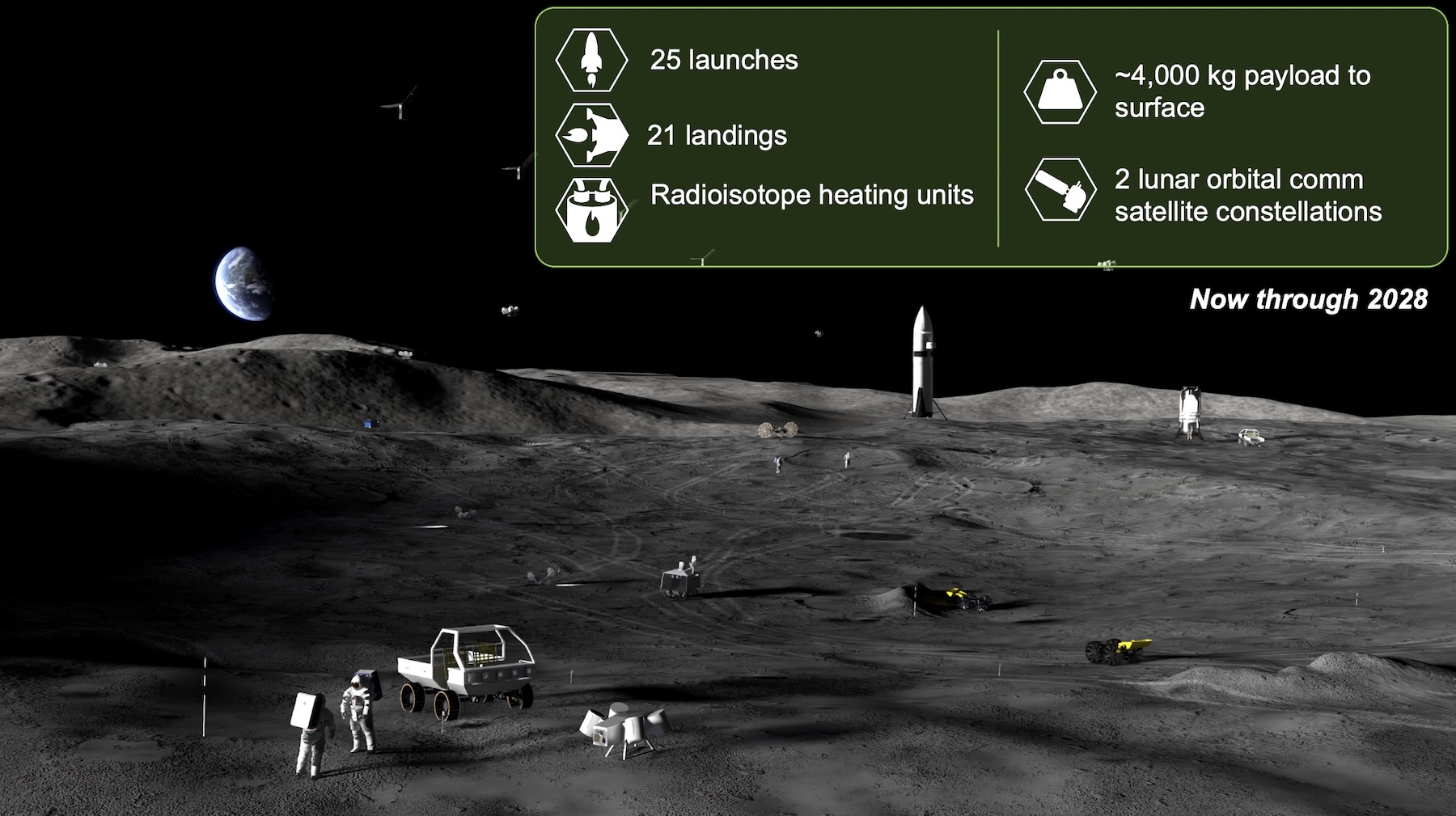
NASA’s goal of reaching the Moon’s surface as many as 21 times over the next two and a half years will require an overhaul of the agency’s approach to buying lunar landers and success in rectifying the myriad problems that have, so far, caused three of the last four US landing attempts to falter.
It will also require improved oversight of NASA’s industrial base and better management of a supply chain that has often failed to deliver on time.
These landers are separate from NASA’s Human Landing System program, which has contracts with SpaceX and Blue Origin to develop and deliver human-rated landers to ferry crews to and from the lunar surface for the agency’s Artemis program. Alongside the crew landers, dozens of robotic and cargo landings will deliver payloads to scout for a future Moon base and demonstrate technologies for larger vehicles, mining and resource utilization, and sustained operations during the two-week-long lunar night.
“Frequent high-mass, low-cost access to the lunar surface” should be the highest priority for the early phase of the Moon base initiative, said Jacki Cortese, vice president of civil space at Blue Origin. This tracks with the roadmap NASA Administrator Jared Isaacman outlined in March, when he announced that the agency will refocus its efforts on building an outpost on the lunar surface, rather than a mini-space station thousands of miles above the Moon.
The fundamentals for high-frequency missions to the lunar surface are in place. NASA’s Commercial Lunar Payload Services (CLPS) program, announced eight years ago this week, has assembled a roster of commercial providers to design and build robotic Moon landers. Through CLPS, NASA has contracted with US companies for 13 missions since 2019. Four of them have launched, and just one has completed a fully successful landing. Four more commercial landers are under construction now for launches in the second half of this year, but as is common in the space industry, their schedules have a history of delays, and some are likely to move into 2027.
Eight years in, CLPS is still in its “infancy,” said Brad Bailey, NASA’s assistant deputy associate administrator for exploration, during a recent lunar science workshop. Now, NASA is asking its lander providers, still learning to crawl, to rapidly learn to walk and run over the next two years.
Improving reliability
NASA has penciled in nine lunar landings for next year, followed by 10 in 2028. NASA and its commercial partners must pick up the pace to come anywhere close to that. Isaacman acknowledged this in a hearing last week before the Senate Appropriations Committee’s Subcommittee on Commerce, Justice, and Science.
“We have to do more than talk,” Isaacman said. “For a very long time across all of NASA, we’ve talked a really good game but then we kind of sit and wait for our vendors and partners to deliver outcomes, and as a result we tend to be late and it tends to cost more, so how do you change that?”
One way, Isaacman said, is for NASA to offer more aid to the companies it is paying to develop Moon landers. “You start to embed subject matter experts across the supply chain to drive outcomes,” he said.
“I don’t want to sit and watch on TV as a lander tips over,” Isaacman said. “I want a high batting average here, a high probability of success. I think the way you do that is you leverage a lot of the NASA expertise, incorporate it in the supply chain, and drive the outcomes that we’re looking for.”
The framework for the CLPS program is similar to that of NASA’s Commercial Crew and Commercial Resupply Services programs, which partnered with industry to develop new crew and cargo vehicles to service the International Space Station after the retirement of the Space Shuttle fleet. But there’s a key difference. With the crew and cargo programs, NASA provided government funding and personnel to directly support development and testing before purchasing operational crew and cargo transportation missions through a separate contract. With CLPS, the agency largely skipped over this phase and went straight to buying lunar landing services.
The results of NASA’s hands-off approach on CLPS are mixed, at best. In contrast, SpaceX and Northrop Grumman flew eight consecutive successful cargo missions to the ISS before each suffered a single failure in 2014 and 2015. All of SpaceX’s crew missions have been successful to date, while Boeing’s Starliner crew capsule hasn’t worked out as NASA hoped.
The early CLPS missions also have an unenviable record, with one fully successful landing, two landers that toppled over, and one spacecraft that failed to reach the Moon entirely. NASA officials knew the first few CLPS missions would be risky, with companies trying something no private enterprise had done before, and something NASA itself had not accomplished since 1972.
Aware of the hazards, NASA leaders at the start of the CLPS program likened the approach to a soccer or hockey team taking “shots on goal.” Their thinking was that numerous landing attempts would allow companies to wring out their technology and improve their chances of sticking the next landing. The program’s progress has been slow.
Today, NASA is in a race. The agency is charged with landing astronauts on the Moon before China, perhaps as soon as 2028, and following that achievement with the build-out of a permanent base near the south pole. Future CLPS missions will carry more sophisticated payloads, such as expensive rovers, hopping drones, communications relay satellites, and other pioneering tech demos that will underpin the Moon base design. If they are to succeed, NASA and its commercial partners will have to turn the page from taking shots on goal to hitting the net almost every time.
Facing this new urgency, NASA officials are eager to transition from demonstrating reliable lunar landers to delivering tangible infrastructure to the Moon’s surface. Today’s reality is that none of the lander contractors are there yet. There’s still a lot to learn about landing and operating on the Moon.
“We have very little experience operating on the Moon,” said Nujoud Merancy, NASA’s Moon base architect, in a meeting last week of the Lunar Surface Innovation Consortium (LSIC). “Humans have lived on the Moon for less than 13 days. We have one CLPS lander that landed successfully upright, [and] three that at least made soft landings. We don’t know very much. We do not know how these systems will operate. Nothing currently is surviving the night at the south pole.”
This means NASA will need to take risks. The agency is still in an “exploratory phase,” Merancy continued. “How do we get these systems out there, test them, and learn from them? That means dissimilar systems because I don’t know which one’s going to work well.”
Block buys
Paradoxically, NASA must take more shots on goal in order to stop taking them. That means buying more CLPS missions—and doing so quickly. An update posted by NASA on a federal government procurement website last week signaled the agency’s intent to raise the ceiling of the CLPS contract from $2.6 billion to $4.2 billion. There are 13 companies eligible to compete for CLPS missions, but three—Astrobotic, Firefly Aerospace, and Intuitive Machines—have won the lion’s share of CLPS contracts to date.
This change sets the stage for NASA to order many more CLPS missions before the existing contract expires in 2028. NASA plans a follow-on contract, called CLPS 2.0, to cover robotic landings into the 2030s.
“We have to start ramping now into this higher cadence with a target of monthly landings to bring some of the things to the surface very, very soon for Moon Base,” said Joel Kearns, NASA’s deputy associate administrator for exploration, at the LSIC meeting last week. “At the same time, we’re getting ready to do the competition for the CLPS 2.0 follow on contract.”
NASA also plans to order more than one CLPS landing mission at a time. Using a block buy scheme will allow CLPS providers to place longer-term orders for parts from their suppliers. This increased volume should help shore up the CLPS supply chain after years of late deliveries of sometimes unreliable components. Theoretically, NASA should also see a benefit with lower prices.
“NASA, six or seven years ago, set up CLPS so that NASA would buy services twice a year and one landing service for each of those opportunities,” Kearns said. “We realized later this really didn’t give an opportunity for industry to set up deep supply chains and make really advantageous price purchases for them, or develop component suppliers, maybe even for a new component that they already didn’t have.”
Eddie Seyffert, a director of civil space at Blue Origin, said companies need to become accustomed to building landers faster, going from a bespoke design for each mission to a “build to print” model.
“What we’re seeing in CLPS 1.0 is this potential for multi-mission block buys,” Seyffert said. “So we’re looking forward to seeing that in CLPS 2.0.”
Blue Origin is a player in both the CLPS and Human Landing System programs, with a pathfinder cargo lander named Endurance set to fly to the Moon later this year. It will help pave the way for a crew lander for NASA’s use on future Artemis missions.
“The development (of the cargo lander) is done,” Seyffert said. “We have great test data. We’re going to fly that later this year, and then we’re going to build to print dozens of landers to help NASA achieve its goals.”
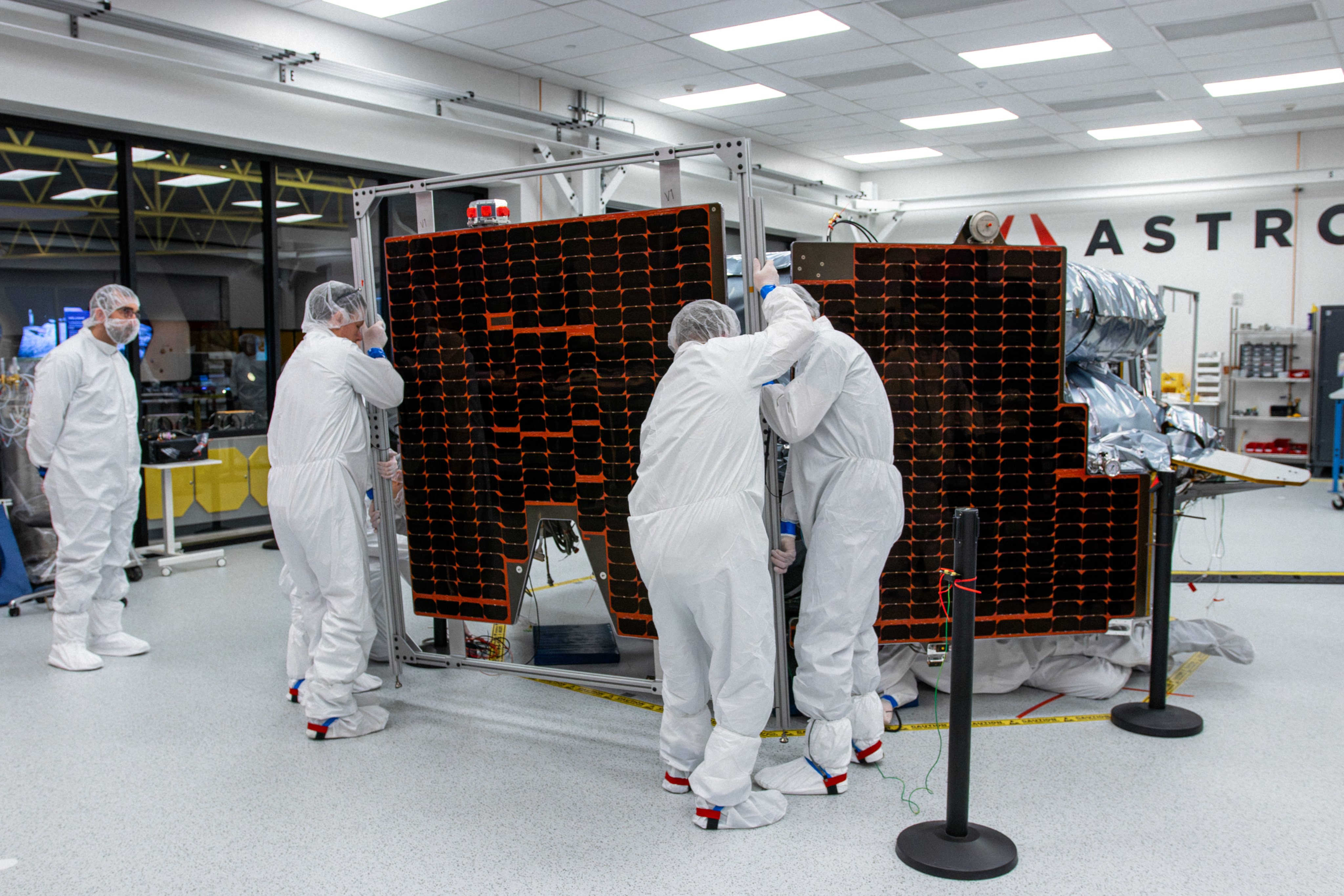
Astrobotic, which failed on its first mission to the Moon and is now manufacturing a larger lander for its second try, also supports the idea of block buys.
“I’m really excited to now leverage a finished product and be able to utilize that over and over again,” said Dan Hendrickson, vice president of business development at Astrobotic. “One of the challenges, I think, that we faced is the bespoke nature, sometimes, of mission to mission. If we can try to maintain some of these vehicle types over and over again, I think we’ll reap the benefit of all of the blood, sweat, and tears that went into getting our supply chain to be able to perform and to overcome some technical challenges that were pretty significant.”
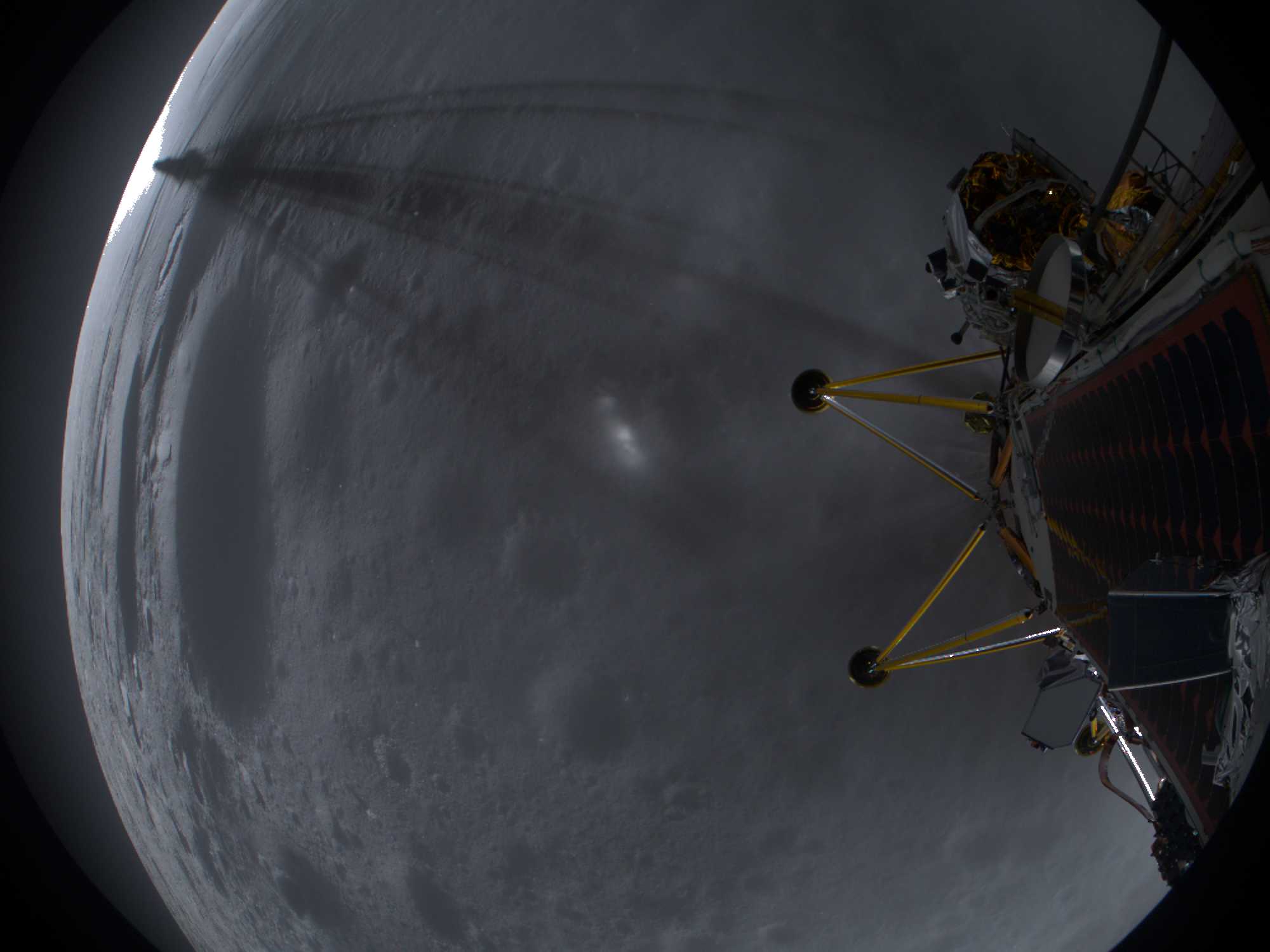
Like Astrobotic, Intuitive Machines is planning a heavier lander after flying a smaller vehicle on its first few missions to the Moon. Its next mission, IM-3, is scheduled for launch toward the end of this year in tandem with the first node of a lunar data relay satellite constellation. Intuitive Machines aims to bounce back from its first two CLPS missions, in which the company’s landers tipped over after touchdown.
“I think what you will see is the lander design modifying slightly to become basically like a Model T Ford,” said Ben Bussey, chief scientist at Intuitive Machines.
Firefly Aerospace nailed its first attempt to land on the Moon last year. Its Blue Ghost lander returned scientific data from the lunar surface for 14 days before succumbing to the dark lunar night. Firefly’s second Blue Ghost lander is slated to launch later this year, using the same basic design as the first, but accompanied by a pair of data-relay satellites to enable a landing on the far side of the Moon.
Firefly is expanding its factory capacity in Texas to churn out more landers and transfer vehicles. The first voyage to the Moon with the Blue Ghost lander launched in January 2025, less than four years after NASA awarded the contract to Firefly, a “record-breaking timeline” for a commercial lunar mission, said Farah Zuberi, the company’s director of spacecraft mission management.
“The takeaway is that with this mission, the NASA CLPS model did what it was intended to do, which was to enable reliable access to the Moon at a fraction of the cost and schedule,” Zuberi said.
It’s now up to NASA’s other CLPS providers to show they can reach the Moon, and all of them—including Firefly—must prove they can do so repeatedly. NASA and its contractors must cut Firefly’s four-year lead time in half to ramp up to a monthly cadence in the next two years.
NASA will take a more paternalistic approach with the next round of CLPS orders. “When you are building, we need to hear the things that are slowing you down, and we’re going to try to help you with those things,” Carlos Garcia-Galan, head of NASA’s Moon base program, told representatives of the CLPS companies at last week’s LSIC meeting.