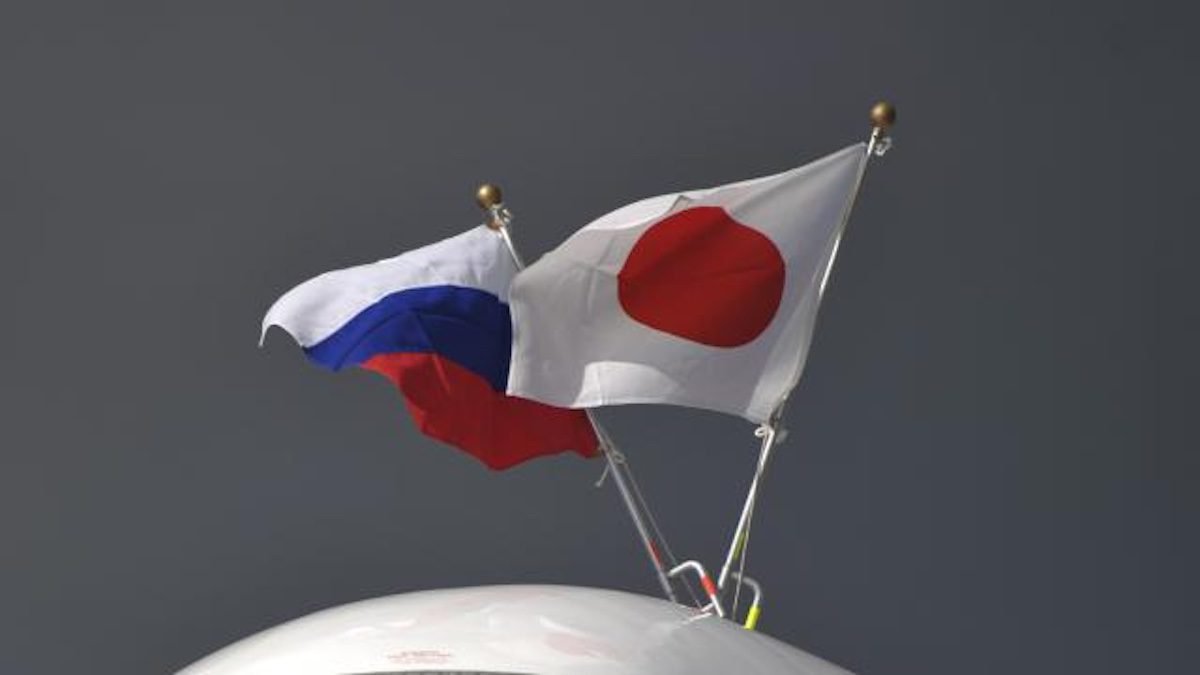
An oil tanker from the Sakhalin-2 oil and gas extraction project arrived at Taiyo Oil’s refinery at Imabari, Ehime Prefecture, on May 5, signaling that Japan’s efforts to diversify away from the Persian Gulf have gone as far as to include some improvement in relations with Russia.
The tanker’s voyage south through the Sea of Japan, tracked in real time by Marine Traffic, was a big story on Japanese TV news and in the Japanese press.
But only a week earlier, on April 29, Japanese drone aircraft developer Terra Drone announced plans to invest in a second Ukrainian drone maker, WinnyLab. Interceptor drones made with its first partner, Amazing Drones, are already in service in Ukraine, an activity the Russian Foreign Ministry calls “openly hostile and detrimental to our country’s security interests.”
Japanese parliamentarian Muneo Suzuki was in Moscow earlier this week, attempting to arrange a meeting between Japanese Foreign Minister Toshimitsu Motegi and his Russian counterpart Sergei Lavrov. A senior Diet member from Hokkaido, from which Sakhalin is visible on a clear day, Suzuki is an expert on Japanese-Russian relations who advised former Prime Minister Shinzo Abe and who is appreciated in Moscow for his pro-Russian views.
Suzuki met with Russia’s Deputy Foreign Minister Andrey Rudenko, who told him that a meeting between the two foreign ministers could take place in conjunction with ASEAN-related events in the Philippines in July – provided the Japanese take “concrete measures” demonstrating that they are abandoning their hostile policy toward Russia.
“I very much want to restore Japan-Russia relations to the state they were in under Abe and President Putin,” Suzuki said to Grigory Karasin, head of the Russian Federation Council Committee on International Affairs.
“The current Japanese Prime Minister, Ms. Takaichi, is a follower of Mr. Abe. I spoke with her before leaving for Moscow. Ms. Takaichi said that she is very well aware of the importance of Japan-Russia ties. I have consistently taken a negative view of the fact that Japan, at the request of Biden, has adopted cold ties with Russia,” Suzuki said.
Suzuki did not say that Takaichi is ready to do that, but as a staunch supporter of Abe’s other policies, she might. She would no doubt face considerable opposition from hardliners, but after all, the threat to Japan’s oil supply did not come from Russia.
Sakhalin-2, which is 12.5% and 10% owned by Mitsui & Co. and Mitsubishi Corp., respectively, supplied about 9% of Japan’s LNG in 2025 and a small amount of its oil. 77.5% of the project is owned by Gazprom.
Due to its importance to the Japanese economy, the US exempted Sakhalin 2 from its sanctions on Russian energy. Last December, the Japanese expressed relief when the US extended this waiver until June 18, 2026. There is a “take-or-pay” clause in the contract that requires the Japanese to pay even if they don’t take their share of the LNG.
Last October, US Treasury Secretary Scott Bessent told Japanese Finance Minister Katsunobu Kato that the Trump administration expected Japan to stop importing Russian energy in coordination with the G7, but that didn’t fly.
Now the Japanese are wondering whether they will be able to import more oil from Sakhalin-1 and other Russian sources. Sakhalin-1 is 30% owned by SODECO (Sakhalin Oil and Gas Development Co.), a Japanese consortium including JAPEX, Itochu, Marubeni and Inpex. Rosneft companies own 50% of Sakhalin-1, while India’s ONGC Videsh owns 20%.
Russia supplied Japan with less than 1% of its oil last year, making it an obvious choice for Japan’s energy diversification.
But Japan is also building up its military, and drones are high on its list of defense technologies to be acquired and developed, with the Defense Ministry’s goal of achieving self-sufficient domestic production. At present, Terra Drone is the most promising venture pursuing that objective, plus an ambitious foray into global markets.
Established in 2016, Terra Drone is headquartered in Tokyo. Overseas, in addition to its activities in Ukraine, it currently has offices in Belgium, the Netherlands, Saudi Arabia, Malaysia and Indonesia, as well as sales efforts in the UAE and elsewhere.
Its original target markets were agriculture, inspection of industrial facilities, surveying for construction and engineering projects, and unmanned aircraft traffic management.
In March 2026, Terra Drone announced its “full-scale” entry into the defense equipment market, a strategic investment in Amazing Drones, and plans to establish a US subsidiary, Terra Defense, to facilitate procurement and logistics.
In April, the investment in WinnyLab was announced, and the operational deployment of the “Terra A1” interceptor drone, developed with Amazing Drones, commenced in Ukraine. The first successful interception of a “long-range unmanned aerial threat” was announced at the end of the month.
How the Japanese government will reconcile its defense build-up with its energy needs, and to what degree the issue can be fudged, should become apparent over the summer.
Follow this writer on X: @ScottFo83517667