When Donald Trump and Xi Jinping met in Washington on September 24, AI and Taiwan shared the agenda. Xi said AI should remain “under human control” and called for continued US-China dialogue on its risks and benefits.
On Taiwan, he urged Washington to “oppose Taiwan independence” and handle the issue “with caution.” Trump, for his part, entered the summit having already rejected calls to slow the AI race: “Whoever wins AI, wins.”
The pairing is revealing. One issue turns on speed, the other on stability. Washington and Beijing may build guardrails around AI and keep Taiwan Strait tensions manageable, but neither appears ready to relax the underlying competition.
Ahead of the summit, Washington had floated an AI incident-notification mechanism, but risk management is not the same as strategic restraint.
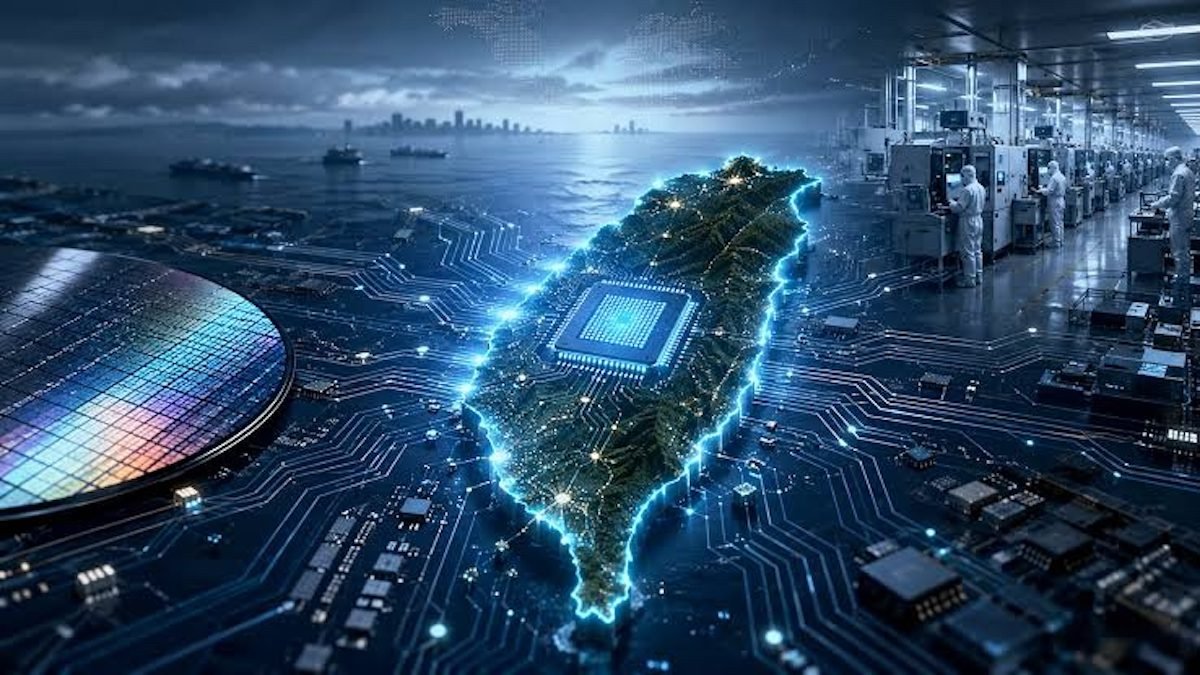
That distinction matters for Taiwan. The old “silicon shield” argument rested on scarcity: Taiwan’s concentration of advanced semiconductor production made major conflict extraordinarily costly.
In the AI era, scarcity still matters, but time matters more. The question is no longer whether Taiwan’s hardware ecosystem can be replicated elsewhere. It is whether it can be replaced fast enough while the US-China AI race continues and accelerates.
The debate over whether to “pace the frontier” underscores the dilemma. Slowing frontier development may buy time for safety work, but unilateral restraint risks ceding ground to the other side. And China is not standing still. Huawei is pushing its Ascend ecosystem and has unveiled the Atlas 960E SuperPoD as part of a broader effort to reduce dependence on US-controlled technology.
The phrase “mutually assured acceleration” has begun circulating in the AI safety debate. Unlike a nuclear arsenal, AI is also a commercial technology and productivity tool.
Yet the competition has acquired an arms-race feature: what matters is not only capability, but how quickly each side gains it relative to the other. Both governments may want guardrails without wanting to be first to ease off the accelerator.
The Trump administration has already written that logic into national security policy. A June memorandum directed agencies to accelerate frontier AI adoption, maintain “technological overmatch” and build a resilient supply chain that “cannot be severed in times of conflict.” The race, in other words, is thus not only about models – it is also about the physical systems needed to train and deploy them.
To be sure, reducing US dependence on Taiwan is rational policy. But diversification alone is not a strategy for the interval before replacement capacity exists.
The United States can build more fabs in Arizona and Taiwanese server makers are expanding production in the United States, Mexico and Southeast Asia – yet final assembly can move faster than the industrial ecosystem behind it.
Taiwanese firms account for nearly 90% of global AI server production. Production is becoming geographically dispersed, but the dense combination of leading-edge process technology, advanced packaging, specialized suppliers, engineering talent and system integration that supports each new generation of AI hardware is far harder to reproduce on a political timetable.
Taiwan does not host most American compute – the United States does. But much of US frontier AI expansion still depends on a hardware stack in which TSMC fabrication, advanced packaging and Taiwanese system integration remain central. Scarcity made Taiwan costly to lose; speed makes it hard to replace.
A prolonged disruption of Taiwan’s hardware ecosystem would therefore impose more than lost output or GDP. It could cost the United States strategic time. The two sides, moreover, are exposed at different layers of the race.
Washington’s frontier expansion still relies heavily on an internationally distributed but Taiwan-centered hardware ecosystem, while Beijing is organizing more of its frontier push around a domestic stack built around Huawei’s Ascend chips and SuperPoD architecture. A shock centered on Taiwan would hit both, but not in the same way.
This adds a material interest to Taiwan Strait stability, not a new theory of deterrence. A crisis need not become a full-scale invasion to matter. A blockade, cyberattack, prolonged shipping disruption or serious interruption to energy supplies could slow the hardware pipeline on which US AI expansion depends.
Nor would AI decide whether Washington intervened militarily in a Taiwan conflict. Military feasibility, nuclear escalation risk, alliance credibility, domestic politics and the regional balance of power would remain central.
AI changes the cost of delay in a technology competition Washington increasingly treats as central to national power, but it does not decide whether the United States should fight.
Beijing would not escape the timing cost of a Taiwan disruption. China is localizing chips and computing infrastructure, but the process remains incomplete, and cross-Strait semiconductor and electronics ties remain substantial.
The timing penalty is bilateral, but not symmetrical. For Washington, it bears directly on frontier AI expansion; for Beijing, it would disrupt an unfinished transition toward technological self-reliance.
That creates a contradiction for Washington: the more it worries about reliance on Taiwan, the harder it will push for reshoring and diversification. That response is sensible, but resilience takes time, and the AI race is not waiting. Hedging reduces future exposure; it does not eliminate vulnerability during the transition.
This window will not remain open indefinitely. As advanced fabrication, packaging and server production spread abroad, the cost of disrupting Taiwan could gradually decline. Taiwan’s longer-term relevance will depend less on preserving today’s concentration than on remaining embedded in successive generations of the AI hardware stack.
The September 24 summit may have helped Washington and Beijing manage AI’s risks, but it did not suspend the race. If the two sides can install guardrails without slowing competition, Taiwan’s strategic value will rest on something more limited than permanent indispensability: time.
Taiwan matters not because it can never be replaced. It matters because, in a race where time itself has become a strategic resource, it still cannot be replaced fast enough.
Chih-Cheng Meng is a Taiwan-based political scientist specializing in international political economy and US-China-Taiwan relations. He previously taught at National Cheng Kung University and holds a Ph.D. from the University of Texas at Austin.