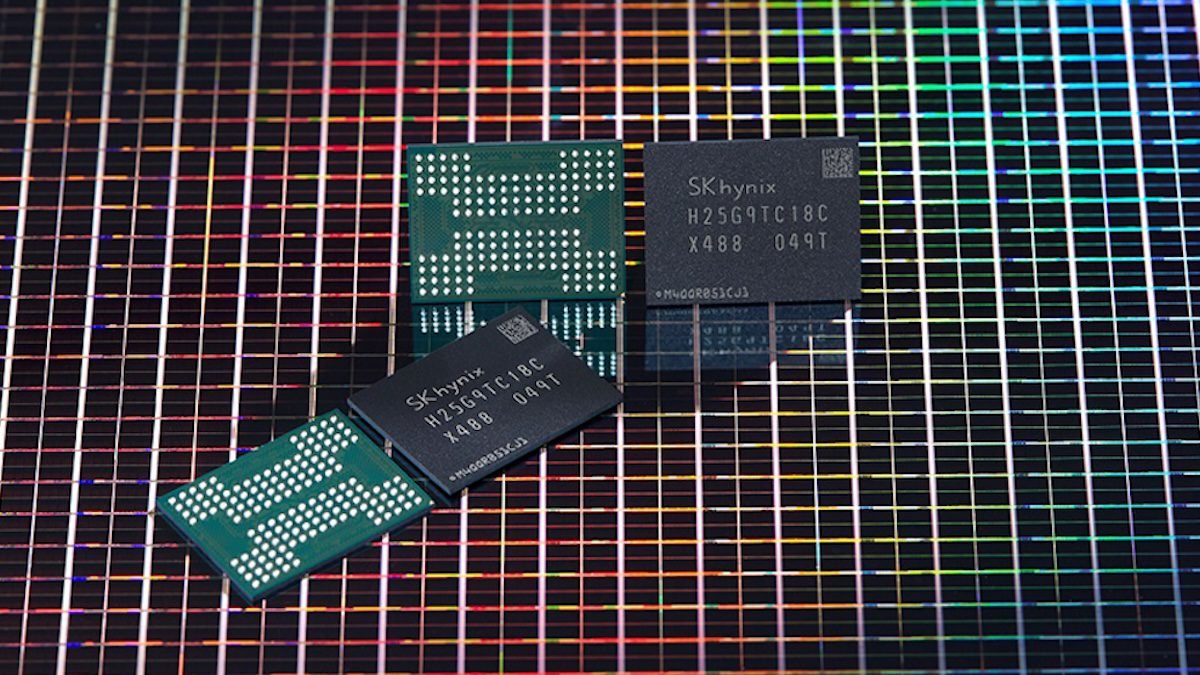
South Korean memory chipmakers must secure new United States licenses by year-end to keep shipping top-end American tools to their Chinese factories, after the Trump administration scrapped blanket permits last year.
To win the permits, SK hynix and Samsung must promise to build or expand factories in the US. SK Hynix’s one-year license to ship US equipment to its NAND flash memory plant in Dalian, a port city in northeast China, expires at the end of this year.
The US Commerce Department has not yet issued SK hynix an authorization for 2027, Reuters reported exclusively on Thursday. Citing anonymous sources, the report said Solidigm, SK hynix’s US-based flash memory unit, is seeking approval to ship more equipment to Dalian as it plans a new NAND factory in the US.
SK hynix told Reuters it plans to install equipment at Mod B, an unused section of the Dalian plant, in consultation with US authorities and with the relevant government approvals. It stressed that it is not seeking to expand the facility’s production capacity.
Both South Korean firms have increased their US commitments since Trump took office in January 2025.
SK hynix:
- In August 2026, it broke ground on a US$4 billion high-bandwidth memory (HBM) packaging plant in Indiana.
- Last month, its California-based subsidiary Solidigm was reported to be weighing a NAND factory in upstate New York.
- At the same time, SK hynix was reported to be in talks with Intel to make memory chips in Ohio.
Samsung:
- In July 2025, it signed a US$16.5 billion deal to make artificial intelligence (AI) chips for Tesla.
- Its first chip factory in Taylor, Texas, is due to be fully operational by the end of 2026.
- Foundation work on a second Taylor factory is largely done.
Chinese commentators framed the story differently, praising SK hynix for daring to test the Trump administration’s bottom line.
“Samsung and SK hynix used to have validated end-user (VEU) status at their China plants, so they did not need a license for importing US equipment,” says Xiao Song, a Shandong-based columnist. “Now they need to renew their import licenses annually, and Washington only approves tools that keep existing plants running, not those for expansion or upgrades.”
“SK hynix has created some bargaining chips for itself. If Washington wants it to build a plant in America, it wants equipment installed in Dalian first. This is not a refusal to invest in the US but a way to turn that investment into a deal,” she says.
She notes that the Trump administration has urged Samsung and SK hynix to expand production in the US, but it is now hesitating because letting SK expand its Dalian factory means a compromise of its export controls.
She says SK hynix is using the AI-driven memory boom as leverage in the talks, turning its US investments into a bargaining chip with Washington.
“The global chip supply chain has long been tightly intertwined, so it cannot be cut cleanly. Washington’s wish to bring manufacturing back home is obvious, but companies are not charities and they have to make money,” says a Sichuan-based writer using the pen name “Scientific Explorer.”
“A new plant in the US takes at least three to five years to reach production. In the meantime, supply cannot stop and customers cannot be lost, so expanding the Dalian plant is the right choice,” he says.
However, he adds that the public should not rush to take sides since the negotiation seems to have just started. It remains unclear whether SK hynix can secure its 2027 permits by year’s end.
In October 2022, the Biden administration banned exports to China of machines that can make NAND chips with 128 or more layers unless a license is granted.
In late August 2025, the US Commerce Department said it would revoke the blanket exemptions for SK hynix’s and Samsung’s China plants at the end of the year, calling them a “Biden-era loophole.” On December 30 of the same year, it granted the two firms annual licenses to ship American chipmaking tools to their Chinese factories throughout 2026.
In October 2022, the Biden administration banned exports to China of machines that can make NAND chips with 128 or more layers. It gave SK hynix and Samsung one-year waivers and, in October 2023, made them indefinite by granting VEU status to the firms’ China plants.
In late August 2025, the Trump administration’s Commerce Department said it would revoke that status at the end of the year, calling it a “Biden-era loophole” that failed to help the US attract investments. On December 30, 2025, it granted SK hynix and Samsung annual licenses to ship American chipmaking tools to their Chinese factories throughout 2026.
Beijing hopes for deal
The Dalian plant is the world’s only facility producing the 192-layer floating-gate 3D NAND used in Solidigm’s solid-state drives (SSDs) for AI, enterprise and hyperscale data centers. Its Mod B building, completed in 2023 but never fully equipped because of a memory slump, can start production as soon as the American tools arrive.
By contrast, a new factory in the US would take three to five years to go from planning to production. SK hynix’s high-bandwidth memory (HBM) packaging plant in Indiana, which broke ground in August, isn’t due to start mass production until the second half of 2029.
The gap matters because NAND prices have jumped about 700% since mid-2023, and AI data centers are driving a global memory chip shortage. Operating costs in China are also lower than in South Korea, making it cheaper and quicker to add output in Dalian than to build elsewhere.
Chinese state media outlets hope SK hynix will win its 2027 license as the arrival of more high-end American chipmaking machines on Chinese soil would echo Beijing’s call for US-China technology cooperation.
“Some people say SK hynix’s bold proposal leaves Washington with a hard choice, while those who want to curb China’s tech progress are urging the US government to reject it,” says a Global Times columnist. “But at least, the proposal confirms China’s long-held view that, as two AI powers, China and the US could let more countries share the benefits of AI by working together on its development and governance.”
Before the US curbs, Yangtze Memory Technologies Co (YMTC), together with Advanced Micro-Fabrication Equipment Inc China (AMEC), combined two 116-layer dies into a single 232-layer NAND chip with its Xtacking technology in mid-2022. The more layers a memory chip has, the more data it can store.
In late 2024, YMTC used workarounds such as multiple exposure and etching steps to produce a 150-layer chip. It then combined a 150-layer and a 144-layer die into a 298-layer chip, close to the 321-layer chips mass-produced by SK hynix.
However, industry experts say this 298-layer chip is thicker than SK hynix’s and less durable under heavy workloads.
Read: Nvidia chip export loophole clouds US-China AI summit talks
Follow Jeff Pao on X at @jeffpao3