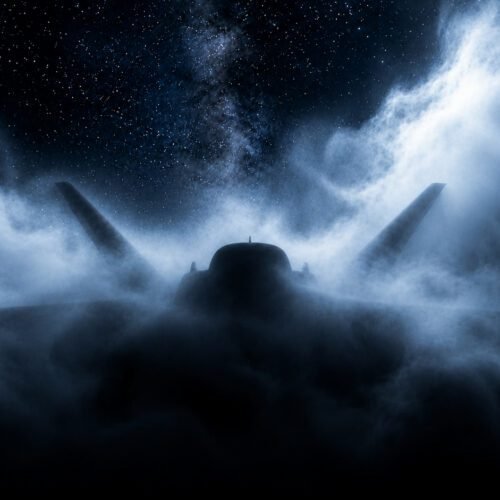
The mystery surrounding NASA’s newest X-plane was exemplified by the agency’s press release, including an apparently AI-generated image of the X-70, showing a dark silhouette vaguely resembling a military fighter jet obscured by smoke. The news was announced by Isaacman during the UP.Summit held at the agency’s Kennedy Space Center in Florida on November 4.
“The X-70 Fractal gives NASA a crewed, high-performance platform to test advanced flight-control, maneuverability, and other cutting-edge technologies in real flight,” Isaacman said. “Its modular design and ability to rapidly swap internal and external payloads will keep our teams flying, learning, and moving quickly from one experiment to the next.”
NASA’s press release described the X-70 as a crewed aircraft designed to cruise at Mach 0.75 while reaching a maximum altitude of up to 45,000 feet, and having an operational range beyond 1,726 miles (2,778 kilometers). The article did not mention a specific aircraft manufacturer that might be helping the agency develop the X-plane.
The X-70 would also have a takeoff weight of 10,000 pounds (4,536 kilograms) and a design capable of accommodating up to 2,000 pounds (907 kilograms) of experimental payloads both internally and externally. Ars has reached out to NASA for more details.
Return of the Blackbird?
Another X-plane is also expected to be announced at the UP.Summit on November 6, according to Aviation Week. That would coincide with a scheduled announcement from President Donald Trump at the event.
This comes after Isaacman previously appeared in front of another smoke-shrouded silhouette image with the tagline “Rebuilding our X-plane portfolio” during the All-In Summit in Los Angeles held from September 12–14, according to TWZ. That silhouette appeared strikingly similar to the SR-71 Blackbird that flew Cold War reconnaissance missions at supersonic speeds in the stratosphere.
Rumors have circulated about a possible revival of the SR-71 in one form or another, after former NASA employees told Aviation Week they received job offers to help restore an SR-71 to operational flight capability.
In September, the publication also reported on the removal of a NASA-owned SR-71 with the tail number 844 that had stood on display at NASA’s Armstrong Flight Research Center inside Edwards Air Force Base in California.
Quiet supersonic flight testing
Meanwhile, NASA recently commemorated the first flight anniversary of its supersonic X-59 Quesst, a needle-nosed aircraft designed by Lockheed Martin to reduce sonic booms to sonic thumps. Ars has previously looked at how this X-plane program is intended to support the design of future supersonic airliners that may fly overland while minimizing disturbances for buildings and people below.
Since first taking to the skies on October 28, 2025, the X-59 has completed over 40 flight tests, including both low-speed flights and supersonic test runs reaching Mach 1.53, according to NASA. Such testing has taken place at NASA’s Armstrong Flight Research Center inside Edwards Air Force Base in California.
The X-59 also recently completed its first cross-country journey from California to Florida with stopovers in Texas and Alabama, accompanied by an F-15 and an F/A-18 from the agency’s research fleet that served as chase planes. It sat on the ground as a static display during the NASA Max Power airshow at Kennedy Space Center in Florida from November 7–8.
The supersonic aircraft will resume its test flight schedule once it returns to Armstrong Flight Research Center in California, a NASA spokesperson told Ars. Given the agency’s latest X-plane push, the X-59 may not be flying alone for many more years.
Source: Iwpost.com