AMD reported third-quarter revenues on Tuesday with a record $13.4 billion, an increase of 45 percent year over year, as data center business nearly doubled and the company’s gaming segment cratered.
AMD CFO Jean Hu said, “We expect revenue to be approximately $17 billion, plus or minus 3%. The middle point of our guidance represents approximately 66% year-over-year revenue growth, primarily driven by the acceleration of our Data Center segment.” AMD says its Q4 revenue projections are up another 27 percent from this quarter’s results. As reported by Tom’s Hardware, Intel’s Q4 guidance places revenue estimates between $15 billion and $16 billion. That means that if both companies land where they expect to at the end of the fourth quarter, AMD would exceed Intel’s revenue for the first time in history.
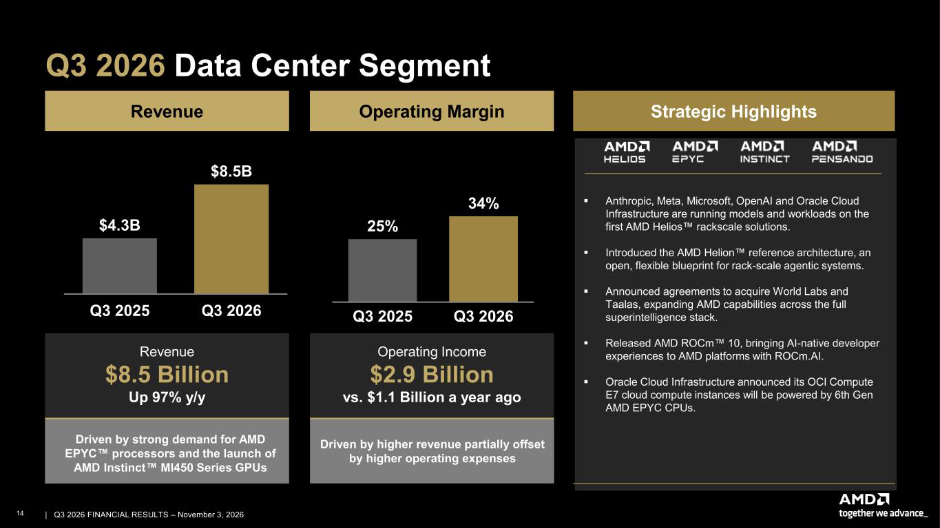
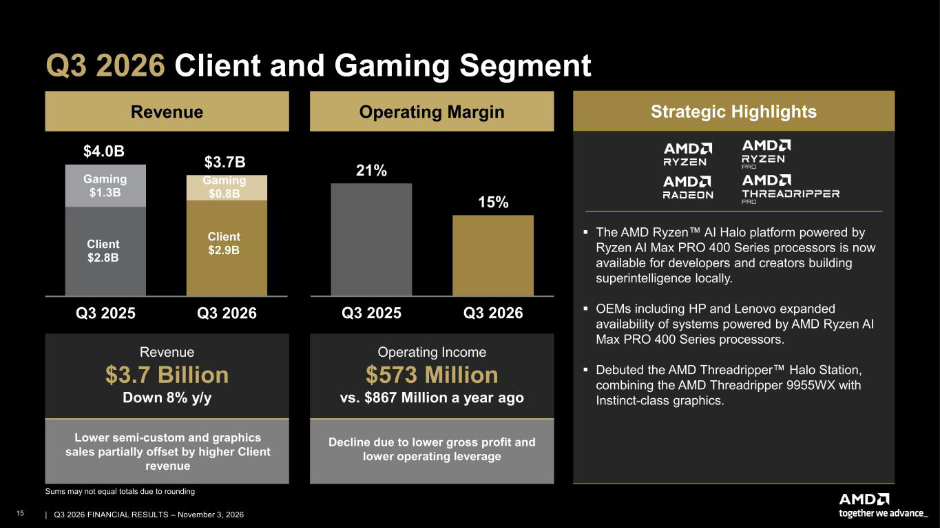
The data center segment of AMD’s business was up 97 percent year over year, with a record $8.5 billion. AMD attributes the growth to demand for its EPYC line of enterprise server CPUs, along with the launch of the Instinct MI450 series GPUs. Sales of AMD Ryzen mobile chips led growth in the Client business, which includes desktop Ryzen processors and posted $2.95 billion in revenue, up 7 percent year over year.
Gaming revenue fell sharply for the company, posting a 40 percent drop in revenue at $773 million, which AMD attributes to “lower semi-custom and graphics revenue.” Operating margins in AMD’s data center business expanded from 25 percent to 34 percent, with operating income surging 168 percent to $2.88 billion.
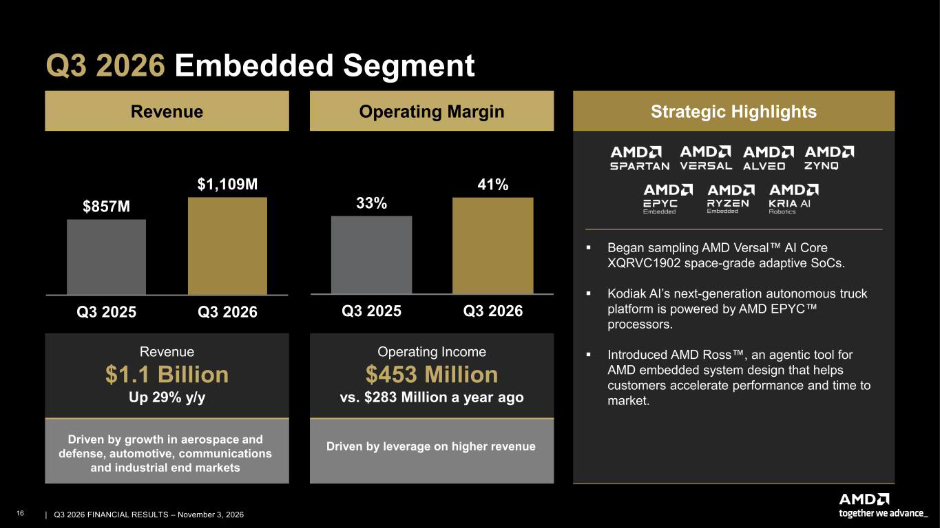
Embedded segment revenue, or all the SoCs, FPGAs, and boards under AMD’s umbrella that go into other hardware, was $1.1 billion, up 29 percent. AMD attributed this growth to gains made in the “aerospace and defense, automotive, communications, and industrial end markets.”
The gaming segment of AMD’s business is composed of two main sources. There are semi-custom processors that AMD supplies to other manufacturers’ consoles, as well as its own Radeon graphics business. Where things can get confusing is that Ryzen processors, like those commonly installed in gaming PCs, are counted under the company’s client business, not gaming. According to AMD Chair and CEO Lisa Su, “In Gaming, revenue declined 40% year over year to $773 million, primarily due to lower semi-custom sales as expected at this stage of the console cycle.” The financial results do not break down the split between console chip sales and PC graphics cards.
Along with the Q3 financial results, AMD used the occasion to highlight hardware still in the hopper. The new AMD Threadripper Halo Station, which AMD first showed at IFA in September, pairs a Threadripper 9995WX CPU with up to four Instinct MI350P GPUs and can run trillion-parameter LLMs locally. The system is slated for a release sometime in 2027, with pricing still to be announced.
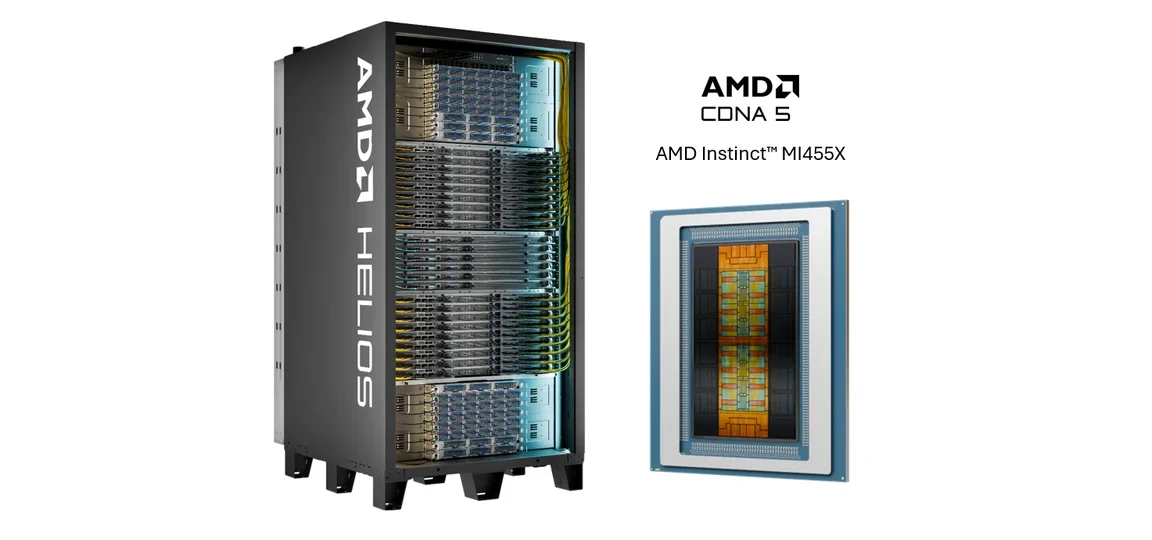
AMD also announced that Windows-based systems running on its Ryzen AI Halo platform will be “coming soon.” Known as Project Zenith, the effort will support a developer-focused Windows experience on the current PRO 400 Series platform. Built on the Ryzen AI Max+ PRO 495 processor, the chip supports up to 192GB of unified system memory, with up to 160GB of that available to be allocated for graphics, and is capable of running 300 billion-parameter models at 4-bit quantization. On the call, Su stated that AMD “started shipping MI455X in volume in the quarter, and lead customers, including Anthropic, Meta, Microsoft, OpenAI, and Oracle, brought their first Helios racks online quickly.”