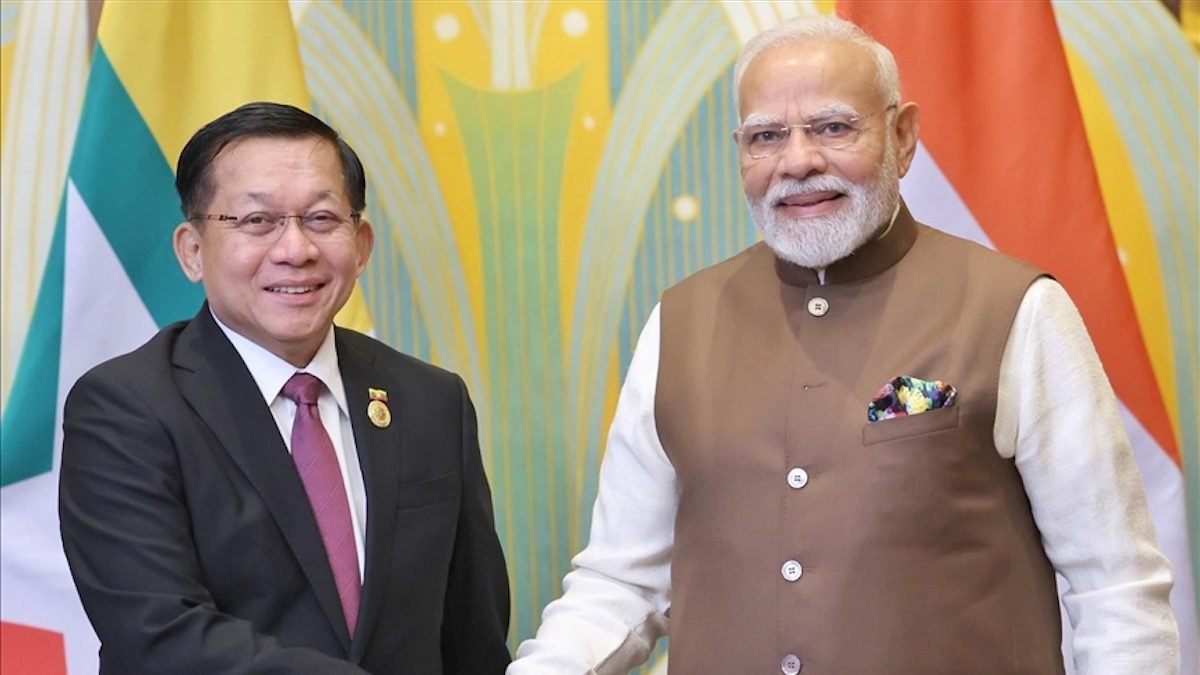
When Senior General Min Aung Hlaing arrived in India on May 30 for his first official overseas visit as Myanmar’s new “president,” the photo op was exactly what he wanted.
The man who seized power in a coup, jailed elected leaders, crushed a nationwide uprising and drove Myanmar deeper than ever into civil war was received in New Delhi not as an isolated general but as a respected head of state.
For a ruler still searching for legitimacy after years of bloodshed and diplomatic rejection, the five-day visit, which concluded on June 3, was nothing less than a gift.
For Indian Prime Minister Narendra Modi, the calculation was different. Myanmar is not a distant moral question for India. Rather, it is a neighbor with a 1,643-kilometer border, a long-time source of instability for India’s northeastern states of Manipur and Mizoram and a strategic theater where China has spent years building substantial influence and infrastructure.
The problem is not that India engaged Myanmar; geography dictates that it must. The problem is that New Delhi appears to be placing too much weight on a man who can sign agreements in New Delhi but cannot deliver the territory those agreements require.
Min Aung Hlaing’s visit produced the familiar language of bilateral diplomacy: friendship, territorial integrity, security cooperation and promises of connectivity via the Kaladan Multi-Modal Transit Transport Project and Trilateral Highway.
On paper, this is a practical agenda. On the ground, much of it runs through rebel-controlled territory the junta no longer controls.
The Kaladan project is the clearest example. Designed to connect India’s Kolkata to Sittwe Port in Myanmar’s Rakhine State, move goods up the Kaladan River to Paletwa in Chin State and link by road to the northeastern state of Mizoram, it is a cornerstone of India’s “Act East” policy. It aims to reduce the isolation of India’s often volatile northeast and bypass travel through Bangladesh.
But that strategic route cuts through Myanmar’s rewritten western map. The rebel Arakan Army now controls most of Rakhine State. Paletwa and its surrounding terrain in neighboring Chin state are likewise no longer under Naypyitaw’s authority.
A hodge-podge of Chin resistance forces now hold vital ground along India’s frontier. Rakhine’s capital of Sittwe may still matter as a port, but the roads, rivers and borderlands around it are no longer under the junta’s command.
That is the hard truth behind the handshake in Hyderabad House. Modi can press for Kaladan’s completion, and Min Aung Hlaing can promise cooperation, but neither man controls the ground under the proposed route.
At the same time, New Delhi wants the junta to secure Indian interests. Yet the junta’s method of “securing” territory relies on airstrikes, artillery, forced conscription and scorched-earth operations. This does not stabilize India’s border. It drives refugees into Mizoram and Manipur, deepens anger among border communities and ties India to a grasping military establishment that is the cause of the crisis.
India has faced a version of this question before. In 1949, when U Nu’s post-independence government was on the verge of collapse amid rebellions, Jawaharlal Nehru provided crucial assistance to the central government in Rangoon.
But 2026 is not 1949. U Nu was a fragile civilian leader trying to hold together a newly forged post-colonial state. Min Aung Hlaing is the author of Myanmar’s present collapse. He destroyed the pre-coup political order by overthrowing a popularly elected government led by Aung San Suu Kyi and now asks its neighbors to treat him as the only person who can fix it.
For Min Aung Hlaing, the India trip was a desperate move dressed up as statecraft. To survive, he is auctioning off Myanmar’s sovereign assets to anyone willing to throw him a lifeline. He dangles the Kyaukphyu seaport and controversial Myitsone dam to China, the Dawei deep seaport to Russia and border security, Kaladan and even rare earth mining deals to India.
But when he assures New Delhi that Myanmar’s territory will not be used against Indian security interests, he is writing a check his military cannot cash. Myanmar’s generals have long leveraged geography for bargaining power, but Min Aung Hlaing has less territory and legitimacy than any of his military predecessors. He can offer access on paper, but he cannot guarantee delivery.
Nor will the visit free him from China’s overarching influence. Beijing understands India has legitimate interests next door, but it will watch closely if New Delhi gains ground in Rakhine, over critical minerals or via border access.
If India tries to secure Kaladan solely through Naypyitaw, it will fail. If India builds real influence with the Arakan Army, Beijing may respond by pressing its own pressure points. Balancing India against China sounds useful in speeches, but on the ground, it solves none of the junta’s military problems.
India now risks repeating the worst part of China’s Myanmar policy: treating central military authority as the nation’s legitimate sovereign power. Beijing has invested heavily in Naypyitaw, yet it still has to negotiate with ethnic armed organizations and resistance forces for resources and avenues.
India should not repeat China’s mistake. New Delhi possesses something China cannot offer: the experience of a federal democracy. Myanmar’s anti-junta forces, ethnic organizations and civil society organizations are actively debating federalism and a future political settlement. India could support that discussion with a democratic credibility that Beijing will never have.
Instead, the optics of Min Aung Hlaing’s state visit sent a damaging message. It told Myanmar’s people that India’s democratic language stops at the border. It told ethnic armed groups that New Delhi still views them merely as obstacles to infrastructure, rather than as political actors who now control the routes India needs. And it handed Min Aung Hlaing a domestic propaganda victory while giving India little assurance in return.
A smarter India policy would separate engagement from endorsement. India should talk to Naypyitaw because geography requires it. But it must also deepen pragmatic engagement with the Arakan Army, Chin rebel groups, the anti-junta National Unity Government, and border communities.
It should press for civilian protection, cross-border aid and an end to airstrikes near its frontier, if not everywhere across the country. No connectivity project can or should be built over the dead bodies of the people who live or lived along the proposed route.
Modi’s calculation is that engaging Min Aung Hlaing will protect India’s security and strategic interests. Min Aung Hlaing’s calculation is that Modi’s welcome will boost his claim to legitimacy and recognition after sham elections in December and January. But both calculations are flawed and will remain so until the Myanmar’s military has an honest negotiation with the many rebel groups that control much of the nation.
Nyein Chan Aye is a Washington-based Burmese journalist who previously worked for the BBC and Voice of America and writes on Myanmar, China, the US and regional affairs.