While the US military has had many achievements in the Iran conflict, it’s been far from cost free. Iran conducted extensive retaliatory strikes targeting high-value US bases.
According to international reports and satellite data, the damage to aircraft, radar, and communication systems throughout February and March was more significant than initially reported.
In all, 16 US military sites in eight countries across the Middle East were hit, and some of them sustained enough damage to be unusable.
Did the US learn any lessons as much from the failures as from the successes?
The US clearly made some major blunders, despite far superior air defenses and sophisticated command and control systems. Most spectacularly, the US lost two AWACS aircraft, one totally destroyed and the other possibly unrepairable, and three F-15 fighter jets, downed by “friendly” fire. The US also “missed” an Iranian jet that did substantial damage to Camp Buehring in Kuwait.

The AWACS Story
The airborne warning and control system is one of the most important US systems for the long range detection of enemy aircraft, missiles and ships. The US fields two versions: the E-3 Sentry and the E-2 Hawkeye.
The E-3 is a land-based four engine jet that is built on the old Boeing 707 narrow-body airframe. The last Boeing 707 was retired from commercial service in the United States in 1983.
The E-3 is a true battle management system. It features a large 30 foot radome mounted on the rear section of the aircraft body. By contrast, the E-2, which can be both land and sea based, is a twin engine turboprop and a tactical early warning aircraft. It has a crew of 5, compared with the E-3 which has a crew of between 17 and 33 (13 to 29 specialists), depending on the mission.
The E-2 is operated by the US Navy and mostly provides early warning and control for the US fleet.

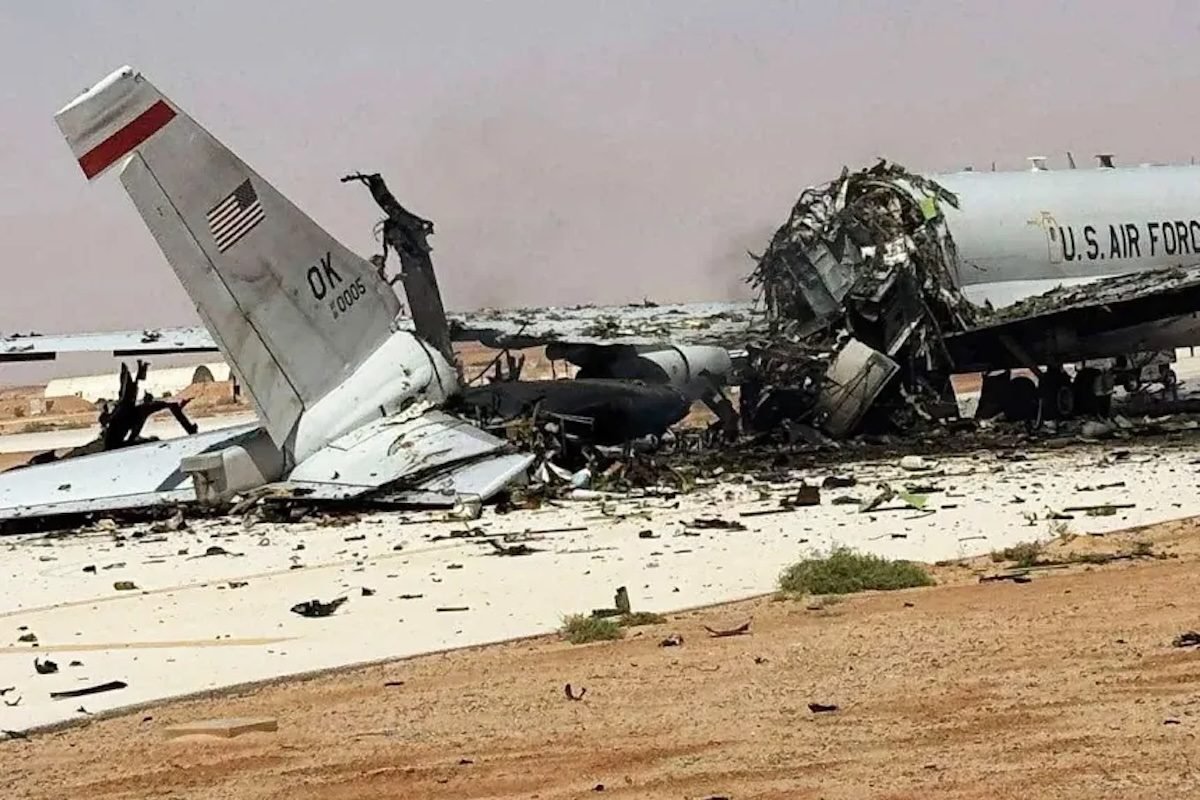
The E-3 is operated by the US Air Force. The first production of the E-3 was in 1975 and production ended in 1992. The aircraft that was totally destroyed in Saudi Arabia, unit 81-0005, was manufactured in 1981.
The size of the US E-3 fleet has been rapidly declining as many of the jets are no longer repairable. By the time of the start of the recent conflict with Iran, the US had around 10 AWACS planes that were deployable, although keeping them functioning is a major challenge. On February 28, the US moved six AWACS to Prince Sultan air base in Saudi Arabia and two to al Dhafra air base in the UAE. Another four were stationed in Europe, at Mildenhall in the UK and Ramstein in Germany.
The decision to move the better part of the functioning E-3 AWACS fleet to Saudi Arabia and the UAE was a major blunder, one that the Pentagon should have understood but chose to ignore.
The Russian AWACS fleet
The US operating through NATO played a major role in destroying a significant part of Russia’s AWACS fleet in the Ukraine war.
Russia operates an AWACS platform directly copied from the US E-3, called the Beriev A-50 (NATO name, Mainstay). In 2024 two were shot down by Ukrainian air defenses and in 2025 two more were either damaged or destroyed by drone attacks on Russian air bases. Like the US AWACS, the Russian A-50 fleet has been contracting as airframes wear out, leaving between 8 and 15 operational. The losses in the Ukraine war (over Ukrainian territory, the Sea of Azov, and at bases in Russia) significantly impact Russian warfighting operations.

The Russians’ exposure of their A-50s, especially at forward bases on Russian territory, was a military error that was avoidable.
The US role was in tracking the Russian AWACS platforms and in assisting Ukraine in locating them.
The Iranians needed little encouragement to go after the US-deployed AWACS, and they got targeting information from Russian and Chinese satellites, including a Chinese “commercial” satellite. These assets provided hard information on the precise location of the US AWACS aircraft.
The TEE-01B Chinese satellite is made and operated by the Chinese company Earth Eye. This model satellite features a resolution of half a meter (1.6 feet). Log files show that the IRGC used this satellite to target the Prince Sultan Air Base on March 13, 14, and 15, exactly when the first wave of strikes began.
At least two of the AWACS aircraft were parked on the tarmac at Prince Sultan. There were no hardened shelters for the E-3s, as the aircraft’s radome is too high to fit into any existing shelters.
The reason given for the forward deployment is that it allowed the E-3s to operate for longer periods on station than if they were deployed further back.
The alternative would have been to use air to air refueling for the AWACS. Whether refueling tankers were available is uncertain, as tankers were heavily used to support fighter aircraft, bombers and other command and control assets.
Prince Sultan has sophisticated air defenses including Patriot PAC-2 and PAC-3 MSE and THAAD (including the An-TPY-2 radar, similar to the one Iran destroyed in Jordan) plus CRAM. Even so, the base was hit by swarm attacks and the E-3s were not repositioned or cleared from the facility. How much early warning the US force had, if any, isn’t known.
The destroyed E-3 suffered a precision strike that targeted the radome on the aircraft. Some say it was hit by a missile, possibly the solid-fueled Khaibar-Shekan, a third generation IRGC missile that is maneuverable in its terminal phase. This medium range ballistic missile features a 550 kg (2,205 lbs.) warhead. It is also possible the AWACS was hit by a modified Shahed drone, since the blast size (as shown in photos) appears smaller than the damage likely caused by a 2,000 pound warhead.

In the background of the Iranian strike there is a strong sense that the attack was a Russian revenge operation as much as it was important to Iran’s war objectives.
f it was a drone, it may have been like some of the modified Russian Gerans with a Starlink terminal, because Starlink terminals are not banned in Iran as they are in Russia. Alternatively, either the drone or a missile could have been equipped with pattern matching technology, enabling it to accurately strike the E-3.
Iran has proven in the past it can accurately target fixed sites with drones and cruise missiles, as it did in the Abqaiq and Khurais attack in eastern Saudi Arabia in 2019.
The F-15 shootdowns
One of the heaviest losses in the war has been the destruction of three US F-15s that were shot down over Kuwait on March 2nd. Initial reports suggested they were hit by Kuwaiti operated Patriot missiles, but it became clear that in fact a single Kuwaiti F-18 aircraft downed all three F-15s in a 30 second engagement using Aim-9M missiles.

The Aim-9M is a short range “all aspect” air-to-air missile with an advanced infrared (heat seeking) sensor. The F-15E is not equipped with Missile Warning Sensors (MWS) for infrared threats and therefore the aircrews received no cockpit warning that a missile was in flight. One of the missiles hit the right engine of one F-15 and another hit the rear section of another F-15 from the side.
It is debatable that the F-15s could have evaded the Aim-9s even if they received a warning. All three pilots ejected and were rescued.
Kuwait operates both the F-18 (legacy and newer models) and the Eurofighter. The legacy F-18 (F/A-18C/D) is the model that knocked out the three F-15s. It appears the Kuwaiti operator thought the F-15s were Iranian F-5s or partially home built Iranian F-5s called Kowsar. This is the aircraft that got past air defenses on March 1st and bombed Camp Buehring in Kuwait, causing extensive damage.
If the pilot was looking for F-5 Kowsars on March 2nd, then it is possible both pilots and air defense operators understood that the F-5 Kowsars could get through and cause significant damage.
The US and Kuwaiti aircraft and air defenses use advanced IFF (identification friend or foe) systems (specifically Mode 5 IFF). IFF when operating properly should lock out a friendly aircraft from an attack. Mode 5 uses codes that are shared daily and encryption so the codes can’t be compromised. Some have suggested that the IFF was turned off in the Kuwaiti F-18, possibly because heavy jamming made it unreliable. Or IFF frequencies could have been jammed. Even so, the F-18 radar should have registered the F-15s as “green” or friendly, but apparently did not. Instead the F-15s may have shown up as “red” on the F-18’s radar screen.
Modern radars use threat libraries to identify aircraft, missiles and drones. The libraries match the radar image and related information to the library listed threats.
One thing is clear, the Kuwaiti pilot did not request ground clearance to fire his missiles. He had time to do so, and it is far from clear the pilot was following established procedures.
The F-5 Kowsar incident
Camp Buehring is a critical US Army installation located in the Udairi Desert in northwestern Kuwait, approximately 25 miles from the Iraqi border. On March 1, 2026, at 4:15 am an Iranian F-5 or modified F-5 Kowsar took off from a base in southwestern Iran, crossing the Persian Gulf at very low altitude to avoid radar detection. Less than half an hour later it entered Kuwait’s airspace and less than ten minutes later reached Camp Buehring.
It was not intercepted by air defenses and it carried out a bombing attack. The strike caused massive damage to the base’s command center and warehouses. Six US soldiers were killed, and nearly 60 others were wounded. Confirmed damage included multiple structures housing equipment from Army Prepositioned Stocks-5 (APS-5), a CH-47 Chinook destroyed on the ground, and several other tactical vehicles damaged; craters on the main airstrip and satellite communications (SATCOM) nodes degraded or knocked out.

It isn’t clear why the F-5 was not detected or intercepted. It successfully returned to Iran. One contributing factor possibly was radar ducting, an atmospheric phenomenon in which radar waves are trapped and guided along the Earth’s surface due to sharp temperature inversions or moisture gradients. That’s a problem over Persian Gulf waters.
During the March 2026 strikes on Prince Sultan Air Base, Iranian Kowsar jets and drones utilized “ducting holes.” By flying at specific low altitudes during intense ducting periods, they stayed within blind zones where ground-based Patriot radars could not “see” them, despite being technically within the radar’s range. It isn’t known if this was a factor in the Camp Buehring attack.
While it isn’t clear if radar ducting contributed to the Camp Buehring strike, the US had the technological capability to “find” the Iranian strike aircraft.
The US has many aircraft with look down, shoot down radars. Look down, shoot down radars can “see” aircraft and drones from above.
Until the early 1980s this was not possible because radars would encounter heavy ground clutter when trying to look down. However, the US Air Force designed a special computer capable of sorting out radar ground clutter from moving objects using a mathematical radar processor (utilizing fast Fourier transform computing). American fighter jets such as the F-15 and F-16 and F-35 have look down, shoot down computers, as do AWACS aircraft.
Exactly why the F-5 Kowsar was not detected remains a mystery. While it may have been able to sneak across the Persian Gulf, exactly how it evaded air and ground based systems is concerning. Did Iran find a hole or gap in US and allied defense systems?
It should be remembered that the US designed the Tomahawk cruise missile to fly nap of the earth treetop level to get under Russian radar coverage. Iran was certainly familiar with US Tomahawks. The US fired 850 Tomahawks at Iranian targets over a four week period.
The US rushed a number of systems to Gulf bases after the F-5 incident and related drone and missile attacks. The most noteworthy were M-SHORAD systems (Stryker-based) to provide mobile, 360-degree protection. M-Shorad uses Stinger missiles and is supposed to be capable of knocking out low flying aircraft like the F-5 Kowsar, assuming it can detect the aircraft.
By May, Iran’s Kowsar aircraft were mostly destroyed on the ground by US B-2 bombers and F-35s. Until then, the Kowser served as Iran’s Tomahawk.
Lessons not necessarily learned
There is no perfect war and losses are inevitable. In the big picture, the US has done very well in the Iran conflict, but inevitably mistakes and oversights have happened.
One feature that may have escaped notice is that Iran, despite its limitations, has been very resourceful and has carried out effective strikes against US bases, destroying important equipment and costing lives.
Iran also has had important outside help from China and Russia. Both countries have provided intelligence, command and control support and important equipment (even during the conflict). Both continue to do so with supplies arriving by ship, aircraft and overland.
Stephen Bryen is a former US deputy under secretary of defense. You can find this article and many more on his Weapons and Strategy site, from which this article is republished with permission.