Students and education specialists say Syria’s universities need investment in laboratories, research, academic freedom, and job prospects to rebuild lasting credibility
[DAMASCUS] Damascus University’s recent rise in international rankings has drawn renewed attention to Syria’s battered higher education sector, raising cautious hopes that one of the country’s oldest academic institutions is beginning to recover after years of war, isolation, and institutional decline.
The university retained its position as Syria’s highest-ranked institution in the 2026 UNIRANKS rankings while maintaining its presence in several other global university assessments. For some observers, the development is an early sign of academic recovery. For others, it is only a modest step in a much longer effort to rebuild a university system weakened by conflict, economic pressure, political control, and the migration of academic talent.
Dr. Mohammad Suwaid, deputy minister of higher education and scientific research for private education affairs, told The Media Line that Damascus University’s presence in several international assessments reflects the beginning of a gradual improvement in indicators related to scientific output, digital presence, and international academic engagement.
While rankings are not the sole measure of university quality, they provide an important indicator of an institution’s ability to restore its global presence
“While rankings are not the sole measure of university quality, they provide an important indicator of an institution’s ability to restore its global presence,” Suwaid said.
Damascus University is Syria’s oldest university and one of the Arab world’s most prestigious academic institutions. Founded in the early 20th century, it served for decades as a leading center for education and scientific research in the region. Thousands of physicians, engineers, and scholars graduated from the university and went on to play influential roles inside Syria and abroad.

Faculty of Architecture. (Damascus University Presidency)
Over time, that historic position weakened as the gap widened between Syrian universities and their regional and international counterparts in research funding, academic development, and global engagement.
When the Syrian conflict erupted in 2011, universities entered a period of severe strain that directly affected educational quality, scientific research, and international academic cooperation. During the years of former Syrian President Bashar Assad’s rule, the higher education sector faced declining funding, the departure of many academics, deteriorating infrastructure at several educational institutions, and shrinking opportunities for collaboration with international universities.
Although public universities maintained educational continuity throughout the conflict, most experienced a noticeable decline in international rankings, scientific publication indicators, and research output.
University life was also shaped for decades by a strong security and political presence on campuses. According to human rights reports and accounts from students and academics, Syrian universities imposed restrictions on independent student activity. After 2011, some institutions reportedly witnessed arrests, dismissals, and prosecutions targeting students and academics for political reasons or for participating in protests.
Academics argue that such conditions damaged the university environment and limited opportunities for dialogue and free thought, affecting scientific research and academic creativity.
Syria’s higher education sector has also faced recurring criticism over academic integrity and university governance. Media reports and student platforms have circulated complaints about alleged academic and administrative corruption, including accusations of leaked or sold examination questions, abuse of influence in administrative and academic procedures, and educational privileges granted in violation of established regulations.
Although such cases did not characterize all universities or faculties, they fueled broader calls to reform the higher education system, strengthen transparency and accountability, and protect the value of Syrian university degrees.

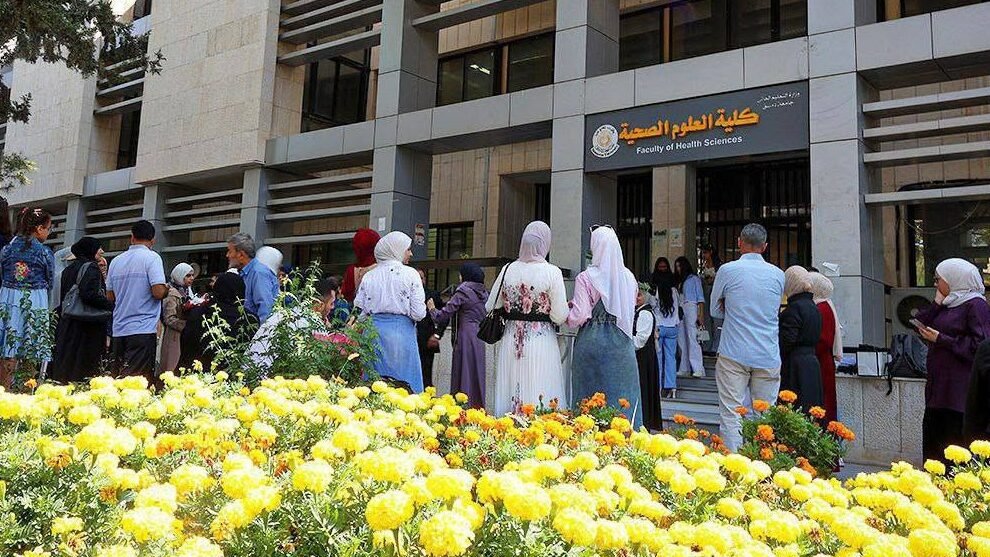
University of Damascus. Faculty of Health Sciences at Damascus University. (Damascus University Presidency)
Specialists say any serious effort to restore the academic standing of Syrian universities must be accompanied by institutional reforms that reinforce academic integrity and ensure equal opportunities for students.
As Syria enters a new political phase, universities have increasingly spoken about academic openness, rebuilding international scientific partnerships, encouraging scholarly publication, updating research databases, and expanding cooperation with educational institutions abroad.
The discussion extends beyond Damascus University. Syria’s higher education system currently includes 11 public universities, 39 officially recognized private universities, and nine specialized higher institutes.
Those figures reflect the breadth of Syria’s academic landscape while also pointing to the scale of the work facing higher education institutions in the coming years.
Suwaid said the Ministry of Higher Education and its affiliated institutions are prepared to receive high school graduates after the completion of national examinations through a higher education system comprising nearly 50 public and private universities, in addition to higher institutes and educational institutions affiliated with the ministry.
Together, these institutions serve approximately 1.5 million students across a wide range of academic disciplines and programs.
He added that the ministry continues to work on improving the university environment and introducing new academic specializations and programs aligned with scientific and technological developments and labor market needs.
Despite the expansion in the number of universities, public institutions continue to attract the majority of students and researchers, while Damascus University remains Syria’s largest university and the country’s most visible institution in international assessments.
Broader progress in higher education, specialists say, cannot depend on the ranking of a single university alone. It will require the development of Syria’s entire university system, both public and private.
Mohammad al-Ahmad, an information engineering student at Damascus University, told The Media Line that the university’s return to international rankings sends a positive message to Syrian students.
“For years, we heard about the decline of Syrian universities and their disappearance from the international academic scene,” he said. “Today, we feel there is an opportunity to restore confidence in our educational institutions, but we are waiting to see that reflected in the quality of education, employment opportunities, and scientific research.”
Aya al-Khatib, a medical student at Damascus University, said the university’s international reputation directly affects students’ futures.
“When the university’s global standing improves, it opens broader opportunities for graduate studies, fellowships, and research opportunities,” she told The Media Line. “But we also need improvements in laboratories, scientific references, and educational infrastructure.”
Omar al-Salem, an economics student at the University of Aleppo, argued that rankings are not the ultimate goal.
Real success will come when graduates feel that their degrees allow them to compete both locally and internationally
“What matters most to students is the quality of education, training opportunities, and access to the job market,” he told The Media Line. “Real success will come when graduates feel that their degrees allow them to compete both locally and internationally.”
Nour Ali, a pharmacy student at Tishreen University, described the recent achievement as an important beginning after difficult years.

Examination Halls. (Damascus University Presidency
“Maintaining educational continuity throughout the war was a major challenge,” she told The Media Line. “But the next phase requires greater investment in scientific research, equipment, and laboratories.”
Abdul Rahman al-Masri, a graduate student in the Faculty of Science, argued that the future of Syrian universities depends primarily on scientific research.
“If scientific publishing, international cooperation, and the academic research environment improve, rankings will naturally improve as well,” he told The Media Line. “Focusing on numbers alone will not create a strong university.”
If scientific publishing, international cooperation, and the academic research environment improve, rankings will naturally improve as well
Academics and education experts agree that the decisive factor in improving universities’ global standing is not the ranking position itself but the quality and impact of scientific research.
Universities that achieve meaningful progress are those that invest in laboratories and research centers, support researchers, and provide an academic environment that is open and intellectually free. Reversing the brain drain, encouraging international partnerships, and modernizing curricula are all essential components of any sustainable university reform project.
Today, Syrian universities stand at a historic crossroads. They carry the burden of years of war, isolation, and political and economic challenges that have weakened their academic role, but they also have a chance to restore their scientific presence and reconnect with the world.
Damascus University’s progress is an encouraging sign that a new chapter may be beginning. Yet the real test will be whether Syrian universities can move beyond symbolic gains and produce lasting improvements in teaching, research, academic freedom, infrastructure, and employment prospects for graduates.
Their success will not be measured solely by global rankings, but by their ability to generate knowledge, develop talent, and reclaim their role as centers of learning, research, and intellectual advancement within Syrian society.