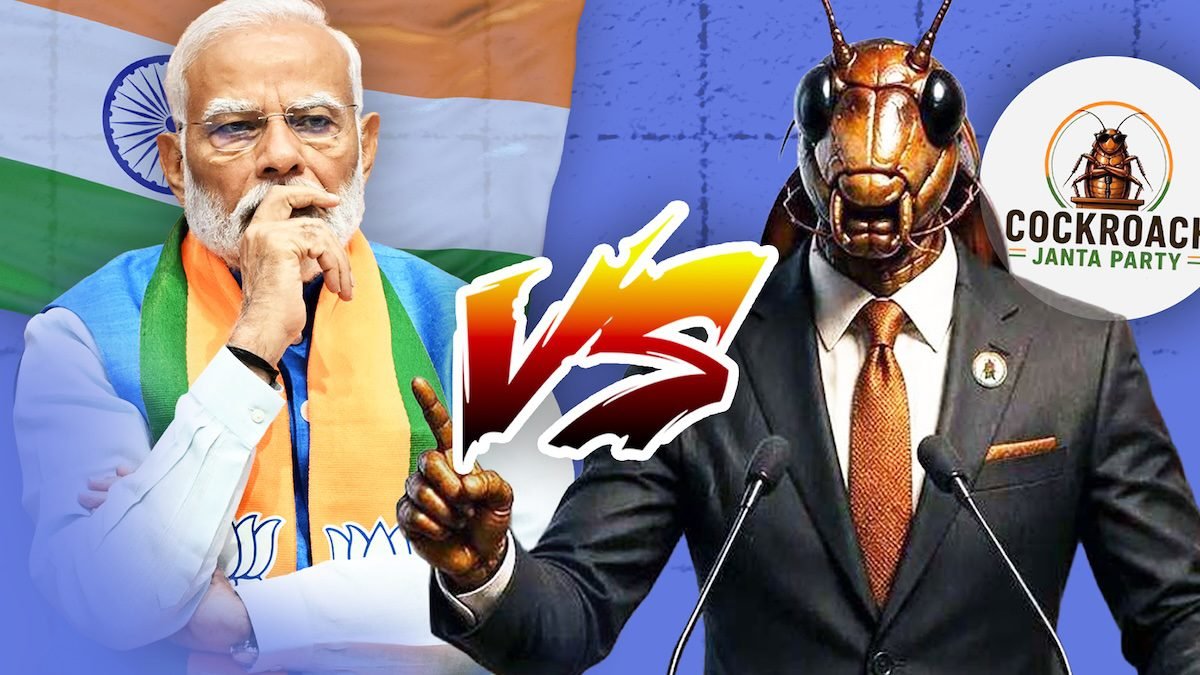
You can kill a revolutionary but never kill the revolution.
A revolutionary can be silenced, imprisoned or exiled but ideas have a remarkable ability to outlive those who champion them. Thousands of young protesters took to the streets of Delhi as part of Cockroach Janta Party (CJP), a movement demanding action over alleged exam paper leaks and calling for the resignation of India’s Education Minister Dharmendra Pradhan.
The protesters got results over the weekend and it’s worth looking back at preceding events so that we can look forward and try to predict the movement’s future trajectory.
An exam paper leak can be defined as the illegal sharing of test question before a national or state test happens. This is a form of organized crime that involves the unauthorized disclosure of, access to and distribution of question papers, often for monetary gain.
These protests are mainly driven by anger over alleged exam paper leaks and concerns about India’s education system in recent times, especially around NEET.
National Eligibility cum Entrance Test is an entrance examination conducted annually for admission to undergraduate medical courses. The most recent examination May 3 faced major controversy due to a widespread question paper leak, thus forcing the National Testing Agency ( NTA ) to set a new substitute exam date.
Pre-circulated question banks and guess papers matched up to 140 questions on the actual paper out of 200, raising serious doubts of manipulation. Some 20 students died by suicide due to related distress.
Students in millions across the country prepare for the highly competitive exams, often spending years and a substantial amount of their family’s income. The issue of paper leaks has triggered widespread disappointment and anger among students and families. In the last 10 years, a total of 152 exam papers have been leaked, according to the opposition – an average of more than one paper leak every month. Yet, not a single person has been punished.
Supreme Court chief justice Surya Kant on May 15 notoriously compared unemployed youth to “cockroaches,” saying they fail to find jobs and turn to social media, journalism and “attack the system” with what Indians call RTI activism – the use of the Right to Information Act 2005 to demand government transparency, expose corruption, and hold public officials accountable. He called such individuals “parasites of society.”
Content strategist Abhijeet Dipke launched the satirical Cockroach Janta Party as a viral online response on social media. The party gained more than 5 million adherents in just four days following its launch on May 16. It was started as a meme page but soon it becomes an online phenomenon.
The cockroach was an apt symbol of the restiveness of young people, and the immediate context of the NEET paper leak ensured the CJP resonated even more with them.
Starting as just an online revolution, the movement became an on-the-ground revolution. The CJP demanded a complete overhaul of the education system, better accountability over exam leaks and the resignation of Education Minister Dharmendra Pradhan.
For nearly a month, supporters of the viral “cockroach” movement occupied New Delhi’s Jantar Mantar area, India’s most popular protest site a couple of kilometers from Parliament; it became one of the biggest youth-led challenges to the government in recent years. Opposition leaders supported the protesters, criticiszd the police response and called for dialogue.
Gen Z is the new hope of India.
For almost a decade, Prime Minister Narendra Modi has dominated India’s political conversation. But the Gen-Z generation is changing that. Modi’s political success rested on a simple promise: a stronger more confident India whose young people would inherit unprecedented opportunity with projects like Digital India, Start-Up India and Skill India.
The situation has changed; the very same young Indians are on the Delhi streets demanding accountability from the government that once promised to empower them.
The movement was galvanized after the support of educator & activist Sonam Wangchuk, who began a hunger strike on June 28, but was forcibly moved by the Modi government to a hospital by police after 21 days, on July 18.
The protest got global media attention after Indian security forces used tear gas and batons to suppress largely peaceful student and youth protests in New Delhi on July 20 during a planned march toward Parliament on the opening day of that body’s monsoon session, demanding the resignation of Pradhan. Around 150 protesters were hospitalized and roughly 70 were detained.
On July 22, the state of Bihar became the catalyst for the student’s protest movement. What was supposed to be a peaceful protest turn violent with a police jeep overturned by student protesters in Patna, followed by heavy stone pelting of the police, overwhelming law enforcement and intensifying pressure on the government.
The unrest, amplified by widespread support for Bihar’s Gen Z action from across the country on social media. It transformed the protests into a national political crisis. Later that night, Modi released a selfie-style Instagram video pledging to set up fast-tracks courts to punish those involved in the leaks. For many student protesters, however, the message fell short because it didn’t satisfy the students’ resignation demand.
On July 25, student activists of Bihar called for a statewide shutdown in response to the prime minister’s weak response to their demands. But the protest turned violent as three protesters were injured after the police in Bihar’s Siwan district opened fire on student demonstrators. The situation was getting out of hand.
The same afternoon, bowing to mounting pressure, Dharmendra Pradhan announced his resignation. Following his resignation, the Cockroach Janta Party called off its protest with immediate effect as government had agreed to the party’s demands.
But this protest has changed the perception about Gen Z. Before the protest, Gen Z were treated by social media as a politically non-serious or distracted generation. They were sen as lacking the capabilities to built a mass movement. But the perception has changed.
Modi, over a decade, may have galvanized and united millions behind him. But today Indian youth have turned against his style of governance and demanded accountability.
This has become the defining political story of this generation as Modi’s strong image of invincibility has been challenged. Toay’s India greatest hope is no longer its leader but the young citizens demanding that their democracy work again.