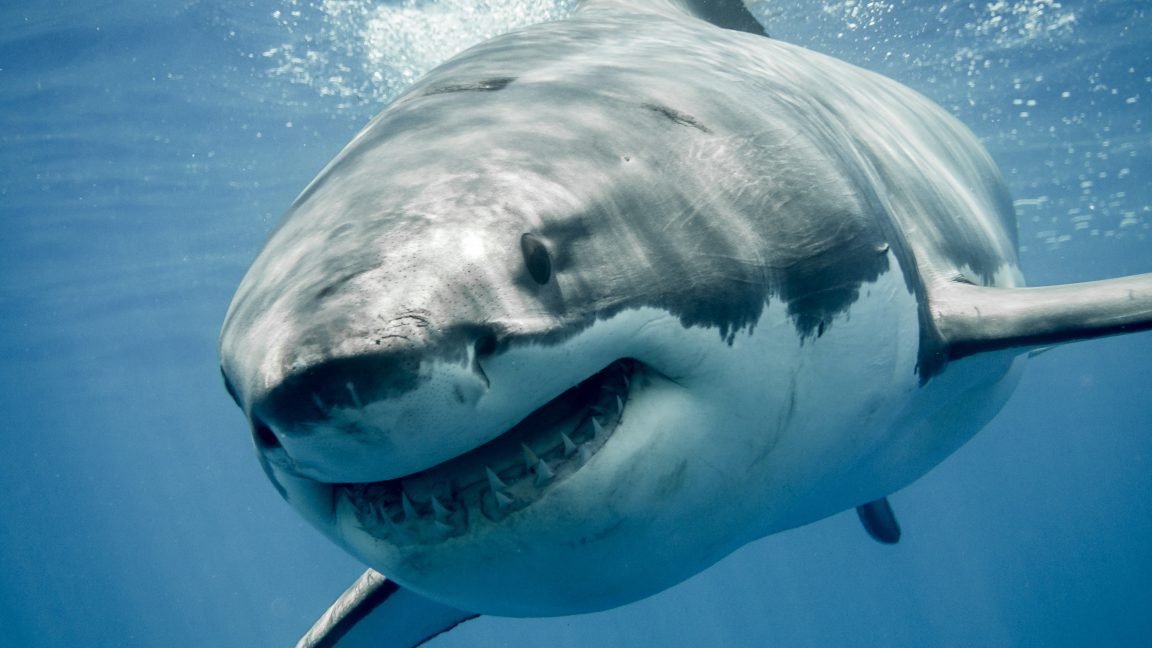
The evolutionary edge that fueled great white shark dominance for millions of years could soon become its greatest downfall.
The ocean’s most iconic predators maintain warmer body temperatures than the surrounding seawater and are paying an increasingly steep price for it. As the oceans warm due to climate change, they now face the risk of potentially fatal overheating, according to a new report in Science.
Several large tuna species and sharks, known as “mesothermic” species for the way their bodies run hot, require more fuel to maintain their temperature and are thus confronting a “double jeopardy” of warming oceans and declining food, mainly from overfishing. As water temperatures climb, these species will be forced to relocate to cooler waters.
“If you’re a shark, you can’t just pop down to the supermarket and buy more food,” said Nick Payne, lead author and associate professor at Trinity College Dublin, Ireland. “We’re seeing animals move with climate change in every biome on land and in the sea; this is just another example of that mechanism.”
From South Africa’s powerful great whites to Ireland’s filter-feeding basking sharks, these mesotherms burn nearly four times as much energy as their cold-blooded counterparts, whose body temperatures match the surrounding water. As oceans warm, these species must slow down, alter their blood flow or dive to cooler temperatures, all while hunting for an ever-dwindling food supply.
A rare group comprising fewer than 0.1 percent of all marine life, mesothermic fishes—also including thresher and porbeagle sharks—trap metabolic heat to keep their bodies warmer than surrounding seawater. This has been evolutionarily key to enabling higher swimming speeds, enhanced predation and their long-distance migrations.
However, as fish grow larger, their bodies generate heat faster than they can shed it. This mismatch—driven by the physics of surface area and heat retention—triggers the overheating dilemma in warmer waters.
While some species like Atlantic bluefin tuna can temporarily boost their heat loss or dive to colder waters, the suitable habitats for mesotherm species will shrink as larger swaths of oceans become inhospitably hot. This will be especially the case during summer months when sharks will experience increased competition for prey.
This will disrupt ecosystems as mesotherms are typically apex predators that exert disproportionate control on species below them in the food chain, said Edward Snelling, co-author and physiologist at the University of Pretoria.
“These species are being pushed closer to their physiological limits, which could have consequences for where they can live and how they survive,” said Snelling in a press release. “These animals are already operating on a tight energy budget, and climate change is narrowing their options even further.”
Using tiny sensors on a range of fish, including basking sharks weighing over three tons, researchers calculated how much heat fish produce and lose in real time. From this, they calculated that a one-ton warm-bodied shark may struggle to remain in waters above 62.6° Fahrenheit (17° Celsius) without taking countermeasures. Discovering these “hidden heat budgets” could prove critical to any hope of conserving them or mapping protection areas, researchers said.
In South Africa, the stakes are both ecological and cultural. Here, great whites have emerged as a “sentinel species”: When their patterns change, it signals a deeper shift in the marine ecosystem.
While long sensationalized as feared predators, they’ve increasingly become icons of marine conservation and eco-tourism, said Stephanie Nicolaides, a marine conservation researcher at the University of the Western Cape. “Many local and international conservation narratives now position the great white not as a villain, but as a keystone species essential to maintaining ocean health,” Nicolaides said.
Declines of great white sightings in False Bay, Mossel Bay, and Gansbaai, however, are multifaceted. Though thermal relocation may be a contributor, their population decline is also linked to a history of overfishing, shark netting, and habitat destruction.
Indeed, though warming waters heighten mesotherms’ vulnerability worldwide, other manmade harms exert the most danger. “If we had to say what is the one thing that we need to urgently address for these animals, it’s the fishing problem,” said Payne. “The most acute, urgent crisis these animals face is from overfishing, and particularly now from bycatch.”
Bycatch refers to fish and other marine animals caught unintentionally by fishermen using huge nets or long lines baited with thousands of hooks.
History, however, offers a grim precedent for physiological vulnerability itself. Fossils of extinct warm-bodied species—like the infamous Megalodon shark, which reached almost 60 feet long—suggest they suffered disproportionately during past ocean temperature increases as they likely struggled to secure food to fuel their large, warm bodies.
“Today’s oceans are changing at unprecedented speeds,” Payne said. “The alarm bells are ringing loudly at this point.”
This article originally appeared on Inside Climate News, a nonprofit, non-partisan news organization that covers climate, energy, and the environment. Sign up for their newsletter here.