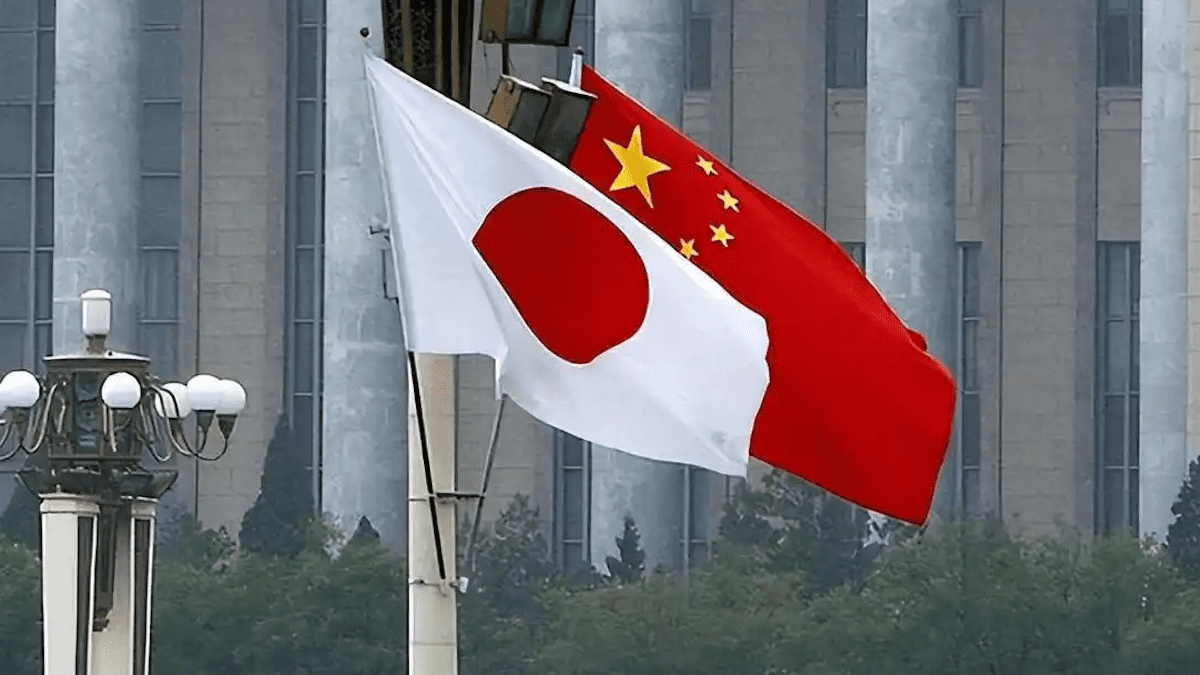
China has added 40 Japanese companies to its export control lists, accusing them of supporting Tokyo’s military buildup, as trade and military tensions between the two countries continue to escalate.
China’s Ministry of Commerce said on Monday that 20 Japanese entities had been placed on its Entity List and another 20 on a watch list. The ministry cited their roles in advancing Japan’s military capabilities and “re-militarization.” The move follows a similar round of listings in February.
“Japan has refused to reflect on its actions and instead gone further down the wrong path, accelerating its pursuit of new-style militarism, deploying offensive weapons and launching offensive missiles from overseas,” said a spokesperson for the commerce ministry. “The 20 entities placed on the control list are those involved in boosting Japan’s military strength, while the 20 on the watch list failed to verify the end users or end uses of the dual-use items they handled.”
“We hope Japan will turn back from the wrong path, correct its wrongdoings, do serious soul-searching and go back to the right track,” Guo Jiakun, a spokesperson of the Chinese Foreign Ministry, said in a regular media briefing. “The relevant measures target only the dual-use items, and will not affect the normal business exchanges between China and Japan. Japanese entities have no need to worry as long as they operate in good faith and in compliance with the law.”
He stressed that it is fully justified, legitimate and lawful for China to take these measures, which aim to contain what China sees as Japan’s reckless neo-militarism.
On February 24, Sino-Japanese relations deteriorated when China’s Ministry of Commerce added 20 Japanese entities to its export control list, including Mitsubishi Heavy Industries Shipbuilding Co Ltd, Fujitsu Defense & National Security Ltd, and NEC Aerospace Systems Ltd. The two rounds of sanctions in February and June have hit a total of 80 Japanese firms.
“The control list is defined by entities where there is a clear, confirmed national security risk,” said Wan Zhe, an economist and professor at Beijing Normal University. “The 40 entities placed on China’s Entity List are directly involved in boosting Japan’s military strength, meeting the threshold for serious harm to national security and interests under the dual-use export control regulations.”
“Forty other companies were added to the watch list as their end users and end uses for dual-use items could not be verified,” she said. “They have not yet reached the level of clearly endangering China’s national security, but they still need to be closely monitored targets.”
She said that the core goal of the measures is to curb Japan’s military expansion capabilities at the supply chain level, and that the policy is precisely targeted at risk, with the vast majority of compliant Japanese companies and normal trade and industrial cooperation between China and Japan left unaffected. She said the combined measures are both defensive, plugging gaps in the system, and reactive, a proportionate countermeasure that draws a clear line on national security while demonstrating strategic judgment.
Beijing’s latest export control measures come as Japan presses ahead with a long-range missile buildup that Chinese experts say is aimed at China.
In late March, Tokyo announced the deployment of its Type 25 missiles, its first long-range strike weapons capable of hitting ground and maritime targets at extended range. The series includes a surface-to-ship variant based in Kyushu and a hypersonic gliding variant based at Fuji, both with a range of over 1,000 kilometers, putting mainland China within reach. Tokyo plans to extend the hypersonic variant’s range to 2,000 to 3,000 kilometers in future versions.
The missile deployment came alongside the largest overhaul of Japan’s Maritime Self-Defense Force since its founding. Its main surface fleet units were merged into a new Fleet Surface Force, a new amphibious warfare unit was established in Sasebo, and the Air Self-Defense Force began building a dedicated space operations unit.
“Japan’s military moves are part of the government’s strategy to fundamentally strengthen its defense capabilities, using limited equipment and personnel to pursue far more aggressive military goals,” said Fan Xiaoju, a research fellow at the China Institutes of Contemporary International Relations. “These moves reveal the underlying tone of Japan’s diplomatic and security policy, a pursuit of military supremacy and stronger deterrence.”
“Combined with the rising tide of populism and xenophobia inside Japan, the country is heading in an increasingly dangerous and uncontrollable direction,” she said. “Japan should hold a correct view of history, honor its commitments and treat its neighbors well. That is what would truly serve regional peace and stability, as well as Japan’s own security.”
Japan’s photoresists
China’s newly imposed export controls on Japanese firms also came after Prime Minister Sanae Takaichi told G7 leaders at a summit in France on June 16 that China’s export controls against Japan risked disrupting partner nations’ supply chains. She called on G7 members and multilateral development banks to build more resilient mineral supply chains.
An article published by NetEase on June 22 said that four major Japanese photoresist makers, Tokyo Ohka Kogyo, JSR, Shin-Etsu Chemical and Fujifilm, had stopped accepting new orders for advanced argon fluoride (ArF) and extreme ultraviolet (EUV) photoresists and trimmed orders for lower-end krypton fluoride (KrF) grades.
EUV photoresists are used for the most advanced chip nodes below 7 nanometers, while ArF photoresists cover nodes from 65nm down to 7nm. KrF photoresists are suited only to larger nodes of 65nm and above.
The article said China’s photoresist imports from Japan fell by about 95% to just 111.3 tons in the first quarter of 2026, down from 2,200 tons a year ago. High-end photoresist imports recorded zero in the second quarter.
As of now, neither the Japanese government nor the four companies have confirmed a coordinated halt.
Chinese commentators have mixed views on the matter. Some dismissed the photoresist ban report as fake news, saying it lacked any verifiable evidence. Others said this may be a good opportunity for domestic photoresist suppliers, such as Jiangsu Nata Opto-Electronic Material Co Ltd and Red Avenue New Materials Group Co Ltd, to grow, as their manufacturing yields have matched those of their Japanese peers. Still, some said the reality is stark if the news is true.
“Japan’s photoresist ban has opened a rare window for domestic suppliers, but a window of opportunity is not the same as a shortcut,” writes a Liaoning-based columnist using the pen name Digital Observatory. “One domestic supplier saw its KrF photoresist’s yield rate plunge during testing because of a mismatch with the lithography’s temperature. Long-term stability, resistance to etching and ion implantation and storage life all still need to be tested over time.”
The columnist adds that domestic photoresist suppliers’ limited production capacity is another major problem, and large-scale domestic substitution in advanced chipmaking will only occur in three to five years.
Read: Japan seeks G7 price floors to break China’s rare earth grip
Follow Jeff Pao on X at @jeffpao3