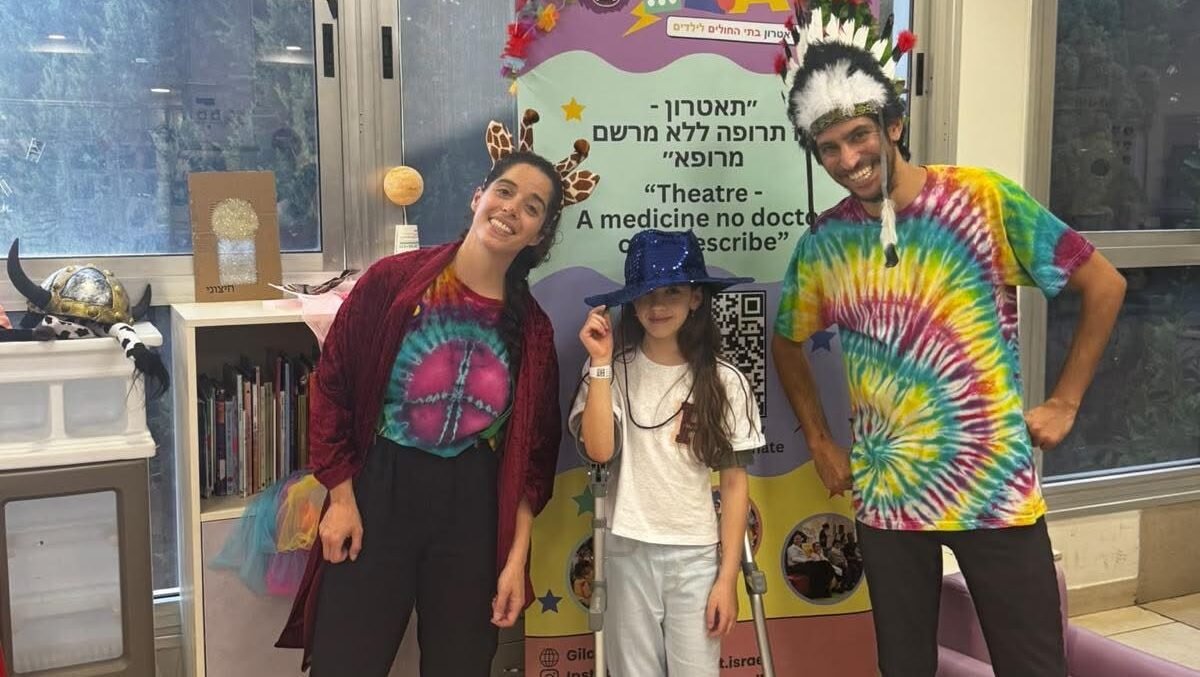
Looking at 10-year-old Yuval Atzmon’s clear blue eyes and bright smile, it is hard to imagine that she spent months at ALYN Hospital’s Pediatric and Adolescent Rehabilitation Center in Jerusalem. The sixth grader, who loves art, says much of her time there was filled with medical treatments and demanding rehabilitation exercises.
Yuval came to ALYN after undergoing complex surgery at Hadassah Hospital to correct a difference in the length of her legs. Between treatments and the daily challenges of rehabilitation, she had something special to look forward to: three theater performances presented at the hospital by the Gilat Foundation.
The foundation brings interactive therapeutic performances to pediatric hospitals across Israel. Led by trained actor-therapists, the programs are tailored to children’s physical and emotional needs.
“It takes you out of your uncomfortable routine. It makes you happy, because it’s not fun knowing that you’re in a hospital,” Yuval said. “So, it helps you have fun and not feel stuck.”
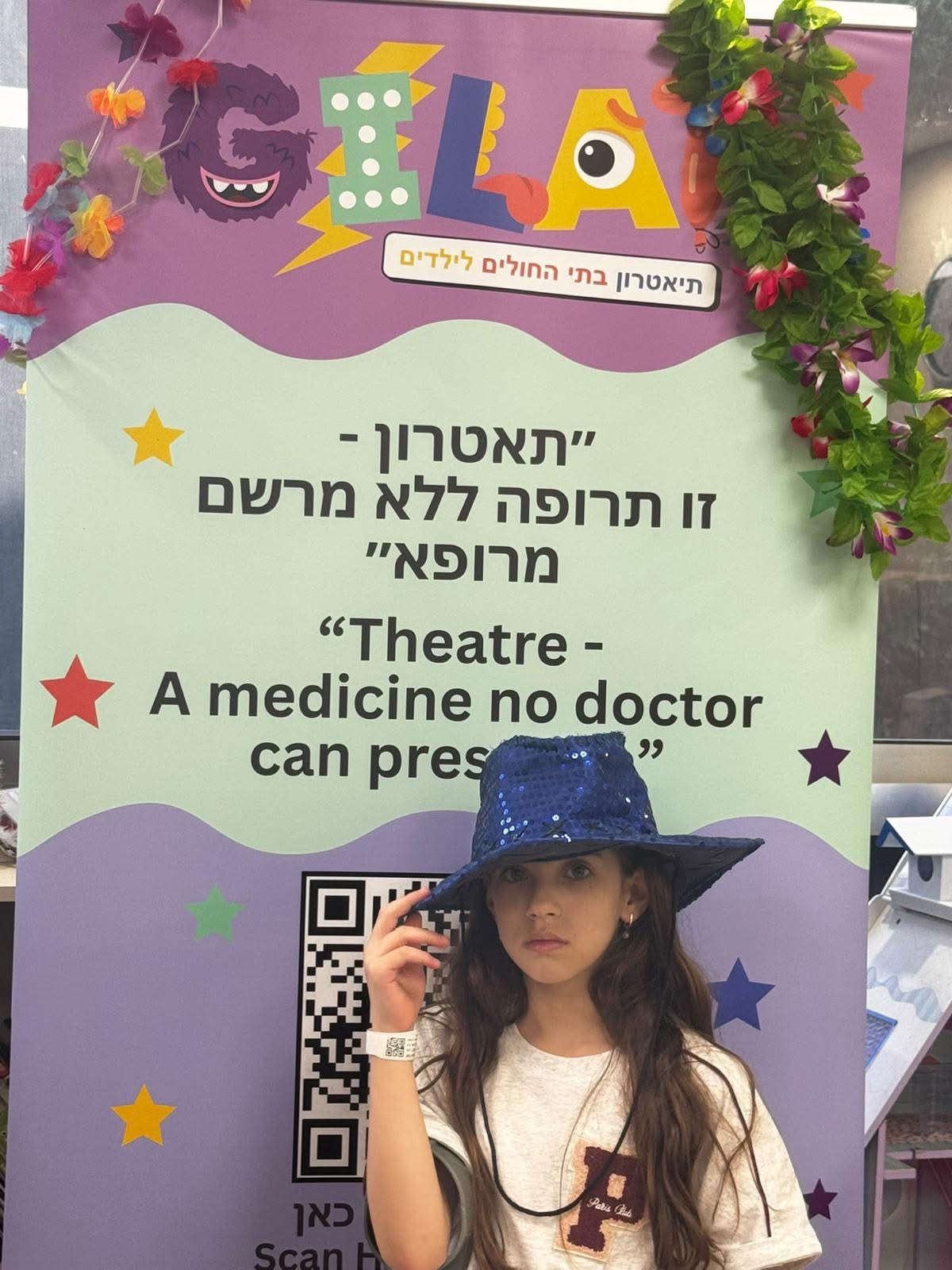
Yuval Atzmon. (Courtesy / Gilat Foundation)
Her father, Guy Atzmon, sees the theater as more than a welcome distraction. Before Yuval’s surgery, the family had prepared for the medical risks. What caught them off guard was how much independence she would lose afterward. Getting dressed, moving through the day, and deciding what to do next were no longer simple.
Everyone tells her what to do every minute, even when it hurts, and she doesn’t want to. And in the show, she could be like a child.
“She could be a child again, and not everybody telling her, wake up, go to eat, go to physio, or go to hydro, or everything,” he said. “Everyone tells her what to do every minute, even when it hurts, and she doesn’t want to. And in the show, she could be like a child.”
At home in northern Israel, Yuval has four brothers. Since her hospitalization began on June 1, her parents have taken turns staying with her while keeping the rest of the family going. Guy continued working and slept near Yuval on a folding sofa. The performances offered him a rare pause as well.
“And for a couple of minutes or half an hour for the show, I could relax,” he said. “And she’s playing and happy, and I could drink a cup of coffee, or do a phone call or stuff for myself, and reach out to take care of her again.”
For Yuval, who loves drawing, making things, and math, even a small choice can matter. “Even choosing the color of what she’s drawing became very important to her,” Atzmon said.
That idea—that a child in a hospital needs more than medical care—is at the heart of Gilat. The initiative is named for Tali and Jair Eisenmann’s daughter, Gilat, who died in 2008 at age 11. She used a wheelchair and could not attend a regular theater, her mother said. During long hospital stays, she found pleasure in music, theater, and being around people.
After Gilat died, her family wanted to give other hospitalized children some of what she had enjoyed.
“So, when she passed away, we said we have to do something like this for other children who are in pretty much the same position,” Tali said. “And that’s why we started doing theater for sick children in hospitals.”
Asked what he remembers most about his daughter, Jair returned to her outlook.
“You know, most [of the time] with her, the glass was always half full.”
He recalled Gilat looking forward to a visit from animals even while she was hospitalized. The performances offered in her name are not, he said, about spectacle.
We are not here to make big shows, but we are there to make the children smile and be happy again with all the misery they have
“We are not here to make big shows, but we are there to make the children smile and be happy again with all the misery they have.”
The performances are deliberately interactive, inviting children to participate rather than simply watch.
“We want every child to feel like you would say normal, but we don’t call it that way,” Tali said. “We want every child to feel [like] a child, even that they go through things that no adult should go through.”
Helping children leave their rooms and feel less isolated is part of that effort. Tali described Jewish and Arab children and their mothers coming together around the same wish.
“They’re all connected because they all have one goal: making their child feel better, be happy.”
Jair said the visits take place every second week of the month, with performances beginning at 3 p.m. Posters go up several days beforehand, giving children something to anticipate. Then comes the gathering, the performance and, sometimes, a response that stays with him.
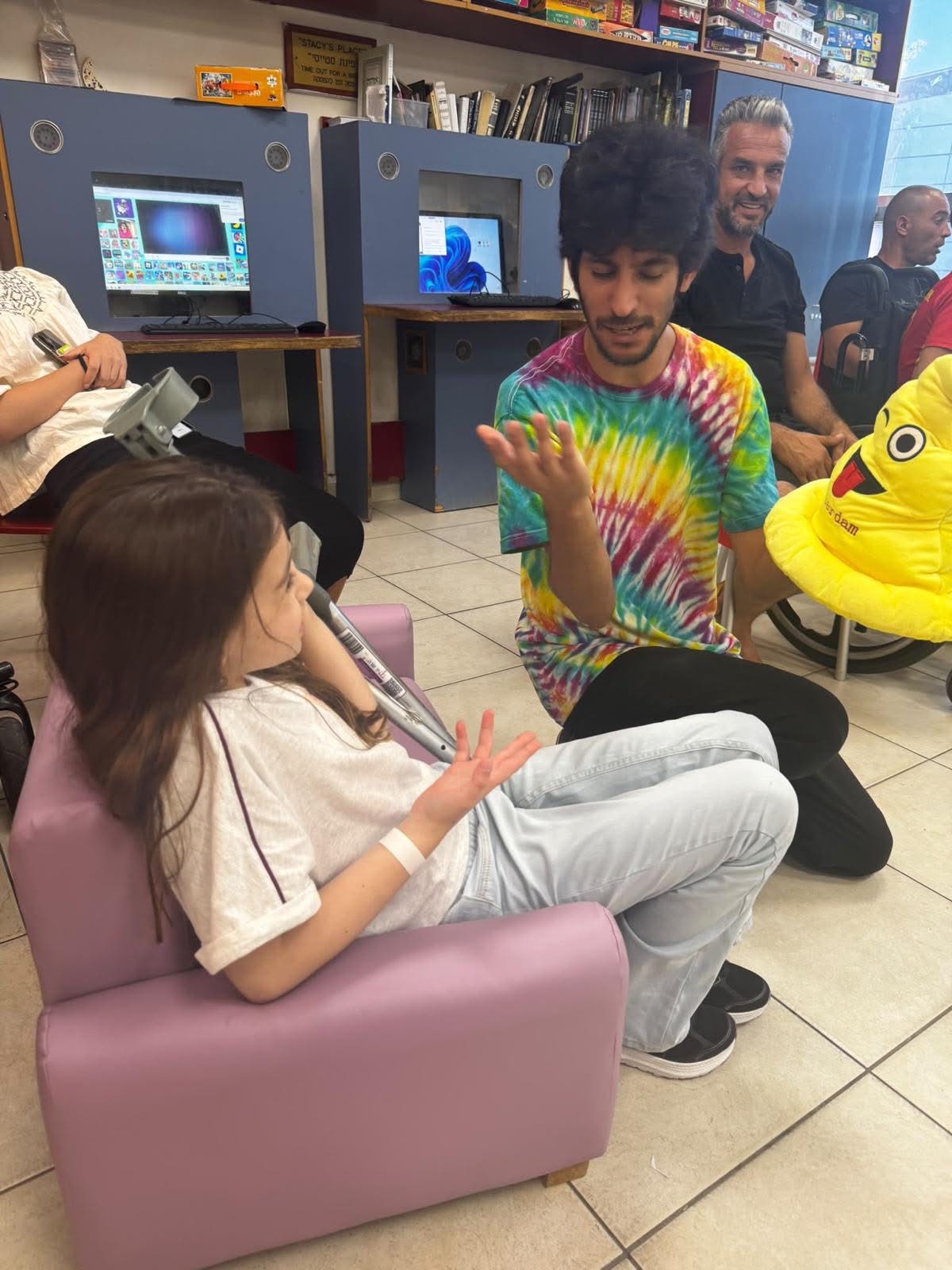
Yuval Atzmon and the Gilat Foundation. (Courtesy / Gilat Foundation)
One father, not knowing who Jair was, pointed out his daughter in the audience. She had cried for two weeks, he told him, and this was the first time she had laughed again.
The need for respite has grown more acute during the war. Jair said hospitalized children in Israel have faced what he called a “double misery”—illness alongside the disruption and fear of conflict. During the war with Iran, he said, some children spent weeks in shelters because repeatedly moving them in and out was too difficult.
Dr. Emmanuel Kornitzer, head of the rehabilitation department at ALYN, said the hospital has roughly 120 to 130 active patients across its inpatient and day-care services at any given time. He described the strain on children already coping with serious physical problems when sirens sounded and staff had to move them to safety. The alerts also put staff under pressure, while parents faced the fear of being at the hospital when their other children were elsewhere.
Kornitzer said the hospital had also seen children whose physical symptoms followed traumatic stress, including one child who developed sudden paralysis of the lower limbs the day after the October 7 attacks, with no physical cause identified.
Even on an ordinary day, rehabilitation demands sustained effort.
“Rehabilitation is during months and months,” Kornitzer said.
A theater performance allows children to step away from that work for a time.
“As I told already many people, it’s not only escapism. Because we know how the mental situation interacts so much with the physical burden, in a positive and negative way,” he said.
Asked what hospitalized children need beyond medical treatment, Shlomi Eisenmann, Executive Director of Gilat, told The Media Line pointed to the social and emotional side of recovery. Children may spend weeks or months away from school, friends and ordinary play, he said. The foundation tries to bring some of that world into the hospital through imagination and participation.
Eisenmann said research indicates that children receiving psychological support during hospitalization recover about 20% more quickly than those who do not. He also pointed to another form of support: helping children understand an upcoming surgery and what to expect afterward, which can reduce fear.
Gilat hopes to reach many more children. Describing the expansion of the foundation’s Israeli program after October 7, Shlomi said it reached four hospitals in its first year and is now preparing to begin work at Rambam Hospital in Haifa, its sixth location.
He estimated that the programs currently reach roughly 2,700 children a year. The goal is to expand to nine hospitals and approximately 4,500 children annually. Jair’s longer-term aspiration is to bring performances to every major hospital in Israel. He and Tali said reaching more hospitals will require additional funding.
For the Eisenmann family, expansion is inseparable from remembrance.
By having our amutah, our foundation, we keep her alive
“To lose a child is the worst thing to happen,” Jair said. “But if she’s forgotten, that’s even worse. And by having our amutah, our foundation, we keep her alive.”
Asked what she would say to other children facing a hospital stay, Yuval was careful not to assume their experiences matched hers.
“I don’t know exactly what every child is going through, but there are a lot of children who smile when they see the performances,” she said.
For a child whose days are so often dictated by necessity, that smile can mark a brief return to something familiar—the freedom to laugh, to join in and to choose what comes next.